In Syntheism (2014) Alexander Bard and Jan Söderqvist invents the universal religion of the Internet Age. In this text (1) I demonstrate that Syntheism renders a version of Lacan’s analytic discourse and (2) translate the terms of Syntheism to my Postmodern Alienation Model (PAM) [1] to show that Syntheism describes a generic process of authorization.
Let’s begin with the descriptions of the four main terms of Syntheism:
Atheos means the god that does not exist in Greek. Atheos is the god of the void or the black hole, the zero position of existence, the existential rather than the physical nothingness, and simultaneously the origin of everything and the engine of all identities from which the subject arises and gets its driving force.
Pantheos is the Universe as the divine. Because there is something rather than nothing – there is after all a life, a world – this something is equivalent to God: the Universe is God. If God exists, God must be the Universe.
Entheos means the God from within in Greek. And our inside is fundamentally split, for we are dividuals and not individuals and thus tangible evidence ourselves of the irreducible multiplicity of existence. Therefore Entheos is the difference as a divinity, and since difference piled on difference becomes a duration of differences, we are also speaking here of the god of time.
The Greek word for the creating god is Syntheos, from which syntheism gets its name. God is no longer a patriarchal creator of worlds from the past or a longed-for saviour on a white steed, but the de facto name of the collective utopia of the collective itself in the future.
Now let’s summarize the story of generation that conjoins these four terms: At first, there is the satisfying fullness of a cosmos (Pantheos). Then in the midst of this fullness, there appears the abyssal void of the subject that breaks this full satisfaction (Atheos). As a consequence of the tension and conflict between the cosmos and the void, the multiplicity of differences emerges (Entheos). Finally, these multiple differences dissolve and achieve consummation by synthesizing the God (Syntheos). So the couple Pantheos-Atheos represents a negative tension whereas the other couple Entheos-Syntheos represents a positive movement. If we intertwine these couples together to represent the whole story, the four terms are ordered as follows: Pantheos-Entheos-Atheos-Syntheos (I modified the order by intertwining the two couples because Entheos emerges between Pantheos and Atheos).

The equivalent concepts are ordered as follows: cosmos-difference-void-utopia.

Now just a little further step is needed to translate this into Lacan’s analytic discourse: The cosmos is represented by the treasury of signifiers S2, difference is generated by the objet a, the void is the barred subject $, and the utopia is represented the new Master-Signifier S1 produced by the analytic discourse:

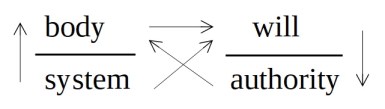
Finally, let me translate the same terms into PAM: The cosmos is the system, difference is the body, the void is the will, and the utopia is the authority. So what Syntheism describes is a generic process of authorization.
Işık Barış Fidaner is a computer scientist with a PhD from Boğaziçi University, İstanbul. Admin of Yersiz Şeyler, Editor of Žižekian Analysis, Curator of Görce Writings. Twitter: @BarisFidaner
Notes:
 Žižekian Analysis
[…] — Syntheism desribes a generic process of authorization […]
LikeLike
[…] [3] See “Masculine and Feminine: Truth, Reality and Semblances”, “Desire to Repair and Desire to Decompose”, “Authorization and Embodiment in Fetish and Symptom”, “Syntheism desribes a generic process of authorization” […]
LikeLike