浪🧩📞 LACAN LESSONS 浪🧩📞
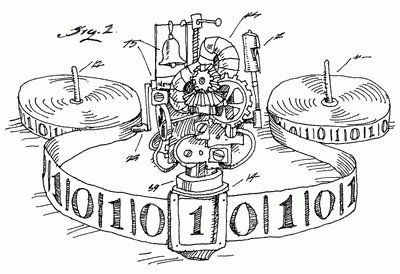
A Turing machine (TM) is a mathematical model that represents a computer in the abstract. The theory of TMs concerns the functioning of all computers in general. A TM can read and write symbols (e.g. 1 and 0) on an infinite strip that serves as its memory.
Any program that works on a TM has to read its input from the strip, manipulate the strip according to a set of preprogrammed rules, write its output on the same strip, and stop, so that the user can retrieve and utilize the output. These are all mathematically defined and developed in order to learn something about the principles of computers. This is all nice and neat.
Seemingly unrelated to the TM theory, Lacan defined a fourfold of concepts based on writing and stopping: necessary (does not stop writing itself), possible (stops writing itself), impossible (does not stop not writing itself), contingent (stops not writing itself). Given that TMs are all about writing and stopping, it’s surprising that nobody seems to have associated this Lacanian fourfold directly to the mechanism of a TM.
Lacan defined the “necessary” as what “does not stop writing itself”. This is translated into TMs as follows: When an ongoing program in the TM continues to manipulate the symbols on its memory, it is “necessary” for its user to wait for the program’s completion. The perfect image of this necessity is the hourglass animation. When the program successfully prints its output and “stops writing itself”, it simply enacts the “possible” for the user.
Notice the essential difference of status between the human and the computer: Since the user has minimal or no control over an ongoing program, his/her “possible” use is always “castrated” whereas the program’s “necessary” operation is “uncastrated” at any moment. The program possesses the exceptional power to spend the user’s irreplaceable time whereas the user has to obey the program and repeatedly confirm its rule by clicking on “Next”, “I agree”, “OK”, “Update”, etc.
Moreover, it is not guaranteed that the program will eventually complete its operation. It may also get stuck in an infinite loop, which may happen due to bad programming. In the TM literature, this is known as the Halting Problem. Alan Turing proved that the Halting Problem is undecidable in the abstract world of TMs.
A program stuck in an infinite loop “does not stop not writing itself” thereby enacting the “impossible”. In fact, we can generalize this formula to include any inappropriate functioning of the program that “bugs” the programmer. In debugging his/her program, the programmer always hunts for the “impossible” precisely as what “does not stop not writing itself”.
The most common way to catch a software bug is to insert the program additional directives to display information that might reveal the bug. When these directives manage to reveal the bug, they enact the “contingent” as what “stops not writing itself”. These additional directives are typically temporary and are removed from the code once the bug is revealed and apprehended. When the “contingent” bug-catch is used to implement the “necessary” bug-fix, the negation is displaced from writing to stopping.
Debugging is a greatly immersive activity. It is like the hunt that Lacan describes in Seminar 19: “When hunting, there is a virtuous display of what is finest about [the man], namely to be passive.” (s. 164) Here Lacan is alluding to Freud’s association of men with activity and women with passivity.
Debugging is also a quite intimate activity. The non-being and non-appearing of the “bug” is always extimately related to the programmer’s own parapraxes in writing the code. Fixing the bug also involves fixing his/her own defective coding practices. But there is also a deeper sense to this intimacy/extimacy: Since the bug satisfies the Lacanian formula of the “impossible”, it has an association with the impossibility of the sexual relationship.
Finally, let us interpret an important political event with these concepts. Recall where the hourglass image of necessity was used in radical politics.
Wikileaks was the attempt of a hacker (Julian Assange) to (not hack but) debug the world politics. He assumed the image of computational “necessity” by using the hourglass logo for Wikileaks, redefined the “possible” by publishing “contingent” documents about “impossible” bugs of world politics. But this great project was eventually bogged down by accusations of sexual assault; in other words, the impossibility of the sexual relationship was mobilized against him.
This fate is not limited to Julian Assange. The politics on the social media [1] is also bogged down through the weaponizing of the impossibility of the sexual relationship. Just recall the unending fierce fights about the definition of “Woman” (between gender-critics and trans-activists) which Lacan had already said didn’t exist [2]. There are many potential debuggers on the Internet but none can help in the present atmosphere. Sometimes the field is reduced to nothing and you have to construct the system first.

(Turkish)
Işık Barış Fidaner is a computer scientist with a PhD from Boğaziçi University, İstanbul. Admin of Yersiz Şeyler, Editor of Žižekian Analysis, Curator of Görce Writings. Twitter: @BarisFidaner
Notes:
[1] Mainly Twitter because it’s the place for politics. See “Social media and the three registers”
[2] See “The Conflict About Sex”
TM image source.


[…] (İngilizcesi) […]
LikeLike
[…] [4] “Shouldn’t be” is literally a prohibition but what it articulates is an impossibility. About the impossible and the necessary, see “Turing Machine and Lacan: Writing and Stopping” […]
LikeLike
[…] [2] It is something that bugs you, like a programming bug. See “Turing Machine and Lacan: Writing and Stopping” […]
LikeLike
[…] — Turing Machine and Lacan: Writing and Stopping […]
LikeLike
[…] [2] About these correspondences: “Resolving the Žižekian Indecision by Settling the Location of the Fantasy”, “Turing Machine and Lacan: Writing and Stopping” […]
LikeLike
[…] [6] See “Turing Machine and Lacan: Writing and Stopping” […]
LikeLike
[…] [3] “Still spinning” also denotes the Lacanian impossible that “does not stop not writing itself”. To be specific, this is the impossibility of the sexual relationship. It’s also somewhat related to the infinite loops and the Halting Problem in computer science. See: “Turing Machine and Lacan: Writing and Stopping” […]
LikeLike
[…] [Note to reader: Detouring Test refers to the Turing test. See also “Turing Machine and Lacan: Writing and Stopping”] […]
LikeLike
[…] — Turing Machine and Lacan: Writing and Stopping […]
LikeLike