Words combine authorization and embodiment [1]. In its ‘natural’ ideological state, a word bears the authority of an abstract concept pointing to the body of a concrete referent that supports the word’s present use. Example: We call a woman a woman and the body of the referent supports the authority of the concept used in speech or writing. This initial configuration is the ‘ego’ of the word, its formula is ‘authority plus body’ [2]:

Although mathematical addition is commutative, it would be inaccurate to write B + A in this formula because the ego always gives priority to the abstract authority over the concrete body whose role is to be the authority’s fetishistic supplement [3]. The ego of the word is what Lacan called the ‘speaking present’ (le dire du présent) in Seminar 5.
This ‘natural’ ideological ego of the word falls under threat when it becomes suspect whether the concept rightfully corresponds to its referent and whether the word deserves to be used in the present context. For example, think of the fierce battles in feminism about the definition of ‘woman’ between gender critics and trans activists. This threatening gaze is the ‘superego’ of the word, its formula is ‘authority minus body’:

This accusatory gaze is conventionally notated by ‘scare quotes’ (also called ‘sneer quotes’, ‘shudder quotes’) that render the word’s present usage suspicious and untrustworthy.
But there is another way to use the quotation marks. For example, when I use quotation marks in the present text, my purpose is rather to stress the symptomatic value of the literal body of the word itself, instead of rendering suspect the body of the concept’s referent.
Let’s call this other usage ‘stress quotes’. In contrast to ‘scare’ which fears a positive object constructed by an ideology, ‘stress’ is just anxious due to the negative object of desire (objet a). Stress quotes in this sense quite frequently appear in Žižek’s texts. His unusual practice of recycling passages from himself and others also serve this function of stress quotes.
When we emphasize the literal body of the word itself, the word’s conceptual authority of pointing to a referent is suspended and subtracted from the word’s present occurrence in the enunciation, and what is left in the present context of speech or writing is just the occurrence of the word itself. Lacan called this the ‘present speaking’ (le présent du dire). This is the ‘symptom’ of the word, its formula is ‘body minus authority’:

The stance of using stress quotes is totally different from the stance of using scare quotes. Scare quotes effectively propagate a belief in the “subject supposed to know how to use the words appropriately to ensure that they make the correct sense” whereas stress quotes propagate the awareness that each and every occurrence of a word carries a singular significance in the context of its enunciation and deserves to be interpreted in universal linguistic terms like metaphor and metonymy. For our example, this means that “the woman does not exist” and she is the symptom [4].
The ego or superego of a word mainly concerns its ‘use’ and the purity of intentions behind this use, whereas the symptom of a word concerns its ‘occurrence’ and the unconscious desires that motivate this occurrence.
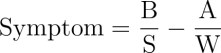
Recall that “the ground of embodiment is system” and “the ground of authorization is will” [5] and extend the symptom formula to include these two separate grounds:
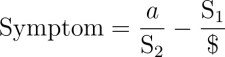
Replace the terms with the corresponding Lacanian symbols and what we get looks like the analytic discourse minus master’s discourse (the “other side of psychoanalysis”) in terms of their agent/truth:
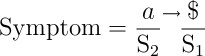
Apply the minus sign by inverting the second term, and we obtain the analytic discourse:
Since at least Freud, the word ‘symptom’ designates the way lack in the Other S(Ⱥ) manifests as a real exception and calls for an interpretation. I am cautious against the Lacanianist ‘update’ of symptom into ‘sinthome’ because it claims a certain immunity to interpretation which makes it liable to function as an uncastrated S1, a symbolic exception that can constitute a fetishistic ground for legitimizing the enjoy-meant of a Lacanianist ideology [5].
Işık Barış Fidaner is a computer scientist with a PhD from Boğaziçi University, İstanbul. Admin of Yersiz Şeyler, Editor of Žižekian Analysis, Curator of Görce Writings. Twitter: @BarisFidaner
Notes:
[1] See “The Separation of Authorization (Symbolic Suture) from Embodiment (Real Suture)”
[2] I produced these formulations here: “Benlik ile Belirti, Bakım ile Adaptasyon”
[3] See “The Authority-Body Complex”
[4] There’s also a simple statistical (or rather dynamistical) meaning to these formulas. If we take authority as the alternative hypothesis and body as the data supporting it, ego becomes a true positive, superego becomes a false positive (type I error) and symptom becomes a false negative (type II error). The ego’s imposture is initially confronted with the superego (type I error) but what it truly overlooks is the symptom (type II error). See “Dynamistics and Dynamistical Significance”
[5] See “The Separation of Authorization (Symbolic Suture) from Embodiment (Real Suture)”


[…] [2] See “Scare Quotes and Stress Quotes: Ego, Superego, Symptom of Words” […]
LikeLike
[…] — Scare Quotes and Stress Quotes: Ego, Superego, Symptom of Words […]
LikeLike
[…] “Scare Quotes and Stress Quotes: Ego, Superego, Symptom of Words” […]
LikeLike
[…] [2] About these formulas: “Scare Quotes and Stress Quotes: Ego, Superego, Symptom of Words” […]
LikeLike
[…] [1] Bkz “Scare Quotes and Stress Quotes: Ego, Superego, Symptom of Words” […]
LikeLike
[…] [1] See “Scare Quotes and Stress Quotes: Ego, Superego, Symptom of Words” […]
LikeLike
[…] [2] Bu formüllere dair: “Scare Quotes and Stress Quotes: Ego, Superego, Symptom of Words” […]
LikeLike