The combinatorial field corresponds to the fifth dimension w that is orthogonal to the regular spatial dimensions of space-time x, y, z, t. This dit-mansion w has two modes: The objective initiation prior to the signifier and the subjective initiation posterior to the signifier [1]. Now let’s map the complexity of the prior mode of w to the plane of complex numbers. Examine the following figures:
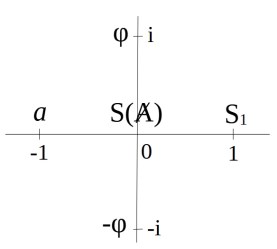
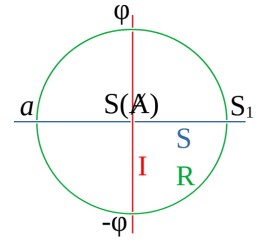
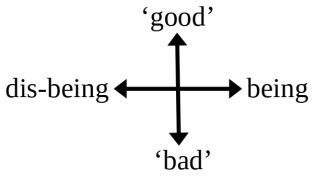
Recall the elementary movement of objective initiation as de-separation: objet a supports S(Ⱥ) to constitute S1; in other words, the dis-being (désêtre) of desire supports the symptomatic ground in order to confer being on the signifier.
As you can see on the figures, this elementary movement takes place on the horizontal symbolic axis (shown in blue) departing from the inward horizon of desire (left side), passing through the symptomatic ground (middle), and aiming to establish the signifier (right side): from -1 through 0 to 1.
But this abstract horizontal symbolic movement is always accompanied by the spectre of an imaginary vertical axis (shown in red) that carries a strong affective tension between the ‘good’ object that bestows the imaginary phallus (φ) and the ‘bad’ object that deprives of the imaginary phallus (-φ). Following Lacan who associated φ with the square root of minus one, let’s assert φ = i, -φ = -i.
The zero point at the middle is called the symptomatic ground and is associated with the lack in the Other S(Ⱥ) precisely due to the spectral vertical imaginary tension between φ and -φ. If this tension is disavowed (apparently cancelled) we have a fetish instead of a symptom. This disavowal blames the ‘bad’ -φ for the misfortune of castration and tosses it out in order to just retain the ‘good’ φ. This disavowal is not entirely avoidable and any functioning signifier S1 is always at least partially fetishistic (recall that the main function of S1 is to enact the subjective initiation that takes place in the posterior mode of w).
Although φ and -φ appear unrelated from the symbolic and imaginary perspectives that tend to fetishistically disavow the symptomatic ground of S(Ⱥ), these two elements are in fact connected via the circular real axis (shown in green) that makes a unit circle around the zero point. One can traverse the upper half of this unit circle by using Euler’s famous formula:
eiπ + 1 = 0
which says:
desire + signifier = symptom
since eiπ = -1 stages the imaginary tension within desire.
Desire is always partly disavowed due to the fetishistic aspect of the signifier. This disavowal is staged by -1 and +1 apparently cancelling each other to yield the quasi-neutrality of 0.
Also note:
1) The horizontal symbolic axis (blue), the vertical imaginary axis (red) and the circular real axis (green) together constitute a Borromean knot. Lacan shows this crosshair-shaped formation in Seminar 22 page 17.
2) The location of the terms are consistent with the triangular schema on Seminar 20 page 90 [2]: S(Ⱥ) is located between the imaginary and the symbolic, objet a and S1 are located between the symbolic and the real, φ and -φ are located between the real and the imaginary.
In terms of passions, S(Ⱥ) evokes the love of truth that grounds the objective initiation, objet a and S1 evoke the ignorance of semblances that moves the objective initiation forward, φ and -φ evoke the hatred of reality that hinders the objective initiation. All of these elements together constitute the symptomatic plane, i.e. the complex plane of symptom.
3) One can obtain S1 or objet a by staging a dual-relation between two imaginary phalli:
φ2 = i2 = -1 = a
(-φ)2 = (-i)2 = i2 = -1 = a
φ(-φ) = i(-i) = -i2 = -(-1) = 1 = Φ = S1
An inherent reflection on the imaginary phallus regardless of its affective sign (‘good’ or ‘bad’) generates the dis-being of desire, whereas establishing a dual-relation between ‘good’ and ‘bad’ phalli generates the positive being of the signifier.
Notice that the signifier is generated by the fetishistic disavowal -(-1) in which the minus of castration (-i) is apparently cancelled by the minus of desire (-1). In fact, these two minuses belong to different axes (imaginary and symbolic) that are connected merely by the circularity of the real.
(Turkish)
Işık Barış Fidaner is a computer scientist with a PhD from Boğaziçi University, İstanbul. Admin of Yersiz Şeyler, Editor of Žižekian Analysis, Curator of Görce Writings. Twitter: @BarisFidaner
Notes:
[1] See “Fifth dit-mansion: w”, “Subjective Initiation and Objective Initiation”, “The combinatorial ground of spatiality”


[…] — The Complex Plane of Symptom […]
LikeLike
[…] [1] See “The Complex Plane of Symptom” […]
LikeLike
[…] [1] See “The Complex Plane of Symptom” […]
LikeLike
[…] [2] See “Frustration and Dissatisfaction, Privation and Castration”, “The Complex Plane of Symptom” […]
LikeLike
[…] and dissatisfaction: “Frustration and Dissatisfaction, Privation and Castration”, “The Complex Plane of Symptom”, “Castrated: Cast & Rated”; about the child being beaten: “An account is […]
LikeLike
[…] formüller konusunda bkz “The Complex Plane of Symptom”, “Frustration and Dissatisfaction, Privation and […]
LikeLike
[…] Hüsran ve tatminsizliğe dair: “Frustration and Dissatisfaction, Privation and Castration”, “The Complex Plane of Symptom”, “Castrated: Cast & Rated”; dövülen çocuğa dair: “Bir hesap […]
LikeLike
[…] [2] Bkz “Frustration and Dissatisfaction, Privation and Castration”, “The Complex Plane of Symptom” […]
LikeLike
[…] [1] Bkz “The Complex Plane of Symptom” […]
LikeLike
[…] (İngilizcesi) […]
LikeLike