In Physics there is something called the Holographic Principle. It tells you that the information about the space is encoded in a lower-dimensional boundary. This boundary is usually a 2D surface that is located on the horizon and it “knows everything” about the 4D spacetime.
This is metaphorically quite productive. This omniscient surface is like the physical and real version of a fantasy screen. It may recall Lacan’s mirror stage where a person’s ego is shaped by his/her reflection on the mirror or screen. Or it may recall Pink Floyd’s The Wall in which the person is literally eaten up by the wall of commodity fetishism in capitalist society.
Erik Verlinde is a physicist who came up with an important theory that:
1) Explains gravity as an entropic force that emerges from the holographic principle.
2) Declares that gravity can no longer be considered to be a fundamental natural force.
Verlinde’s theory has passed some experimental tests but still has a way to go. In any case, he did stage the fundamental fantasy of physics by putting a simple particle in front of the holographic screen. I won’t go into the equations. Let us just observe what he stages in this figure [1]:
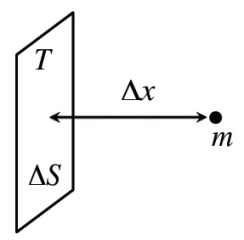
Read his description:
we consider a small piece of an holographic screen, and a particle of mass m that approaches it from the side at which space time has already emerged. Eventually the particle merge with the microscopic degrees of freedom on the screen, but before it does so, it already influences the amount of information that is stored on the screen. (…) The screen bounds the emerged part of space, which contains the particle, and stores data that describe the part of space that has not yet emerged, as well as some part of the emerged space.
Like the fundamental fantasy that can dissolve and refound social reality, the spacetime is here incomplete and is in the process of emerging by the “scansion” of the holographic screen. Moreover the particle does not remain a mere bystander but becomes an active participant: It zealously runs to the screen, traverses the distance Δx, and merges its existence with the “degrees of freedom” that is found on the screen (which are incidentally “microscopic”).
The letter m is intended to denote mass but it might as well denote moi: ego. The expression ΔS is intended to denote the increase in entropy but it might as well denote the additional signification: The weight of the singular ego is sacrificed to produce extra entropy and surplus-signification dispersed along the available “degrees of freedom” on the screen. This sacrifice sounds like the inversion of Freud’s formula: “Where I was, there it shall be.” Freud called this tendency death drive and imagined to counter-act it by another force called Eros.
In Erik Verlinde’s text, this figure has another message; it inverts the relationship between temperature (T) and acceleration (a). In usual classical physics, a particle feels hotter because it is going faster and faster; so an external force that accelerates the particle is responsible for its experience of high temperature. But in the case of this fundamental fantasy, the particle goes faster and faster precisely because it is subjected to the hotness on the fantasy screen (denoted by T). The particle cannot help but sacrifice itself to the “degrees of freedom” on the fantasy screen. In a way, it runs to its grave, deeply immersed in the prospect of the symbolization of its loss. This is precisely ideology, which is a grave matter indeed!
This reminds me of Alan Sokal who famously made fun of quantum gravity and Lacan associating them with the vanity of postmodernism. Would Sokal be embarrassed if Erik Verlinde’s theory would pass all the tests and achieve a paradigm shift? I don’t think so!
(Turkish)
Işık Barış Fidaner is a computer scientist with a PhD from Boğaziçi University, İstanbul. Admin of Yersiz Şeyler, Editor of Žižekian Analysis, Curator of Görce Writings. Twitter: @BarisFidaner
Notes:
[1] Verlinde, E. (2011). On the origin of gravity and the laws of Newton. Journal of High Energy Physics, 2011(4).


[…] — Ideology is grave matter indeed! […]
LikeLike
[…] [2] ç.n. Solaris belki de Evrenin Ufkundaki Holografik Perdedir. Bkz “Ideology is grave matter indeed!” […]
LikeLike
[…] [3] About emergent gravity, see “Ideology is grave matter indeed!” […]
LikeLike
[…] [1] See “Ideology is grave matter indeed!” […]
LikeLike
[…] See “Ideology is grave matter indeed!”, “Double time theory and the […]
LikeLike
[…] — Ideology is grave matter indeed! […]
LikeLike
[…] — Ideology is grave matter indeed! […]
LikeLike
[…] [3] Bkz “Yerçekçi Olalım: Uçmak Düştüğünü Unutmaktır”, “Ideology is grave matter indeed!” […]
LikeLike
[…] (İngilizcesi) […]
LikeLike
[…] “Ideology is grave matter indeed!” by Işık Barış […]
LikeLike