Here is Saussure’s diagram for the sign:
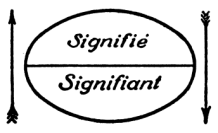
This diagram marries the signifier and the signified in a quasi-sexual unity. Their relation supposedly achieves a mutual reciprocity that is denoted by the upward and downward arrows shown on the two sides. The ellipse around the terms denotes their static unity whereas the arrows around the ellipse denote their dynamic relation.
Lacan famously compared this Saussurean diagram of the sign to another diagram of “urinary segregation” in which the two signifiers ‘Gentlemen’ and ‘Ladies’ are depicted on top of exactly identical two restroom doors that are their signifieds.
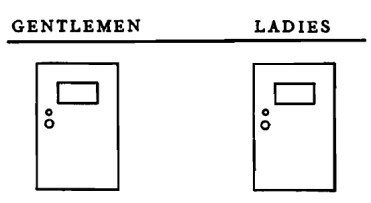
This image is usually interpreted as depicting the differentiating power of the signifiers over the signifieds: The restrooms are different only because of the different signifiers that label them. This interpretation disrupts the static unity of the Saussurean sign and displays the primacy of the signifier’s power to differentiate.
But what happens to the dynamic relation between the signifier and the signified? Are ‘Gentlemen’ and ‘Ladies’ just a random pair of terms that are indifferently put side by side to illustrate the power of signifiers, or do they stage a particular interaction that motivates the ongoing signification? To emphasize the dynamic aspect of Lacan’s diagram, I suggest that we bring back the Saussurean upward and downward arrows:

When Lacan’s diagram is drawn with the arrows in this manner, it becomes significant why ‘Gentlemen’ is on the left and ‘Ladies’ is on the right. The directions of the arrows depict the transmission of meaning in a patriarchal society:
1) The signified of man substantiates and authorizes the masculine signifier.
2) The masculine signifier dominates and determines the feminine signifier.
3) The signified of woman adheres and conforms to the feminine signifier.
Of course one can always invert these terms for a matriarchal society or replace them with another pair of signifiers for any other context.
Now we only need to change this diagram minimally to obtain the Master’s discourse:

Instead of masculine and feminine signifiers, we have S1 and S2. Instead of the signified man, we have the barred subject $. Instead of the signified woman, we have the object-cause of desire (objet a). These correspondences are all very precise for the usual patriarchal context, and let me repeat that the terms can be inverted or replaced by another set of terms for different contexts. In any case, the whole thing will be structurally identical to the Master’s discourse; and one can derive all other discourses from the Master’s discourse.
The association of S1 with man and S2 with woman is also significant in a deeper sense: Since “the binary signifier is primordially repressed” and “the woman does not exist”, we can only have a knowledge S2 about the woman instead of an exact signifier that would be able to designate her being. Woman is the “object” of the masculine “subject”, but (1) she is a negative object that is structured like a hole in knowledge, and (2) the man is not a free subject, he is subjected and subjugated to the whims of the signifiers in language.
Due to this structure, it is more accurate to mark the masculine/feminine divide not horizontally between the left side and the right side, but vertically between the top part and the bottom part: S1 and S2 are masculine, $ and objet a are feminine [1]. The discordance between the false horizontal division and the true vertical division is due to the following inherent illusions of the symbolic order:
1) S2 is perceived as if it was feminine, even though it is actually knowledge about women that is mostly constructed by men. This false femininity of symbolic knowledge emanates from the objet a that the knowledge disguises within a “functional” context.
2) $ is perceived as if it was masculine, even though the subjectivity of men is often deeply perturbed and thereby determined by feminine hysteresis. This false masculinity is conferred on the subject by the signifying imposture that frames the subject within a “functional” context.
Of course, the model “function” is to reproduce and perpetuate the species.
Işık Barış Fidaner is a computer scientist with a PhD from Boğaziçi University, İstanbul. Admin of Yersiz Şeyler, Editor of Žižekian Analysis, Curator of Görce Writings. Twitter: @BarisFidaner
Notes:
[1] See “Resolving the Žižekian Indecision by Settling the Location of the Fantasy”


[…] — From the Saussurean sign to the four discourses […]
LikeLike
This is one of the best descriptions of the discourses and structuralism I’ve come across, amazing!
LikeLike
thanks!
LikeLike
[…] See “From the Saussurean sign to the four discourses”, “So […]
LikeLike
[…] Bkz “From the Saussurean sign to the four discourses” […]
LikeLike
[…] Eşleşen Örgütlü Düşüncedir” Ferdinand de Saussure, “Öyle doğru ki!!!”, “From the Saussurean sign to the four discourses”, “Differential Synchronicity and Deferential Diachronicity: Signifi-cushion, Signifi-caution, […]
LikeLike