Lacan introduces three important terms in Seminar 4:
castration: symbolic lack of an imaginary object
frustration: imaginary lack of a real object
privation: real lack of a symbolic object
There is a certain opposition between castration and privation, whereas frustration is the less stable middle term.
What is the opposite of frustration? Is it the satisfaction after getting the object? No, the opposite of frustration is rather dissatisfaction since the object always disappoints. Now let’s place these four terms on the complex plane of symptom [1]:
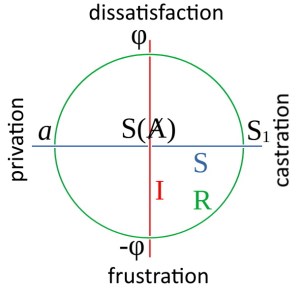
The first opposition is between frustration and dissatisfaction: The lack of phallus is experienced as frustration, whereas if you actually get the phallus, you are dissatisfied (which is still a privilege).
To intuitively understand this opposition, associate frustration with the “real world problems” faced by the lower classes, and associate dissatisfaction with the so-called “first world problems” experienced by the less lower classes (it would be a stretch to speak of stable middle classes for most of the world).
Depending on how you operate on frustration and dissatisfaction, you get either privation or castration.
1) If you put frustration and dissatisfaction side by side indifferently to discern their common feature, you get privation. Privation designates the out-of-jointness of either the world or the self or some other thing without a proper place (e.g. a symptom). Although the basic nature of this imbalance is always the same, there are two different routes that bring you to it:
frustration × frustration = privation
This formula articulates the out-of-jointness of the usual poor rabble, the needy, the underclass, the dispossessed, those who are forcibly excluded from the social order, some of who are then offered the privilege to “integrate” and get exploited by the capitalists.
dissatisfaction × dissatisfaction = privation
This formula articulates the out-of-jointness of the other rabble, sometimes called the rich rabble [2], those who fall out of the social order not because they are pushed out of it, but because their needs are met without needing them to work in the usual sense of spending labour-time or executing a planned “productive” expenditure of energy. They need not be rich in the usual exploitative sense, they are just those who have the luxury of obtaining the object and being dissatisfied with it. A loose definition of the rich rabble would include academics as well as artists, professional activists and the like.
The poor rabble experiences their privation as a frustrating lack, whereas the rich rabble experiences their privation as an unsatisfying excess. The fact that both routes arrive at privation demonstrate the fact that lack and excess are two sides of the same coin.
2) If you establish a relation between frustration and dissatisfaction, you get castration. Castration as symbolic debt emerges from a kind of trade, exchange or contract between frustration and dissatisfaction.
In a work contract, the worker agrees to be burdened by frustration in order to serve the capitalist’s dissatisfaction. The worker agrees to be frustrated during work hours in order to have the luxury of being dissatisfied during his/her free time. This is a literal description of the dominant ideals of freedom since it is always “cooler” and more enviable to be dissatisfied than to be satisfied, be it about bad fashion choices or unhealthy nutrition.
Here is the formula for castration [3]:
dissatisfaction × frustration = castration
Now we can differentiate the problems faced by the two kinds of rabble that experience privation. Both the poor rabble and the rich rabble fail to get castrated, but in different ways.
The poor rabble gets stuck with frustration and fails to trade it for dissatisfaction. This can either be a desperate failure by someone who deeply envies the “middle classes” and strives to be dissatisfied just like them, or it can be a convenient failure by someone who deeply disdains the pretentious dominant culture and would like to keep his/her distance from it. The first case could be a refugee desperate to “integrate” into the exploitative system. The second case could be a politicized worker who would rather organize his/her frustrations around something like “the party of the proletariat”.
The rich rabble gets stuck with dissatisfaction and fails to confer social value on it through frustration. This can be either due to a failure to express and find witnesses to validate one’s own sacrificial frustration, or it can be due to an existential extraneity to frustration as such. The first case could be an artist who says “I work so much and go through so much pain but nobody appreciates the value of my art.” The second case could be a non-utilitarian philosopher who goes on and on about his/her theories entirely unconcerned about how to put them in “practice” or “apply” them in any way.
(Turkish)
Işık Barış Fidaner is a computer scientist with a PhD from Boğaziçi University, İstanbul. Admin of Yersiz Şeyler, Editor of Žižekian Analysis, Curator of Görce Writings. Twitter: @BarisFidaner
Notes:
[1] See “The Complex Plane of Symptom”
[2] About poor and rich rabbles, see Less Than Nothing (2012). Here are the full formulas (partly copied from [1]):
frustration × frustration = (-φ)2 = (-i)2 = i2 = -1 = a = privation
dissatisfaction × dissatisfaction = φ2 = i2 = -1 = a = privation
[3] Full formula:
dissatisfaction × frustration = φ(-φ) = i(-i) = -i2 = -(-1) = 1 = Φ = S1 = castration


[…] See “Frustration and Dissatisfaction, Privation and Castration”, “The Complex Plane of […]
LikeLike
[…] See “Frustration and Dissatisfaction, Privation and Castration”, “Internegation and Positnegation”, “Proof is masculine, evidence is […]
LikeLike
[…] About frustration and dissatisfaction: “Frustration and Dissatisfaction, Privation and Castration”, “The Complex Plane of Symptom”, “Castrated: Cast & Rated”; about the […]
LikeLike
[…] — Frustration and Dissatisfaction, Privation and Castration […]
LikeLike
[…] Bkz “Castrated: Cast & Rated”, “Frustration and Dissatisfaction, Privation and Castration”, “Internegation and […]
LikeLike
[…] Bu formüller konusunda bkz “The Complex Plane of Symptom”, “Frustration and Dissatisfaction, Privation and Castration” […]
LikeLike
Reblogged this on attis.
LikeLike
[…] [1] See “Castrated: Cast & Rated”, “Networking and Wetworking”, “Occidental Demembrance”, “Frustration and Dissatisfaction, Privation and Castration” […]
LikeLike
[…] [1] Bkz “Castrated: Cast & Rated”, “Networking and Wetworking”, “Occidental Demembrance”, “Frustration and Dissatisfaction, Privation and Castration” […]
LikeLike
[…] Hüsran ve tatminsizliğe dair: “Frustration and Dissatisfaction, Privation and Castration”, “The Complex Plane of Symptom”, “Castrated: Cast & Rated”; dövülen çocuğa dair: […]
LikeLike
[…] Bkz “Frustration and Dissatisfaction, Privation and Castration”, “The Complex Plane of […]
LikeLike
[…] (İngilizcesi) […]
LikeLike
[…] görme” itkisine çevrilebildiğini tartışan çerçevelerde daha çıplak görünür (🔗). Aynı şekilde, ritim ve eşik üzerinden algının nasıl yeniden kurulduğunu gündelik bir […]
LikeLike