Perhaps the essential scientific gesture is to privilege the parts over the whole, the molecular over the molar. According to science, the molar whole (e.g. an everyday object) is truly an aggregate of its molecular parts (its physical building blocks). The wholeness of an everyday object is non-scientific and imaginary (apart from its local continuities like solid rigidity or homogeneity) but the part-objects that constitute it are scientific and real.
This non-whole aggregate of parts (not “assemblage”) constitutes the microstate. But the microstate, in addition to being inaccessible to observation, turns out to bear certain peculiarities like quantum indeterminacy and nonlocality [1]. This is why science has to compromise and settle with the observable parameters of the macrostate (pressure, volume, temperature, etc.) which function like a symbolic middle ground that mediates the imaginary molar wholes and their real molecular parts.
Can we observe this scientific gesture at the origin of psychoanaysis, in Freud’s interpretation of dreams?
At first the objects of waking life (“real world”) seem to possess a certain perfection and the fantasmatic world of dreams seems to be populated by merely imperfect copies of these “real world” objects. Say, a person has a whole perfect body that exists in the “real world”, whereas the symbolic language of dreams imperfectly represents his/her being through part-objects like nose, eyes, hands, fingers, sexual organs, etc.
Freud follows the scientific gesture precisely by inverting this assessment: The person’s whole body in the “real world” is rather imaginary, precisely because its “perfect look” is synthetic; and what is truly real are the part-objects in the dream precisely because they are just fragments of reality (peu du reel) whose true scientific purpose is not to display wholeness or perfection but to be analysed and interpreted.
First we must admit that dreams are made up of imperfect copies of “real world” objects. But then we must make the scientific gesture and assert: Dreams are more real than waking life because parts are more real than the whole. The brain (or the neuron) deemed as a “functional whole” is a neurological fetish to cover up the embarrassing reality of parts and fragments in dreams and fantasies. When these imaginary fetishes of “functional wholes” are replaced by the non-whole aggregates of dream fragments, it becomes obvious that the copying also works in the other direction: The “real world” copies the dreams in a more fundamental sense than the dreams copy the “real world”. Both worlds are copies of copies, but in different senses: The “real world” is merely a synthetic copy of a copy, whereas a dream is an analytic copy of a copy. This emphasizes a certain equivalence between thinking and dreaming, which explains why the “real world” obstinately resists against thought and imagination.
In constructing and synthesizing a holistic self-perception of itself, the “real world” resists and excludes (represses or disavows) the dreamlike part-objects. According to Lacanian psychoanalysis, these dreamlike fragments of reality denote the lack in the Other: S(Ⱥ). This special signifier is the truly scientific building block of psychoanalysis, warranting the “-analysis” in its name as opposed to the “-logy” of neurology or psychology. S(Ⱥ) is a basis for what could be called an ontoanalysis (which is also an hontoanalysis: “une honte!”) that admits “ontological incompleteness” (Žižek).
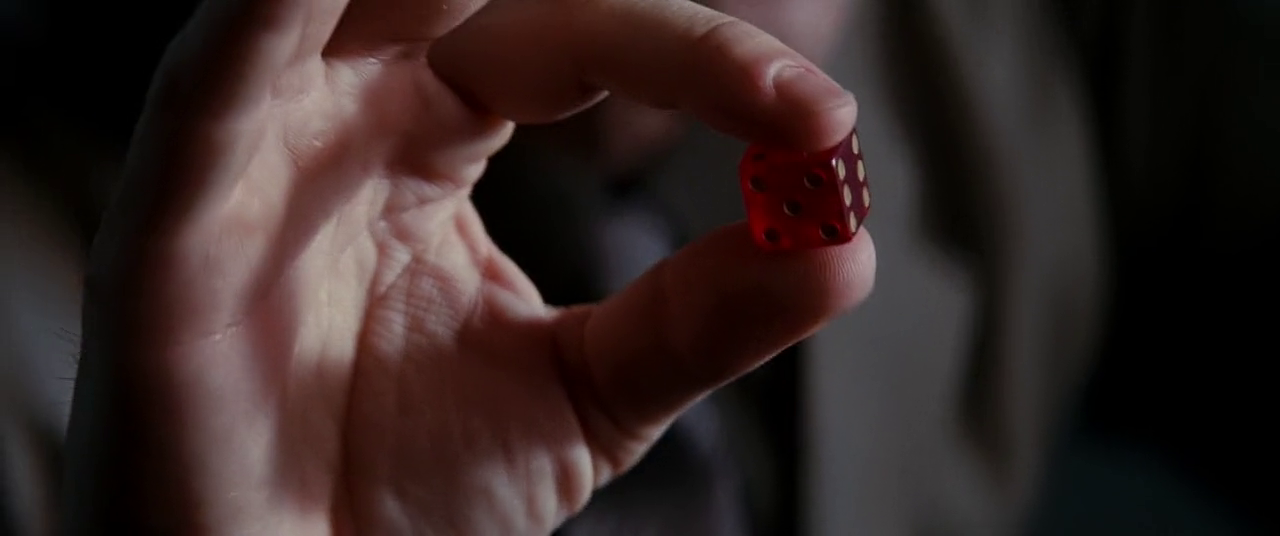
Since films are analytic copies of copies just like dreams, one can find examples of S(Ⱥ) in films [2]. One of the most prominent films about dreams is Inception (2010) which makes excellent use of an object to embody the lack in the Other: the spinning top. The protagonist can use the spinning top to test whether he is in the “real world” or dreams: If it stops spinning, then he knows that he is in the “real world”. If it does not stop spinning, then he thinks he might still be in a dream. “Still spinning” means “still dreaming” or “rêve encore” [3]. At some point in the film, it is suggested that a die can take the place of the spinning top (they are called totems). So it is reasonable to substitute both objects with a third object that combines their properties: a dreidel.

+
=
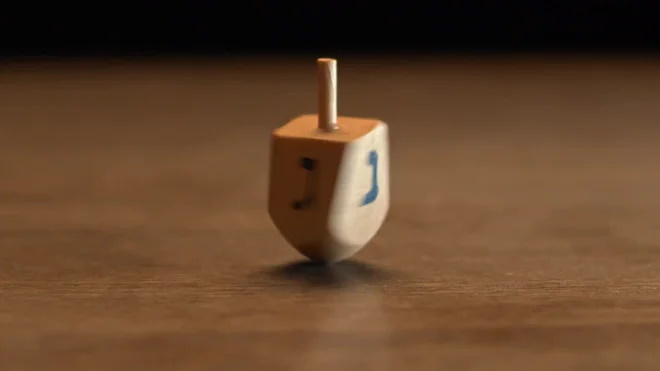
You can spin a dreidel just like a spinning top, but when a dreidel slows down and stops spinning, it turns up a symbol just like a die. So it combines their associations:
1) Just like the spinning top, the dreidel’s “still spinning” (rêve encore) denotes the lack in the Other S(Ⱥ). Its blazing spin is a fragment of reality “driven” by the psyche. It’s the paradoxical “building block” that simultaneously enables and blocks the construction of the “real world”.
2) As with the die, the symbol that the dreidel eventually turns up denotes the Master-Signifier S1. This signifier sutures (erases) and represents (registers) the subject in a “single stroke” (unary trait) and confers the imaginary-synthetic consistency of the “real world”.
The turning up of the dreidel is also a metaphor for the collapse of the wave function in quantum mechanics. The disjoint probabilities of exclusive physical events function like competing Master-Signifiers. But the “real world” is possible only when (or if!) the inevitability of the “full probability = 1” acquires its possibility, which happens only when (or if!) the dreidel stops spinning. This is why “still spinning” (rêve encore) denotes a peculiar possibility which can never have any probability, just like the sexual relationship (Lost Highway: “You’ll never have me.”). This lack in the Other can alternately be called (1) the improbable possibility, (2) the impossible possibility, (3) the pure possibility, (4) the virtual possibility (as opposed to merely potential possibilities) [4].
“Still spinning” makes academic science quite uneasy and impatient. It would rather hurry and hustle to “suture the subject”: to submit a paper to a publication, to “run for the door” like one of the Three Prisoners.
(Turkish)
Işık Barış Fidaner is a computer scientist with a PhD from Boğaziçi University, İstanbul. Admin of Yersiz Şeyler, Editor of Žižekian Analysis, Curator of Görce Writings. Twitter: @BarisFidaner
Notes:
[1] See “The microstate does not exist”
[2] In Enjoy Your Symptom! (1991) Slavoj Žižek gives several examples of S(Ⱥ) from movies and opera:
Within this dimension of the outstanding debt, the role of the letter is assumed by an object that circulates among the subjects and, by its very circulation, makes out of them a closed intersubjective community. Such is the function of the Hitchcockian object: not the decried MacGuffin but the tiny “piece of the real” which keeps the story in motion by finding itself “out of place” (stolen, etc.): from the ring in Shadow of a Doubt, the cigarette lighter in Strangers on a Train, up to the child in The Man Who Knew Too Much who circulates between the two couples. The story ends the moment this object “arrives at its destination,” i.e., returns to its rightful owner: the moment Guy gets back the lighter (the last shot of Strangers on a Train where the lighter falls out of dead Bruno’s unclasped hand), the moment the abducted child returns to the American couple (in The Man Who Knew Too Much), etc. This object embodies, gives material existence to the lack in the Other, to the constitutive inconsistency of the symbolic order: Claude Levi-Strauss pointed out how the very fact of exchange attests a certain structural flaw, an imbalance that pertains to the Symbolic, which is why the Lacanian mathem for this object is S(Ⱥ), the signifier of the barred Other. The supreme exemplar of such an object is the ring from Richard Wagner’s Ring des Nibelungen, this gigantic drama of the unbalanced symbolic exchange. The story opens with Alberich stealing the ring from the Rhine maidens, whereby it becomes the source of a curse for its possessors; it ends when the ring is thrown back into the Rhine to its rightful owners-the Gods, however, pay for this reestablishment of the balance with their twilight, since their very existence was founded upon an unsettled debt.
[3] “Still spinning” also denotes the Lacanian impossible that “does not stop not writing itself”. To be specific, this is the impossibility of the sexual relationship. It’s also somewhat related to the infinite loops and the Halting Problem in computer science. See: “Turing Machine and Lacan: Writing and Stopping” Not to mention Eppur si muove.
[4] See Less Than Nothing (2012) about potentiality vs. virtuality.


[…] — Inception’s spinning top is the lack in the Other […]
LikeLike
[…] [3] About Dynamistical Echology, see “Echology, Echosystems, Echocide”, “Dynamistics and Dynamistical Significance”; about the one-sided coin, see “One-sided Coin is the Unary Trait”, “The greatest possible division: 1/e”; about the lack in the Other, see “Inception’s spinning top is the lack in the Other” […]
LikeLike
[…] [2] Bkz “Inception’s spinning top is the lack in the Other” […]
LikeLike
[…] (İngilizcesi) […]
LikeLike