Nature surely increases entropy directly through the arrow of time. According to Dissipative Adaptation, nature also increases entropy indirectly by driving the adaptation of specialized systems that reliably absorb work from and dissipate heat to their environment [1]. In other words, these special systems are driven to make themselves worked on by their environment.
To distinguish the specialized system from its environmental system, let’s call it a systerm, since it marks a terminus by making itself worked on. But every systerm may also contain smaller systerms which absorb work from it. Let’s call this second-level systerm a systherm since it dissipates heat to the systerm that contains it. Here’s a diagram:
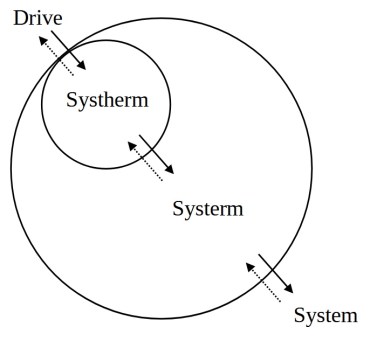
It shows a system that contains a systerm that contains a systherm. The whole thing is driven by an energy source, which originally refers to sunlight, but it might also be some other physical drive (e.g. sound waves or voice). Two adaptations take place here:
1) The systerm is driven to absorb work from the system.
2) The systherm is driven to absorb work from the systerm.
These are the simple adaptations.
Due to the indirect effect of 2 on 1, two other complex adaptations take place:
3) The systerm is driven to exude work to the systherm, i.e. it is driven to make itself used by the systherm [2].
4) Since the systerm is in the middle, it is driven to absorb work from the system while being used by the systherm. The systerm is thereby driven to make use of the system in the service of the systherm.
In brief, the systherm that dwells within the systerm becomes a parasite that imposes a certain orientation on the systerm within the system.
It becomes easier to understand these adaptations when we translate the whole diagram into Freud’s second topography: The systerm is the Ego, the systherm is the Superego plus the Id, and their environmental system is the Eco:

Here’s the briefest summary of this diagram: The Ego is driven to make use of the Eco in the service of the Superego and the Id.
To distinguish the Superego from the Id, we have to take into account the bifurcating aspect of dissipative adaptation (see [1] for details). The systerm adapts to the systherm in two parallel ways:
1) It becomes relatively insensitivized against the larger part of the systherm.
2) It reliably exudes work to (makes itself used by) a smaller part the systherm.
The former part of the systherm is the Id and the latter part of the systherm is the Superego. The Superego is much narrower than the Id in terms of energy bandwidth, since what the Superego finally manages to emit to the Ego is a mere signal, a result only obtained after greatly filtering the original Id energy of the drive. Here’s the final diagram:

To conclude, let’s recap our previous results and derive a final result from them:
1) The Ego is adapted to absorb work from the Eco.
2) The Superego plus the Id is adapted to absorb work from the Ego.
3) The Ego is relatively insensitivized to the Id.
4) The Ego is adapted to make itself used by the Superego.
5) The Ego is adapted to make use of the Eco in the service of the Superego.
6) The Ego’s service to the Superego is both reinforced and thwarted by the Id.
The peculiarity of the final result is due to the fuzzy boundary between the Id and the Superego. This combination of reinforcement and thwarting is particular to the psychoanalytic drive.
This is how an external drive finds its echo in an internal drive. In terms of information, this entropic echo is the throw of a one-sided coin that “will never abolish chance” (Mallarmé). In Lacanese therms, it is the lack in the Other S(Ⱥ) [3].
Işık Barış Fidaner is a computer scientist with a PhD from Boğaziçi University, İstanbul. Admin of Yersiz Şeyler, Editor of Žižekian Analysis, Curator of Görce Writings. Twitter: @BarisFidaner
Notes:
[1] See “Dissipative Adaptation is Death Drive”
[2] See “The Perverse Core of Labor-Power: Making Oneself Used”
[3] About Dynamistical Echology, see “Echology, Echosystems, Echocide”, “Dynamistics and Dynamistical Significance”; about the one-sided coin, see “One-sided Coin is the Unary Trait”, “The greatest possible division: 1/e”; about the lack in the Other, see “Ontoanalysis: Inception’s spinning top is the lack in the Other”


[…] — Freud’s Second Topography Derived From Dissipative Adaptation […]
LikeLike
[…] — Freud’s Second Topography Derived From Dissipative Adaptation […]
LikeLike
[…] [3] Bkz “Freud’s Second Topography Derived From Dissipative Adaptation” […]
LikeLike
[…] [1] Bkz “Hep Sonradan: Entropi ve Feda”, “Salımlı Uyumlanma Ölüm Dürtüsüdür”, Entropi (özel sayfa), “Freud’s Second Topography Derived From Dissipative Adaptation” […]
LikeLike
[…] Fidaner, Freud’s Second Topography Derived From Dissipative Adaptation (🔗): […]
LikeLike
[…] Fidaner, Freud’un İkinci Topografyası Disipatif Uyumlanmadan Türetilmiştir (🔗): […]
LikeLike