
(Warning: Spoilers)
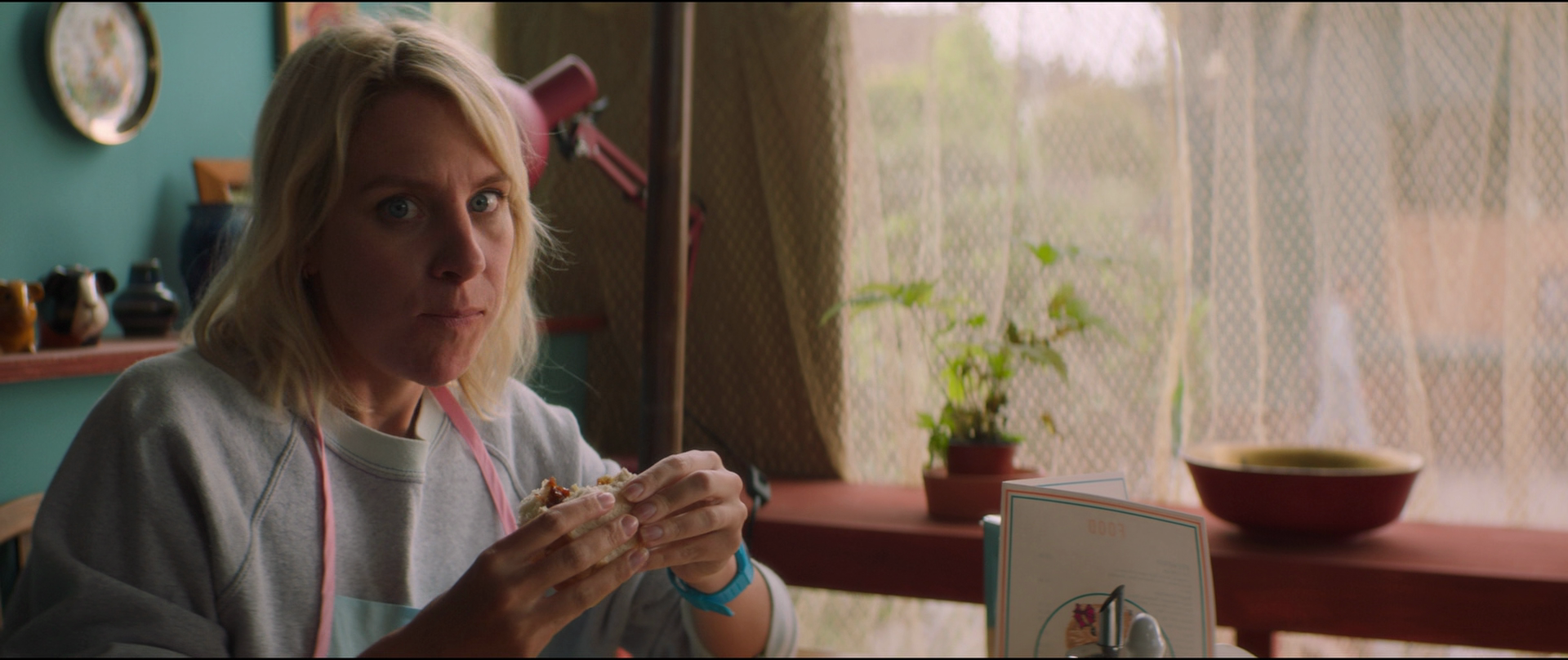
The series Fleabag is based on a Brechtian distancing effect in which the heroine frequently turns to the camera and addresses the viewer directly, putting him/her in the position of her big Other (breaking the Fourth Wall). Moreover, the viewer is occasionally shown images from her memory, staging the return of what is repressed by her big Other. Behind her apparent coolness the heroine continuously struggles with two big traumas that form the background and the horizon of the story:
1) Her concrete trauma is the recent death of her partner Boo whose name evokes the image of a ghost. The heroine represses her role in Boo’s death: She stole Boo’s boyfriend, causing Boo’s suicidal “accident”.
2) Her abstract trauma is the death of her mother a few years ago. There is an explicit link between the traumas: It’s mentioned that her love for her mother was displaced onto her love for Boo.
There is a constant dynamic between the heroine’s big Other and what is repressed by it. But the most interesting aspect is revealed later in the series when this distancing dynamic is disturbed by the heroine’s new friend who is a priest. Unlike all the other characters who are oblivious to the heroine’s frequent exchanges with her big Other, the priest is able to detect when the heroine turns to her big Other, presumably because he has a contact with God. The priest is surprised when he becomes aware that the heroine spiritually and momentarily goes away and comes back. This is disturbing for the heroine who thereby faces additional difficulty in sustaining the repression by keeping the appearances (thereby breaking the Fifth Wall too). This difficulty is heightened by the priest’s questions like “What happened to Boo?” In response, the heroine imagines Boo shaking her head as if to say “No, I’m not dead” and she is unable to tell him that Boo died. This scene provides the perfect representation of the big Other as an ignorant ghost who lives on only because (s)he doesn’t know that (s)he is dead. In a sense, Boo is equated with God. This association gives a further significance to the fact that Boo owns a guinea pig and loves guinea pigs: Here the guinea pig stages the human condition of being owned and loved by the ghost of one’s ignorance [1]. This basic ignorance emphasized by “rubbers at the end of pencils” requires that the subject be unsutured, which is why most characters in Fleabag don’t have proper names.
Another significant moment is when the heroine has sex with the priest: She reaches for the camera and moves it away. If the initial Brechtian distancing was her alienation in the big Other, the disturbance of her big Other by the priest’s entrance is the separation that eclipses her alienation. This separation, as the second phase of the Brechtian distancing effect, is fully embodied in the answers of the real: A picture on the wall drops on the floor, two times: (1) when the heroine declares her atheism, (2) when she kisses the priest. Another answer of the real is the fox that occasionally visits the priest (Hegel: cunning of history).
But perhaps the greatest emphasis is given by the scenes in which a man commands a woman to kneel down, two times: (1) when the priest interrupts the heroine’s spiritual desperation in the confession booth by commanding her to kneel down, (2) when the egotist husband commands his fed-up wife (heroine’s sister) to kneel down and beg him to leave. In both cases, the woman obeys his command, but she is not thereby subjugated to the man. In the first case, kneeling down stages the love that drops the heroine’s big Other. In the second case, kneeling down makes it evident that the wife has reached the absolute limit of her patience. In both cases, kneeling down does not signify the woman’s weakness but her strength. It is the subjective acknowledgement that the big Other is merely an ignorant ghost which is more closely accessible to the feminine subject in both of its modes: alienation and separation.
(Turkish)
Işık Barış Fidaner is a computer scientist with a PhD from Boğaziçi University, İstanbul. Admin of Yersiz Şeyler, Editor of Žižekian Analysis, Curator of Görce Writings. Twitter: @BarisFidaner
Notes:
[1] See “Okay but where is your hamster?” Slavoj Žižek
 Žižekian Analysis
[…] — God = Boo: Big Other as Ignorant Ghost in Fleabag […]
LikeLike
[…] [1] Bunun çok iyi bir örneği Fleabag dizisidir: “God = Boo: Big Other as Ignorant Ghost in Fleabag” […]
LikeLike
[…] (İngilizcesi) […]
LikeLike
[…] 3) God = Boo: Big Other as Ignorant Ghost in Fleabag […]
LikeLike