When Byung-Chul Han tells that the transparency society “lacks all negativity” and becomes “pornographic” [1] he mentions the informatic striptease of what people “represent” into what people “present”. In this text, we go further along the pathway of this infomatic striptease to reveal what they “resent” and what they “sent”.
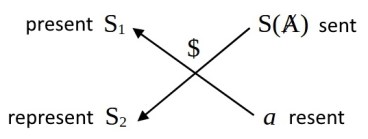
1) Represent → Present
In this step, people choose to present their case directly instead of relying indirectly on their legitimate public representatives. This is sometimes celebrated as direct democracy, sometimes decried as the erosion of values.
Formally, we take a complex situation (field of possibilities) shaped by a knowledge (symbolic mediations, S2) and gradually strip its layers to reach the minimal immediate ground (repetition of phallic signifiers, S1) that renders this situation necessary.
When presence becomes dominant over representation, one leaves behind the rationalizations of the University discourse and one is faced with the direct injunctions of the Master’s discourse. After stripping the symbolic mediations, the issue becomes that of showing up, standing up, taking up, keeping up, etc. just like the role of phallus in sexual intercourse.
In this way, long discussions about what constitutes reality are left behind and firmer and more politicized confrontations emerge about who has the right to say or do what in which conditions.
2) Present → Resent
When presences confront each other directly without the buffer and cushion of symbolic mediations, frictions of resentment appear about who shows the better presence, thereby proving their competence. This is metaphorically about who has/is the bigger imaginary phallus φ.
When these resentments are openly expressed, one’s symbolic presence turns into a shameless phallic flaunt and we enter the properly obscene “pornographic” waters.
This second step of informatic striptease reaches the contingent ground of necessity (the objet a that gives S1 its aura) revealing the arbitrariness of the underlying truth that determines the concrete political rights of the parties in the present situation.
3) Resent → Sent
Finally one understands that “resent” is basically “re-sent”: Resentment gives the users a deep feeling of insufficiency and impotence. It thereby causes an irresistible compulsion-to-repeat that is the main reason why they are addicted to the network, never ceasing to “re-send” new content about themselves.
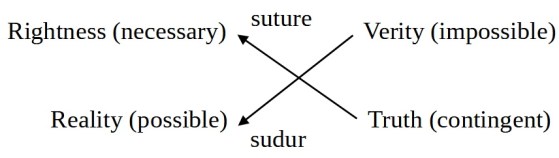
One finally strips the user’s compulsive feeling of resentment to reveal the user’s drive to send new content. One thus moves from the contingency of desire towards its impossible ground: from the true object-cause of desire (objet a) towards the very symptom that conditions it (lack in the Other: S(Ⱥ)). This is the move from truth to verity [2].
Işık Barış Fidaner is a computer scientist with a PhD from Boğaziçi University, İstanbul. Admin of Yersiz Şeyler, Editor of Žižekian Analysis, Curator of Görce Writings. Twitter: @BarisFidaner
Notes:
[1] Byung-Chul Han (2012) The Transparency Society.
[2] See “Suture and Sudur”
 Žižekian Analysis
[…] — Informatic Striptease: Represent → Present → Resent → Sent […]
LikeLike
[…] See “Suture and Sudur”, “Informatic Striptease: Represent → Present → Resent → Sent”, “Jesse and Celine Shall Bring Us the Horns of Wilmington’s Cow”, “Identity and […]
LikeLike
[…] Bkz “Sütur ve Südur”, “Informatic Striptease: Represent → Present → Resent → Sent”, “Jesse and Celine Shall Bring Us the Horns of Wilmington’s Cow”, “Identity and […]
LikeLike
[…] See “Suture and Sudur”, “Informatic Striptease: Represent → Present → Resent → Sent”, “Identity and Disparity of Same and Different”, “The Minimal Structure of […]
LikeLike