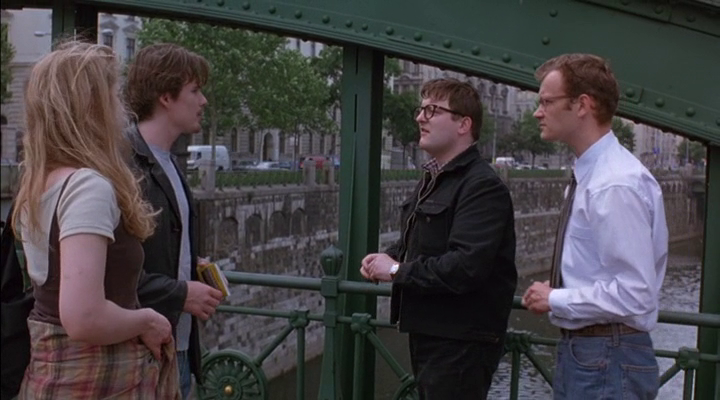
(Warning: Spoilers)
Jesse and Celine’s neglection of their rendezvous to the amateur drama play called “Bring Me the Horns of Wilmington’s Cow” haunts not only Before Sunrise (1995), but also Before Sunset (2004) and Before Midnight (2013).
In Before Sunrise, immediately after the initial awkwardness of their official presence in Vienna on the Zollamtssteg bridge, the couple encounters two amateur actors and promise going to their play in the evening. It’s an absurd play about Indians searching for a cow that (1) has a disease, (2) acts like a dog, (3) smokes with her hoofs. This cow seems to symbolize both sanctity and its profanation, as well as the breast as the initial object of desire. It is quite significant that Jesse asks whether the cow is real, and one of the actors says: The cow is not real, he plays the cow, he is the cow. Actually, the cow here is meant to take the place of the woman who does not exist symbolically. One should note that both actors are male, they both have spectacles, and they are portrayed like weird geeks. Jesse and Celine do not dare turn down the invitation to the play and they promise to meet the actors in the evening.
In fact, they are obliged to primordially repress this encounter with the actors and they have to completely forget about this “play about the cow” if they are going to (1) make sexual relationship possible, and (2) make woman exist. The particularity of this shared negligence is the couple’s true initiation that bridges them together in Vienna. The repression of the cow haunts the couple with a beautifully impossible intimacy (see the diagrams below for these terms), it becomes the symptom that they share, and during their limited time together, they convert this intimacy into the contingent extimacy of their love: They intimately forget about the geeks’ sacred cow, but instead they encounter a local poet and get an extimate “poem about milk shake” as what returns from the repressed cow. This repression drives the entirety of their desire [1].
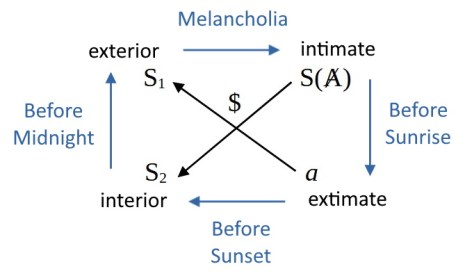
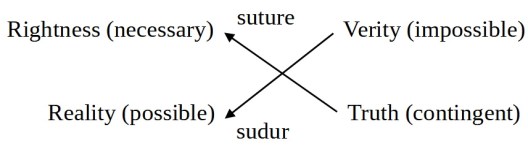
In Before Sunset, while speaking to his readers in the bookstore a moment before Celine makes her surprise visit, Jesse imagines the exact moment with her on the Zollamtssteg bridge, the moment just before they encountered the two actors and committed their primordial repression, which apparently remained quite alive after all those years. Jesse and Celine’s meeting in the bookstore in Before Sunset is the second phase of their love: It takes their contingent extimate love (that they had built on their impossible intimacy in Before Sunrise) and converts it into the possibility of an interiority, culminating in their intense reunion in Celine’s apartment.
In Before Midnight, on the other hand, the couple has converted the possible interiority in Before Sunset into a necessary exteriority of their marriage-like arrangement of parenting their twin daughters. The cow repressed in Before Sunrise returns in Before Midnight in the form of Celine’s intense fear of “being turned by a man into a submissive housewife” which metaphorically means: To be milked like a cow.
Celine’s trauma in Before Midnight (2013) is the same with Justine’s trauma in Melancholia (2011) [2]. Here’s a provisional formula of this trauma: Ultimately, a woman’s breast is never meant for any mortal man, it is only meant for the absolute master, death; and her children are just representatives of this absolute master. Thus it is always a bit sinful to marry a man, since he can only be an impostor of God. Thus Melancholia gives the missing link of the “Before” Trilogy by connecting the necessary exteriority at the end of the trilogy (intense fear of being milked like a cow) back to the impossible intimacy that initiated the trilogy in the first place (neglecting to go to the play about the cow). The couple can generate and experience their love only by suspending and then missing this melancholic hidden link.
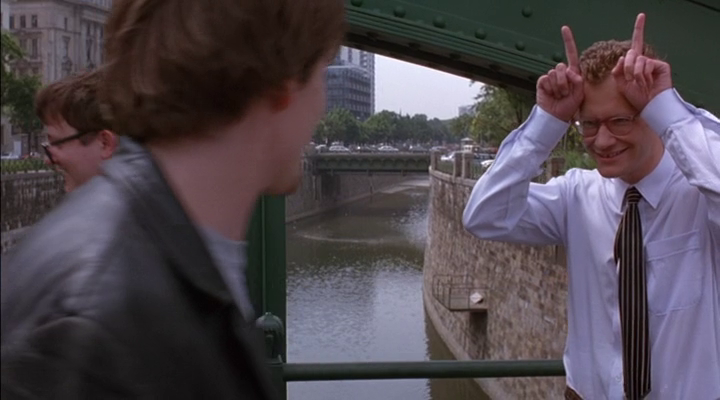
So one could say that the true purpose of inventing a “time machine” at the very end of Before Midnight is to go back to Vienna, heed their rendezvous with the geeks and watch the absurd play “Bring Me the Horns of Wilmington’s Cow” that would profane the sacred cow of sex. In this way, they would at least learn something about the impossibility of the sexual relationship, and they would truly have “horns” like the cow instead of being condemned to a constant oscillation between “feeling horny” and “feeling cheated”. This would also solve the main problem of humanity that Celine tells about in Before Midnight:
I saw a documentary where they were doing an experiment on a lab rat. And he was wired up and he could push a switch and have an orgasm. And so the scientists were sort of laughing at this pathetic little creature while it ignored his food and water and didn’t do anything else. And eventually it just died. I mean, I think that’s the future of humanity.
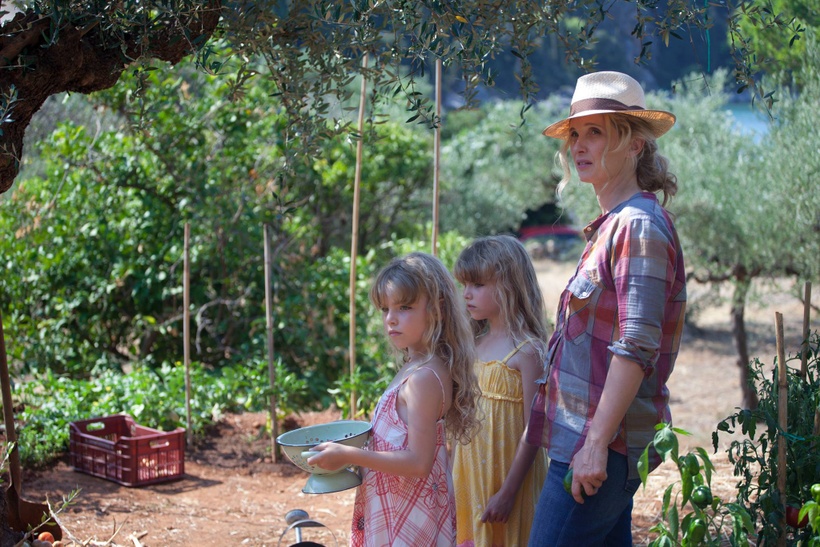
Or you could say that Jesse and Celine actually inadvertently bring the horns of Wilmington’s cow, in the form of their twin daughters, Elle and Nina. When the twins fight with each other (antagonism of horns cause trouble) Jesse feels despair about flawed human nature but Celine is on the contrary filled with hope for their kids.
Işık Barış Fidaner is a computer scientist with a PhD from Boğaziçi University, İstanbul. Admin of Yersiz Şeyler, Editor of Žižekian Analysis, Curator of Görce Writings. Twitter: @BarisFidaner
Notes:
[1] The multiple instances of grandmothers that punctuate the crucial moments in the trilogy should also be interpreted as various incarnations of this same repressed sacred but profaned cow. About the diagrams, see “Sutur and Sudur”
 Žižekian Analysis
[…] [2] Bkz “Jesse and Celine Shall Bring Us the Horns of Wilmington’s Cow” […]
LikeLike
[…] — Jesse and Celine Shall Bring Us the Horns of Wilmington’s Cow […]
LikeLike
[…] and Sudur”, “Informatic Striptease: Represent → Present → Resent → Sent”, “Jesse and Celine Shall Bring Us the Horns of Wilmington’s Cow”, “Identity and Disparity of Same and Different”, see also “Subjective Initiation […]
LikeLike
[…] ve Südur”, “Informatic Striptease: Represent → Present → Resent → Sent”, “Jesse and Celine Shall Bring Us the Horns of Wilmington’s Cow”, “Identity and Disparity of Same and Different”, ayrıca bkz “Subjective […]
LikeLike
[…] [2] See “Jesse and Celine Shall Bring Us the Horns of Wilmington’s Cow” […]
LikeLike
[…] Bkz “Efesli Artemis: Mamilla Hasetine Kapılarak Sanal Ağa’nın Veri Memesi Olmak”, “Jesse and Celine Shall Bring Us the Horns of Wilmington’s Cow” […]
LikeLike
[…] Jesse and Celine Shall Bring Us the Horns of Wilmington’s Cow […]
LikeLike
[…] Jesse and Celine Shall Bring Us the Horns of Wilmington’s Cow […]
LikeLike
[…] [1] See “Aries in Astrology: Meaning and Traits” The Astrology Podcast, “Jesse and Celine Shall Bring Us the Horns of Wilmington’s Cow” […]
LikeLike
[…] Bkz “Jesse and Celine Shall Bring Us the Horns of Wilmington’s Cow”, “There is no Other jouissance but only the Othering of […]
LikeLike
[…] Jesse and Celine Shall Bring Us the Horns of Wilmington’s Cow is funny if it’s a parody or satire, and hilarious if it is serious. I was wishing the cow actor guys had a post-credits scene with the cow guy in costume smoking a cigarette while sitting on the edge of the stage with his friend saying “I guess that tourist couple isn’t coming.” […]
LikeLike