Hegel defined the absolute as the “identity of identity and non-identity” (The Science of Logic). Let’s devise a model through the parallax of two perspectives:
Identity of Same and Different
From the perspective of identity, a particular symbolic order is made up of the same guy (S1) doing or attempting to do different things (S2). It’s a field of possibilities grounded on a single necessity. Think of a great empire that values itself solely with respect to the singular existence of the king. Or think of big capital that values itself solely with respect to a single currency or a small group of monopolists. Or think of an activist movement that values itself solely with respect to a single oppressed identity or a single fashionable slogan. Let’s call this first perspective the Identity of Same and Different. This is the energetic and positive perspective that belongs to the ego’s conscious attempts to achieve and succeed symbolic valuation [1].
Disparity of Different and Same
From the perspective of disparity (non-identity), every time it’s a different guy (objet a) doing the same thing or managing to fail in the same way (S(Ⱥ)). Every king shall fail his empire, every currency shall fail its capital, every boss shall fail his company, every identity or slogan shall fail its supporters, and the fundamental reasons for these failures are ultimately the same: The Master-Signifier S1 is always an impostor, which implies two facts:
1) The occupant of this position is merely a contingent element and is meant to be replaced with another guy or thing who will be brought into attention by the object-cause of desire (a).
2) Whatever element is put at the helm, it will always confront a structural impossibility (the symptom S(Ⱥ)) that is even more unchangeable and unavoidable than the Master-Signifier S1.
This impossibility is called the lack in the Other which implies that every symbolic order is meant to fail. Let’s call this second perspective the Disparity of Different and Same. This is the entropic and negative perspective that belongs to the unconscious manifestations of the symptom.
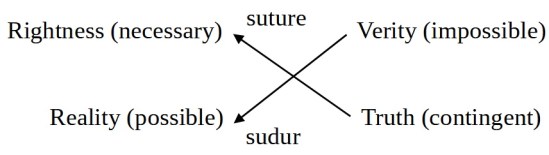
The four elements that make up this parallax model are nicely combined in the following table:

Two arrows on the table denote two operations, suture and sudur [2]:
1) The arrow on the diagonal a → S1 denotes suture: In suture, a contingent element (a) establishes itself as the new center of a symbolic order (S1). Examples: A candidate is elected to become the next president; someone falls in love with a person and “raises [him/her] to the dignity of the Thing” (Lacan); a slogan establishes itself as an accepted truth in a political field; etc. In suture, disparity and difference (in objet a) seemingly cancel each other out and yield the unity of the identical and the same (S1). The unity that results from the suture stands for the energy that is conserved by the universe. But the apparent cancellation of disparity and difference is actually a deceptive illusion. Here is the mathematical staging of suture in terms of imaginary numbers:

2) The arrow on the anti-diagonal S(Ⱥ) → S2 denotes sudur: In sudur (emanation), we witness the radiant expansion of a symbolic field but the underlying cause can only be articulated in terms of a fundamental impossibility. When you superficially examine the propagation of a sudur, it might look like being motivated by a “life drive” to grow and flourish. But if you investigate it more closely, you eventually discover that the actual cause of any sudur is a “death drive” that is ultimately bent on decomposition and fragmentation; in other words, the energy that is seemingly conserved actually dissipates heat and increases the entropy of the universe. Sudur is a perpetual conversion: It converts the same disparity (S(Ⱥ)) into identical difference (S2).
The best metaphor for sudur is echo [3]: Sudur is the eternal echo of the symptom S(Ⱥ) within any symbolic knowledge S2. By resonating within knowledge, the symptom constitutes the negative unknown aspect of positive knowledge. This is why the symptom always warrants interpretation and analysis.

(Turkish)
Işık Barış Fidaner is a computer scientist with a PhD from Boğaziçi University, İstanbul. Admin of Yersiz Şeyler, Editor of Žižekian Analysis, Curator of Görce Writings. Twitter: @BarisFidaner
Notes:
[1] See “Incomplete Universe: Energy & Entropy, All & Not-All”
[2] See “Suture and Sudur”
[3] See “Ego is Echocide before Ecocide”, “Echology, Echosystems, Echocide”


[…] — Identity and Disparity of Same and Different […]
LikeLike
[…] → Sent”, “Jesse and Celine Shall Bring Us the Horns of Wilmington’s Cow”, “Identity and Disparity of Same and Different”, see also “Subjective Initiation and Objective Initiation”, “The Opportunistic […]
LikeLike
[…] → Sent”, “Jesse and Celine Shall Bring Us the Horns of Wilmington’s Cow”, “Identity and Disparity of Same and Different”, ayrıca bkz “Subjective Initiation and Objective Initiation”, “Fırsatçı Medya […]
LikeLike
[…] — Identity and Disparity of Same and Different […]
LikeLike
[…] and Sudur”, “Informatic Striptease: Represent → Present → Resent → Sent”, “Identity and Disparity of Same and Different”, “The Minimal Structure of […]
LikeLike
[…] [4] See “Identity and Disparity of Same and Different” […]
LikeLike
[…] [1] See “Identity and Disparity of Same and Different” […]
LikeLike
[…] (İngilizcesi) […]
LikeLike