We have a circular edge that simply connects to itself:
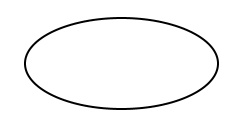
There is not yet any surface for the ant to walk on, which means:
no over no under
Since over/under refers to place/placed, this pair translates to:
nowhere none there
These are equivalent but not equal. The edge has thereby self-separated and self-combined. Now we have a twisted edge, which is a Möbius strip:

In the Möbius strip, there is a surface between the twisted edge. Now the ant can walk over the surface, but it also ends up walking under the surface:
over = under
This is the elementary form of the subject $.
In order to distinguish over from under (place from placed), we must strip the Möbius strip: We disentangle the twist (Möbius-without-strip) from the edge (strip-without-Möbius) and get the cross-cap (marked 1 in the figure):

In the cross-cap, there is a twisted surface delimited by an ordinary edge:
— The twist is the wavering line (which looks like the mouth of a carnivorous plant).
— The edge is the bottom circle (which looks like a gray belt).
By being disentangled, the twist becomes explicit and distinguishes over from under:
over / under (cover)
The cross-cap covers the distinction without cancelling it, by sustaining its permeability. This is the fantasy $ ◊ a.
If we chose to cancel the distinction, we could erase the edge by mounting a disc over it (marked 2 in the figure). The resulting combination 1+2 is called the cross-capped disc [1]. When “distinction” is cancelled, it turns into “this thing shown” and becomes impermeable:
over // under (discover)
The following operations are equivalent:
— Mark “this cover”
— Discover “this thing shown”
— Mount a “disc over” the cross-cap
They all lead to the Master-Signifier S1.
But there is another option: One can maintain the distinction by marrying one cross-cap to another cross-cap, which yields a Klein bottle:
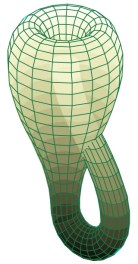
In the Klein bottle, there is a virtual edge that erases itself by attaching one twist to another twist. Over and under are thus attached:
over + under
This is the symptom S(Ⱥ). The place is the feminine subject and what is placed there is the unconscious:
of her + unheard
Beware that the symptom is ordinarily disguised by commonsense:
of her? offer! unheard? endear!
of her? lover! unheard? endure!
Psychoanalysis can only work through uncommonsense by attaching the symptom back to the initial twist of the edge:
of her? nowhere… unheard? none there…
Işık Barış Fidaner is a computer scientist with a PhD from Boğaziçi University, İstanbul. Admin of Yersiz Şeyler, Editor of Žižekian Analysis, Curator of Görce Writings. Twitter: @BarisFidaner
Notes:
[1] The literature (including Lacan and Žižek) often confuses the cross-cap with the cross-capped disc and thereby automatically erases the edge and cancels the distinction. See “The Möbius Strip is an Island”
The cross-cap image is from Lacan’s Seminar 9 (French Edition, page 441).
 Žižekian Analysis
[…] — The Topology of Symptom […]
LikeLike