For Žižek, the imposture that distinguishes man from woman is a pretense to existence:
If Woman does not exist, then man is Woman pretending to exist.
(The Most Sublime Hysteric)
In the ongoing conflict about sex within feminism [1], both sides take the opposite approach: They both uphold a pretense to existence for the woman in order to distinguish her from the man. For the purpose of giving due credit to the woman, they imitate the imposture of man. But despite their similarity, their approaches turn out to be logically incompatible with one another:
— For gender critics (second wave radical feminism) woman is defined by the ex-sistence (external being) of her biological sex organs. This position applies the commonsensical rule from the existing knowledge (S2) by saying “woman is an adult female human being”.
— For trans activists (third wave queer feminism) woman is defined by the insistence (internal being) of the self-identification of one’s gender. This position enacts the basic exceptional gesture of symbolization (S1) by saying “trans women are women”.
Both feminisms look bizarre to Lacanian eyes: The formulae of sexuation clearly state that both the rule (S2) and its exception (S1) belong to the masculine logic. It appears that this conflict about sex stages the contradiction between the company of brothers (S2) and the primal father (S1). So neither of these feminisms look quite feminine.
To resolve this paradox, we just need to ask: What operates behind these two masculine terms? The answers are simple enough:
— Behind the existence of S2, there is the persistence of S(Ⱥ): This is sudur.
— Behind the insistence of S1, there is the resistance of objet a: This is suture.
Now it’s clear that the feminine terms are actually operative behind the scenes [2]. Here is the combined diagram:
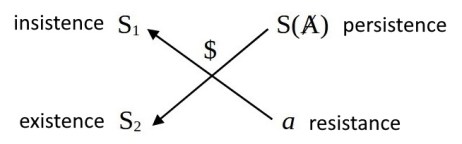
Ex-sister, in-sister, re-sister, per-sister. Now we can see why Žižek is right to say “both men and women are women”: The part that is shared by all four terms imply that both men and women “sist” in one way or another, so we are all “sisters”: Every apparent brotherhood actually relies on a sisterhood that operates behind the scenes.
Işık Barış Fidaner is a computer scientist with a PhD from Boğaziçi University, İstanbul. Admin of Yersiz Şeyler, Editor of Žižekian Analysis, Curator of Görce Writings. Twitter: @BarisFidaner
Notes:
[1] See “The Conflict About Sex”
[2] See “Suture and Sudur”, “Informatic Striptease: Represent → Present → Resent → Sent”, “Identity and Disparity of Same and Different”, “The Minimal Structure of Language”
 Žižekian Analysis
[…] — The Sisterhood of Humanity […]
LikeLike
[…] [5] Bkz “Cinsiyet Üzerine Çatışma”, “Cinsiyetsiz Ödül ve Ataerki”, “The Sisterhood of Humanity” […]
LikeLike
[…] [5] Bkz “Cinsiyet Üzerine Çatışma”, “Cinsiyetsiz Ödül ve Ataerki”, “The Sisterhood of Humanity” […]
LikeLike
[…] [6] Bkz “Bilinçdışı arzunun yok edilemez direşkenliği” Jacques Lacan; “Sadece sevgi keyfiyeti arzuya tenezzül ettirebilir” Jacques Lacan; “The Sisterhood of Humanity” […]
LikeLike
[…] and Deferential Diachronicity: Signifi-cushion, Signifi-caution, Signifi-crouching”, “The Sisterhood of Humanity”, “There is no Other jouissance but only the Othering of […]
LikeLike
[…] “The Sisterhood of Humanity”, “Direniş ve Direşim: Horgörgü/Hoşgörgü ve […]
LikeLike
[…] [3] Bkz “Gelin Artık Şu Erillik Yasağını Kaldıralım”, “The Sisterhood of Humanity” […]
LikeLike
[…] Bkz “Direnç, Israr, Direşim” Jacques Lacan, “Dürtü: İtim, Amaç, Nesne, Kaynak” Sigmund Freud, “Tözne/Cevherzat: özgür, özür, zaten, bizzat”, “Antinomiler” Slavoj Žižek, “The Sisterhood of Humanity” […]
LikeLike
[…] [2] Bkz “Direnç, Israr, Direşim” Jacques Lacan, “Otomatizmin Berisinden Gelip Dokunan Gerçek”, “Direniş ve Direşim: Horgörgü/Hoşgörgü ve Haysiyetmezlik”, “The Sisterhood of Humanity” […]
LikeLike
[…] See “The Sisterhood of Humanity” […]
LikeLike