(Warning: Spoilers)
In the original Matrix movie (1999) the hero (Neo) undergoes a series of forced choices like a machine gun. He experiences the loss of reality precisely due to (1) the sheer excessive number of and (2) the disparity and inconsistency among these forced choices. Neo is the ultimate victim of Neo-liberalism, as it were. The famous “blue pill or red pill” dilemma is just the peak that caps off the long list of choices that Neo faces:
1) Computer: Wake up, Neo. The Matrix has you. Follow the white rabbit. Knock, knock, Neo. (Neo accepts and follows the girl with the rabbit tattoo)
2) Man: You look a little whiter than usual. It sounds like you need to unplug. Get some R and R? (Neo initially rejects this idea but then observes the tattoo and follows them)
3) Boss: Either you choose to be at your desk on time from this day forth or you choose to find another job. (Neo accepts to obey the boss)
4) Phone: There are two ways out of this building. One is that scaffold. The other is in their custody. (Neo attempts the first option but then falls back to the second)
5) Agent Smith: It seems that you’ve been living two lives. In one life, you’re Thomas A. Anderson program writer for a respectable software company. The other life is lived in computers where you go by the hacker alias “Neo” and are guilty of virtually every computer crime we have a law for. One of these lives has a future. (Neo rejects to cooperate with the agents and gives them the finger)
6) Switch: Right now, there’s only one rule: Our way or the highway. (Neo momentarily rejects but then Trinity intervenes)
7) Trinity: Please, Neo, you have to trust me. (Neo accepts to join the gang)
8) Morpheus: You take the blue pill, the story ends, you wake up in your bed and believe whatever you want to believe. You take the red pill, you stay in Wonderland and I show you how deep the rabbit hole goes. (Neo accepts to be shown “the truth”)
There’s a catch that guides Neo in all of these choices: Having no principle to guide him, Neo chooses the “cooler” option as much as he can, but there are material limits to how “cool” he can be. In other words, he strives to obey the superego injunction to “Enjoy!” but this course of action only manages to bring him greater complication, which is fun only for the spectator (ourselves) not for Neo himself.
During this whole business of making the “cooler” choice by obeying the superego, Neo has been “making-himself-used” to entertain the spectator, reducing himself to a source of enjoyment, like an electric battery [1]. This “truth” is revealed to him through the forced choice that immediately follows the famous “red pill”:
9) Morpheus: The Matrix is a computer-generated dream world built to keep us under control in order to change a human being into this (he shows an electric battery). (Neo rejects to admit “the truth”)
Fortunately, the hard truth about the Matrix comes with a nice caveat or perk: Neo is supposed to be the “chosen one” which is why he can hack the Matrix and turn it into “My-tricks!”
10) Morpheus: This is a sparring program similar to the programmed reality of the Matrix. It has the same basic rules. Like gravity. These rules are no different than those of a computer system. Some of them can be bent. Others can be broken. Understand? (Neo accepts the challenge) Then hit me if you can.
This final choice is quite different than all the previous ones, including the “red pill” and “the truth”. Accepting to fill the shoes of the “chosen superhero” is, so to say, the (phallic) mother of all forced choices, it’s the “matrixial” capture (to use Bracha Ettinger’s term). The idea of being chosen or captured by the phallic mother is quite moving: Its echo is carried by all the other forced choices that had rendered Neo helpless in the “society”. It offers him an imaginary exit, a redemption from his helplessness as a human being.
Neo’s matrixial capture is essentially his pre-Oedipal ego construction, it is his “residual self-image” from being loved as a child (“the chosen one” most probably means “the only child”) before he got “socialized” into the Neo-liberal dilemma: The incongruent aggregate of Oedipal forced choices from his friends, his boss, the police, etc.
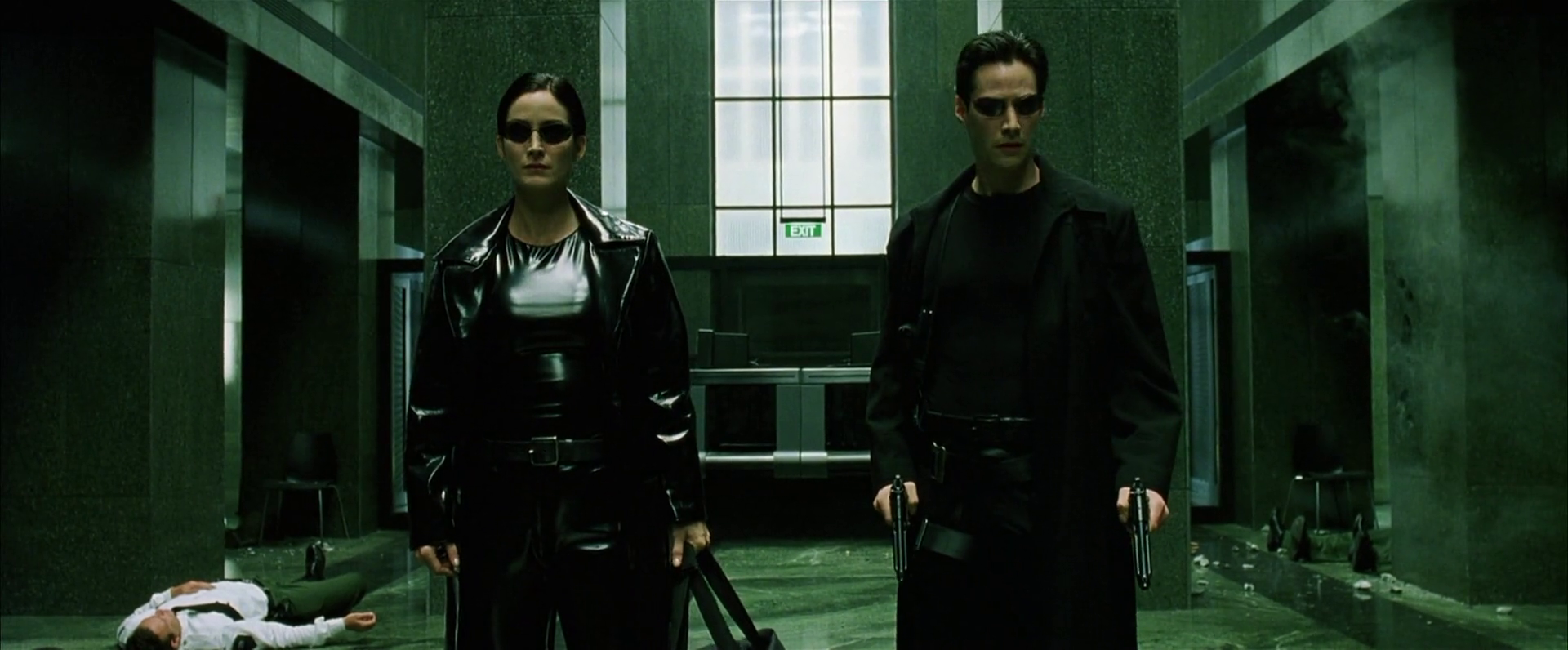
The ultimate representation of Neo’s Oedipal dilemma is the motherly oracle’s announcement in the kitchen that Neo may have to kill the fatherly Morpheus to survive. It is then translated into “death drive” in the mortal threats of Agent Smith who is frustrated with civilization as such. This “death drive” in turn authorizes Neo and Trinity to become ruthless killers in defiance of the foretold Oedipal dilemma, becoming the pre-Oedipal agents of the matrixial capture (as seen in the image above).
In sum, the Matrix amounts to “My-tricks” of the proud boy to impress his (phallic) mother. The matrixial capture lets Neo imagine that he is getting rid of the judging paternal superego (Morpheus: “Don’t think; know!” “Don’t try; do!”) but the permissive maternal superego inevitably comes back through the back door of his ego construction.
This fantasy of the matrixial capture is openly revealed in the recent sequel The Matrix Resurrections (2021) in which Trinity is a mother with little children and Neo is practically competing against these siblings for their mothers’ attention [2]. The “chosen superhero” turns out to be a little boy who strives to complete his mother by becoming her imaginary phallus. This is why the “chosen superhero” is as inexistent as the woman, the sexual relationship and the big Other:
1) Woman does not exist: The girl in red dress is a matrixial construct.
2) There is no sexual relationship: What the oracle said to Trinity can never be revealed and Neo is apparently “not too bright” since he asks to hear it. He will only be able to “hear” that Trinity loved him under doubly impossible conditions: In a meta-dimension after he died.
3) There is no big Other: The world is a neural-interactive simulation.
4) There is no “chosen hero”: Neo’s “My-tricks” is just the side-effect of his matrixial capture; he is really “the son of the Other” (Thomas Andere-son) which makes him truly Neo (new).
In conclusion, the whole purpose of the film’s glorious fanfare and fireworks is to repress and disavow that the mother does not have a penis. The story echoes the following eternal questions:
1) How can any phallus be worthy unless it belongs to the phallic mother? This is the fate of Agent Smith who falls out of favor after the golden boy arrives.
2) How can a phallus be unworthy when it “really” belongs to her? This is what lets Trinity resurrect Neo by a meta-kiss after he got killed by Agent Smith.
What Morpheus reveals to Neo is merely the “truth about truth”: “You are her penis!” But what “really” holds is the “true truth” that the mother does not have a penis [3]:
Don’t talk to me about women’s secondary sexual characteristics because, barring some sort of radical change, it is those of the mother that take precedence in her. Nothing distinguishes woman as a sexed being other than her sexual organ (sexe). (Lacan, Seminar 20)
.
Işık Barış Fidaner is a computer scientist with a PhD from Boğaziçi University, İstanbul. Admin of Yersiz Şeyler, Editor of Žižekian Analysis, Curator of Görce Writings. Twitter: @BarisFidaner
Notes:
[1] See “The Perverse Core of Labor-Power: Making Oneself Used”
[2] See “Blue Pill or Red Pill: Masturbate or Master-bait”
[3] See “The meaningless signification of the true truth”
motherator: maternal superego incarnated as fake democracy


[…] — The Matrixial Capture: What is the Matrix? It is My-tricks! […]
LikeLike
[…] [2] Bkz “Arzu ile Arıza”, “Yetki, Beden, İrade, Sistem, Arzu, Arıza ve Koronavirüs”, “Networking and Wetworking”, “The Matrixial Capture: What is the Matrix? It is My-tricks!” […]
LikeLike
[…] [4] Bkz “Blue Pill or Red Pill: Masturbate or Master-bait”, “The Matrixial Capture: What is the Matrix? It is My-tricks!” […]
LikeLike
[…] Bkz “The Matrixial Capture: What is the Matrix? It is My-tricks!”, “Gelin Artık Şu Erillik Yasağını Kaldıralım”, “Medyada İçeriğin […]
LikeLike
[…] 2) The Matrixial Capture: What is the Matrix? It is My-tricks! […]
LikeLike