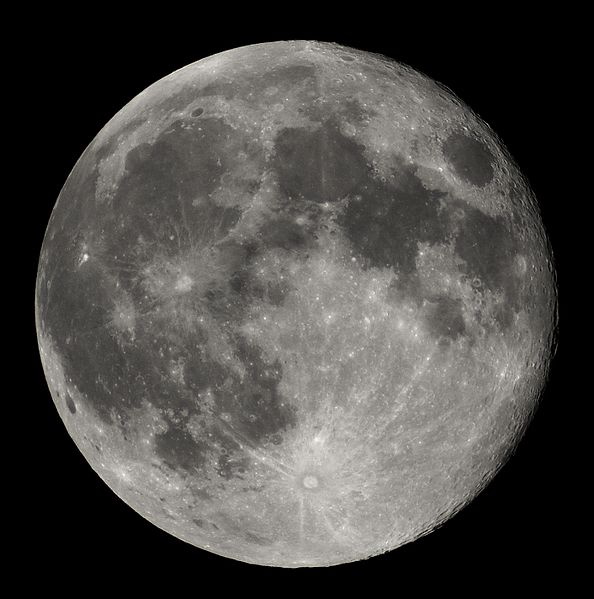
An impressive miracle told in Quran is the splitting of the Moon:
The zero hour is coming and the Moon has split. When they see a sign they turn away and say “This magic is just a cliché!” They always disavowed and followed their enjoyment. Everything gets decided. (al-Qamar 1-3)
A NASA official explained the imaginary character of this miracle as follows:
No current scientific evidence reports that the Moon was split into two (or more) parts and then reassembled at any point in the past. (Brad Bailey, NASA Lunar Science Institute, 2010)
Yet disclosing the split in the Moon is like how Lacan reveals that the human is naked:
If I do say “The king is naked,” it is not in the same way as the child who is supposed to have exposed the universal illusion, but more in the manner of Alphonse Allais, who gathered a crowd around him by announcing in a sonorous voice, “How shocking! Look at that woman! Beneath her dress she’s stark naked!” (Seminar 7)
So the splitting of the Moon is like the splitting of the Ego (Spaltung); even when it hides behind an appearance of wholeness, the moon is split, it is wounded for us humans since the year dot. The NASA official looking from the Earth cannot see the seams on the Moon because the curve that separates its face and its dark side is the very curve that encircles the Full Moon and gives it the semblance of wholeness, since the Moon’s rotation around itself and its rotation around the Earth are in synch.
To find the link between the naked woman in dress and the Moon’s orbital synch let’s turn to the Buffy episode “Phases” (S02E15). Willow has learned that her lover Oz, despite being a sweet man, is also a monster who turns into a werewolf in the nights of Full Moon. The gentle werewolf responds to this complication: “Maybe it’d be best if I just stayed out of your way for a while.” Willow answers:
Willow: Well… I like you. You’re nice and you’re funny. And you don’t smoke. Yeah, okay, werewolf, that’s not all the time. I mean three days out of the month, I’m not much fun to be around either.
Years later when the werewolf defies his control, Oz mentions the split between “Me and It” (Ego and Id) (S04E06, “Wild at Heart”):
Oz: The wolf is inside me all the time, and I don’t know where that line is anymore between me and it. And until I figure out what that means, I shouldn’t be around you… Or anybody.
In this scenario three splits overlap and form a synchronous orbit:
1) Willow as fun and not fun
2) Oz as man and werewolf
3) Woman and man
The split in the Moon is both the synch between the Moon and the Earth, the synch between the natural sea tides and the humans’ tides of desire, and also the synch of these two (“or more”) synchs. We can distinguish three concepts by looking at the split in the Moon:
1) The face of the Moon: Scope
2) The dark side of the Moon: Cache
3) The split/wound in the Moon: Context
These three concepts distinguish the three meanings of Hegelian Aufhebung (sublation):
1) Scope is conservation.
2) Cache is cancellation.
3) Context is updating (sublimation).
(Turkish)
Işık Barış Fidaner is a computer scientist with a PhD from Boğaziçi University, İstanbul. Admin of Yersiz Şeyler, Editor of Žižekian Analysis, Curator of Görce Writings. Twitter: @BarisFidaner


[…] (İngilizcesi) […]
LikeLike
[…] [2] See “The Moon is Split: Scope, Cache, Context” […]
LikeLike
[…] — The Moon is Split: Scope, Cache, Context […]
LikeLike
[…] Bkz “The Moon is Split: Scope, Cache, Context”, “Kainatın Ufkunu Kaplayan Gürültü: Yadigar Südur”, “Simgesel Dünyanın Zarı: […]
LikeLike