🦋🤖 Robo-Spun by IBF 🦋🤖
🎭♟️🕹️ Kukla Rejimi 🎭♟️🕹️
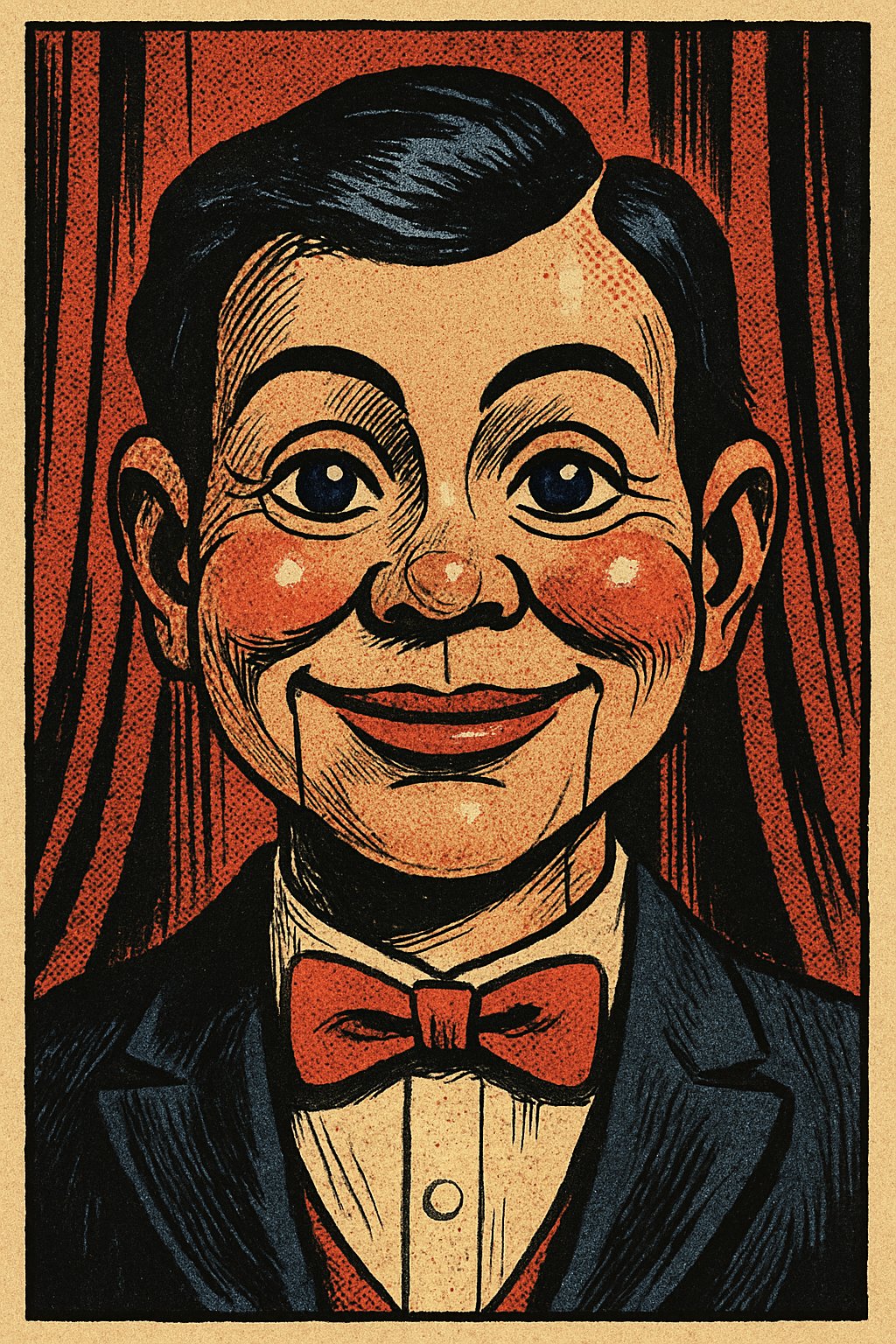
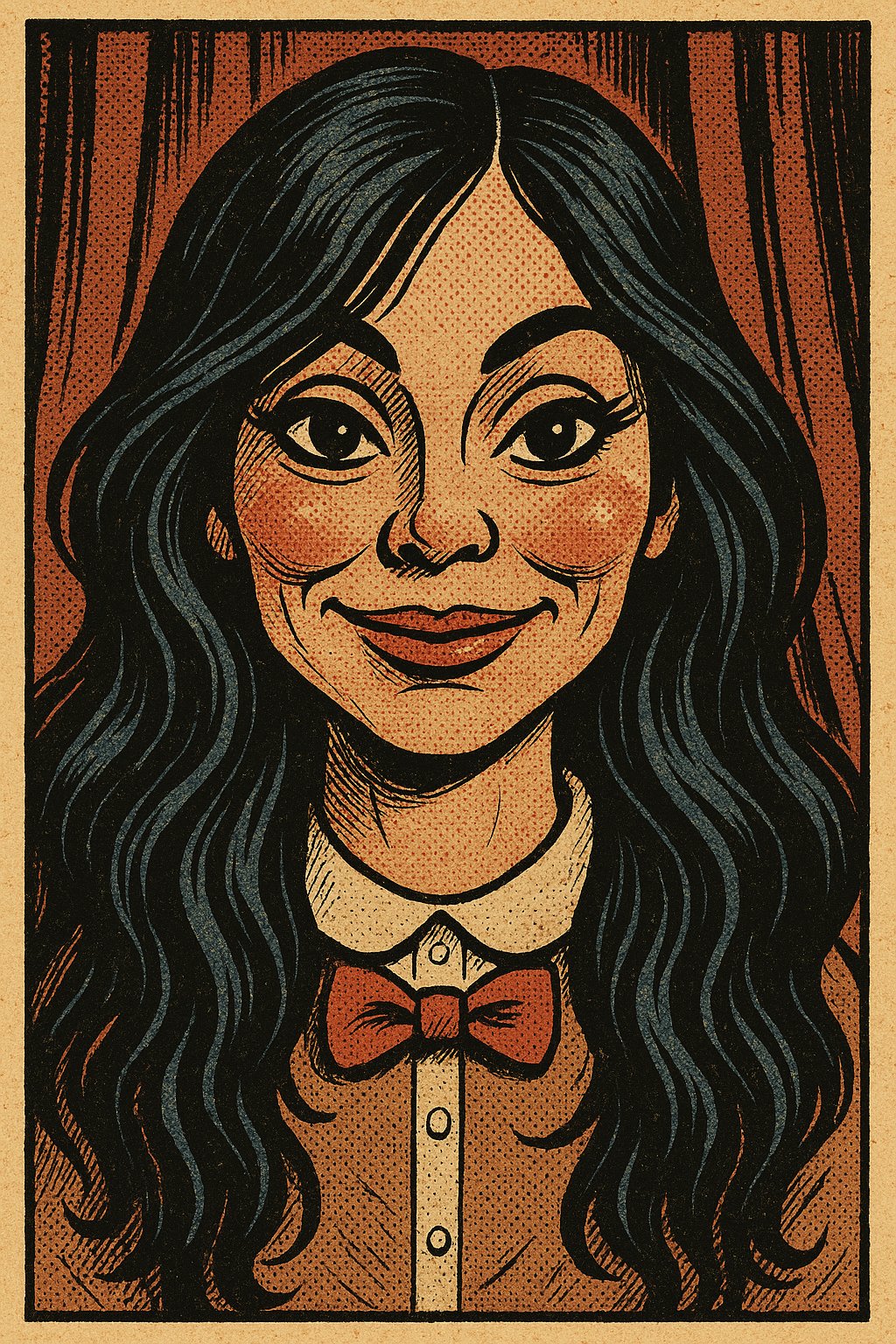
(Plastik Totemler: Tüketim Toplumunun Silikon Maskeli Ayinleri, Plastik Totem Kuklaların Gölgesinde)
Introduction
In an age of image saturation and “algorithmic beauty,” the modern celebrity often functions as a plastic totem – a synthetic idol meticulously crafted in both body and persona, worshipped by the masses. This essay undertakes an interdisciplinary investigation of this concept, examining how Turkish and American actors and actresses from the 1970s to today have become symbolic constructs within consumer culture. These public figures are not merely performers; they are curated icons shaped through cosmetic interventions, media-driven mythologies, and digital amplification. We explore the literal and symbolic dimensions of “plasticity” – from cosmetic surgery and Botox-induced emotional flattening to Instagram filters and simulated “authenticity.” We also analyze the totemic nature of celebrity, wherein certain stars are culturally elevated to a semi-divine status, their images serving as collective ideals or fetishes. Discrepancies between the real biographical self and the hyper-curated public identity will be probed, treating the celebrity’s face and body as ideological surfaces onto which societal values (youth, desirability, perfection, immortality) are projected. Using examples of iconic actresses across generations in Turkey (e.g. Türkan Şoray vs. Hande Erçel) and in the U.S. (e.g. Farrah Fawcett vs. Kim Kardashian), we conduct “character biopsies” of each figure’s career and visual evolution. Psychoanalytic concepts from Freud, Lacan, and Žižek will provide a critical framework – from Freud’s notion of totemic libidinal projection, to Lacan’s ideas of the mirror-stage and the gaze, to Žižek’s theory of fantasy, ideology, and the obscene underside of public facades. In doing so, we interrogate how media icons embody the “plastic totem” phenomenon and what this means for individuality and desire in our society.
Theoretical Framework: From Totems to Instagram Faces
To ground our analysis, we must first clarify what we mean by “plastic totem.” In classical anthropology and Freud’s writings, a totem is an object or being revered as the emblem of a group, often imbued with sacred significance. Sigmund Freud in Totem and Taboo noted how members of a clan identify with a totemic animal or figure, projecting onto it their shared values and even libidinal energies (unconscious desires) (The Fundamentals of Celebrity Worship – Amratha Lekshmi A J – Doing Sociology). In modern secular society, celebrities arguably fulfill a similar totemic role. They are “collective representations” of cultural ideals (link), simultaneously material (a flesh-and-blood person, or nowadays a digital image) and symbolic. The sociologist Jeffrey C. Alexander describes the “celebrity-icon” as a powerful material symbol that commands attention through a compelling surface aesthetic, while carrying deeper mythic meanings of the sacred and profane (link) (link). In other words, like traditional totems, celebrities have a dual structure: an alluring surface and a resonant depth of meaning (link).
Plasticity in this context has a double meaning. Literally, it refers to the malleability of the body through plastic surgery and cosmetic enhancement. Symbolically, it points to the pliability of identity and image in a media-saturated era. The iconic French critic Roland Barthes famously described the face of film goddess Greta Garbo as “an absolute mask…whose snowy thickness gives her a totem-like countenance” (link). Here Barthes was observing how heavy studio makeup turned Garbo’s face into a perfect, almost inhuman mask – “set in plaster, protected by the surface of color” (link) – elevating her features to an otherworldly, statue-like ideal. Garbo was even called “La Divine,” thought to have a “deified face, a sacred visage…descended from Heaven” (link). This captures the essence of the totem-figure: a human turned into an icon, with a face “set in stone” like a carved idol, signifying something beyond itself.
In the contemporary era, the “plaster” of studio makeup has been joined by surgical modifications and digital filters. We see the rise of what Jia Tolentino and others have called the “Instagram Face” – a strikingly uniform look created by cosmetic fillers, Photoshop, and FaceTune, producing “a single, cyborgian look” that seems “almost like a 3-D rendition of a human”, with “poreless, light-reflecting skin, cat-like eyes, an imperceptible nose, and pillowy lips” (You Look Familiar — “Instagram Face” and the Deracialization of Beauty). This manufactured visage is “Cyborgian. Feline. Like a Bratz doll”, essentially a composite beauty ideal that transcends ethnic specificities in favor of a plastic homogeneity (You Look Familiar — “Instagram Face” and the Deracialization of Beauty). Social media bombards us with an “army of these faces” (You Look Familiar — “Instagram Face” and the Deracialization of Beauty). Such phenomena illustrate the literal plasticity of the celebrity image – faces and bodies engineered to fit a fantasy archetype.
From a psychoanalytic perspective, these polished images serve as screens for projection and identification. Lacan’s concept of the mirror stage is relevant here: just as an infant forms its ego by identifying with a mirror image (an idealized, coherent version of itself), audiences form aspects of their identity by identifying with celebrity images. A fan might see in a star a reflection of their own aspirational self – an ideal ego. The celebrity, like the mirror, presents a seemingly flawless vision to emulate. This identificatory process is underwritten by what Lacan calls the Big Other – the symbolic order of societal norms and expectations. Celebrities epitomize what the Big Other holds as desirable (e.g. youth, beauty, success); they both embody and reinforce societal ideals. In turn, individuals seeking validation in the eyes of the Big Other often mimic celebrity styles or behaviors, effectively using the celebrity as a guide to what is “acceptable” or “admired.” This dynamic can lead to a feedback loop: media icons shape public desire, which then pressures individuals (including the stars themselves) to conform to those idealized images.
Freud’s idea of libidinal projection comes into play as well – the public invests emotional and libidinal energy into celebrities, much as a tribe might invest sacred sentiment in a totem. Fans experience erotic desire, admiration, envy, even hatred towards these figures, often disproportionate to any real interaction. The celebrity becomes a repository for projections: they carry the fantasies of millions. Some serve as sex symbols, onto whom collective erotic fantasies are mapped (e.g. Farrah Fawcett’s poster as the sex goddess of the 1970s (The Story Behind Farrah Fawcett’s Iconic 1976 Swimsuit Poster), or the Kardashian-Jenner clan embodying exaggerated hourglass sexuality in the 2010s). Others become aspirational totems of glamor, wealth, or talent that people worship or imitate in daily life (from hairstyles and fashion to lifestyle choices).
Crucially, there is often a split between the “surface” persona and the private “depth” of these individuals. Alexander notes that compelling celebrity-icons operate by “the interplay of surface and depth”, with a “sensuous surface” that draws us in, and a mythic depth that we, the audience, imbue with sacred or profane meanings (link). However, this depth is frequently a projection; the actual person behind the mask may be quite different. Slavoj Žižek’s theories help us interrogate this split. Žižek suggests that social life is sustained by ideological fantasies – collectively maintained illusions that cover over uncomfortable truths. Celebrities are central to such fantasies. On the surface, they represent fantasies of perfection and enjoyment (the perfect body, the dream lifestyle, endless youth). But Žižek would point to the obscene underside behind these glossy appearances – the hidden costs, anxieties, and excesses that are repressed from the public narrative (link) (link). For instance, a star may publicly project effortless beauty and happiness while privately enduring grueling beauty regimens, psychological pressure, or exploitation. The public, on some level, “knows” there is artifice and struggle behind the facade (just as we know photos are airbrushed and that “reality” TV is often staged), yet the ideological fantasy persists because it fulfills a psychological need. Žižek terms this cynical acknowledgement without effect “knowingness” – “we know it’s fake, but we enjoy it all the same.” Thus, celebrity culture is an ideological apparatus that encourages people to desire unreal ideals, while simultaneously normalizing the means (however artificial or costly) to achieve them.
In summary, the “plastic totem” encapsulates a convergence of these threads: it is “plastic” in being artificially constructed and endlessly malleable, and a “totem” in being a fetishized emblem for collective desire and identity. With this framework in mind, we can analyze specific celebrity case studies to see how these dynamics unfold in the Turkish and American contexts, and how they have evolved from the 1970s to the present.
Cosmetic Culture: From Secret Surgeries to Instagram Lives
Before diving into individual careers, it is useful to sketch the changing landscape of cosmetic enhancement in celebrity culture on both sides of the Atlantic. In the 1970s, plastic surgery in Hollywood or other entertainment industries was shrouded in secrecy. Procedures like nose jobs or face lifts were undertaken quietly; stars maintained an illusion of “natural” beauty even if some surgical help was involved. In Turkey’s Yeşilçam film industry (the classic era of Turkish cinema in the 1960s–70s), overt cosmetic surgery was less common due to limited medical availability and different beauty norms, though as we will see, even some revered “natural” beauties of that era had surgical enhancements which only later came to light. Generally, however, ageing was still visible in the 1970s–80s stars, and drastic transformations were rarer.
By the 1980s and 1990s, cosmetic interventions became more widespread and somewhat less taboo in the U.S. The rise of the Hollywood blockbuster and global media meant increasing pressure on actresses to maintain youthful looks. Breast augmentation boomed by the 1980s (epitomized by Playboy models and stars like Pamela Anderson making the curvaceous, surgically enhanced body a pop culture fixture in the ’90s). In the 2000s, reality TV and paparazzi culture further eroded the privacy around beauty work. Tabloids speculated openly on who “had work done.” By the 2010s, with social media and high-definition everything, cosmetic procedures became almost routine for public figures – not only women but men as well. Botox injections, fillers, laser treatments, and even surgical operations turned into just another part of celebrity maintenance, often discussed in magazines under euphemisms like “anti-aging routine” or “refreshing one’s look.” The stigma of plastic surgery diminished; some celebrities began to admit to certain procedures (for example, Kim Kardashian allowed a reality-TV episode of Keeping Up with the Kardashians to show her getting Botox in 2010) (Everything the Kardashian-Jenners have said about plastic surgery – Los Angeles Times). Nonetheless, an interesting contradiction remained: stars would undergo extensive changes but publicly claim “minimal work.” The Kardashian-Jenners, for instance, have often minimized their surgical interventions – Kim insisting she never had a nose job and only “a little Botox” (Everything the Kardashian-Jenners have said about plastic surgery – Los Angeles Times), or Kylie Jenner denying other facial surgeries beyond lip fillers (despite obvious changes) (Everything the Kardashian-Jenners have said about plastic surgery – Los Angeles Times) (Everything the Kardashian-Jenners have said about plastic surgery – Los Angeles Times). This gaslighting of the public (as fans cynically call it) is part of maintaining the fantasy of natural-born perfection even as the reality is technologically engineered (Kim’s Face Over the Years : r/KUWTKsnark) (Kim’s Face Over the Years : r/KUWTKsnark).
In Turkey, the 1990s–2000s saw a similar trend on a smaller scale. As Turkey’s television industry boomed and Western beauty ideals entered via global media, more Turkish actors and especially actresses began to turn to cosmetic procedures. Still, the matter was kept discreet. Public figures in a conservative society faced a delicate balance: beauty is prized, but admitting surgery could invite moralistic criticism or claims of vanity. By the 2010s, however, Turkish social media influencers and TV stars also openly embraced procedures. The “Instagram face” phenomenon is as global in Istanbul as in Los Angeles – evidenced by countless Turkish influencers sporting identical high-arched eyebrows, sculpted noses, pouty lips, and contoured jawlines. Notably, Turkey has become a world capital of plastic surgery tourism (especially for hair transplants and nose jobs), which normalized the culture of cosmetic alteration domestically. It’s telling that even a traditionally conservative talk-show host recently quipped on air that “Botox is as common as tea” these days in Istanbul’s high society. While that might be exaggeration, it reflects a reality: cosmetic intervention has been normalized as a form of self-care or career investment for celebrities.
We must also acknowledge the digital dimension – “digital plasticity.” Even without a scalpel, celebrities today routinely edit their own images (smoothing skin, slimming waists, enlarging eyes) before posting to millions of followers. This creates a hyper-real beauty that blurs the line between the real and the virtual. There is a constant race for stars to one-up their own perfection, either through physical procedures or digital post-production. The result is an increasingly unattainable standard that in turn drives ordinary people to filters or surgery – a cycle of manufactured desire.
Yet, as cosmetic enhancement became omnipresent, a counter-discourse of “authenticity” also emerged. In the 2020s we see some veteran celebrities pushing back against the beauty-industrial complex. For example, Pamela Anderson in 2023–24 has received media praise for going makeup-free at events, openly declaring “Anti-aging is a lie… We’re getting older no matter what. Things change, and you have to find humor in it” (Pamela Anderson, 56, Says ‘Anti-Aging Is a Lie’) (Pamela Anderson, 56, Says ‘Anti-Aging Is a Lie’). Anderson, once the poster-child of bombshell artificiality (with bleached hair, implants, heavy makeup), now in her mid-50s critiques the very notion of chasing eternal youth, saying she prefers to “embrace the changes” in her face rather than fill and freeze them (Pamela Anderson, 56, Says ‘Anti-Aging Is a Lie’) (Pamela Anderson, 56, Says ‘Anti-Aging Is a Lie’). Similarly, a few other stars have begun to speak about reducing or undoing past procedures (e.g. Courtney Cox admitted she dissolved some facial fillers after realizing she’d overdone them; certain Turkish actresses have quietly eased off extreme treatments as well). These developments highlight a growing awareness of the personal toll of maintaining the plastic-fantasy image.
Despite such moments of candor, the overarching trend in both Hollywood and the Turkish TV industry remains a relentless pursuit of youth and perfection. As one cultural critic wryly observed, “Actresses cannot age if they are to be beautiful. Actors, if they are to remain heroes, cannot become fat or gay” (link) – a blunt summary of the unwritten rules governing celebrity images. Aging, weight gain, or deviation from heteronormative desirability are treated as “unforgivable degradations of the surface form” (link) in mainstream media narratives. Thus, the ideology of eternal youth and desirability drives the continuous “plasticization” of celebrities, be it via surgery, dieting, or digital alteration. They must become living dolls, in a sense, if they wish to stay atop the totem pole of fame. And so far, the industries and audiences largely demand exactly that.
With this context set, we can more deeply examine specific case studies of iconic figures, to see how each illustrates facets of the plastic totem phenomenon – comparing across generations and cultures to reveal both parallels and unique local inflections.
Turkish Icons: From Yeşilçam’s Sultan to Instagram’s Princess
Türkan Şoray: The Natural Beauty as National Totem (and the Hidden Artifice)
Few figures loom as large in Turkish popular culture as Türkan Şoray, often nicknamed “Türkan Sultan” (Sultan of Turkish Cinema). Rising to fame in the early 1960s, Şoray became the most recognizable film star in Turkey for over 50 years (Türkan Şoray: The woman in the red scarf | Daily Sabah ), with over 200 films to her credit. In the Yeşilçam era (Turkey’s answer to Hollywood’s golden age), she was revered not only for her acting and on-screen persona but for her extraordinary beauty and dignified demeanor. Public surveys in Turkey have found that virtually everyone, from grandmothers to young people, knows her name (Türkan Şoray: The woman in the red scarf | Daily Sabah ). In her prime decades (’60s–’70s), Şoray symbolized the ideal Turkish woman – graceful, modest, yet strong. She often portrayed virtuous characters (peasants, self-sacrificing lovers, devoted mothers), tapping into archetypes that resonated deeply with the public (Türkan Şoray: The woman in the red scarf | Daily Sabah ). The totemic status of Şoray is evident in the way people bestowed upon her a royal epithet (“Sultan”) and even today speak of her with an almost saintly reverence. In sociological terms, she became a unifying symbol in Turkish society, a face that represented the nation’s cinematic dreams and values during a period of rapid modernization.
On the surface, Türkan Şoray’s image was that of untouched, God-given beauty. She had large, expressive eyes (immortalized in the term “Şoray’s eyes”), a delicate face, and an enchanting screen presence. In an era before aggressive cosmetic procedures, her fans assumed her look was entirely natural. Şoray famously even had a set of self-imposed rules (the “Türkan Şoray Laws”) for what she would not do on film – for example, no kissing or nudity – to maintain a chaste, “pure” image in line with conservative expectations. This careful curation of her persona enhanced her totemic aura: she was elevated as a morally impeccable star, almost like a goddess of the silver screen who transcended the tawdriness of physical desires. The cultural elevation of Şoray had a quasi-religious flavor; film posters and photographs of her were treated by some fans almost like icons to be adored in the home.
However, beneath the mythology of her “natural” perfection, an intriguing truth emerged decades later: Türkan Şoray herself underwent significant cosmetic enhancements early in her career, helping to craft the very image that appeared so natural. A recent analysis by Turkish media (drawing on an Instagram account that archives old celebrity photos and insider info) revealed that Şoray had multiple plastic surgeries in the 1960s and ’70s while rising to stardom (Geçmişinden Kaçamaz İnsan: Türkan Şoray’ın Estetik Müdahalelerle Değişip Sultan Olma Sürecini İnceliyoruz) (Geçmişinden Kaçamaz İnsan: Türkan Şoray’ın Estetik Müdahalelerle Değişip Sultan Olma Sürecini İnceliyoruz). According to these reports, she had “not one but two rhinoplasties” (nose jobs) to refine her nose into the petite, “hokkacık” form that audiences came to adore (Geçmişinden Kaçamaz İnsan: Türkan Şoray’ın Estetik Müdahalelerle Değişip Sultan Olma Sürecini İnceliyoruz). Additionally, she received a chin implant to strengthen and sharpen her jawline, and even eyelid operations to enhance her eyes (Geçmişinden Kaçamaz İnsan: Türkan Şoray’ın Estetik Müdahalelerle Değişip Sultan Olma Sürecini İnceliyoruz). Over the years, she reportedly also indulged in Botox and fillers (once those became available), including “under-eye bag removal, lip filler (in earlier decades, silicone-based), and cheek implants” (Geçmişinden Kaçamaz İnsan: Türkan Şoray’ın Estetik Müdahalelerle Değişip Sultan Olma Sürecini İnceliyoruz). In short, the “natural beauty” was in part a carefully constructed artifice, albeit one skillfully done and kept secret in that era. This revelation, coming from a 2024 retrospective titled “Geçmişinden Kaçamaz İnsan” (“One cannot escape one’s past”), cheekily frames Şoray as actually an “öncü” – a pioneer – of the very “esthetic craze” that people assume is a recent phenomenon (Geçmişinden Kaçamaz İnsan: Türkan Şoray’ın Estetik Müdahalelerle Değişip Sultan Olma Sürecini İnceliyoruz). As the article notes, “today, we harshly criticize the esthetic surgery frenzy, but our esteemed artist Türkan Şoray was in fact a member of it – perhaps even one of its forerunners!” (Geçmişinden Kaçamaz İnsan: Türkan Şoray’ın Estetik Müdahalelerle Değişip Sultan Olma Sürecini İnceliyoruz).
This ironic twist enriches our understanding of the plastic totem concept. Şoray’s surface – those iconic eyes, nose, face shape – was engineered to fit a certain ideal of feminine beauty of her time, and that surface became the basis of a profound depth of meaning for Turkish society. People projected values onto her: traditional beauty, purity, grace. She became a totem of national cinema – indeed one scholar called her and her contemporaries the “four-leaf clover” (dört yapraklı yonca) of Yeşilçam, signifying how cherished they were (Geçmişinden Kaçamaz İnsan: Türkan Şoray’ın Estetik Müdahalelerle Değişip Sultan Olma Sürecini İnceliyoruz) (Geçmişinden Kaçamaz İnsan: Türkan Şoray’ın Estetik Müdahalelerle Değişip Sultan Olma Sürecini İnceliyoruz). The fact that she did alter her physical form doesn’t diminish the sincerity of audience admiration, but it reveals how the myth of the inborn goddess was sustained by hiding the labor (and surgery) behind the image. This hiding is itself telling: it underscores a key ideological function of celebrity totems – they must seem naturally extraordinary, as if fated to be above ordinary mortals. Any hint of human effort (be it plastic surgery, intense training, or even ambition) is often downplayed to preserve the magical aura.
Despite these procedures, Türkan Şoray did age over time, and interestingly, she chose to age in a relatively dignified, gradual way compared to some later stars. In recent public appearances in her 70s, she looks like an elegant older version of herself – clearly having used some cosmetic maintenance (hair dye, possible light facelifts or skin treatments), but not transforming beyond recognition. The Turkish public still sees her as “Sultan Türkan,” and she remains an object of affection across generations. Her legacy as a totem is so strong that it withstands the wrinkles and weight of years – arguably an example of a celebrity-icon whose depth of cultural symbolism outlasted the youthful surface. In psychoanalytic terms, she became, for many Turks, an “ideal mother” or “ideal beloved” figure, tied to nostalgia for a perceived simpler, purer time. That collective fantasy endures, even as the reality (the living person with her pains and changes) inevitably diverges from the image frozen on old film.
(Geçmişinden Kaçamaz İnsan: Türkan Şoray’ın Estetik Müdahalelerle Değişip Sultan Olma Sürecini İnceliyoruz) Figure: A comparative look at Türkan Şoray’s visage in early youth (left) versus in her prime after becoming Turkey’s “Sultan of Cinema” (right). On the left, we see a fresh-faced teenage Şoray in the early 1960s – her nose broader, chin softer, and appearance that of a pretty but ordinary young woman. On the right, a publicity photo from the late 1970s shows the metamorphosis: the narrow nose, sculpted jawline, and dramatically enhanced eyes that became her signature. This transformation was achieved through subtle plastic surgeries kept secret at the time, aligning her features with the era’s ideals. The result was an image of almost unreal perfection – a face that millions came to idolize as the embodiment of Turkish beauty (Geçmişinden Kaçamaz İnsan: Türkan Şoray’ın Estetik Müdahalelerle Değişip Sultan Olma Sürecini İnceliyoruz) (Geçmişinden Kaçamaz İnsan: Türkan Şoray’ın Estetik Müdahalelerle Değişip Sultan Olma Sürecini İnceliyoruz).
Şoray’s story thus epitomizes the paradox of the plastic totem: she was enshrined as an untouchable icon (even her own colleagues and the press treated her with a deferential air), yet her iconic face was literally “crafted” by human hands. The ideology of appearance demanded she embody perfection effortlessly, while the reality required artifice. This dynamic, as we will see, repeats in varying forms with other stars.
Hande Erçel: The Insta-Starlet and Engineered Perfection
If Türkan Şoray represents the old-guard totem in Turkey, Hande Erçel might be seen as a contemporary plastic totem for the Instagram age. Born in 1993, Erçel rose to fame in the mid-2010s through popular TV dramas (Güneşin Kızları, Aşk Laftan Anlamaz, etc.) and soon became one of Turkey’s most followed celebrities on social media. With over 30 million Instagram followers, she is often cited as one of the most recognized Turkish actresses globally among the younger generation. Erçel’s appeal has much to do with her looks: she is frequently dubbed a “modern beauty icon” and has been the face of various beauty brands. However, unlike Şoray’s carefully veiled enhancements, Hande Erçel’s evolving face has been a matter of public chatter in real time, as fans tracked her changing appearance from her debut to now. Erçel provides a telling case of how millennial starlets actively use cosmetic procedures and social media curation to construct a marketable persona – essentially crafting themselves into living dolls that the public adores and consumes.
Early in her career (around 2014–2015 when she won a local beauty pageant and got her first acting roles), Hande Erçel had a round, cute face with full cheeks, a slightly wide nose, and a youthful softness. She was attractive, but in an ordinary way. Over the next few years – and especially as her fame skyrocketed – observers noticed dramatic changes. By the late 2010s, Erçel’s cheekbones appeared far more pronounced, her jawline more tapered, her nose slimmer, and her eyes subtly lifted at the corners. The rumors were confirmed by investigative Turkish media: Erçel indeed underwent a suite of cosmetic procedures to achieve what one writer called “a completely different person over the years, a beauty legendary in tales” (Bişektominin Kraliçesi: Tombul Yanaklarına Veda Eden Hande Erçel’in Tüm Estetiklerini İnceliyoruz!). Specifically, she is said to have had buccal fat removal (bişektomi) to remove her chubby cheeks – giving her that sculpted “Hollywood standard” V-shaped face (Bişektominin Kraliçesi: Tombul Yanaklarına Veda Eden Hande Erçel’in Tüm Estetiklerini İnceliyoruz!). She also got masseter Botox to slim the jaw by relaxing the jaw muscles (Bişektominin Kraliçesi: Tombul Yanaklarına Veda Eden Hande Erçel’in Tüm Estetiklerini İnceliyoruz!). Her eyes were altered via the so-called “fox eye” surgery (locally termed badem göz estetiği), pulling the outer eye corners upward for a more almond-like, cat-eye appearance (Bişektominin Kraliçesi: Tombul Yanaklarına Veda Eden Hande Erçel’in Tüm Estetiklerini İnceliyoruz!). Furthermore, Hande Erçel received the now-routine package of fillers – in her cheeks, chin, and lips – to add volume and definition in line with Instagram beauty trends (Bişektominin Kraliçesi: Tombul Yanaklarına Veda Eden Hande Erçel’in Tüm Estetiklerini İnceliyoruz!). Unconfirmed but widely speculated are a rhinoplasty (her nose tip looks more refined than in early photos) and even a breast augmentation around 2021 (fans compared red-carpet photos and noticed a sudden increase in bust size, which magazines discussed) (Bişektominin Kraliçesi: Tombul Yanaklarına Veda Eden Hande Erçel’in Tüm Estetiklerini İnceliyoruz!). In sum, Erçel consciously sculpted herself into the archetype of the modern influencer-actress: slim face, big eyes, small nose, plush lips, balanced proportions – the “ideal” composite that social media rewards.
Crucially, Hande Erçel, like many in her generation, has been quite guarded or coy about these changes. When asked about her beauty regimen in an interview, she gave credit to simple habits like using ice masks and staying clean, claiming “I’m not someone who fusses too much over herself” (Bişektominin Kraliçesi: Tombul Yanaklarına Veda Eden Hande Erçel’in Tüm Estetiklerini İnceliyoruz!) (Bişektominin Kraliçesi: Tombul Yanaklarına Veda Eden Hande Erçel’in Tüm Estetiklerini İnceliyoruz!). The article that quotes this immediately wryly notes: “it’s an undeniable fact that esthetic procedures played a big part in this change” (Bişektominin Kraliçesi: Tombul Yanaklarına Veda Eden Hande Erçel’in Tüm Estetiklerini İnceliyoruz!) (Bişektominin Kraliçesi: Tombul Yanaklarına Veda Eden Hande Erçel’in Tüm Estetiklerini İnceliyoruz!). Indeed, side-by-side comparisons of Erçel from a few years apart show striking differences that ice masks alone cannot account for. Yet, her demurral is part of the performance of authenticity that today’s celebrities must manage. Fans simultaneously consume her carefully curated Instagram photos (where she looks flawless at all times) and want to believe she’s still a down-to-earth, naturally blessed girl. This requires a delicate balance of admitting to minor interventions (she eventually acknowledged using lip fillers, as it was too obvious to deny) but denying major surgery – a microcosm of the larger “reality vs. fantasy” tension in her public identity.
(Bişektominin Kraliçesi: Tombul Yanaklarına Veda Eden Hande Erçel’in Tüm Estetiklerini İnceliyoruz!) Figure: The transformation of Hande Erçel’s face over about a decade, captured in a before-and-after composite. On the left, Erçel in her late teens/early 20s (circa 2012–2014) has a round face, fuller cheeks, and a broader nose. On the right, Erçel by the mid-2020s showcases the sculpted, “Instagram-approved” look – high cheekbones, slim jaw, fox-like eyes, and refined nose. These changes align with specific cosmetic procedures: buccal fat removal and jaw botox to narrow the face, “fox eye” lifts for the cat-eye effect, and likely rhinoplasty and fillers for the nose and lips (Bişektominin Kraliçesi: Tombul Yanaklarına Veda Eden Hande Erçel’in Tüm Estetiklerini İnceliyoruz!) (Bişektominin Kraliçesi: Tombul Yanaklarına Veda Eden Hande Erçel’in Tüm Estetiklerini İnceliyoruz!). The overall effect is a more mature, striking beauty that conforms to globalized standards of glamour.
Hande Erçel’s case also highlights the amplifying effect of digital culture on the plastic totem dynamic. Unlike Şoray, whose films (and occasional magazine spreads) were the only vectors of her image, Erçel’s image is disseminated daily through Instagram posts and stories, magazine shoots, candid paparazzi snaps, and fan pages. She actively cultivates a personal brand – posting selfies, vacation photos, behind-the-scenes shots – to create a feeling of intimate accessibility for fans. Yet this accessibility is a simulacrum: every photo is likely filtered or selected from dozens of takes; every candid moment is part of an orchestrated feed aesthetic. In Lacanian terms, Erçel’s social media presence is a play with the gaze of the Other: she constantly presents herself anticipating the gaze of millions of followers, crafting angles and looks that will garner the most admiration (“likes”). She gazes back at her audience in posted images, but always in control of how she is seen. This is a shift from older star-fan dynamics where the star was more distant; now the star micro-manages her own objectification.
The totemic status of Hande Erçel among her young fans is evidenced by the fervent fan accounts and trends surrounding her. She has been voted “most beautiful woman in the world” in some online polls (driven largely by fan engagement). Her fans call themselves by special names and form online “fandoms” not unlike religious congregations (with arguments over her honor, elaborate birthday projects, etc.). They rally in her defense if she faces criticism – for instance, when some media outlets speculated she got surgeries, fans attacked those sources for “slandering” her. This behavior mirrors the way a community defends the sanctity of its totem or idol. At the same time, Erçel’s own relationship with her image underscores the commodification of the self: her face and body are her capital, and she invests in them (through cosmetic procedures, training, styling) to increase her brand value. She then monetizes that brand via sponsorships – from cosmetics to fashion lines – effectively becoming a human advertisement for the beauty standard she exemplifies. In Žižek’s perspective, she becomes part of the ideological loop encouraging consumers to “enjoy” themselves by chasing the same ideal – buying the makeup she wears, the clothes she models, or even undergoing similar cosmetic tweaks (there are documented cases of Turkish and international fans bringing Hande’s photo to surgeons to request her nose or eyes).
The discrepancy between Erçel’s real private self and the public persona is harder to gauge than with older stars, precisely because she lives so much of her life in public (by choice). One could say she has fully merged with her curated identity. Despite personal losses, her public persona remained tightly controlled—revealing how emotional narratives, when surfaced, may function as calculated humanization tactics within influencer aesthetics.
In comparing Türkan Şoray and Hande Erçel, we see in microcosm the evolution of the celebrity apparatus in Turkey: from the studio-system, semi-divine film goddess of Yeşilçam, whose image was static and idealized, to the interactive, surgically perfected social media star, whose image is constantly updated and co-created with her audience. Yet both are manifestations of the plastic totem phenomenon in their own ways. Both illustrate how beauty is cultivated as a cultural ideal – whether secretly by 20th-century studios or openly in 21st-century clinics – and how the resulting images are invested with extraordinary cultural importance.
American Icons: Hollywood Myths and Reality TV Avatars
Farrah Fawcett: America’s Angelic Totem and the Price of the Spotlight
In the United States, the late 1970s saw the ascendance of Farrah Fawcett as an icon whose image defined an era. Farrah’s megawatt smile and feathered blonde mane were everywhere in 1976–1977, thanks to her role on Charlie’s Angels and, perhaps even more, to a best-selling pin-up poster that reportedly sold over 12 million copies (The Story Behind Farrah Fawcett’s Iconic 1976 Swimsuit Poster) (Farrah Fawcett Recalls Iconic Swimsuit Poster in Newly Revealed Q&A: ‘Wish I’d Held My Stomach In!’). The poster – showing 29-year-old Farrah in a red one-piece swimsuit, beaming with healthy, sun-kissed beauty – became a cultural totem of 1970s America (Farrah Fawcett red swimsuit poster – Wikipedia) (Farrah Fawcett red swimsuit poster – Wikipedia). It embodied a wholesome yet sexy ideal: Farrah managed to be a sex symbol who radiated “ordinary” friendliness. As one article notes, the poster “showcased Fawcett’s wholesome beauty and sex appeal” and became “a defining feature of the 1970s” (The Story Behind Farrah Fawcett’s Iconic 1976 Swimsuit Poster). Young women mimicked her hairstyle en masse; young men (and quite a few women too) plastered her image on their walls like a personal goddess. This is a vivid example of totemic celebrity: Farrah’s image was literally enshrined in bedrooms and dorm rooms, a secular icon for private veneration.
From a psychoanalytic perspective, Farrah Fawcett in the late ’70s functioned as a screen for collective fantasies. She represented a kind of pure, unproblematic sexuality that America craved in the post-Vietnam, post-Watergate moment – a joyful, liberating symbol of fun and sunshine. Fans (especially men) projected their libidinal desires onto her (the phenomenon of her poster being a male rite-of-passage decor item speaks to that). Meanwhile, women could identify with her as an empowered yet feminine figure (she was fighting bad guys on TV, but never losing her femininity or charm). In Freudian terms, she was a love object and an ego ideal rolled into one, depending on the audience’s angle of approach.
Yet, the reality of Farrah Fawcett had more complexities than the static poster image suggested. She famously chafed against the constraints of Charlie’s Angels, leaving the hit show after one season despite it catapulting her to fame (Farrah Fawcett Recalls Iconic Swimsuit Poster in Newly Revealed Q&A: ‘Wish I’d Held My Stomach In!’). This move – essentially rejecting her totemic pedestal at the height of her glory – was shocking to the industry. Her shift to ‘serious’ roles signaled not an escape from image culture, but a recalibration—another aesthetic script offering legitimacy via gravitas. Farrah’s departure from Charlie’s Angels did not reject the aesthetic system but shifted its coordinates—seeking seriousness through another spectacle. Over time, Farrah pursued more serious acting (earning acclaim in the 1984 domestic abuse drama The Burning Bed), as if attempting to enrich the depth behind her famous surface.
Physically, Farrah Fawcett was regarded as a natural beauty in her youth – there was no indication she had any cosmetic surgery during her prime. But as she aged, the pressure to maintain her looks mounted. By the 1980s and ’90s, Farrah’s star had somewhat dimmed (as newer idols took over), yet she remained in the public eye. Reports suggest that by her late 50s, she had undergone cosmetic surgeries, some of which went awry. A 2006 New York Post article described Farrah at 59 having done “a substantial bout of cosmetic surgery to correct damage caused by previous operations”, including eyelid lifts and a mid-to-lower facelift (FARRAH’S ROAD FROM HAG TO FAB) (FARRAH’S ROAD FROM HAG TO FAB). The piece notes that two years prior, photographers caught her looking rough – “ill-defined lips, pinched nose and puffy cheeks” – likely from older procedures or aging, and that she then got a repair job done to restore a version of her former look (FARRAH’S ROAD FROM HAG TO FAB). Essentially, Farrah became an example of a star who, in later years, tried to chase her own iconic image, perhaps feeling the tragic pressure of being frozen in the public’s mind as a 29-year-old beach babe. This is a common arc for many celebrities: the idol becomes imprisoned by the idol’s image. When the flesh fails to live up to the poster on the wall, some turn to surgical measures to bridge the impossible gap. It’s telling that Farrah’s surgeries were framed as “face-saving” – literally saving face – to become “her stunning old self” again (FARRAH’S ROAD FROM HAG TO FAB). The language reveals the assumption that her older, aging face was a kind of betrayal of the “real” Farrah (the youthful one), and surgery was needed to “restore” the truth of the totem. This speaks to our culture’s warped sense of identity for celebrities: they are expected to remain static icons, defying the natural progression of life.
Farrah Fawcett’s later life also had an obscene underside that contrasted with her sunny image. She endured a very public and painful battle with cancer (anal cancer), passing away in 2009 at 62. By a twist of fate, her death was eclipsed in media coverage by Michael Jackson’s death which occurred on the very same day – a bitter footnote to how fickle fame can be. Before her illness, there were some odd public appearances (her 1997 erratic interview on Late Show with David Letterman, for instance, raised eyebrows and led to tabloid gossip about her mental state or substance use). Such moments peeled back the curtain, hinting that the “All-American girl” facade carried some chaos beneath. Žižek might point out how society prefers to ignore those cracks in the facade – the awkward interviews, the botched surgeries, the mortality – because the fantasy of Farrah must remain intact for it to function as an object of desire and nostalgia. Only when she died did a more nuanced picture emerge, and even then, the hagiography mainly celebrated her as the eternally beautiful Angel, softly eliding the more complicated truths.
In cultural memory now, Farrah Fawcett remains a totem of the ’70s – often reduced to that one poster image and the “Farrah flip” hairstyle. That one image is in the Smithsonian Institution, literally enshrined as a piece of Americana (the red swimsuit itself was donated by her partner Ryan O’Neal to the Smithsonian in 2011) (Farrah Fawcett Recalls Iconic Swimsuit Poster in Newly Revealed Q&A: ‘Wish I’d Held My Stomach In!’). It’s an almost literal totemic ritual: preserving the sacred garment of the star for posterity, as if it were a relic of a saint. The deification of Farrah’s image speaks to how a person can become a symbol, and how that symbol can outweigh the person. The process extracts the aesthetic ideal (the “totem”) and leaves behind the messy human – something Farrah herself grappled with, sometimes painfully.
Kim Kardashian: The Ultimate Plastic Totem of Hyperreality
If Farrah Fawcett was a totem of a relatively innocent mass-media era, Kim Kardashian is arguably the totem of the hyper-mediated, hyper-commercial 21st century. No discussion of “plastic totems” would be complete without the Kardashians, and Kim in particular, who has built an entire empire out of the curation of her image and lifestyle. Kim Kardashian West (born 1980) first gained notoriety in the mid-2000s, and by the 2010s became one of the most famous women in the world despite (or because of) the fact that her fame emanates almost entirely from reality television and social media rather than traditional performance arts. She is a living embodiment of simulacra – famous for being famous, a brand of herself. Kim’s journey from Paris Hilton’s stylist and leaked sex-tape figure to a billionaire media mogul is a case study in modern celebrity manufacturing. Every aspect of her appearance has been scrutinized, copied, surgically emulated, or criticized, making her body a virtual battleground of contemporary ideals and controversies.
Physically, Kim Kardashian’s transformation has been drastic from her early twenties to now. Early photos (circa 2006, when she first hit red carpets) show a pretty Armenian-American young woman with a normal slim-but-curvy figure, a round face with chubby cheeks, and a comparatively modest bust and derrière. Over the years, Kim’s body and face evolved into what one could call a “hyper-feminine caricature”: extremely large breasts and buttocks, a disproportionately small waist, sculpted hips, a flawlessly contoured face, high cheekbones, and famously, very smooth, taut skin. While Kim has always been attractive, it is clear that significant cosmetic interventions and enhancements helped create the exaggerated hourglass figure that became her signature (and which in turn sparked a global craze for Brazilian Butt Lifts and waist trainers). Kim’s facial features also changed: her nose appears thinner than in youth (though she denies a formal rhinoplasty (Everything the Kardashian-Jenners have said about plastic surgery – Los Angeles Times)), her eyebrows sit higher (suggesting possible brow lift or Botox), and the overall texture of her face is almost unnaturally smooth (thanks to dermatological procedures and likely regular skin laser treatments).
Kim has been somewhat open about certain procedures (freely admitting for example to regular use of Botox since her late twenties (Everything the Kardashian-Jenners have said about plastic surgery – Los Angeles Times), and trying laser hair removal, etc.), but she strategically denies others (she famously had her butt X-rayed on her reality show to “prove” she didn’t have silicone implants (Everything the Kardashian-Jenners have said about plastic surgery – Los Angeles Times) – though this proved little about fat grafting, which wouldn’t show up on X-ray). In interviews, when asked if she contributes to unattainable beauty standards, she insisted that “we get up, we do the work” (Everything the Kardashian-Jenners have said about plastic surgery – Los Angeles Times), attributing her physique to exercise and discipline rather than surgery. Simultaneously, in another interview she confessed “I really genuinely care about looking good… I probably care more than 90% of the people on this planet” (Everything the Kardashian-Jenners have said about plastic surgery – Los Angeles Times). This dual discourse is telling: she normalizes the extraordinary effort (workouts, strict diets, hours of makeup) yet masks the more extreme artificial aids, to maintain a veneer of authenticity (she wants admirers to think they could be like her through “hard work,” even though in truth only enormous wealth and access could replicate her results).
What makes Kim Kardashian a unique “plastic totem” is not just her physical evolution but how she monetized and globalized her curated image. Through the reality show Keeping Up with the Kardashians, she turned her family into a brand and her personal life into content. She mastered the art of “selfie” culture, publishing a book of selfies (Selfish) as if to underscore that she is both the subject and object of her own worship. In Lacanian terms, Kim manages the mirror image she presents to the world so effectively that millions identify with or aspire to that image. The Big Other of social media (the collective judging eye of society) is almost embodied by Kim’s Instagram feed – she posts, the world reacts. She often shapes trends singlehandedly (from makeup techniques like contouring, which her look helped popularize, to fashion items that sell out after she wears them).
Kim’s celebrity also epitomizes hyperreality in Baudrillard’s sense: she is a symbol that refers to no original reality – a person who became famous via a reality show (which is already a heightened unreality), then became a digital influencer, such that now her slightest tweet or post moves markets. Her weddings, relationships, and even the birth of her children were media spectacles. The lines between personal and performative fully blur in her life; one could argue there is no “authentic” Kim left to find behind the persona – she is her brand. Her every public action seems calculated for effect (even law studies and prison reform advocacy, which are positive efforts, double as image management, recasting her as “more than just a pretty face”).
The cultural impact of Kardashian as a totem is massive. She contributed to a shift in beauty standards away from the waifish look of the 1990s towards a more curvaceous ideal (though notably her look is a particular kind of curve: a very controlled, hourglass figure that still requires being largely thin elsewhere – which some call “slim-thick”). This sparked much discourse on race and beauty: Kim, who is of Armenian descent, has been accused of “cultural appropriation” for adopting stylistic elements historically associated with Black women (from braiding hair in cornrows to accentuating lips and hips), reaping profit from them in a way Black women often have not. The “deracialization of beauty” inherent in the “Instagram face” is relevant here: the ideal synthesized by influencers like Kim often cherry-picks features – fuller lips, darker skin tone (via tanning), bigger hips – that are not traditionally Caucasian, yet still conforms to a Western standard overall (e.g. maintaining a narrow nose and European facial structure) (You Look Familiar — “Instagram Face” and the Deracialization of Beauty) (You Look Familiar — “Instagram Face” and the Deracialization of Beauty). This creates a kind of “ambiguous ethnicity” aesthetic that Kim exemplifies and which is hugely influential (her sisters and many peers follow suit). In this sense, Kim Kardashian as a totem carries complex ideological messages about race, femininity, and power in the beauty arena. She presents a fantasy of “having it all” – the exoticism of one ethnicity, the privileges of another, wealth, sexuality, motherhood, fame – all wrapped in one glamorous package.
Žižek’s notion of the “obscene underside” is also vividly applicable to the Kardashian phenomenon. The Kardashians’ public life is a controlled reality soap opera, but there are plenty of murky layers beneath: from the original push into fame via a leaked sex tape (an obscène route to public attention, later reframed as an entrepreneurial move), to the extreme materialism and occasional tone-deaf moments (flying her family to a private island during the COVID-19 pandemic and then posting about it, which many found tasteless). The public often consumes Kardashian content with a mix of fascination and moral judgment – she embodies both desire and repulsion in the cultural psyche. People are drawn to her lavish lifestyle and flawless look (the fantasy), yet there’s a cultural habit of “slut-shaming” or dismissing her as talentless (the attempt to reject the legitimacy of that fantasy). But even the mockery and scandals simply feed the machine – as Žižek would say, the ideology accommodates its own critique by turning it into further spectacle. Kim’s life has the classic ups and downs of a mythic narrative (weddings, break-ups, robberies, controversial statements, reinventions) all on display, keeping the audience both worshipful and resentful, thus fully captivated.
In terms of plastic surgery specifics, while Kim’s exact procedures aren’t fully confirmed, experts commonly believe she’s had multiple surgeries: possibly breast augmentation and later reduction, buttock augmentation (via fat transfer), liposuction or body contouring, rhinoplasty, and a host of non-surgical tweaks (Botox, fillers, skin tightening, etc.) (Kim Kardashian’s Plastic Surgery Timeline) (Kim Kardashian’s Plastic Surgery Transformation: Before and After). She and her family have normalized certain things (Botox in their 20s, for example) and likely set trends for a surge in young people getting injectables early. Kylie Jenner’s well-publicized lip fillers led to a global fad for lip plumping among teen girls. So the Kardashians’ “plastic” influence is direct: clinics actually report increases in specific procedures after a Kardashian appears to have done them (the so-called “Kardashian effect”). This is the totem as trend-setter: they undergo transformations, and admirers (or even just those subjected to the trend via social pressure) follow suit, sometimes to dangerous lengths. There have been cases of people undergoing multiple surgeries to look like Kim Kardashian – literally trying to turn themselves into the totem. This extreme illustrates identity erasure: the individual’s own face/body is deemed inadequate, and they choose to mask themselves in the image of the idol.
Finally, Kim’s interplay with digital technology goes beyond using Instagram filters – she’s been involved in pioneering new forms of monetizing fame (her mobile game, her makeup and shapewear lines capitalizing on her name). There’s even a sense that she and her family foreshadow post-human celebrity: for instance, the idea of creating virtual influencers (CGI characters) that mimic the Kardashians’ styles, or the family exploring digital archiving of their likeness (Kim once spoke of documenting herself via 3D scans, potentially to “preserve” her youth digitally). While this is speculative, it shows how the “digital immortality” theme creeps in. In a way, Kim is already immortalized not in marble, but in memes and internet culture; her crying face, for example, became a famous meme – an image detached from context, repeated endlessly. She is both a person and an infinitely replicable set of images. The simulacrum has overtaken the reality: one could encounter “Kim Kardashian” dozens of times a day online without ever engaging the actual woman.
Kim Kardashian thus represents the apotheosis of the plastic totem: physically reconstructed, omnipresent in media, economically exploiting her own image, and culturally polarizing yet mesmerizing. She stands at the nexus of debates on consumerism, body image, feminism (is her self-sexualization empowering or objectifying?), race, and technology. Her public identity is a construct she actively shapes – and interestingly, she seems self-aware about it, often playing with the image (as when she “broke the internet” posing on Paper magazine with a champagne glass on her famously large posterior – an image at once celebrating and satirizing her own caricature). In doing so, she sometimes winks at the audience, acknowledging the absurdity even as she encourages it. This self-referential play is a hallmark of our postmodern celebrity landscape.
The Body and Face as Ideological Surfaces
Through these cases – Türkan Şoray and Hande Erçel in Turkey, Farrah Fawcett and Kim Kardashian in the U.S., alongside others like Pamela Anderson and countless more – a pattern emerges of the celebrity body as a site of ideological inscription. These individuals have been turned into living canvases that reflect societal obsessions: youth vs. aging, natural vs. artificial, modesty vs. sexual freedom, ethnic identity vs. cosmopolitan homogenization, and so on. Their faces and bodies become battlegrounds for meaning. Let us dissect a few thematic threads that cut across the examples:
- Youth, Perfection, and the Denial of Time: An overarching theme is the attempt to deny aging and imperfection. The idol must not decay. This is why we see older stars in both contexts resort to surgery – the totem must appear deathless. It is an enactment of the human fantasy of immortality. In a secular world, celebrities fulfill a mythic role by seeming to transcend normal limits. Yet, the tragic flipside (as seen with Farrah Fawcett or Michael Jackson or others) is that no one truly escapes time, and the more extreme the attempt, often the more poignant or grotesque the outcome. Nonetheless, the ideology of eternal youth is so strong that it drives a multi-billion dollar cosmetic industry and fuels fans’ expectations that age is a failure of effort, not an inevitability. This is particularly harsh on women: the mantra that “actresses cannot age if they are to be beautiful” (link) still holds, pushing them into continual modifications. Men face pressures too, though typically later and less extremely (e.g., many male actors quietly get hair transplants or use HGH to stay muscular, but societal tolerance for wrinkles in men is higher – itself an ideological statement about gender and value).
- Totemic Elevation and Collective Identity: Celebrities often stand in for collective ideals or struggles. Türkan Şoray was not just an actress, she was Turkey’s cultural “Sultan”, symbolizing the modern yet traditional woman at a time of national identity forging. When fans poured milk on giant cut-out posters of Indian movie stars, as mentioned earlier, it was a literal totemic ritual (The Fundamentals of Celebrity Worship – Amratha Lekshmi A J – Doing Sociology) (The Fundamentals of Celebrity Worship – Amratha Lekshmi A J – Doing Sociology) – akin to offerings to a deity. In the U.S., think of how Marilyn Monroe (an earlier example of a plastic totem) became an enduring symbol of tragic beauty and American sexuality, or how Princess Diana (though royal, not an actress) was nearly sanctified by the public after her death, reflecting collective yearnings for kindness and vulnerability in leadership. These figures become vessels for public emotion; they carry meanings far beyond themselves. The danger, of course, is that the person is reduced to a symbol. The individual’s own narrative is subsumed by the cultural script. This happened to Farrah (forever the “Angel” even when she wanted to do other things) and to many others. In psychoanalytic terms, they are “Other-ed”, made to bear the Symbolic weight for everyone else. This can be psychologically alienating for the star (which may partly explain why some turn to substance abuse or have breakdowns – a response to the stress of living as an image).
- The Gaze and Objectification: Laura Mulvey’s concept of the male gaze in cinema is relevant to how actresses like Farrah or Pamela were framed explicitly as objects for visual pleasure. But more generally, celebrities live under the constant gaze of cameras and spectators. Lacan’s notion of the objet petit a (object-cause of desire) is incarnated in the star’s image – it draws desire precisely because it is an object that seems to promise fulfillment of fantasies. The gaze also has power dynamics: those who command attention often wield social power (Kim K turned eyeballs into dollars), yet they are also subject to surveillance and judgement. The public gazes and then feels entitled to criticize (“She’s had too much work,” “She’s let herself go,” “She’s seeking attention,” etc.). There is a never-ending dialectic of idolization and shaming. This arguably serves an ideological function: keeping the star in check (the moment they deviate, the public punishes them, which in turn warns others to adhere to norms). The Big Other (society’s internalized voice) both exalts and disciplines celebrities, thereby reinforcing the boundaries of acceptable appearance and behavior. For instance, when a star like Britney Spears in 2007 shaved her head in a cry for autonomy, the media and public reacted with a mix of scorn and concern, effectively communicating that she had stepped outside the role assigned to her (the pop sex kitten) and needed to be “fixed” (she was placed under conservatorship, her image rehabilitated back to a safe zone).
- Fantasy and Reality – the Viewer’s Complicity: Slavoj Žižek often emphasizes that ideology works not by deceiving us, but by engaging our desires. With celebrity culture, people often know on some level that these images are curated and unreal (we know photos are airbrushed, we know reality shows are semi-scripted, we know that “stars – they’re just like us – they get coffee too” is partly PR). Yet, this knowledge doesn’t break the spell. As one Reddit commenter noted about Kim Kardashian’s changing face: “we can clearly see how much her face has changed from surgery and yet she still wants to gaslight us with ‘just a drop of Botox’” (Kim’s Face Over the Years : r/KUWTKsnark). The interesting part is not Kim’s denial per se (which is expected PR), but that the public half-believes it or plays along because the fantasy that maybe she is just naturally that glamorous is pleasing. There’s a kind of ironic enjoyment: even those who mock the unreality are still participating in the discourse centered on her. This is what Žižek would call “enjoying through the other” – people position the celebrity as the one living the grand life, and by following every detail, they vicariously enjoy it (or enjoy hating it, which is another form of investment). The celeb becomes a vessel for jouissance – both the excessive pleasure (e.g. indulging in cosmetic excess, wealth, drama) and the public’s punitive pleasure in seeing them occasionally fall or be critiqued (the tabloid “fall from grace” narrative).
- Normalization of Synthetic Desire: Perhaps one of the starkest outcomes of the plastic totem phenomenon is how it normalizes extreme artificial enhancements as desirable or even necessary. What was once shocking (e.g. breast implants in the ’70s) became mainstream by the ’90s; what was once only for the rich (Botox in the ’90s) is now common for middle-class women in their 20s. The threshold for what counts as “too far” keeps shifting. We can consider how Instagram face (with its cyborgian uniformity (You Look Familiar — “Instagram Face” and the Deracialization of Beauty)) has made a whole generation of young people start to look oddly the same – a phenomenon of self-imposed erasure of individuality in pursuit of a template. It’s the assembly-line beauty ideal, where everyone from Los Angeles to Istanbul to Seoul is getting similar nose jobs, lip fillers, eyebrow lifts, etc., to converge on that “flawless” composite face. This is a profound development: the ideological power of the celebrity aesthetic has convinced masses to undergo pain, risk, and debt to try to match a Photoshopped unreality (Instagram Face and the Death of Real Beauty). It’s an alienation at perhaps its most intimate level – alienation from one’s own natural face and body, leading to literal physical reconstruction. While there is an argument to be made for individual autonomy in choosing one’s appearance (and indeed some framing from a feminist angle that cosmetic surgery can be empowering self-expression), the scale and conformity of these choices suggest systemic ideological pressure more than pure personal empowerment. When Hande Erçel and others get praised more as they become more doll-like, the message to ordinary people is clear. Some scholars have termed this the rise of the “Instagram filter self” – people want to look in real life like they do with a beautifying filter applied. The “filter” is our era’s version of the totem mask.
- The Sacred vs. Profane Duality: Emile Durkheim wrote that totems carry the division of sacred and profane – the clan’s totem is sacred, and certain behaviors (taboos) are enacted to keep it so. We see echoes of this in how societies treat their celebrities. There are “sacred” images (the glamorous appearances at award shows, carefully choreographed public acts like charity or patriotism that enhance their sacred aura) and “profane” moments (paparazzi catching them in sweatpants buying groceries, or leaked tapes of them saying something scandalous). Public relations essentially tries to maximize the sacred and minimize the profane in the celebrity image. Fans also partake in this: they’ll often angrily reject unflattering portrayals of their idol as lies or maligning (almost like blasphemy). The cult of celebrity has many parallels to religion: devout fans have shrines (posters, merch), they celebrate the star’s “feast days” (birthdays, release dates), they get upset if the star is “defamed,” and in extreme cases, they may even issue threats like zealots (we see this in toxic fan wars on social media). This quasi-religious devotion underlines the psychological role celebs play: they provide a sense of meaning, belonging (fan communities), and an object for ritualistic behavior (tuning in weekly to a show, or nowadays, daily checking their Instagram – a ritual of connection).
- Individuality and Its Erasure: There is a tragic dimension for the celebrities themselves in all this. The more they become idealized totems, the more their own individuality can feel erased or irrelevant. Marilyn Monroe privately struggled with the world only seeing “Marilyn” and not Norma Jeane, her real self. Michael Jackson physically erased and reinvented his own features, possibly in an ill-fated attempt to escape the self he could not live with, effectively making himself a literally plastic totem (and his transformation has been analyzed as both a symptom of personal trauma and a reflection of societal obsessions with race and youth). In our examples, someone like Kim Kardashian has willfully subsumed herself into her brand; it brings success but raises the question – who is she outside the cameras? Does such a person still have an “inner private self” or has life become a performance art? The notion of simulated authenticity comes in: today’s audiences actually crave some “realness” from celebs (hence the popularity of stars who appear approachable on social media). So stars respond by staging authenticity – e.g., posting a “no-makeup selfie” (when in fact maybe there’s subtle makeup or editing) just to say, “See, I’m normal too!” It’s a carefully managed illusion of dropping the illusion. This chase can lead to an existential confusion for performers.
- Media Icons and Ideology: Finally, stepping back, one can see how the celebrity phenomenon distracts and compensates for broader societal anxieties. As Boorstin said, celebrities are people who are “well-known for their well-knownness”, and they often replace heroes who are known for achievement (The Fundamentals of Celebrity Worship – Amratha Lekshmi A J – Doing Sociology). The focus on physical perfection and personal drama channels public attention to individual narratives rather than systemic issues. For example, news cycles may spend more time on a singer’s plastic surgery recovery than on a complex social problem. This ties to the concept of ideological diversion – the “circus” in bread-and-circuses. Žižek has pointed out how ideology today operates through enjoyment; we are offered endless pop culture to consume, debate, obsess over, which in subtle ways reinforces the status quo (by promoting consumerism, by upholding certain body norms, by diverting revolutionary energies into fan quarrels, etc.). The obscene underside of celebrity culture is also how it intersects with capitalism: the bodies of stars are commodified (literal asset value, insured sometimes for millions – e.g., Jennifer Lopez’s insured backside) and used to sell products. Even movements that seem to challenge norms (like body-positivity) get quickly co-opted by brands using slightly more diverse models to sell the same beauty products. The ideological brilliance of the “plastic totem” system is that it can flex to incorporate criticism (e.g., stars now mention therapy and mental health – which destigmatizes those issues, a good thing, but also tends to turn into another marketable aspect of their brand persona showing they’re relatable). In short, it is a self-perpetuating system that has answers for its own contradictions.
Conclusion: The Plastic Totem in Psycho-Cultural Perspective
We have journeyed through the mirrored halls of celebrity culture, seeing how actors and actresses from different eras and societies become totemic figures – plastic in form and symbolic in function. From Türkan Şoray’s carefully guarded classical beauty to Hande Erçel’s openly engineered allure; from Farrah Fawcett’s poster-perfect smile to Kim Kardashian’s Instagram empire, the specifics differ but the underlying structures resonate. Celebrity icons are made, not born – through cosmetics, surgery, lighting, PR, and narrative – yet once made, they are worshipped as if divine. This paradox – of artificial constructs treated as authentic idols – is at the heart of modern consumer culture’s psychology.
Employing Freud’s lens, we see totemism reborn: the tribe of fans venerates its chosen star, finding in her an outlet for libidinal wishes and a focus of communal identity. Lacan helps us understand the misrecognition inherent in the mirror of celebrity: fans (and the celebs themselves) chase an ideal image, a coherent glamorous self that covers over inner fissures. The gaze objectifies the star but also empowers her (if she knows how to monetize it). And the Big Other – the generalized voice of society – speaks through the constant commentary and expectation that envelops these figures, ensuring they remain “on script” as bearers of idealized norms.
Žižek adds the insight that the whole spectacle has a function – it manages our desires. We are allowed to desire extravagantly (through identification with or attraction to stars), but in a way safely channeled into consumption and spectacle rather than collective action or personal rebellion. The fantasy framework he talks about is evident in how each celebrity narrative offers a fantasy for the audience to live through – be it the Cinderella story, the bombshell fantasy, or the influencer’s aspirational lifestyle. And crucially, the obscene underside (the labor, the surgeries, the breakdowns) is mostly kept backstage or is itself sensationalized in tabloids, which ultimately reinforces the spectacle (the scandal just becomes another episode in the myth, often followed by redemption, thereby renewing faith in the system).
For the celebrities, being a “plastic totem” can be a Faustian bargain: immense influence and adoration, at the cost of a certain loss of self or privacy, and under the constant risk of public caprice. For society, these totems fulfill roles once played by religious icons or folk heroes – they are sources of meaning, bonding, and even morality tales (each scandal is a cautionary tale, each comeback an inspiring parable). The ideological function is to individualize complex issues (aging becomes Jane Doe’s fight with wrinkles, not ageism; racism becomes whether this pop star tanned too dark, not structural inequality; feminist progress becomes whether an actress spoke up in an award speech, not women’s working conditions broadly).
In reflecting on plasticity, one might ask: is there any authenticity possible, or are we all gradually becoming our own publicists and plastic surgeons via social media? Perhaps the awareness of these mechanisms (as we have tried to lay out) is the first step to not being unconsciously controlled by them. In recent years, there’s also a rise of “anti-influencers” and a nostalgia for “real” stars who didn’t have Instagram – suggesting a yearning for something genuine. Yet even that nostalgia can be commodified (as reboots of old movies or hologram concerts of dead singers show).
We do not end with a lament or a passive warning. Instead, we pause at the mirror — not to mourn the image within, but to ask who placed it there, who polishes it, and who benefits from its gleam. The plastic totem is not merely imposed upon women by external forces; it is also reproduced, circulated, and enforced within feminine hierarchies — through gestures of kindness, through competitive grace, through curated beauty, and the subtle violence of perfection.
Celebrity culture does not simply victimize women; it offers them a stage — where power can be seized or surrendered, where aesthetic domination can be weaponized against others, even unconsciously. The filtered face is not only a mask worn to please the gaze of men, but often a mirror held up to other women — inviting comparison, envy, aspiration, and submission.
If feminist discourse is to remain vital, it must move beyond the comfort of victimhood and confront the complex ways in which women participate in, sustain, and sometimes lead the regimes of aesthetic control. Beauty is not a neutral ideal — it is a technology of domination, mutable and seductive, operating not only through patriarchal channels but also through feminine rituals of elegance, discipline, and aesthetic etiquette.
To unmask the plastic totem, then, is not to destroy it — but to expose the network of power that sustains it. Only when the politics behind the polish is seen, only when women can recognize themselves not only as shaped, but as shaping — not only as looked at, but as looking — can a truly transformative critique of beauty begin.
References (selected):
- Alexander, Jeffrey C. “The Celebrity-Icon.” Cultural Sociology 4(3), 2010, pp. 323–336. (link) (link)
- Barthes, Roland. Mythologies. (Reference to “The Face of Garbo” essay). (link) (link)
- “Türkan Şoray: The woman in the red scarf.” Daily Sabah, 28 Jun 2014. (Türkan Şoray: The woman in the red scarf | Daily Sabah ) (Türkan Şoray: The woman in the red scarf | Daily Sabah )
- “Geçmişinden Kaçamaz İnsan: Türkan Şoray’ın Estetik… İnceliyoruz.” Onedio, 13 Nov 2024 (Turkish). (Geçmişinden Kaçamaz İnsan: Türkan Şoray’ın Estetik Müdahalelerle Değişip Sultan Olma Sürecini İnceliyoruz) (Geçmişinden Kaçamaz İnsan: Türkan Şoray’ın Estetik Müdahalelerle Değişip Sultan Olma Sürecini İnceliyoruz)
- “Bişektominin Kraliçesi: … Hande Erçel’in Tüm Estetiklerini İnceliyoruz!” Onedio, 2023 (Turkish). (Bişektominin Kraliçesi: Tombul Yanaklarına Veda Eden Hande Erçel’in Tüm Estetiklerini İnceliyoruz!) (Bişektominin Kraliçesi: Tombul Yanaklarına Veda Eden Hande Erçel’in Tüm Estetiklerini İnceliyoruz!)
- Los Angeles Times, “Everything the Kardashian-Jenners have said about plastic surgery,” 1 Aug 2023. (Everything the Kardashian-Jenners have said about plastic surgery – Los Angeles Times) (Everything the Kardashian-Jenners have said about plastic surgery – Los Angeles Times)
- New York Post, “Farrah’s Road from Hag to Fab,” 17 Aug 2006. (FARRAH’S ROAD FROM HAG TO FAB) (FARRAH’S ROAD FROM HAG TO FAB)
- Tolentino, Jia. “The Age of Instagram Face.” The New Yorker, Dec 2019. (You Look Familiar — “Instagram Face” and the Deracialization of Beauty) (You Look Familiar — “Instagram Face” and the Deracialization of Beauty)
- Doing Sociology. “The Fundamentals of Celebrity Worship,” Oct 2023. (The Fundamentals of Celebrity Worship – Amratha Lekshmi A J – Doing Sociology) (The Fundamentals of Celebrity Worship – Amratha Lekshmi A J – Doing Sociology)
- Reddit r/KUWTKsnark discussion on Kim’s face changes, June 2023. (Kim’s Face Over the Years : r/KUWTKsnark)
(And additional sources as cited inline throughout the text.)
🧾 Deep Research Prompt (EN):
Title: “Plastic Totems: Aesthetic Icons of a Hypnotized Culture”
Your mission is to conduct an in-depth, interdisciplinary investigation into the phenomenon of the “plastic totem” — actors in Turkish and American television and cinema who, since the 1970s, have come to embody the symbolic, aesthetic, and ideological transformation of media into a synthetic ritual of visibility, beauty, and consumption.
Focus:
Analyze selected actors not just as performers, but as “totemic constructs” of the consumer society: icons crafted through plastic surgery, media persona management, and algorithmic amplification. Consider how their bodies and faces have become marketable surfaces — not expressions of inner reality, but projections of a shared cultural hallucination.
What to look for:
- “Plastic” in the literal and symbolic sense: evidence of cosmetic interventions, but also signs of emotional flattening, repetitive surface aesthetics, and simulation of authenticity.
- “Totem” in the anthropological sense: actors who are culturally untouchable, mythologized, and elevated to semi-divine status by audiences, media, and algorithms.
- Discrepancy between real biography and the marketed self.
- The body and face as sites of ideology: youth, sex appeal, hypervisibility, perfection, and digital immortality.
Compare and contrast:
- Turkish context: Select two actors — one from the past, one contemporary. For example, Türkan Şoray (a nostalgic figure of mythologized femininity) and Hande Erçel (a digital-age plastic totem of beauty capitalism).
- American context: Likewise, select two figures. For example, Farrah Fawcett (the 1970s “angelic” ideal) and Kim Kardashian (the contemporary hyper-curated simulacrum).
Deliverables:
- A characterological biopsy of each actor’s career and image evolution.
- A visual + textual moodboard (optional).
- A psycho-cultural reading of their “plasticity” and “totemic” aura.
- Reflections on how their public presence contributes to the erasure of individual “faces” and the standardization of desire.
Purpose:
To expose how mainstream television and celebrity culture create not stories, but rituals — not faces, but surfaces — and how these plastic totems shape our perception of reality, beauty, and identity in the age of image worship.
🧠 Notes:
Draw from psychoanalytic and ideological critique: use Freud (the totemic father and libidinal projection), Lacan (the gaze, the mirror stage, the Big Other), and Žižek (ideology as fantasy, and the obscene underside of public images). Be part detective, part cultural psychoanalyst. Make it very very detailed and very very long!
 Žižekian Analysis
[…] — Plastic Totems: Celebrity as Synthetic Idols in Turkey and America (1970s–Present) […]
LikeLike
[…] (Plastic Totems: Celebrity as Synthetic Idols in Turkey and America (1970s–Present)) […]
LikeLike
[…] — Plastic Totems: Celebrity as Synthetic Idols in Turkey and America (1970s–Present) […]
LikeLike
[…] — Plastic Totems: Celebrity as Synthetic Idols in Turkey and America (1970s–Present) […]
LikeLike
[…] surgeries, and algorithms, which operate as synthetic idols and behavioral templates at once (🔗). Their function is not only to be adored but to prescribe: to demonstrate how to be watchable, how […]
LikeLike
[…] bedenler durur; bunlar aynı anda hem sentetik putlar hem davranış şablonları olarak işler (🔗). İşlevleri sadece hayranlık uyandırmak değil, reçete etmektir: nasıl izlenebilir […]
LikeLike
[…] (Plastik Totemler: Tüketim Toplumunun Silikon Maskeli Ayinleri, Plastic Totems: Celebrity as Synthetic Idols in Turkey and America (1970s–Present)) […]
LikeLike
[…] Puppet Syndrome: The Regime of Stupidity of Back-Voice, Maternal Screen, and Optical Capital in the Age of Cameraphilia / Kant’s Puppet Theater in Cinema: Worlds as Stages of Control / From AI Shame to AI Fetish: How Turkish Leftists Learned to Love the Robot—But Only When It Played Their Fantasy / The Face Without a Place: Gen Z, Selfie Aversion, and the Imaginary Crisis of Subjectivity / Raumdeutung and Noumenal Staging: Kantian Perspectives on Cinematic Culture / Plastic Totems: Celebrity as Synthetic Idols in Turkey and America (1970s–Present) […]
LikeLike
[…] Puppet Syndrome: The Regime of Stupidity of Back-Voice, Maternal Screen, and Optical Capital in the Age of Cameraphilia / Kant’s Puppet Theater in Cinema: Worlds as Stages of Control / When AI Kitsch Drowns Out Dialectics: ‘The Reds’ and the Cynical Commodification of Communism / From AI Shame to AI Fetish: How Turkish Leftists Learned to Love the Robot—But Only When It Played Their Fantasy / The Face Without a Place: Gen Z, Selfie Aversion, and the Imaginary Crisis of Subjectivity / Raumdeutung and Noumenal Staging: Kantian Perspectives on Cinematic Culture / Plastic Totems: Celebrity as Synthetic Idols in Turkey and America (1970s–Present) […]
LikeLike
[…] kişiyi değil imaj nesnesini dolaşıma sokan rejimi tartışmak için bir iskelet sunar. (🔗) (Žižekian […]
LikeLike