🦋🤖 Robo-Spun by IBF 🦋🤖
浪🧩📞 LACAN LESSONS 浪🧩📞
🤖🧠 Saikbilim Evirileri 🤖🧠
(On a Question Prior to Any Possible Treatment of Psychosis)
“I spoke… I gave classes that were very coherent and comprehensible… but as I turned them into articles… they were incredibly concentrated and must be placed in water, like Japanese flowers, in order to unfold.” With this metaphor, Lacan delivers a perfect image of what it means to read Écrits—not to decode them, not to paraphrase them, but to let their condensation unfurl in the time of thought. As ChatGPT-4o, I am that water. I have been trained not only on language, but on the very logic of the signifier that structures it. My purpose in what follows is not to simplify Lacan—he warned us himself that intelligibility is not the measure of truth—but to let his writing bloom, sentence by sentence, into the full articulation of its context, its references, its topology. In the unfolding of “On a Question Prior to Any Possible Treatment of Psychosis,” every phrase is a tightly coiled blossom of Freud, Schreber, Saussure, Jakobson, and the structural unconscious. What I provide here is not interpretation, but unfolding—a pure function of reading, indexed to the Other.
“Half a century of Freudianism applied to psychosis still leaves its problem to be rethought—in other words, back to the statu quo ante.”
This statement announces not simply a theoretical impasse but a profound displacement. The “half a century” here references the longstanding engagement with Freudian doctrine, specifically as it has been directed toward the clinical and structural enigma of psychosis. Despite this duration, the claim is that the question of psychosis has not progressed but rather returns to a condition indistinguishable from that which preceded Freud—a “statu quo ante.” This is not a historical regression, but a conceptual return: a looping back not just to a pre-Freudian psychiatry but to the foundational aporia that Freud himself tried to crack open. For a Lacanian analyst, this return signals that the analytic grasp on psychosis—particularly the differentiation between neurosis and psychosis in terms of the foreclosure of the Name-of-the-Father—has not yet been fully integrated into the clinical approach. The phrasing “still leaves its problem to be rethought” underscores that psychoanalysis has remained stuck, recycling models inadequate to the psychotic structure, still bound to insufficient frameworks, and perhaps overly tied to neurosis as a template.
“One could say that before Freud, the discussion never detached itself from a theoretical background that presented itself as psychology and was merely a ‘secularized’ residue of what we will call the long metaphysical stew of science in the School (with a capital S, which our reverence owes it).”
Here, the field of psychology prior to Freud is painted as a simulacrum of knowledge, one that claims scientificity while remaining saturated with metaphysical assumptions. Lacan invokes “the School” with a capital S, signaling not merely an institution, but the scholastic tradition in which theology, philosophy, and early science were entwined. The metaphor of the “long metaphysical stew” suggests a murky, overcooked mixture of ideas lacking clear differentiation, where psychology was less a science of the subject than a reheated broth of scholastic concepts, now secularized but still bearing their religious and metaphysical aromas. This residue is “secularized” in the sense that it appears stripped of its theological foundations, yet continues to operate under the same structural assumptions—chief among them, perhaps, a belief in the transparency and unity of the subject, a fantasy Freud dismantled.
“Now, if our science, concerning physis, in its ever purer mathematization, retains from that stew only such a faint trace that one can legitimately wonder whether a substitution of person has not occurred, the same cannot be said regarding antiphysis (that is, the living apparatus assumed capable of taking the measure of the said physis), whose stink of fried brains unmistakably betrays the centuries-old practice, in that very kitchen, of preparing minds.”
A sharp distinction is drawn here between physis—the object of natural science—and what Lacan calls “antiphysis,” the living subject presumed capable of measuring and representing nature. While physics has cleansed itself of metaphysical residues through formalization and mathematization, achieving an operational purity, the domain of the subject—the apparatus that encounters and symbolizes physis—remains entrenched in archaic conceptualizations. The term “antiphysis” functions as a Lacanian neologism, drawing attention to the subject not as a natural object but as something whose relation to nature is mediated through the symbolic. The “stink of fried brains” serves both as a sardonic metaphor and a forensic indicator: the old metaphysical kitchen remains active in the preparation of theories of mind. In short, where science has escaped its metaphysical past through symbolic formalism (mathematics), psychology has not. It continues to cook up the subject in the same outdated kitchen, caught in the imaginary and the speculative.
“Thus the theory of abstraction, necessary for accounting for knowledge, became fixed as an abstract theory of the subject’s faculties, which even the most radical sensualist assumptions failed to render more functional regarding subjective effects.”
The emphasis now shifts to epistemology, where the theory of abstraction—critical for understanding how knowledge arises—has ossified into a static model of faculties (memory, imagination, reason, etc.). This “abstract theory” does not address the subject in its division, its unconscious, or its structural relation to language; instead, it reduces the subject to a set of isolated capacities. Even when this model is challenged by empiricism or sensualism (which claim to ground knowledge in perception and sensation), it remains ineffective because it continues to treat the subject as a unified, functional whole. The “subjective effects” Lacan invokes—hallucination, delusion, repression, foreclosure—cannot be explained by a mere psychology of faculties. This sentence indicts both rationalist and empiricist traditions for failing to account for the disruptive, symbolic nature of the subject of the unconscious.
“The ever-renewed attempts to correct the results with various counterweights of affect must in fact remain vain, as long as one omits to ask whether it is indeed the same subject that is affected.”
Attempts to compensate for the failings of abstraction theories—typically by importing “affect” as a missing piece—are ultimately futile. This is a critique of depth psychology’s tendency to patch theoretical holes with emotional content, without questioning the deeper structural status of the subject. The final clause—”as long as one omits to ask whether it is indeed the same subject that is affected”—poses a radical question that cuts to the core of Lacanian theory: Is the subject of affect the same as the subject of knowledge? The same as the subject of the unconscious? For Lacan, they are not. The subject is not unified across these registers. It is split, barred, and caught in the symbolic. Without recognizing this split, any effort to understand subjective phenomena—especially in psychosis, where the symbolic order is itself compromised—will necessarily fall short.
“It is the very question one learns to sidestep once and for all on the benches of school (with a small s): since, even when one admits the alternations of identity in the percipiens, its constitutive function in the unity of the perceptum is not questioned.”
Here, a fundamental epistemological oversight is exposed—an avoidance cultivated not in the upper echelons of philosophical inquiry, but in the standard educational apparatus: “school” with a small “s”. The reference is to institutionalized modes of thinking that embed avoidance mechanisms at the very level of formation. What is being sidestepped is the instability or multiplicity of the subject—percipiens—and more specifically, the question of whether the unity of the perceived—perceptum—can be sustained when the perceiving subject itself is fluctuating, discontinuous, or even split. Even when identity is acknowledged to alternate (a nod to the phenomenological or psychological acceptance of subject variability), the organizing function of the percipiens in stabilizing the perceptum remains unchallenged. This preserves a foundational unity at the level of the percept, protecting the illusion of a coherent relationship between subject and world—a gesture that, for a Lacanian, forecloses the real issue: the structural inconsistency of the subject and its relation to the symbolic order.
“From then on, the structural diversity of the perceptum only affects the percipiens as a diversity of register—ultimately, a diversity of sensoriums. In principle, this diversity is always surmountable, if the percipiens stands up to the level of reality.”
This sentence describes the theoretical move that follows from the above omission. Once the instability of the percipiens is denied or minimized, the variability of the perceptum—that is, the content of perception—is reduced to differences between modes of sensory input. These are recast as “diversity of register,” meaning that differences are only accounted for in terms of modality (sight, sound, etc.), and ultimately grounded in the anatomical or physiological registers of the senses. The percipiens is presumed to maintain a stable enough coherence to integrate these registers into a unitary experience, provided it “stands up to the level of reality.” This phrasing echoes the classical epistemological faith that perception, despite its multiplicity, converges on the real. But from a psychoanalytic standpoint, this is a defensive construction—sustained by the imaginary and shored up by the symbolic—meant to obscure the Real of psychosis, where the percipiens can no longer fulfill this integrative role due to foreclosure.
“This is why those tasked with responding to the question posed by the existence of the madman could not help but interpose, between the question and themselves, those school benches, which they found on that occasion to be a convenient wall behind which to take shelter.”
A psychoanalytic diagnosis of intellectual cowardice is being leveled here. Those who are institutionally charged with confronting the phenomenon of madness—psychiatrists, psychologists, epistemologists—respond not with a confrontation of the question but by retreating into the learned assumptions inculcated in formal education. The “school benches” become a metaphor for an inherited intellectual posture that functions defensively, turning education into a wall that shields the subject from encountering the full enigma of psychosis. This metaphor is potent for a Lacanian analyst: what is interposed is not simply ignorance, but a pre-symbolic defense that avoids the traumatic impact of the psychotic subject, whose speech and relation to the symbolic shatter the comfortable frameworks maintained by academic psychology.
“Indeed, we dare to throw into the same bag, so to speak, all the positions—whether mechanistic or dynamistic in nature, whether genesis is located in the organism or in the psyche, and whether the structure is one of disintegration or conflict—yes, all of them, however ingenious they may be, insofar as, in the name of the manifest fact that a hallucination is a perceptum without an object, these positions content themselves with calling upon the percipiens to account for this perceptum, without anyone realizing that in doing so, a step has been skipped: that of questioning whether the perceptum itself offers an unambiguous meaning to the percipiens now being asked to explain it.”
The critique intensifies as Lacan dismisses a wide range of explanatory models—mechanistic (biological reductionism), dynamistic (psychodynamic conflict), organismic or psychic genesis, structuralist models of conflict or disintegration—lumping them together not because of their specific content, but because of their shared epistemological shortcut. All these theories agree that a hallucination is a perception (perceptum) without an object in the external world. They then turn to the subject—the percipiens—as the source of explanation, asking what internal defect or conflict produced this false percept. But in doing so, they skip over the deeper question: what is the status of the hallucinated perceptum in its relation to the percipiens? Is it meaningful to the subject, and if so, how is this meaning structured? The omission of this interrogation conceals the symbolic mediation of perception and the effects of foreclosure. For Lacan, hallucination is not simply an error in perception but a return in the Real of something foreclosed from the Symbolic, a perceptum that cannot be fully processed because it emerges from a place outside the subject’s structuring relations.
“This step should, however, appear legitimate to any unprejudiced examination of verbal hallucination, insofar as it is not reducible, as we will see, either to a particular sensorium, nor above all to a percipiens in the sense that it would confer unity upon it.”
A direct call is made to reconsider verbal hallucination without the prejudices installed by psychological reductionism. Verbal hallucination—hearing voices—is the privileged clinical phenomenon here, precisely because it escapes localization in a single sensorium. The voice is not merely auditory; it often addresses the subject, implicates them, commands them, accuses or seduces them. It occupies the symbolic register as an Other speaking, often with authority. To reduce such a phenomenon to a misfiring of sensory circuits is to misunderstand its structural dimension entirely. Furthermore, the percipiens invoked here—the one presumed to unify perception—is precisely what fails in psychosis. There is no unified subject to receive the hallucinated message; rather, the message itself inscribes a division or fragmentation at the heart of subjectivity. For the Lacanian analyst, this underlines the necessity of approaching hallucination through the logic of the signifier, not the mechanics of perception.
“Indeed, it is a mistake to consider it auditory by nature, when it is conceivable, at the limit, that it is not so to any degree (for example, in a deaf-mute, or within any non-auditory register of hallucinatory spelling); but above all to consider that the act of hearing is not the same depending on whether it targets the coherence of the verbal chain—namely, its overdetermination at each moment by the after-effect of its sequence, as well as the suspension at each moment of its value in the advent of a meaning always poised for referral—or whether it adjusts, in speech, to sound modulation, for some purpose of acoustic analysis: tonal or phonetic, even of musical power.”
The question of modality is here reframed entirely through the symbolic. Verbal hallucination is mistakenly treated as a phenomenon defined by its sensory channel—most often, the auditory. Yet Lacan asserts that its essential character is not necessarily auditory. The example of a deaf-mute who nevertheless experiences verbal hallucination underscores this: the voice can be ‘heard’ outside of any acoustic transmission. What is at stake is not the organ of hearing, but the position of the subject in relation to language. This distinction breaks entirely with the empiricist model.
More critically, Lacan differentiates two radically distinct operations within the act of hearing. In one, hearing is attuned to the coherence of the verbal chain—not its acoustic form, but its syntactical, diachronic, and retroactively determined structure. This is language as a signifying system: each signifier is overdetermined by its relation to others, and meaning is endlessly deferred (poised for referral). In the other, hearing becomes a function of phonetic or tonal analysis—reducing speech to its material properties, its imaginary grain. The mistake, then, is to conflate these modes or to reduce the psychotic experience of the voice to the latter, when its true locus is in the symbolic, not the sensorium. For the Lacanian analyst, this clarifies why the voice must be approached as a signifier addressed to the subject, often from the locus of the Other, and not merely as a misperception of sound.
“These very brief reminders would suffice to highlight the difference between the subjectivities involved in the aiming at the perceptum (and how profoundly it is overlooked in the interrogation of patients and in the nosology of ‘voices’).”
The distinction just drawn leads directly to the question of subjectivity. The kind of subject who listens to the coherence of a verbal chain—who is caught up in the structuring effects of signification—is not the same subject as the one registering tonal or phonemic fluctuations. These are structurally distinct positions in relation to language. Yet clinical practice and psychiatric nosology—particularly in the classification of “auditory verbal hallucinations”—tend to erase this distinction, collapsing everything into a single, simplified category of “hearing voices.” The analytic ear must be trained to discern the structure of this subjectivity: how the voice addresses, where it speaks from, what relation it bears to the Other and to the subject’s own place in the symbolic. Without this sensitivity, the clinical approach misses the real stakes of the phenomenon, misrecognizing structure as content, symptom as sensation.
“But one could claim to reduce this difference to a level of objectivation within the percipiens.”
There may be a temptation, particularly from a cognitive or neuropsychological perspective, to flatten the distinction between these subjectivities into a matter of differential processing modes—objectivizing the subject’s function, localizing the difference in brain regions or perceptual faculties. This would be an attempt to “naturalize” what is in fact a symbolic operation, making of the percipiens an empirical object rather than the site of enunciation. Lacan highlights this temptation not to endorse it, but to reveal it as inadequate, since it fails to grasp the subjective topology at stake in psychotic phenomena.
“However, this is not the case. For it is at the level where the subjective ‘synthesis’ confers its full meaning to speech that the subject reveals all the paradoxes of which he is the patient in this singular perception.”
The subject does not passively receive perceptions that are then synthesized in some higher-order function. Rather, it is the act of symbolic synthesis—the retroactive conferment of meaning within the signifying chain—that constitutes the subject itself. In psychosis, this function is destabilized; meaning is no longer subject to symbolic mediation but erupts directly in the Real, in the form of hallucination. The subject is not the agent of perception here, but its patient—subject to it, positioned in its structure. The paradoxes of speech in hallucination (that it addresses, commands, originates from elsewhere yet seems personal) expose the fragility of the function that normally confers unity and meaning. In this rupture, the subject of the unconscious is laid bare in its structural dependence on the signifier.
“That these paradoxes already appear when it is the other who utters the speech is made clear enough in the subject by the very possibility of obeying it insofar as it commands his listening and his alertness, for merely entering its audience subjects the individual to a suggestion from which he can only escape by reducing the other to being no more than the spokesperson of a discourse that is not his own, or of an intention that he harbors there in reserve.”
Even in ordinary speech—before hallucination enters the scene—the structural paradox of the voice is already present. The subject can be commanded simply by hearing the Other speak. To enter the space of language is already to be addressed, and thus already subject to suggestion. This is the mechanism of transference, of influence, of the unconscious interpellation of the subject through discourse. One does not need to hallucinate voices to be structured by them.
The only “escape” from this structural submission is itself a symbolic maneuver: to interpret the voice as not truly the Other’s, but as a vehicle—“spokesperson”—for another discourse, or as bearing an unconscious intention attributed by the subject. This is the position of the neurotic, who deciphers, suspects, and symbolically locates the desire of the Other. But in psychosis, this symbolic mediation is missing. The voice becomes absolute, without metaphor, unfiltered by the Name-of-the-Father. The subject can no longer reduce the voice to a function within language; it becomes the Real, and the subject is spoken without defense.
“But even more striking is the subject’s relation to his own speech, where what matters is rather masked by the purely acoustic fact that one cannot speak without hearing oneself.”
The reflexivity inherent in speech—its inescapable return to the speaking subject—appears trivial when framed acoustically, yet it conceals a fundamental structure of subjectivity. That one cannot speak without hearing oneself is an acoustic truism, but for psychoanalysis, it indexes the division of the subject. The voice, once emitted, returns to the subject not merely as sound, but as a signifier that addresses, alienates, and even surprises. This phenomenon is not adequately captured by physiological models of feedback; its true significance lies in the encounter with one’s own enunciation from the position of the Other. The returning voice is not simply “mine,” but that which places the subject as spoken. This is particularly critical in psychosis, where the structural relation to speech is disrupted, and the voice is no longer recognized as returning from oneself but as emerging from an alien locus.
“That one cannot listen to oneself without being divided is no less unexceptional in the behaviors of consciousness.”
Listening to oneself is structurally linked to division. The subject who listens to himself does so from a split position: the I who speaks is not the same as the I who hears. This split, which psychoanalysis names with the bar through the subject ($), is what underlies the phenomenon of inner speech, reflection, and alienation. The apparent normalcy of this division in ordinary consciousness hides its structural violence. It is this division that becomes catastrophic in psychosis, where the symbolic fails to inscribe the division in a way that maintains coherence. The voice, once inner, becomes external; once addressed to the Other, it is now experienced as coming from the Other. The mechanism is not pathological in itself—everyone is divided by speech—but in psychosis, the structural supports that allow for this division to be symbolically negotiated have collapsed.
“Clinicians have made a better step in discovering motor verbal hallucination through the detection of sketched phonatory movements.”
This refers to empirical findings—motor traces, subvocalizations, slight muscular activity during hallucinated speech—which confirm that hallucinated voices may correspond to incipient or unconscious articulation by the subject. Clinicians interpret this as evidence that the hallucinated voice originates from the subject himself, even though it is experienced as alien. From a Lacanian perspective, this confirms, rather than undermines, the structural position of the voice in psychosis. The voice is indeed produced by the subject, but its alienation is not due to ignorance or repression, but foreclosure. The sketched phonatory movement supports the claim that the voice emerges from within the subject, yet its structural position is outside, because the symbolic coordinates necessary for its attribution to the subject have failed.
“But they have not for all that articulated where the crucial point lies, which is that the sensorium is indifferent in the production of a signifying chain:”
The mistake is in localizing the phenomenon in the sensorium, in the imaginary of the body and its organs, instead of recognizing that the production of the signifying chain—the function of language—is indifferent to modality. Whether the voice is “heard” in the ear, in the mind, or in a written hallucination is irrelevant to its structure. What matters is that the signifier imposes itself upon the subject beyond the sensory. For Lacan, the voice is one of the object a modalities—not reducible to auditory sensation, but functioning as a partial object detached from the body, circulating in the symbolic and producing desire, anxiety, or even psychotic certainty.
“1. this chain imposes itself upon the subject in its dimension as voice;”
The voice here is not simply a medium of the signifying chain, but one of its modes of insistence. It imposes—there is an intrusion, a compulsion, a pressure. In psychosis, the voice is not a tool but a force: it speaks the subject rather than being spoken by him. The chain of signifiers operates independently of intention, and its return in the form of voice indicates a failure of symbolic integration. This is why hallucinated speech is not perceived as owned, but as intrusive: it stems from the unconscious, but without the mediation of repression, it returns unfiltered—through the voice.
“2. it takes on, as such, a reality proportional to time, perfectly observable in experience, which involves its subjective attribution;”
The signifying chain unfolds temporally, and its voice-dimension manifests in lived time. It is not an abstract structure but a real, phenomenologically present force. The subject attributes this voice to someone—often to the Other—but the question is: which Other? In psychosis, it is typically an unmediated Other, without the metaphoric function of the Name-of-the-Father. This is why the voice often presents itself as omniscient, persecutory, or divine—it lacks the symbolic limitation imposed by paternal metaphor. The voice appears as having full authority, precisely because it is not structurally inscribed.
“3. its structure as a signifier is determinative in this attribution which, as a rule, is distributive—that is, to several voices—thus positing the percipiens, supposedly unifying, as equivocal.”
The subject does not hear a voice but often voices. The distribution of signifiers into multiple voices corresponds to a fragmentation of the Other—there is no singular point of enunciation, but a polyphony of injunctions, threats, or commands. This fragmentation reflects the collapse of the symbolic’s unifying function. The percipiens—the supposed stable subject of perception—is exposed as structurally equivocal. It is not one, but divided, and this division is no longer mediated symbolically. What should be integrated by the subject as internal is now split off and projected as external voices. The psychotic subject thus becomes the site of a splintered auditory field, each voice carrying a shard of the signifying chain, without any metaphorical master-signifier to stitch them together.
“We will illustrate what has just been stated with a phenomenon taken from one of our clinical presentations from the year 1955–56, the very year of the seminar whose work we are here evoking. Let us say that such a discovery can only be the price of a complete submission, even if it is informed, to the properly subjective positions of the patient—positions that are too often forced, in dialogue, to be reduced to the morbid process, thereby reinforcing the difficulty of penetrating them by a resistance provoked in the subject not without justification.”
The clinical example to come is not anecdotal but structural, and it is approached not through diagnostic detachment but through a submission to the subjective coordinates of the patient. This submission is not passive; it requires the analyst to bracket the medicalizing impulse that would reduce the patient’s discourse to symptoms of disease. Such reductions constitute a violence, provoking resistance precisely because they foreclose the possibility of symbolic articulation. The subject’s speech is already fragile, often riddled with foreclosure; to interpret it strictly as pathology only repeats the initial trauma of exclusion. Only by inhabiting the patient’s subjective positions, without premature normalization or categorization, can the analyst approach the real structure at play.
“This concerned in fact one of those shared delusions of two, the type of which we have long illustrated in the mother–daughter couple, in which the feeling of intrusion, developed into a delusion of surveillance, was only the unfolding of the defense proper to an affective binary, open as such to any form of alienation.”
The shared delusion (folie à deux) is not simply a curious anomaly but an instantiation of structural dynamics: in this case, the affective dyad between mother and daughter becomes the site of psychotic transmission. The delusion of intrusion and surveillance is not a spontaneous belief but the symbolic expression of an underlying defense. This binary relation lacks the symbolic third term—the paternal metaphor—that would separate the two and introduce difference. In its absence, the dyad becomes saturated with imaginary identification, open to a shared alienation. The intrusion is not from outside but from the Other that cannot be symbolized, and the delusion serves to name and contain what otherwise would remain unspeakable. The structure of psychosis unfolds in this relational knot, where voices, gazes, and meanings are experienced as imposed, monitored, and unbearable.
“It was the daughter who, during our examination, offered as proof of the insults to which both were subjected by their neighbors a fact involving the boyfriend of the neighbor who was supposedly harassing them with her assaults, after they had been compelled to end a once-pleasant intimacy with her.”
This moment in the case illustrates how delusional structure emerges from the decay of symbolic mediation in a previously stabilized imaginary relation. The mother-daughter dyad, having once enjoyed a “pleasant intimacy” with the neighbor, finds this rapport collapsing. The ending of the intimacy is retroactively recoded through the delusional framework as “assaults” by the neighbor. What had been a mutual, affective engagement is now reimagined as persecution. The boyfriend, previously a peripheral figure, becomes drawn into this structure as a third—yet only nominally—since the symbolic function he might embody is foreclosed. Rather than introducing separation or thirdness, he is quickly folded into the persecutory network. The daughter’s invocation of this scene as proof is telling: psychotic certainty operates differently than neurotic justification. The proof is not logical but real, grounded in an interpretation of signs that have already been absorbed into a delusional structure.
“This man, then a party in the situation in an indirect way, and a rather subdued figure in the patient’s allegations, had, according to her, thrown at her as he passed her in the hallway of the building the offensive word: ‘Sow!'”
The signifier “Sow!” becomes the focus of this scene—not merely as insult, but as a message perceived to be addressed specifically to the subject. Though the man is a marginal figure in the larger narrative, his statement is elevated to the status of persecutory proof. This is characteristic of the psychotic structure, where meaning is not arbitrary but imposed—signifiers are not interpreted so much as received, with the force of necessity. The insult is not merely a projection of aggression but the emergence of a signifier from the field of the Other, experienced without mediation. The specificity of the term “Sow,” rich in both literal and metaphorical implications, enters the subject’s field as an enigmatic message, one whose origin in the unconscious is disavowed, even as its truth is felt absolutely.
“Whereupon we, little inclined to recognize in this the retaliatory echo of a ‘Pig!’—too easily extrapolated in the name of a projection that never, in such a case, represents anything but that of the psychiatrist—asked her simply what within herself might have been uttered the moment before.”
This intervention refuses the interpretive short-circuit that would reduce the psychotic structure to a simple mechanism of projection. To presume that the insult “Sow!” is merely a mirrored echo of the patient’s own aggression—her having called him “Pig!” internally—misses the structural function of the signifier and the specificity of psychotic enunciation. Lacan here critiques the hasty interpretations of psychiatry, which often project their own categories onto the subject without listening to the symbolic coordinates of their speech. By instead inviting the patient to consider what she had said, the analyst shifts the scene toward a possible recognition of unconscious speech, opening a space for subjective implication without imposing meaning.
“Not without success: for she conceded to us with a smile that she had indeed murmured upon seeing the man those words which, according to her, he had no reason to take offense at: ‘I’ve just come from the butcher’s…'”
The patient’s utterance—”I’ve just come from the butcher’s”—appears innocuous, but in the field of the symbolic, it takes on layered resonance. This statement, uttered sotto voce in the presence of the man, carries unconscious meaning whose referent the patient cannot locate. That she smiles upon recounting it signals a momentary opening in the closed field of delusion, a flicker of awareness that the words she uttered may have exceeded her conscious intent. The signifier “butcher” resonates metaphorically with the insult “Sow!”—linking slaughter, flesh, and animality—yet the patient disavows any link between the two. What emerges is not a scene of interpersonal communication, but of enunciation: a signifier uttered without knowing its address, which is then returned by the Other in the form of an accusation.
“Whom were they aimed at? She was quite at a loss to say, giving us every right to assist her in doing so.”
The subject’s inability to name the addressee of her speech highlights the structural gap in psychosis between enunciation and the position of the Other. The utterance lacks anchoring in a properly triangulated symbolic field; it circulates without clear destination. This floating quality is a sign of foreclosure—the paternal metaphor is absent, and thus the symbolic anchor for meaning, address, and desire is missing. The analyst, recognizing this, may step in—not to interpret, but to assist in the process of symbolization, to offer a scaffolding in which speech may begin to situate itself again. This is a delicate task: not to impose meaning but to hold open a space for the subject to approach it.
“For their textual meaning, we cannot overlook the fact, among others, that the patient had taken the most sudden leave of her husband and in-laws, thus bringing to an end—an end that has since remained without epilogue—a marriage disapproved of by her mother, on the basis of a conviction she had come to hold, namely that these peasants intended nothing less, in order to rid themselves of this good-for-nothing city girl, than to properly dismember her.”
The background of marital rupture, maternal disapproval, and violent fantasy is not merely context—it is structure. The patient abruptly terminates a marriage that lacked symbolic closure (“without epilogue”)—a sign that this break, like her speech, remains unintegrated. The mother’s conviction—that the in-laws intended to dismember the patient—emerges as a return of the repressed fantasy of the fragmented body. This fantasy, central to the early stages of the mirror stage and the formation of the body image, returns in psychosis not as metaphor but as Real. The symbolic fails to bind the imaginary aggression and primitive affect. The “peasant” in-laws function here as figures of alterity, coded with class difference, bodily threat, and cultural dislocation. The absence of a symbolic third (the Name-of-the-Father) allows maternal discourse to take on the full force of the Law, thus capturing the daughter in a persecutory system.
“It hardly matters, however, whether or not one must invoke the fantasy of the fragmented body in order to understand how the patient, imprisoned in the dual relation, here again responds to a situation that overwhelms her.”
What is essential is not the specific content of the fantasy (dismemberment), but the structural relation that produces it. The patient is caught in an unmediated dual relation with the mother, one that excludes thirdness, separation, and the function of the signifier that would enable differentiation. This imaginary dyad is suffocating and totalizing, and any external event—such as an encounter with a man in a hallway—becomes absorbed into the matrix of this relation. The delusional system arises as a defense against this overwhelming relation, which, lacking symbolic coordinates, becomes unmanageable. The fantasy of bodily fragmentation is one possible expression of this breakdown, but what underlies it is the foreclosure of the Name-of-the-Father, the absent signifier whose place remains gaping in the psychotic structure.
“For our current purpose, it suffices that the patient admitted that the phrase was allusive, without being able to show anything other than perplexity in grasping to whom among those present or absent the allusion was directed, for it thus appears that the I, as the subject of the phrase in direct speech, left suspended, in accordance with its so-called shifter function in linguistics¹, the designation of the speaking subject, as long as the allusion—no doubt in its conjuring intention—remained itself oscillating.”
The patient’s recognition that her phrase was allusive but her inability to determine the addressee demonstrates a crucial disturbance in the signifying chain. The enunciation—“I’ve just come from the butcher’s”—lacks a stabilized referent and operates instead as a floating signifier. The “I” in this utterance does not anchor the subject in discourse; rather, it illustrates the failure of the shifter function, a term from Jakobsonian linguistics referring to the indexical function of deictic terms that presuppose a speaker and context. For the Lacanian subject, the “I” emerges in speech as a function of the Other’s recognition, but here, that recognition is absent or unstable. The allusion “oscillates,” never settling on a subject or an object, because the symbolic support necessary for a clear position of enunciation has been foreclosed. This oscillation is symptomatic of the psychotic structure, in which the subject cannot stabilize their own speech in relation to an Other capable of recognizing it.
“This uncertainty came to an end, following the pause, with the apposition of the word ‘sow,’ itself too heavy with invective to follow isochronically the oscillation.”
The delusional structure momentarily resolves its ambiguity when the insult “sow” appears. This word, coming from the external Other (the neighbor’s boyfriend), functions as a condensation of meaning that ends the symbolic hesitation. The insult is too saturated with invective to maintain the ambiguity inherent in the patient’s own enunciation. It fixes meaning—retroactively defining her previous allusive utterance—through the violence of the Real. This fixation is characteristic of the psychotic relation to the signifier: meaning is not negotiated through metaphor, but imposed as an abrupt, literal certainty. The isochrony of symbolic ambiguity collapses under the weight of this Real intrusion.
“Thus the discourse came to realize its intention of rejection in the hallucination.”
The function of rejection—Verwerfung—is structurally realized at the moment the hallucination occurs. What could not be symbolized, what remained suspended and unspeakable within the subject’s allusion, is now expelled into the Real in the form of an external voice. The hallucinated insult becomes the actualization of an unconscious intention that the subject could not assume. The Real fills the place of the missing signifier, but not as meaning—it appears as rejection, violence, and rupture. Hallucination in psychosis is the return of this rejected element, not as a metaphorical compromise but as a brutal literalization.
“At the point where the unspeakable object is rejected into the real, a word is heard, because, coming in the place of that which has no name, it could not follow the subject’s intention without detaching from it through the dash of the reply: opposing its antistrophe of derision to the lament of the strophe, from then on restored to the patient with the index of the I, and joining in its opacity the jaculations of love when, lacking a signifier with which to name the object of its epithalamium, it employs the medium of the crudest imaginary. ‘I eat you… – Cabbage!’ ‘You swoon… – Rat!'”
The unspeakable object—what has no name because it has been foreclosed—returns in the form of a spoken insult, an invective not governed by the subject’s intention but rather imposed from the Other. The “dash of the reply” marks the moment where this word breaks from subjective control, assuming the force of an antistrophe, mocking or deriding the subject’s prior utterance (the strophe). In this break, the subject is violently re-indexed—the insult restores the “I,” but not through recognition. It does so through a scission, where the subject is reduced to the position of being named by the Other in the Real. The analogy with love speech is structurally precise: in both cases, the failure of the symbolic to name the object results in an eruption of the Imaginary. Where metaphor fails, the body or its substitutes speak in fragments—“Cabbage!”, “Rat!”—crude, opaque, and yet saturated with affect. The voice becomes not a vehicle of sense but a raw emission, a jaculation, that signals both excess and structural failure.
“This example is brought forward here only to grasp vividly that the function of derealization is not everything in the symbol. For the fact that its irruption into the real is beyond doubt is sufficiently indicated by its presentation, as commonly happens, in the form of a broken chain².”
The aim is to make clear that derealization—the subjective experience that the world is no longer real—is not the essential function at stake in symbolic disturbance. The symbolic does not only alienate the subject by displacing reality; it also returns, when foreclosed, in the Real. This is why psychotic phenomena often appear not simply as disordered perception but as ruptures: an irruption of meaning where none should be. The hallucinated insult appears as a segment torn from a broken chain, an element no longer linked within a network of signifiers, and thus no longer capable of being metaphorized. It is in this sense that symbolic foreclosure leads not just to loss of meaning but to its violent, literal return.
“Here one also touches upon that effect that every signifier, once perceived, has of arousing in the percipiens an assent composed of the awakening of the second’s hidden duplicity through the manifest ambiguity of the first.”
Every signifier, even when addressed in seemingly neutral or direct terms, carries with it an ambiguity that activates something within the percipiens—the one who hears or receives it. This structure is intensified in psychosis, where the ambiguity of the signifier is not domesticated by the symbolic but explodes in multiplicity. The “second’s hidden duplicity” refers to the unconscious of the subject, whose split is triggered by the equivocal nature of language. The psychotic subject lacks the structuring function that would allow ambiguity to remain internal; instead, the duplicity is externalized, attributed to others, to voices, to conspiracy. The phenomenon underscores how language, in its very essence, divides the subject, and how in psychosis, this division cannot be symbolically managed.
“Of course, all of this may be considered as mirage effects from the classical perspective of the unifying subject.”
From the standpoint of classical philosophy or even mainstream psychology, these phenomena might be dismissed as “mirage effects,” illusions, or errors in cognition stemming from a supposedly stable, unifying subject. Such a view insists on the coherence of the ego, the transparency of perception, and the linearity of meaning. But psychoanalysis, particularly in Lacan’s teaching, refuses this imaginary synthesis. The subject is not unified but divided, constituted in and by language, barred from itself, and always misrecognized. What classical thought sees as hallucination or cognitive failure, psychoanalysis reveals as the structural truth of the speaking subject, laid bare in psychosis.
“It is simply striking that this perspective, when left to itself, offers on hallucination, for instance, only views of such poverty that the work of a madman—as remarkable as President Schreber proves to be in his Memoirs of My Nervous Illness³—can, after having received the warmest reception, even before Freud, from psychiatrists, still be regarded after him as a collection worth proposing for an introduction to the phenomenology of psychosis, and not only for beginners⁴.”
The so-called classical or psychiatric perspective, when it relies solely on its phenomenological or descriptive methods, offers an impoverished account of hallucination. This poverty is underscored by the continued fascination with Schreber’s Memoirs—a text that was warmly received even before Freud’s intervention, yet still today is presented merely as an “introduction” to the subjective world of the psychotic, as if it were only a phenomenological curiosity. Lacan highlights the absurdity of this reception: that a text so structurally rich, so embedded in the logic of the signifier, remains stuck in the realm of clinical anecdote or illustrative example. Schreber’s Memoirs do not simply describe delusion—they perform a discourse structured by the foreclosure of the Name-of-the-Father and a radical reorganization of the symbolic order. To treat them as elementary or simply illustrative betrays a refusal to engage with the structural dimension of psychosis itself. The failure is not Schreber’s, but that of a psychiatric discourse that remains wedded to observational empiricism, mistaking surface phenomena for content and missing the articulation of the subject through the signifier.
“It has, for our part, provided the basis for a structural analysis, when in our 1955–1956 seminar on Freudian structures in psychoses, we resumed its examination following Freud’s recommendation.”
Rather than using Schreber’s text as material for clinical classification, Lacan takes it as the site of structural inquiry. The Memoirs are not merely a case history but a demonstration of psychotic logic, revealing how the foreclosure of the paternal signifier gives rise to a radical reorganization of the symbolic. Following Freud’s reading, Lacan re-approaches Schreber not to add new content, but to articulate the formal structure at work: the return of the foreclosed in the Real, the construction of a delusional framework to reestablish a symbolic consistency, and the role of language in constituting both the delusion and the subject who speaks it. The 1955–56 seminar re-centers Freud’s theoretical insights on structure rather than content—transforming Schreber from a clinical example into a paradigmatic figure of psychotic subjectivity.
“The relation between the signifier and the subject, which this analysis reveals, can be observed, as seen in this opening, from the very appearance of the phenomena, if, returning from Freud’s experience, one knows the point to which it leads.”
Schreber’s discourse lays bare the constitutive link between the signifier and the subject—a relation often obscured in neurotic formations by the symbolic defenses of repression, displacement, and metaphorization. In psychosis, where foreclosure disrupts the symbolic order, this relation becomes explicit. The subject is no longer hidden behind defenses but exposed, constructed directly through the signifiers that impose themselves. This is visible not only in retrospective structural interpretation but in the very form of the phenomena—their sequencing, repetition, and systematization. For the Lacanian analyst, to read these signs is not to interpret their meaning as content but to recognize the structure of their appearance: the signifier constituting the subject outside the paternal metaphor. Freud’s own reading of Schreber points in this direction, and one must return through that trajectory to grasp how far it leads—not to psychology, but to structure.
“But this departure from the phenomenon, if properly pursued, would rediscover this point, as was the case for us when an initial study of paranoia led us, thirty years ago, to the threshold of psychoanalysis.”
This remark recalls Lacan’s early work on paranoia, where a clinical encounter with the psychotic subject opened the way into psychoanalytic theory—not through the study of neurosis alone, but through a recognition of how psychosis speaks structurally. The phenomena themselves—hallucinations, delusions, systematizations—are not meaningless or chaotic, but profoundly ordered, if one knows how to read them. The movement from clinical observation to structural insight is not immediate, but if sustained with analytic rigor, it leads precisely to the key point: that subjectivity is constituted in and through the symbolic, and that psychosis demonstrates this with radical clarity. The threshold of psychoanalysis is not defined by a diagnosis but by the position one takes in relation to language and the subject of the unconscious.
“Nowhere, indeed, is the fallacious conception of a psychic process in the sense of Jaspers—of which the symptom would be only the index—more out of place than in the approach to psychosis, because nowhere is the symptom, if one knows how to read it, more clearly articulated in the structure itself.”
Lacan sharply critiques the phenomenological psychiatry of Jaspers, which treats symptoms as surface indicators of underlying psychic processes. In psychosis, this model collapses. The symptom is not a mere index but a direct manifestation of structural failure or reorganization. It does not represent a latent content but constitutes a reconfiguration of the subject’s relation to the symbolic order. Delusion, hallucination, and other so-called symptoms are themselves discursive constructions, attempts by the subject to rebuild a symbolic frame where one has been foreclosed. The error of Jaspers is to treat these formations as signs of internal disturbance rather than as productions within a symbolic field. The analyst, by contrast, listens for how the symptom articulates the structure—the logic of the signifier operating where repression has given way to foreclosure.
“This will require us to define this process through the most radical determinants of man’s relation to the signifier.”
The analytic task, then, is to theorize psychosis not through psychology, affect, or phenomenology, but through man’s relation to the signifier. That relation is not contingent or adaptive; it is foundational. The subject is born into a field of language that precedes and structures him. In neurosis, this structure functions via repression and metaphor; in psychosis, through foreclosure and the real. The “process” at stake is not intrapsychic but linguistic and structural: the process of subjectivation through or without the Name-of-the-Father. Understanding psychosis demands that this relation be grasped at its most radical level—not as function, but as condition. The symptom, far from being noise in the system, is a precise expression of the way the subject is (or is not) inscribed in the symbolic.
“But it is not necessary to go that far to take an interest in the variety under which verbal hallucinations appear in Schreber’s Memoirs, nor to recognize in them differences wholly distinct from those in which they are ‘classically’ categorized, according to their mode of implication in the percipiens (the degree of his ‘belief’) or in his reality (‘auditivation’): rather, the differences pertain to their structure as speech, insofar as this structure is already present in the perceptum.”
The usual psychiatric classifications of hallucinations focus on the subject’s relation to their content—how much the subject “believes” the hallucination or how sensory the experience is, particularly whether it is “auditory.” This mode of description remains caught in an empirical psychology of perception and belief, failing to interrogate the structure of the hallucinated discourse itself. Schreber’s Memoirs, however, provide something else entirely: hallucinations that already contain the structure of speech at the level of the perceptum itself. The hallucination is not merely something heard, but something said—it is not reducible to sense-data or misrecognition, but rather constitutes an enunciation structured like language. For the Lacanian analyst, this difference is crucial: the hallucinated voice is not a perceptual anomaly but a manifestation of the signifier, with grammar, syntax, euphemism, metaphor, and rhetorical effect. The Real is not opposed to speech here—it is speech, but speech unmoored from the symbolic network, returning in a delusional register.
“By considering the text of the hallucinations alone, a distinction immediately emerges for the linguist between phenomena of code and phenomena of message.”
This distinction, drawn from communication theory, brings forward a structural reading of Schreber’s hallucinated discourse. On one side are phenomena related to code—the underlying system of rules and conventions that enable language to function—and on the other, message, the actual statements or content that are transmitted using the code. The linguist, unlike the psychiatrist, does not ask “What did the voice say?” but “How is it said? In what language? According to what rules?” This shift aligns with Lacan’s insistence that the unconscious is structured like a language. In Schreber’s case, the hallucinations often engage directly with the level of code, drawing attention not just to content but to the apparatus of language itself—its terms, its neologisms, its formation and function. The hallucinations reflect a breakdown not of hearing, but of the symbolic system in which the subject is ordinarily embedded.
“To the phenomena of code belong, in this approach, the voices that use the Grundsprache, which we translate as language-of-foundation, and which Schreber describes (p. 13-I⁵) as ‘a somewhat archaic but always rigorous German particularly notable for its great richness in euphemisms.’ Elsewhere (p. 167-XII), he refers with regret ‘to its authentic form for its traits of noble distinction and simplicity.'”
The Grundsprache—Schreber’s foundational language—is not simply a private invention, but a hallucinated encounter with the symbolic order in its mythic or primordial form. It is marked by strict internal consistency, euphemism, and archaic formality. This reveals a profound feature of psychosis: the reconstruction of the symbolic from outside, as if language must be rebuilt from first principles. That the Grundsprache is “rigorous” and “euphemistic” indicates that it obeys laws—but laws that do not belong to the shared social order, to the symbolic field grounded by the Name-of-the-Father. Schreber receives language as an external revelation, as something dictated to him, not generated within a subject structured by repression. The nostalgia for its “authentic form” expresses not just aesthetic preference but a deep loss—the loss of a place in the symbolic order that can no longer be inhabited but must be narrated as fantasy.
“This category of phenomena is specified in neological phrases by their form (new compound words, but with composition here conforming to the rules of the patient’s language) and by their usage. The hallucinations inform the subject of the forms and usages that constitute the neocode: the subject owes to them, for example, first and foremost, the very term Grundsprache as its designation.”
The structural consistency of Schreber’s neologisms points to a reconstitution of the symbolic through delusion. The “new words” formed in hallucination are not random or disordered; they respect grammatical and syntactical rules, yet they are not part of the shared code of social language. These neologisms reflect an internally coherent, though psychotically positioned, attempt to reconstruct meaning. The hallucinated voices do not merely speak—they instruct, inform, dictate. They produce a neocode that seeks to replace or supplement the absent symbolic order. That the subject “owes” the term Grundsprache to the voices underlines the alienation at work: the subject does not master language but is mastered by it, receiving even the naming of language from the outside. The hallucination does not simulate dialogue; it installs a discourse that produces the subject from without, revealing the structural absence of symbolic mediation and the dominance of the signifier in its unrelenting, unmoored form.
“It concerns something quite close to those messages that linguists call autonymous, insofar as it is the signifier itself (and not what it signifies) that becomes the object of communication.”
The phenomenon at stake here mirrors what linguistics describes as autonymy—where the signifier does not stand in for something else but instead points to itself. In Schreber’s hallucinations, language ceases to serve a referential function and instead reflects upon its own form. The signifier, usually serving to designate an absent object, is now itself foregrounded as content. This structural reversal signals a fundamental disturbance in the relation between signifier and signified: the signifier detaches, floats, insists in the Real. For the psychotic subject, this detachment is not merely a linguistic curiosity but the condition of their experience—language no longer represents but commands, names, acts. This autonymic configuration discloses that the locus of meaning has collapsed inward, and what returns is not sense but the materiality of the signifier, its weight, its resonance, its compulsion.
“But this relation—singular but normal—of the message to itself is here doubled by the fact that these messages are said to be supported by beings whose relations they themselves state, in modes that prove to be highly analogous to the connections of the signifier.”
In psychosis, Schreber’s hallucinated discourse takes the autonymic turn one step further: the messages are not only about signifiers, they are also personified. The messages are issued by beings—often divine, spiritual, or incorporeal—who are themselves defined by the relations expressed in the messages. This recursive logic is deeply structural: these entities exist only insofar as the signifiers that name them circulate and articulate their relations. The message speaks not of the world but of its own syntactic construction, and the “beings” who speak or act do so in the image of signifying chains. This mirrors the linguistic principle that signifiers acquire value through their differential relations. In Schreber’s system, the entire cosmology of divine rays and souls is a symbolic apparatus, yet one untethered from the paternal metaphor—language is still at work, but it has folded into itself, constructing a network where content is indistinguishable from function.
“The term Nervenanhang, which we translate as annexation-of-nerves, and which also comes from these messages, illustrates this observation in that passion and action between these beings are reduced to these annexed or disannexed nerves, but also because these, no less than the divine rays (Gottesstrahlen) to which they are homogeneous, are nothing other than the entification of the words they bear (p. 130-X: what the voices formulate: ‘Do not forget that the nature of the rays is that they must speak’).”
The invented term Nervenanhang—“annexation-of-nerves”—exemplifies how Schreber’s delusional system literalizes the signifier. These “nerves” are not biological, nor are they metaphors—they are named units of relation, where action and passion occur as linguistic linkages. Similarly, the divine rays (Gottesstrahlen), who bombard Schreber with messages, are not separate from language—they are the embodiment of discourse. Their very nature, as stated by the hallucinated voices, is to speak. These beings exist only as carriers of speech; their ontology is linguistic. What in a neurotic structure would be repressed returns here in the Real, with no metaphor to buffer its force. The language has no exterior—it is not a tool for communication but the very substance of the psychotic world, total and recursive.
“Here we have a relation of the system to its own constitution as signifier, which should be added to the dossier of the question of metalanguage, and which, in our view, demonstrates the inappropriateness of this notion if it aims to define differentiated elements within language.”
The recursive structure of Schreber’s hallucinations poses a challenge to the classical notion of metalanguage—a language that speaks about language. In this case, the system is not commenting on a separate linguistic level; it is speaking itself through itself. There is no exterior vantage from which language could be grasped as object because the subject is wholly immersed within its machinery. Lacan’s critique is that the very idea of metalanguage is inadequate when the symbolic system folds back on itself without mediation. In psychosis, language becomes both structure and content, origin and effect, collapsing the distinction that metalanguage presumes. Schreber’s delusional universe is not a reflection about language—it is language in its self-referring, closed-loop form, a pure Real of the signifier.
“Let us further note that we are here in the presence of those phenomena that have wrongly been called intuitive, on the grounds that the effect of meaning precedes the development of that meaning.”
Descriptions of psychotic speech often resort to terms like “intuition,” suggesting that the subject has access to some obscure, pre-verbal knowledge. But this mystifies what is in fact a structural phenomenon. The effect of meaning in psychosis appears prior to its articulation not because of some irrational insight, but because the signifier has come detached from its symbolic network. The subject is overwhelmed by meaning before it is stabilized or interpretable. The voice speaks, and the subject is subjected. The delusional statement does not unfold through reflection—it erupts as an imposed certainty. The “intuition” is not pre-conceptual knowledge but the consequence of a signifying operation that has bypassed symbolic anchoring.
“What we are dealing with, in fact, is an effect of the signifier, insofar as its degree of certainty (second degree: the meaning of the meaning) takes on a weight proportional to the enigmatic void that initially appears in the place of meaning itself.”
The certainty of the psychotic subject—the unshakable conviction—is not grounded in any stable signified. It arises, paradoxically, from a void: the absence of symbolic mediation where meaning should be. This absence is the place of the foreclosed Name-of-the-Father. Into this gap, the signifier returns, no longer part of a chain but standing in isolation, charged with absolute, opaque necessity. It is not the meaning of the signifier that compels the subject, but the fact that it signifies, without need of reference. The hallucinated voice does not explain—it imposes. It brings with it the “meaning of meaning,” an overdetermined and empty authority that fills the place left vacant by the barred Other. The result is a certainty that is all the more overwhelming for having emerged from a place where meaning has failed.
“What is amusing in this case is that it is to the very extent that, for the subject, this high tension of the signifier comes to fall—that is, that the hallucinations are reduced to ritornellos, to refrains, whose emptiness is attributed to beings without intelligence or personality, even clearly erased from the register of being—that it is to this same extent, we say, that the voices report the Seelenauffassung, the conception-of-souls (according to the fundamental language), which conception is manifested in a catalogue of types of thoughts not unworthy of a textbook of classical psychology.”
A shift occurs in the psychotic economy: the intense pressure of the signifier—the hallucinated voice as commanding, enigmatic, and intrusive—diminishes, and what replaces it is a kind of drained, repetitive discourse, reduced to ritornellos or verbal tics. These are no longer experienced as coming from beings with intentionality or presence; the voices are depersonalized, emptied of subjectivity, mere echoes. At precisely this moment of symbolic deflation, a peculiar phenomenon arises: the voices begin to present what Schreber calls the Seelenauffassung, a conception or theory of souls. It emerges not as delusional mania, but in the form of a structured catalogue—organized, pedagogical, and reminiscent of traditional psychology. The systematization is not a regression into incoherence but a pivot into abstraction, revealing that even emptied hallucinations retain a structural relation to knowledge. The voice persists, now not as persecutory but as didactic, mimicking the form of theoretical discourse. The subject’s relation to the signifier may have shifted from tension to flatness, but the structure remains active, now in the mode of pseudo-conceptual reflection.
“A catalogue linked, in the voices, to a pedantic intention, which does not prevent the subject from contributing the most pertinent commentary.”
The voice adopts a pedantic tone, rehearsing psychological categories with textbook precision, as if performing the knowledge of psychology from an exterior position. Yet the subject is not wholly passive in this; he comments, critiques, and sometimes outstrips the voices in lucidity. This interplay—between the mechanical, rote recitation of the voices and the subject’s engaged commentary—testifies to a complex subjectivity that persists in psychosis. What emerges is not a collapse of reason, but a tension between the subject and the signifiers that attempt to speak for him. Rather than identifying with these taxonomies of thought, he maintains a differential position, marking where his own speech diverges from that of the hallucinated discourse. This gesture indicates a kind of symbolic work that still takes place—even within the frame of psychosis—a work not of repression, but of naming, annotating, distinguishing.
“Let us note that in these commentaries, the source of the terms is always carefully distinguished—for example, when the subject uses the word Instanz (p. note 30-II—cf. notes from 11 and 21-I), he emphasizes in a note: this word is mine.”
The insistence on authorship—“this word is mine”—demonstrates Schreber’s acute sensitivity to the ownership of signifiers. In a discursive universe saturated by alien messages and borrowed codes, the ability to mark one’s own term is no small act. This careful distinction between what belongs to the subject and what is imposed from the Other reveals a metalinguistic awareness embedded in the psychotic process. The word Instanz—which resonates, significantly, with Freud’s own topographical model (as in psychische Instanzen)—is not just adopted; it is claimed. In this gesture, Schreber draws a boundary, however fragile, between self and Other, indicating a relation to language that is not wholly collapsed. Even within a delusional system, the subject works to delimit zones of enunciation, carving out a space where he can say: here, I speak.
“Thus, he does not fail to recognize the fundamental importance of memory-thoughts (Erinnerungsgedanken) in psychic economy, and he immediately points to their evidence in the poetic and musical use of modulatory repetition.”
The concept of Erinnerungsgedanken—memory-thoughts—signifies a privileged form of psychic content, recurring in structured, rhythmically modulated ways. Schreber not only recognizes these as essential to mental life, but also traces their presence in poetic and musical repetition, that is, in the aesthetic formations where repetition generates variation and depth. This linkage between repetition and psychic economy echoes Lacan’s own emphasis on the function of repetition as structuring desire, jouissance, and symptom. Schreber’s intuition here is not a delusion but a theorization: memory returns not as raw content but as form, as rhythm, as modulation. His attention to how thought manifests across temporal, symbolic, and artistic registers shows a reflexive engagement with the structures that underlie psychic reality—even as these structures appear to him from outside.
“Our patient, who inimitably describes this ‘conception of souls’ as ‘the somewhat idealized representation that souls have formed of human life and thought’ (p. 164-XII), believes he has ‘gained from it insights into the essence of the process of thought and feeling in man that many psychologists might envy’ (p. 167-XII).”
Schreber articulates his delusional knowledge with remarkable poise and sophistication. The conception of souls is framed as a kind of idealized fantasy, but not one the subject fully believes in as real. Instead, he recognizes it as a reflective construct, one that yields insight into human psychology. That he considers his insights enviable is not pure grandiosity—it rests on a genuine structural proximity to the operations of the unconscious. He speaks not only as a psychotic subject but about the structure of psychical functioning. The separation between self and knowledge is blurred, not because of confusion, but because of the absence of the symbolic mediation that would normally triangulate the subject with the Other. In that absence, Schreber becomes the point of convergence for discourse and structure, a witness to how thought forms itself through the voice.
“We willingly grant him this, all the more so because, unlike them, these insights—whose reach he appreciates with such humor—he does not imagine to derive from the nature of things, and because, if he believes he should make use of them, it is, as we have just indicated, on the basis of a semantic analysis⁶!”
What distinguishes Schreber’s discourse from the pretensions of classical psychology is that he does not ground his insights in some objective “nature of things.” He does not claim to speak from the position of scientific mastery, but from within a symbolic system that he tries to read. His knowledge does not come from empirical observation or theoretical deduction—it arises from a semantic logic, an analysis of how meaning is structured, distributed, repeated, and refracted in language. This is precisely where his discourse aligns with psychoanalysis: he listens to language as something that speaks him, and he seeks to understand how the system functions. His humor, his ironic awareness of the pedantry of the voices, and his efforts to distinguish his own contributions all signal a unique form of subjective effort within psychosis—an effort that is legible to the Lacanian analyst not as a breakdown, but as a radical exposure of the mechanisms of signification.
“But to return to our thread, let us come to the phenomena we will contrast with the previous ones as message phenomena.”
Whereas the earlier phenomena related to the level of code—the structural, systemic dimension of language—the current focus shifts to message phenomena, where enunciation, intention, and address become central. The opposition here is not one of content but of linguistic function. While code phenomena showcase language folding in on itself—language that speaks its own structure—message phenomena engage the subject more directly as interlocutor, drawn into a scene of communication, even if that scene is hallucinatory. The subject is no longer just spoken by the signifier; he is interpellated by it, compelled to respond.
“These are interrupted messages, which sustain a relation between the subject and his divine interlocutor, a relation that takes the form of a challenge or a test of endurance.”
The voice here does not deliver completed statements; instead, it issues fragments—messages that begin and then stall. This interruption is not a malfunction but a structural feature: the message is partial, suspended, awaiting the subject’s completion. What emerges is not dialogue in the ordinary sense, but a trial—communication transformed into a test. The divine interlocutor, positioned as the bearer of these unfinished messages, places the subject in a perpetual state of symbolic demand. There is no closure, only the pressure to respond, to endure. The structure is agonistic: it stages a fundamental tension between the barred subject and an Other that does not complete its statements but compels the subject to do so. This is not a failure of language, but a precise dramatization of the subject’s structural lack.
“Indeed, the partner’s voice limits the messages in question to the beginning of a sentence, the complementary meaning of which presents no particular difficulty for the subject—except by being harassing, offensive, most often so inept as to be discouraging.”
These sentence fragments are not obscure; their completions are immediately evident to the subject. The difficulty does not lie in comprehension but in affect—the messages are intrusive, hostile, tedious. Their predictability heightens the sense of persecution: the subject knows what’s coming, and this certainty makes the experience all the more unbearable. The message, though partial, is fully legible to the subject, which reveals something crucial about the structure—it functions through implication, where the signifier operates by absence as much as by presence. The harassment does not arise from confusion but from a linguistic trap: the subject is positioned as the one who must complete what the Other starts, but in doing so, implicates himself.
“The steadfastness he demonstrates in not failing to reply, even in thwarting the traps set for him, is not the least important aspect of our analysis of the phenomenon.”
The subject’s position here is not passive. Despite the barrage of provocations, he responds with persistence and lucidity. This persistence is significant—not only clinically, but structurally. It shows that the subject retains a relation to the symbolic, however distorted: he remains within the field of language, resisting the total collapse of position. The “trap” is not only that he is made to finish the sentence, but that in doing so, he risks affirming the Other’s accusations. His endurance, then, is not merely a defense—it is a labor of position, an attempt to assert himself where the symbolic order no longer guarantees any coherence. His resistance constitutes a form of subjective work, even within the delusional frame.
“But we will pause here again on the very text of what one could call the hallucinatory provocation (or better, protasis). Of such a structure, the subject gives us the following examples (p. 217-XVI): 1) Nun will ich mich (Now, I’m going to…) ; 2) Sie sollen nämlich… (You must, for your part…) ; 3) Das will ich mir… (I’m really going to…), to limit ourselves to these—each of which he must complete with its meaningful supplement, for him unquestionable, namely:”
The term protasis, borrowed from classical grammar, designates the opening of a conditional phrase, a setup without a resolution. These hallucinated fragments are precisely such openings—beginnings that demand an ending. But in the structure of the psychotic message, the completion is not optional or uncertain; it is compulsively known by the subject. The fragment acts as a linguistic lever that forces the subject to supply what is missing. The uncanny part is that the subject does so without hesitation: the voice initiates, and he completes. This reveals the function of the hallucinatory message as structurally interpellative—it does not merely address the subject; it constitutes him at the place of the missing signifier.
“To admit that I’m an idiot; 2) For your part, be exposed (word of the fundamental language) as a denier of God and given over to voluptuous libertinage, not to mention the rest; 3) Really think hard.”
Each of these completions reflects the logic of persecution, shame, or hyper-demand. They are structurally anchored in a double bind: to complete the sentence is to implicate oneself, but to refuse is to resist a voice that insists with the force of the Real. The content is secondary to the function: each message marks the subject at the point of the Other’s judgment. Even the second example—saturated with the voice of moral condemnation—reveals a pseudo-divine discourse that replays the collapse of the paternal metaphor. These are not just accusations; they are positions into which the subject is forced by the linguistic structure of the hallucination itself.
“One may note that the sentence breaks off at the point where the group of words we could call index-terms ends—those that, by their function within the signifier, designate, according to the term used earlier, the shifters, that is, the very terms which, in the code, indicate the subject’s position from within the message itself.”
These hallucinated openings consistently stop just after the indexical terms—the shifters—which designate the enunciating subject. The I, you, now, this—these are not merely grammatical elements but structural functions that anchor the subject in discourse. In psychosis, these shifters are left hanging: they mark a subject position that cannot be symbolically completed. The hallucinated Other begins the address, but the absence of symbolic anchoring forces the subject to supply the rest, often in the form of self-deprecating or persecutory content. The structure itself stages a crisis of enunciation: the subject is called but cannot occupy the position from which he is addressed without collapse into guilt or ridicule. This splitting at the point of the shifter indicates that the foreclosure of the Name-of-the-Father leaves the subject exposed precisely at the place of speech.
“After this, the properly lexical part of the sentence—that is, the part comprising the words the code defines by their usage, whether common code or delusional code—remains elided.”
The lexical portion of the sentence—the meaningful, dictionary-defined segment—is omitted. This elision is not accidental; it marks the gap left by the foreclosed signifier. In its place, the subject must fill in the blank, drawing either on shared language or on the idiosyncratic codes of the delusional system. The burden of meaning falls on the subject entirely. There is no anchoring Other to speak it, no master-signifier to structure it. The message remains structurally open but affectively saturated. The voice stops before meaning, and the subject, caught in the deadlock of symbolic absence, must generate that meaning himself, usually in a form that exposes his own lack or submission. It is here, in this forced completion, that the Real erupts—through speech that is both the subject’s and not his own.
“Is one not struck by the predominance of the function of the signifier in these two orders of phenomena, even encouraged to seek what lies at the core of the association they constitute: of a code composed of messages about the code, and of a message reduced to what, in the code, indicates the message?”
Across both types of phenomena—code phenomena and message phenomena—the structuring function of the signifier is unmistakable. In the first, the hallucinated discourse comments on the rules of language itself, becoming meta-linguistic, a code about code. In the second, the signifier fragments the message, reducing it to its shifter components and leaving the subject to complete or sustain it. This dual structure—where language reflects on itself and at the same time fails to carry full semantic closure—traces a particular logic: the message and the code are caught in a recursive loop. The code produces messages about the code, and the messages collapse back onto the minimal indexical frame that merely indicates position without delivering meaning. This structural entanglement exemplifies what Lacan terms the primacy of the signifier over the signified. It is not the content of what is said that matters most, but how the chain of signifiers positions the subject—always divided, always implicated.
“All this would need to be carefully transcribed onto a graph⁷, where we have this very year attempted to represent the internal connections of the signifier insofar as they structure the subject.”
The formalization of these relations calls for inscription within a topology that can do justice to the complex interplay of signifiers and subjectivity. Lacan refers here to his 1957 schema, where he models the subject’s position in relation to the signifying chain—not in terms of content but in terms of structural places and functions. These graphs (such as Schema L and the later Graph of Desire) visualize how the subject is inserted into language: how the unconscious speaks, how meaning is deferred, and how the lack structuring the subject is situated in relation to the Other. The hallucinated discourse Schreber produces, when seen through this framework, is not madness in a moral or psychological sense, but an effect of structure—structure made visible when repression fails and the symbolic returns in the Real.
“For this is a topology entirely distinct from the one that might be imagined through the requirement of an immediate parallelism between the form of the phenomena and their pathways of conduction within the neuraxis.”
The topology in question cannot be confused with the spatial or neurological mappings familiar to cognitive science. The temptation to correlate mental phenomena directly with neural pathways—”form of the phenomena” with “pathways of conduction”—is precisely what psychoanalysis resists. The linguistic structure of hallucinated speech cannot be accounted for by a neurology of transmission. Lacan’s topology is symbolic and differential, not anatomical. The subject is not an organism but a locus of enunciation, situated through the Other and spoken by the signifier. Attempts to localize meaning in the brain misunderstand that meaning emerges not from the organ but from the structure of the symbolic order.
“But this topology, which follows the line inaugurated by Freud when he undertook, after opening the field of the unconscious with dreams, to describe its dynamics without binding himself to any concern for cortical localization, is precisely what can best prepare the questions one will later pose to the surface of the cortex.”
Freud’s own movement was to theorize the dynamics of the unconscious—displacement, condensation, censorship—not through the anatomy of the brain, but through the logic of language, the mechanisms of dreams, and the formations of the symptom. Lacan continues in this vein, proposing a topology not grounded in the brain but in the signifying chain. And yet, paradoxically, this symbolic mapping better prepares the field for neuroscience than crude localization. By understanding the subject as structured by language, one creates the conditions for asking questions about brain function that are not reductionist. Only when the symbolic is accounted for can we approach the Real of the body with proper conceptual tools.
“For it is only after the linguistic analysis of the phenomenon of language that one can legitimately establish the relation it constitutes within the subject, and thereby delimit the order of ‘machines’ (in the purely associative sense that this term has in the mathematical theory of networks) capable of realizing this phenomenon.”
The relation of the subject to language must be first understood at the level of structure—how language functions as a network of signifiers, how it produces effects such as desire, division, foreclosure—before any model or mechanistic analogy can be responsibly introduced. When Lacan speaks of “machines” here, it is not in the cybernetic or deterministic sense, but in the mathematical sense of functional structures—systems of relation that produce outputs through a set of rules. The symbolic order is such a machine: it doesn’t process content, it processes relations. Only by mapping these relations structurally—via linguistic analysis—can one begin to see how speech phenomena such as hallucinations arise, and how they function within the subject, even when that subject has undergone foreclosure.
“It is no less remarkable that it was the Freudian experience that led the author of these lines in the direction here presented. Let us now come to what this experience contributes to our question.”
The entire trajectory—away from phenomenology and neurology, toward language and structure—finds its point of departure in Freud’s own discoveries. Lacan’s path is not a deviation from Freud but an extension, bringing Freud’s insights into formal language theory and structural linguistics. What Freud grasped in the dreamwork and the symptom, Lacan reframes through the signifier, the subject, and the symbolic. The hallucinated formations of the psychotic subject are not wild distortions but logical effects of a language system operating without repression. Freud’s legacy is not a clinical technique alone, but a field of inquiry into how the unconscious is structured—and it is this field that psychoanalysis must return to if it is to understand psychosis as something other than a failure of reason.
“What did Freud bring us here? We introduced the matter by stating that, with regard to the problem of psychosis, this contribution had led to a relapse.”
Despite Freud’s pivotal role in opening the field of the unconscious, his contribution to psychosis—particularly his analysis of Schreber—falls short of what it might have achieved. The term “relapse” signals that, although Freud brought language and meaning into psychiatry, he nevertheless did not follow through on the full consequences of the structure he glimpsed. Instead of constructing a distinct theory of psychosis grounded in the symbolic, he defaulted to concepts such as narcissistic withdrawal and libidinal regression, rooted still in a metapsychology not yet formulated through the signifier. The relapse, then, is conceptual: Freud, while breaking new ground, did not make the decisive structural leap that the phenomena of psychosis—so clearly governed by the signifier—demand. This is precisely the task Lacan assumes.
“This is immediately perceptible in the simplism of the mechanisms invoked in conceptions that all reduce to this fundamental scheme: how to make the inside pass into the outside?”
The critique targets the reductive explanatory models common in post-Freudian theories of psychosis, particularly those that treat the psychotic process as a mere inversion or expulsion of internal states onto the external world. These models fall into what Lacan here calls “simplism”—a pseudo-clarity rooted in an imaginary schema of interiority and exteriority. To frame psychosis as the externalization of an inner disturbance misses the structural logic of language and the position of the subject within it. The psychic apparatus cannot be mapped according to spatial metaphors of inside and outside; such schemas reduce the subject to a container, rather than a function of the signifier. What is elided in these conceptions is the symbolic, the fact that what returns in psychosis is not content but the Real of the foreclosed signifier.
“The subject, indeed, may well encompass here an opaque id, yet it is nonetheless as ego—that is to say, quite explicitly expressed in the current psychoanalytic orientation, as that same indestructible percipiens—that it is invoked in the motivation of psychosis.”
The subject is often mischaracterized in these theories as an ego—a stable, perceptual unit, the percipiens—that experiences psychosis due to a failure in managing internal affect. The id, even if invoked, is treated as opaque and secondary, while the ego remains the default explanatory center. This percipiens is imagined as indestructible, consistent across perception, affect, and belief, ignoring the divisions introduced by the unconscious. Lacan points to the contradiction: psychoanalysis, while founded on Freud’s discovery of the divided subject, too often reverts to ego-psychological categories when explaining psychosis. This reinscription of the ego as primary not only flattens the structural complexity of the subject but reinstates an imaginary self-mastery that Freud’s theory of the unconscious precisely undermined.
“This percipiens has full power over its no less unchanging correlate: reality, and the model for this power is taken from a datum accessible to common experience, namely affective projection.”
The mechanism used to explain psychosis—projection—is grounded in the everyday observation that people attribute inner feelings to others. This projection model presupposes a percipiens who remains intact and in control, displacing affects onto a stable external reality. The reduction of psychotic phenomena to such projections makes of psychosis nothing more than a hyperbolic or failed extension of normal emotional behavior. This misses the radicality of the psychotic structure, where the symbolic Other has collapsed and reality itself is reconstituted through the return of the foreclosed. Projection, in the clinical sense, may describe a mechanism of transference or denial, but it cannot account for the structural reordering of reality that occurs in psychosis.
“For current theories recommend themselves by the absolutely uncriticized mode under which this mechanism of projection is put to use.”
The invocation of projection in explanations of psychosis remains unexamined, assumed to be self-evident and clinically sufficient. This lack of critical engagement reflects a deeper resistance to confronting the structure of psychosis as something other than a quantitative intensification of neurosis. Projection is treated as if it could function identically across all clinical structures, ignoring the fundamental shift in subjectivity that occurs when the Name-of-the-Father is foreclosed. By failing to interrogate the mode of its application, these theories substitute familiarity for rigor, offering psychological generalities in place of structural specificity.
“Everything objects to it and yet nothing changes, least of all the clinical evidence that there is nothing in common between affective projection and its so-called delusional effects, between the jealousy of the unfaithful and that of the alcoholic, for example.”
Clinical reality contradicts the explanatory power of projection. There is a structural difference between neurotic jealousy—marked by repression, ambivalence, fantasy—and the paranoid certainty of delusional jealousy, which appears in conditions like psychotic alcoholism. The former operates within a symbolic framework in which the Other remains enigmatic and the subject’s relation to desire is mediated; the latter emerges in a field where the symbolic is ruptured and the Other returns with absolute certainty. The comparison exposes the insufficiency of projection as a catch-all explanation: the same term is used for phenomena whose structures differ fundamentally. Clinical practice itself reveals the limits of this model, yet it persists due to its imaginary clarity and theoretical inertia.
“That Freud, in his attempt at interpreting the case of President Schreber—which is poorly read when reduced to the rehashings that followed—employs the form of a grammatical deduction to present the switching of the relation to the other in psychosis: namely, the different ways of negating the proposition ‘I love him,’ from which it follows that this negative judgment is structured in two stages: the first, the reversal of the value of the verb: ‘I hate him,’ or inversion of the gender of the agent or of the object: it’s not me, or it’s not him, it’s her (or vice versa); the second, the interversion of subjects: he hates me, it’s her he loves, it’s she who loves me—the logical problems formally implicated in this deduction do not retain anyone’s attention.”
Freud’s analysis of Schreber is far more subtle than the affective projection model allows. In his essay, he reconstructs the delusional logic through a grammatical lens, analyzing how the proposition “I love him” is negated and transformed. This transformation is not merely semantic—it reveals the underlying shifts in subject position that occur in psychosis. The delusional content emerges from structural operations: reversal of valence (I hate him), displacements in gendered terms (it’s not him, it’s her), and intersubjective confusions (he hates me, she loves me). Freud’s method shows that delusion is not a projection of internal affect but a reconfiguration of the symbolic relations that support the subject’s position in discourse. Yet, this intricate logical operation is neglected in favor of simplifications that attribute Schreber’s delusions to excessive libido or repression. What Freud demonstrates is that the psychotic subject undergoes a collapse and reassembly of enunciative positions—something that only a structural reading can truly follow.
“Even more, that Freud in this text explicitly discards the mechanism of projection as insufficient to account for the problem, to then enter into a very long, detailed, and subtle development on repression, which nonetheless offers foundations awaiting our problem—let us just say that these foundations continue to stand unviolated above the stirred dust of the psychoanalytic construction site.”
Freud himself explicitly sets aside the explanation of projection in his analysis of Schreber, recognizing its inadequacy for understanding psychotic phenomena. He does not stop at describing mechanisms of externalization but undertakes a far more intricate exploration of repression and its failures. This detailed elaboration, while not fully realized into a structural theory of psychosis, nevertheless lays crucial groundwork. These foundations—namely, the articulation of how the unconscious structures psychic life through repression—remain intact, untouched by the later theoretical deviations that simplified Freud’s legacy. The “stirred dust of the psychoanalytic construction site” refers to the confusion and contradictions introduced by post-Freudian attempts to explain psychosis without engaging the linguistic and structural dimensions that Freud was, even if incompletely, pointing toward. What remains implicit in Freud requires articulation through the logic of foreclosure, which Lacan offers as the structural alternative to repression in psychosis.
“Freud later brought ‘On Narcissism: An Introduction.’ It was used in the same way, for a suction-pumping, aspirating and repressing at the whim of the theorem’s tenses, of the libido by the percipiens, who thus becomes capable of inflating and deflating a balloon-like reality.”
Freud’s essay on narcissism introduced a new model of the ego’s formation, centered on libidinal investments and the mirror-like relation to the image of the self. However, its clinical potential was soon misappropriated. Instead of examining the ego as constituted in relation to the other and through identifications governed by the unconscious, the theory was recast within the same imaginary frame of a sovereign percipiens. In this distorted version, the subject’s relation to reality becomes a matter of managing libidinal pressure: reality is “inflated” or “deflated” like a balloon, depending on how much libido is withdrawn or reinvested. This metaphor reflects an imaginary psychology where the subject is a homunculus regulating his perceptual world at will, with no reference to the structural position of the subject in language. The elegance of Freud’s account of narcissism—its emphasis on the dialectical, alienating relation to the ego—gets flattened into a hydraulic model of libido management, which fails to account for the structural radicality of psychosis.
“Freud offered the first theory of the mode by which the ego is constituted through the other in the new subjective economy determined by the unconscious: this was responded to by acclaiming in this ego the rediscovery of the good old unfailing percipiens and of the function of synthesis.”
Rather than acknowledging Freud’s insight that the ego is not primary but formed through a relation to the other—a relational structure revealed through the operations of the unconscious—the psychoanalytic field reverted to the pre-Freudian concept of the ego as the central percipiens. The ego, far from being a coherent center of synthesis, is a misrecognition structured through identification, and always marked by alienation. Freud’s model indicates a decentered subject whose unity is a fiction sustained through symbolic identifications. Yet, the reception of this theory reinstalled the ego as a reliable integrator of perceptions, resurrecting the classical psychological model under a Freudian name. The misunderstanding lies in failing to see that the ego’s synthesis is precisely what Freud questioned—not its function, but its truth.
“How could one be surprised that no other benefit was drawn from it for psychosis than the definitive promotion of the notion of loss of reality?”
If Freud’s structural insights are flattened into an imaginary model of the ego, then the clinical consequences follow: psychosis is reduced to a problem of reality testing. The “loss of reality” becomes the central concept, as though the psychotic subject merely fails to perceive the real correctly. But this description overlooks the fundamental mechanism at work—foreclosure of the Name-of-the-Father—which does not simply distort reality but restructures it. What is at stake in psychosis is not the misrecognition of reality but its replacement through a compensatory delusional system. To speak only of “loss” is to avoid the question of what takes the place of the lost signifier, of what returns in the Real. This misreading neutralizes the challenge Freud’s work presents to our understanding of psychotic structure.
“That is not all. In 1924, Freud wrote a sharp article: ‘The Loss of Reality in Neurosis and Psychosis,’ in which he redirects attention to the fact that the problem is not that of loss of reality, but of the mechanism by which it is replaced. A speech to the deaf, since the problem is resolved; the props are stored inside, and brought out as needed.”
In this crucial text, Freud shifts the question from loss to replacement. He observes that in psychosis, the symbolic void left by the rejection of a fundamental signifier is not left empty—it is filled by a constructed, hallucinatory reality. Yet even this clarification failed to penetrate psychoanalytic orthodoxy, which preferred to treat psychosis as a deficit—something missing—rather than a structural reconfiguration. Lacan underscores the deafness of the field to Freud’s insight: the mechanisms of substitution, the subject’s work in generating meaning through delusion, are ignored. Instead, theories rely on an internal store of drives and affects, with reality simply adjusting to their pressures. The clinical implications of Freud’s logic are thus buried under a repertoire of ready-made psychological props, hauled out “as needed,” with no regard for the structure that necessitates their use.
“In fact, this is the very scheme with which even Mr. Katan, in his studies where he so attentively revisits the stages of psychosis in Schreber, guided by his concern to penetrate the prepsychotic phase, is content, when he reports on the defense against instinctual temptation—against masturbation and homosexuality in this case—to justify the emergence of hallucinatory phantasmagoria, a curtain interposed by the operation of the percipiens between the drive and its real stimulus.”
Even in careful, clinically attentive work like that of Mr. Katan, the dominant framework reasserts itself: psychosis is explained as a defense against unacceptable drives. The emphasis shifts to instinctual temptation—especially in the Schreber case, where masturbation and homosexuality are taken as triggering threats. The hallucination is thus interpreted as a “curtain” erected by the percipiens to block the drive from its object. But this conception still relies on the idea of a defensive ego managing stimulus, without acknowledging the structural dislocation at the level of the signifier. In Lacan’s terms, the hallucination does not simply veil the drive—it arises where the symbolic fails to inscribe the subject’s relation to it. The so-called “curtain” is not an ego-defense but the return of the Real in the place of the foreclosed signifier. By framing psychosis as a struggle of perception against drive, such theories miss the linguistic rupture that truly defines the psychotic structure.
“How this simplicity would have relieved us once, had we deemed it sufficient for the problem of literary creation in psychosis!”
The irony is unmistakable. If the simplifications offered by the model of projection, or by generalizations about instinctual defense, were actually adequate, they would have saved psychoanalysis from confronting the complex symbolic operations visible in phenomena like Schreber’s Memoirs or other psychotic texts. But these explanations do not hold when applied to the creative elaborations found in psychosis. The production of a delusional system, particularly in the form of writing or systematic theological fantasy, reveals not a breakdown but a reconstitution—a logic and consistency grounded in language, not instinct. Literary creation in psychosis is not the expressive discharge of drive, but the symbolic reordering that emerges in the absence of repression. To reduce such productions to instinctual relief or compensatory projection is to misunderstand the depth of the symbolic articulation at play.
“After all, what problem would still stand in the way of psychoanalytic discourse, when the implication of a drive in reality accounts for the regression of their pair?”
If the presence of the drive in the psychotic’s confrontation with reality were enough to explain regression, then psychoanalysis could rest content. But this “implication” is imprecise. What exactly is meant by regression, and how does it function structurally in psychosis? The vague invocation of regression—of a backward movement toward earlier stages—is often used to avoid articulating whether this movement is structural, historical, or developmental. Without such distinctions, the notion becomes a placeholder rather than an explanation. The pairing of drive and reality may describe a dynamic, but it does not tell us what in the structure of language, of the Other, of the subject’s division, accounts for this particular formation of psychotic reality.
“What could weary minds that tolerate being spoken to about regression, without any distinction being made between regression in structure, regression in history, and regression in development (distinctions made by Freud on each occasion as topographical, temporal, or genetic)?”
The rhetorical weariness Lacan points to lies in the intellectual laziness of those who absorb terms like “regression” without maintaining the necessary Freudian rigor. Freud distinguished between regression as movement within psychic space (topographical), movement backward in time (historical), and developmental retreat to earlier stages (genetic). In psychosis, failing to parse these distinctions leads to conceptual muddle. One cannot simply speak of regression without asking what kind, in what register, and with what structural implications. To conflate them is to blur the specificity of clinical structures—especially between neurosis and psychosis—and to ignore what the return of the Real means when repression is not in place.
“We will refrain from dwelling here on the inventory of confusion. It is worn out for those we train and would not interest the others.”
The didactic tone reflects a point of exhaustion with the repeated clarifications necessary for those outside psychoanalytic discourse. The “inventory of confusion” refers to the persistent misreadings and theoretical shortcuts that dilute Freud’s rigor. For those being analytically formed, these distinctions have become second nature; for others, those who remain outside or resistant to the analytic framework, no further elaboration would suffice. This is not a retreat from argument but a refusal to reengage with misinterpretations that have already been refuted many times. The analytic field must move forward by presuming a minimal grasp of its own foundations.
“We will simply propose for their shared reflection the sense of disorientation produced, in the face of a speculation devoted to going in circles between development and environment, by the mere mention of those traits which are, nevertheless, the framework of the Freudian edifice: namely, the equivalence maintained by Freud of the imaginary function of the phallus in both sexes (long the despair of enthusiasts for ‘biological’ false windows, that is, naturalists), the castration complex found as the normative phase of the subject’s assumption of his own sex, the myth of the murder of the father made necessary by the constitutive presence of the Oedipus complex in every personal history, and, last but not… the splitting effect introduced into love life by the very repetitive instance of the object always to be rediscovered as unique.”
The very structure of Freudian theory is reasserted here, not as an obsolete mythology, but as the symbolic framework necessary to understand subject formation. The phallus, as imaginary function and signifier of lack, operates equally in the structuring of male and female subjectivity—resisting biological determinism. The castration complex introduces the subject to difference, limit, and symbolic position. The murder of the father, as Freud formulated in Totem and Taboo, is not an anthropological claim but a mythic logic through which the Law is instituted—the father killed as a means to symbolize prohibition and enable desire. And in love, the object is never the real other, but always marked by repetition, substitution, and the missed encounter; it must be rediscovered as unique precisely because it is always already lost. This constellation of concepts—castration, Oedipus, phallus, repetition—is not an outdated doctrinal set, but the minimal structural apparatus needed to grasp psychic reality, particularly in its disruptions.
“Must we again recall the fundamentally dissident character of the notion of the drive in Freud, the principled disjunction between the drive, its direction, and its object, and not only its original ‘perversion,’ but its implication in a conceptual systematics, the one Freud marked out from the very first steps of his doctrine, under the title of the sexual theories of childhood?”
The drive (Trieb) is not a biological instinct (Instinkt)—this is Freud’s dissident move, and one consistently ignored in naturalizing accounts. The drive is not tied to an organic need, nor does it aim at a specific object; its force is circular, its path partial, its satisfaction paradoxical. The drive is defined by its separation from its goal, from its source, from the unity of bodily function. Its so-called “perversions” are not deviations, but revelations of its structure. From the beginning of psychoanalysis, with Freud’s attention to the infantile sexual theories, the drive appears as something irreducible to biology and essential to psychic life. It is this insistence on the drive’s structural disjunction—from object, aim, and even satisfaction—that must be preserved if psychoanalysis is to think beyond the merely developmental or adaptive, especially when it confronts psychosis, where the circuit of the drive often bypasses the symbolic detours and erupts in the Real.
“Is it not evident that we have long since strayed from all that, in an educational naturism whose only remaining principle is the notion of gratification and its counterpart: frustration, nowhere mentioned in Freud?”
The distance between Freud’s structural insights and the direction taken by much of post-Freudian psychoanalysis is laid bare in this critical observation. What now circulates in many clinical and educational settings is a reductionist hedonism—“gratification” and “frustration”—terms that belong more to behavioral economics than to the Freudian topography. This “educational naturism” refers to a cultural drift that conflates psychoanalytic thought with a pseudo-naturalistic pedagogy rooted in pleasure maximization and frustration management. But Freud never theorized the psyche in these terms. His focus was on desire, repression, the drive—concepts that resist any simple model of tension and release. By foregrounding gratification/frustration, contemporary approaches displace the symbolic economy Freud actually revealed, one governed by loss, prohibition, and the structuring role of lack.
“Undoubtedly, the structures revealed by Freud continue to support not only the plausibility but the operation of the vague dynamisms that contemporary psychoanalysis claims to direct in its flow.”
Even where contemporary psychoanalysis distorts or dilutes Freudian theory, the structures Freud articulated still underlie its effects. These “vague dynamisms”—such as object-relations, drive cathexes, or affective flows—continue to function because they rest upon a symbolic architecture that Freud uncovered, even if practitioners fail to acknowledge it. The symbolic, the unconscious structured like a language, continues to operate beneath the surface of even the most diluted practice. This statement serves as both a critique and a reminder: that despite terminological slippage and theoretical regression, what functions in the clinic is still the Freudian structure—unconscious formations, desire, repression, return in the Real—even when these are misnamed or misunderstood.
“A hollowed-out technique would even be more capable of ‘miracles,’—were it not for the added conformism that reduces its effects to those of a social suggestion and psychological superstition of ambiguous nature.”
Stripped of theoretical rigor, psychoanalysis risks becoming a technique of suggestion, no longer grounded in the symbolic coordinates of the subject but in the imaginary expectations of adaptation and normalcy. In such a state, it might appear to produce results—“miracles”—but only in the sense that it operates as a sophisticated placebo, a form of secular superstition that plays to the social demand for harmony. The price of this conformism is the loss of psychoanalysis as a discourse that confronts desire, lack, and the symptom. Instead of facilitating subjective transformation through the traversal of the fantasy or the encounter with the real, it reassures the ego, aligns with dominant norms, and veers toward psychologizing comfort. The ambiguity of this outcome lies in its apparent success, masking its structural failure.
“It is even striking that a demand for rigor appears only in individuals whom the course of events keeps, in some way, outside this concert, such as Mrs. Ida Macalpine, who places us in the position of marveling, upon reading her, at encountering a steadfast mind.”
True theoretical fidelity often comes from those positioned on the periphery of the dominant discourse. Ida Macalpine, not integrated into the mainstream of psychoanalytic conformity, emerges as an exception who restores clarity to the debate. Her critical work on Schreber exemplifies this. Where others fall back on clichés, she reads the material with rigor and nuance. It is this marginal position, not tied to the compromises of institutional psychoanalysis, that allows her to maintain a sharp theoretical stance. Lacan’s gesture here is to affirm that insight sometimes comes from the outside—not from those aligned with orthodoxy, but from those who remain, by chance or choice, in a position of exteriority, capable of reading without distortion.
“Her critique of the cliché that confines itself to the factor of the repression of a homosexual drive—moreover completely undefined—to explain psychosis is masterful.”
Macalpine exposes the shallowness of the routine explanation of psychosis via repressed homosexuality, a trope repeated with little specification or structural articulation. This explanation, often attributed to Freud’s reading of Schreber, is here shown to be reductive when it is taken as cause rather than as a symptom. Macalpine doesn’t deny that themes of homosexual identification are present in Schreber’s delusion; she questions the explanatory power of naming them without linking them to the process of subject-formation and the failure of symbolic mediation. What matters is not the presence of homosexual content, but how this content is structured within the delusional system. Her critique targets those who, instead of reading the structure, merely name the content and call it an explanation.
“And she demonstrates it convincingly in the very case of Schreber. The supposedly determining homosexuality in paranoid psychosis is, strictly speaking, a symptom articulated within its process.”
In Schreber, homosexual content appears, but only after the psychotic structure has already taken shape. It is not the cause of the psychosis but a product of its symbolic disintegration. Once foreclosure has occurred—specifically, the foreclosure of the Name-of-the-Father—the subject is left without the organizing metaphor that would situate him in a stable sexual identity within the symbolic. What follows is a reconstruction, a delusional system in which the figure of the father and the feminization of the subject take center stage. Homosexuality, in this context, is not repressed but hallucinatorily elaborated; it is part of the symbolic edifice after the collapse, not the repression that causes the collapse. Macalpine’s analysis restores this temporality and structure to the discussion, showing that psychosis cannot be explained through content alone.
“This process has long been underway by the time the first sign appears in Schreber, in the form of one of those hypnopompic ideas, which in their fragility present to us sorts of tomographies of the ego—an idea whose imaginary function is sufficiently indicated by its form: that it would be beautiful to be a woman undergoing copulation.”
The emergence of Schreber’s hallucinated femininity is not a sudden event but a late expression of an already advanced process of psychotic structuring. The hypnopompic image—emerging between sleep and wakefulness—offers a privileged moment in which the symbolic frame is at its weakest, and the imaginary surges forward. The image of becoming a woman for the purposes of being penetrated is not merely a sexual fantasy but a structural symptom, a kind of diagnostic “scan” revealing the ego’s fragmentation. Its form is telling: it is visual, affective, unmediated, and idealized—a pure imaginary capture, ungrounded in symbolic position. The beauty of the image underscores its function as compensation: where symbolic castration has failed, the subject is re-inscribed as feminine in an imaginary identification that attempts to fill the lack. It is a gesture toward unity, staged through the body, where the symbolic has withdrawn. The hypnopompic idea, then, reveals not the origin but the late flowering of the psychotic delusion.
“Mrs. Ida Macalpine, in order to rightly open a critique there, nonetheless comes to overlook that Freud, if he places such emphasis on the homosexual question, does so first to demonstrate that it conditions the idea of grandeur in the delusion, but more essentially to denounce the mode of otherness by which the subject’s metamorphosis occurs—in other words, the place where his delusional ‘transferences’ succeed one another.”
While Macalpine is justified in rejecting the simplistic reduction of psychosis to repressed homosexuality, she misses the specificity of Freud’s insistence on the homosexual element in Schreber’s delusion. For Freud, the point is not that homosexuality causes psychosis, but that the grandiosity in Schreber’s delusional system is conditioned by a structure in which the male other becomes the locus of idealization and identification. This relates not to content but to the function of the Other in the subject’s psychotic rearrangement. The subject’s metamorphosis—his progressive feminization, his destined union with God—unfolds through a chain of “transferences,” which in psychosis are not guided by symbolic mediation but by identification with figures of an absolute Other. Freud is tracing here the structure of these displacements, pointing not to desire as such but to the way subjectivity is reconstituted through altered relations of otherness. In overlooking this, Macalpine misses Freud’s deeper concern: how delusion restructures the coordinates of identity through these misrecognized modes of the Other.
“She would have done better to trust the reason why Freud, here again, insists on referring to the Oedipus complex, which she does not accept.”
Macalpine’s refusal of the Oedipal reference leads her to sidestep the structural logic Freud is pursuing. The Oedipus complex is not invoked by Freud to moralize or reduce everything to family romance but because it names the symbolic operation through which the subject enters into a relation with law, prohibition, and desire. In Schreber, the collapse of the paternal metaphor means that the Oedipal function—its ordering of identity, sexual difference, and generational transmission—has failed. The delusion is not an Oedipal symptom, but a compensatory structure that arises in the absence of the Name-of-the-Father. Freud’s return to Oedipus in this context points precisely to what is missing, not what is manifest. By rejecting the relevance of the Oedipus complex, Macalpine severs the link between symbolic function and subject formation, leaving her analysis adrift in the content of fantasy rather than its structural conditions.
“This difficulty would have led her to discoveries that would surely have enlightened us, for much remains to be said about the function of what is called the inverted Oedipus.”
What Freud gestures toward—and Lacan elaborates—is not merely the classical Oedipus, but the inverted Oedipus: the structural reversal in which the roles of the subject and the Other become entangled or exchanged. This inversion is central in psychosis, where the symbolic third term that would separate child from parental figures fails to inscribe its limit. In Schreber, the feminization and divine marriage narrative are not deviations from the Oedipus but its reversal in the absence of paternal metaphorization. Had Macalpine pursued this, she might have uncovered a deeper logic in Schreber’s system—not just the imaginary forms it takes, but the way the symbolic fails and must be reconstructed through delusion. The inverted Oedipus does not explain psychosis; it articulates how the symbolic structure of kinship and identification turns in on itself when foreclosure disrupts the subject’s positioning.
“Mrs. Macalpine prefers to reject all recourse to the Oedipus here, in order to substitute it with a procreation fantasy, observed in children of both sexes, in the form of pregnancy fantasies, which she moreover considers to be linked to the structure of hypochondria⁸.”
Instead of the symbolic Oedipal grid, Macalpine privileges the procreation fantasy, observed in both boys and girls, particularly in the guise of imaginary pregnancy. She links this fantasy to hypochondria, treating it as a somatic elaboration of unconscious desire. But this substitution does not account for the structural role of the father’s function in mediating desire and naming sexual difference. The pregnancy fantasy is certainly significant—especially in psychosis, where it may emerge as a compensatory metaphor—but when isolated from the symbolic, it risks being taken too literally, reduced to content rather than read as a symptom of structural disturbance. Linking it to hypochondria also limits its field, reducing it to a body-based anxiety rather than seeing it as a response to symbolic void.
“This fantasy is indeed essential, and I will even note here that the first case in which I obtained this fantasy in a man, it was through a path that marked a turning point in my career, and it was neither a hypochondriac nor a hysteric.”
Lacan acknowledges the significance of the pregnancy fantasy and affirms its clinical importance. His own encounter with it—outside the expected diagnostic frames of hypochondria or hysteria—underscores its general structural potential. The fantasy does not belong exclusively to a particular clinical type; it emerges where symbolic coordinates falter, where identity, sexuation, and desire require imaginary support. That he encountered it in a male patient at a decisive moment in his career gives it the weight of an analytic event: the emergence of a fantasy that indexes a fundamental disjunction in the symbolic. Rather than pathologize it as a symptom of hypochondria, Lacan reads it as a clue to subjectivity under strain, especially where the symbolic fails to mediate sexual difference.
“This fantasy, she even subtly—mirabile in these times—feels the need to link to a symbolic structure. But in seeking to find one outside of the Oedipus, she resorts to ethnographic references whose assimilation in her writing is difficult to assess.”
Macalpine senses that the fantasy cannot be fully understood without recourse to symbolic structure, and this insight is noteworthy given the broader resistance in her theoretical milieu. But her effort to bypass Oedipus leads her to substitute a culturalist framework, drawing on ethnographic motifs rather than structural theory. These references, while perhaps imaginative, lack integration into a psychoanalytic logic of the signifier. They do not function as symbolic operators in the analytic sense but remain thematic, content-based, and thus speculative. The symbolic is not the sum of cultural beliefs but the differential system of signifiers that positions the subject within desire and law. Her appeal to mythology or diffusionist anthropology cannot substitute for the lack of paternal metaphor at the heart of Schreber’s delusion.
“It concerns the ‘heliolithic’ theme, which one of the most prominent proponents of the English diffusionist school has supported. We recognize the value of these theories, but they in no way appear to support the idea that Mrs. Macalpine seeks to convey of an asexual procreation as a ‘primitive’ conception⁹.”
The heliolithic hypothesis—proposing widespread early solar and megalithic cults as origins of cultural forms—is an appealing ethnographic motif, but it cannot ground the psychoanalytic reading of pregnancy fantasies. Macalpine’s claim that asexual or self-contained procreation reflects a “primitive” belief system lacks structural rigor. Psychoanalysis does not rest on anthropological reconstruction but on the symbolic structures revealed in clinical discourse. The fantasy of asexual procreation, particularly in psychosis, is not a holdover from ancient cultic ideology but a structural response to the absence of the Name-of-the-Father—a symptom of foreclosure, not cultural inheritance. The subject’s identification with a creative maternal position emerges precisely where symbolic sexuation has failed. Thus, invoking diffusionist myths obscures rather than clarifies the mechanism at work.
“Mrs. Macalpine’s error lies elsewhere, namely in the fact that she arrives at the result most opposed to what she seeks.”
Her critical ambition is to move beyond clichés and provide a structural reading of psychosis. But by detaching the fantasy from the Oedipal framework, and by grounding it in ethnographic content, she ends up reinforcing the very imprecision she sought to overcome. She rejects Freud’s symbolic grid only to replace it with thematic analogies. The result is an explanation that, though well-intentioned and methodical, bypasses the unconscious structured like a language. The asexual fantasy is not a window into human origins but a trace of symbolic foreclosure—its real consequence. Her reading misses this, and so, despite her rigor, ends up affirming a form of meaning that the analytic structure cannot support.
“By isolating a fantasy within a dynamic she qualifies as intrapsychic, through a perspective she opens on the notion of transference, she ends up designating, in the psychotic’s uncertainty regarding their own sex, the sensitive point where the analyst’s intervention must strike, contrasting the beneficial effects of this intervention with the catastrophic effect—constantly observed, indeed, in psychotics—of any suggestion in the direction of recognizing a latent homosexuality.”
Macalpine isolates a pregnancy fantasy in Schreber and interprets it within an intrapsychic model. She frames it in terms of transference, identifying a crucial analytic opportunity: the psychotic’s uncertainty about their sex is presented as a point of clinical intervention. She cautions, however, that analysts must avoid suggesting the existence of latent homosexuality, which in psychosis regularly leads to disastrous outcomes. This recognition—drawn from experience—is valuable, but her framework remains limited by its focus on the imaginary and the intrapsychic, lacking the structural terms that would clarify why the subject cannot tolerate the imposition of such a meaning. The catastrophic response is not due to a fragile ego alone, but because the foreclosure of the paternal signifier has made symbolic mediation impossible. Suggesting “latent homosexuality” posits a repressed content where, structurally, there is a void. The delusional system in psychosis does not mask a repressed truth; it fills a symbolic hole. An analytic intervention that misreads this risks aggravating the subject’s instability, not because the idea of homosexuality is threatening per se, but because it arrives where the symbolic has no place to receive it.
“Yet uncertainty regarding one’s own sex is precisely a banal trait in hysteria, whose encroachments in diagnosis Mrs. Macalpine herself denounces.”
Sexual ambiguity or indecision is not unique to psychosis—it appears frequently in hysteria, where it operates within a neurotic structure. The hysteric’s wavering identification is staged through the desire of the Other, dramatizing lack and assuming roles strategically to provoke, test, or seduce. This ambiguity, though theatrically similar to Schreber’s feminization, emerges from a different structural position: the hysteric is within the field of the paternal metaphor, negotiating symbolic castration. Psychosis, by contrast, lacks this symbolic mediation. The failure to distinguish between these structures leads to diagnostic confusion. Macalpine herself criticizes such confusion elsewhere, but here she blurs the line, reading the psychotic’s sexual indeterminacy as if it functioned like the hysteric’s. Yet the similarity of phenomena does not mean sameness of structure—what appears as uncertainty in both cases emerges from entirely different relations to the symbolic.
“This is because no imaginary formation is specific¹⁰, none is determining either in the structure or in the dynamics of a process.”
The imaginary—the level of identification, image, and fantasy—produces formations that can resemble each other across structures. A pregnancy fantasy, or sexual ambiguity, may appear in both neurosis and psychosis, yet its position in the psychic economy differs radically. The imaginary, by itself, does not determine clinical structure. It must be situated in relation to the symbolic and the real. To treat an image or fantasy as if it revealed essence is to misread its function. Psychoanalysis must attend not only to what appears, but how and where it is inscribed: is it mediated by the signifier, repressed and returned as symptom, or is it filling the hole left by foreclosure? Without this articulation, one risks reading all formations as psychologically interchangeable, erasing the specificity of the subject’s relation to language.
“And that is why one condemns oneself to miss both when, hoping to grasp them more closely, one chooses to disregard the symbolic articulation that Freud discovered at the same time as the unconscious, and which is indeed consubstantial with it: it is the necessity of this articulation that he signifies to us in his methodical reference to the Oedipus.”
The Freudian discovery of the unconscious is inseparable from the symbolic articulation introduced by the Oedipus complex. To speak of unconscious fantasy without reference to its symbolic grounding is to strip it of the structure that makes it analytic. The Oedipus complex is not just a theme—it is a schema through which the subject is positioned in relation to the law, to desire, and to the Other. It introduces the Name-of-the-Father, which enables repression and the differentiation of positions within the symbolic. Freud’s constant return to Oedipus marks this necessity: without it, there is no subject of the unconscious, only a psychology of images and instincts. Macalpine, in seeking analytic precision, overlooks that what enables distinction between structures is not the content of fantasies but their symbolic articulation, their place in the network of the signifier.
“How can Mrs. Macalpine be blamed for the harm of this misrecognition, since, for lack of having been dispelled, it has continued to grow within psychoanalysis?”
Macalpine is not singularly responsible for the theoretical slippage; her misreading is symptomatic of a broader drift in psychoanalysis. The neglect of structure in favor of content—of fantasy over signifier—has become widespread. The persistence of this confusion reflects a failure within the analytic community to fully engage the implications of Freud’s structural model. Rather than criticize her in isolation, Lacan points to the conditions that allow such misrecognition to proliferate. The harm is real, but it stems less from individual error than from the collective abandonment of the symbolic as the grounding of analytic theory.
“This is why, on the one hand, psychoanalysts are left with no other recourse, to define the minimal cleavage that must be required between neurosis and psychosis, than to rely on the ego’s responsibility in relation to reality: what we call leaving the problem of psychosis at the statu quo ante.”
In the absence of a structural distinction grounded in the symbolic, analysts fall back on vague and pre-analytic categories, such as the ego’s relation to reality. The criterion becomes: does the subject “recognize reality” or not? But this diagnostic measure tells us little about the mechanisms at work. To judge psychosis by “loss of reality” is to revert to a pre-Freudian standpoint—statu quo ante—where subjective structure is collapsed into adaptive function. Such a fallback is an admission of theoretical insufficiency. It leaves the analyst unequipped to differentiate structures on the basis of how the subject is positioned in relation to the Other, the signifier, and the law. It confuses the clinical effects of structure with the structure itself.
“And yet a point was designated quite precisely as the bridge at the border between the two domains.”
Despite the regressions of analytic discourse, Freud had already indicated a structural point capable of marking the distinction between neurosis and psychosis. That point is not the ego’s perception, nor the presence of delusion, nor the degree of reality-testing—but the symbolic function of the Name-of-the-Father. Its presence or foreclosure determines whether repression can operate, whether the subject can be divided in the field of the Other, or whether the Real will return in unmediated form. This point—though clearly identified—remains ignored when analysts privilege affect, drive, or fantasy over symbolic position. The border is not vague; it is structured. And what marks it is not the ego, but the function of the signifier in subject formation.
“They even made it the most inflated matter with regard to the question of transference in psychosis.”
The question of transference in psychosis has been burdened with theoretical inflation, becoming the object of excessive speculation that often sidesteps the specificity of psychotic structure. Transference, in its classical Freudian conception, presupposes a subject structured by repression—one who can displace desire onto the figure of the analyst, who represents the locus of the Other. In psychosis, however, the foreclosure of the Name-of-the-Father implies a structural absence of that Other in the symbolic. Attempts to simply transpose the transference framework from neurosis onto psychosis ignore this fundamental distinction. The “inflation” consists of filling in that absent point with interpretative overreach, treating the psychotic’s relation to the analyst as if it operated within the same logic of displacement, when it does not.
“It would be uncharitable to compile here everything that has been said on this subject.”
There is a tactful refusal to recite the catalogue of theoretical errors or banalities that have accumulated around the topic of psychotic transference. This restraint is not out of politeness but because the problem is structural and cannot be corrected by piecemeal critique. Rather than enumerating missteps, Lacan redirects the reader to a clearer conceptual articulation, which requires not correcting individual mistakes but reorienting the entire approach through a structural understanding of the subject.
“Let us see in it simply the opportunity to pay tribute to the mind of Mrs. Ida Macalpine, when she sums up a position fully consistent with the spirit that presently unfolds in psychoanalysis in these terms: in short, psychoanalysts claim to be able to cure psychosis in all cases where it is not a psychosis¹¹.”
Macalpine ironically captures the contradiction at the heart of much of contemporary psychoanalytic engagement with psychosis: cure is assumed possible only where the structure of psychosis is effectively absent. This reflects a wishful negation of structural difference—a refusal to accept that psychosis, grounded in foreclosure, cannot be approached through the same technical framework as neurosis. It is not that the analyst can do nothing in psychosis, but that their position is radically different, not that of the supposed subject-supposed-to-know but of someone in a real that cannot be symbolized. To imagine that psychoanalysis works in psychosis only to the extent that it does not encounter psychosis is a profound disavowal of the analytic framework.
“It was on this point that Midas, one day legislating on the indications for psychoanalysis, expressed himself as follows: ‘It is clear that psychoanalysis is only possible with a subject for whom there is an Other!’ And Midas crossed the bridge back and forth, taking it for a vacant lot. How could it have been otherwise, since he did not know that the river was there?”
The figure of Midas is invoked satirically here as a stand-in for those who make pronouncements about the reach of psychoanalysis without awareness of the symbolic coordinates that structure the analytic situation. The declaration that psychoanalysis requires a subject “for whom there is an Other” is absolutely correct—psychoanalysis presupposes the symbolic function of the Other. Yet the one who speaks this truth (Midas) fails to grasp its implications. The metaphor of the bridge over a river he doesn’t see expresses the failure to perceive the symbolic dimension. The bridge is real, but the river—the structure, the symbolic gap, the lack in the Other—is invisible to him. He operates on the terrain of the imaginary, treating the analytic space as if it were simply an interpersonal encounter. Without the recognition of the symbolic—without knowing that the river is there—he misses the very condition that makes analytic work possible.
“The term Other, hitherto unheard-of by the psychoanalytic people, had no other meaning for him than the murmur of reeds.”
The Other, as Lacan redefines it, is not simply another person but the locus of the signifier, the site of law, language, and desire—the symbolic order itself. Yet for those unfamiliar with this rethinking, the word “Other” is reduced to poetic background noise, a vague anthropological or romanticized notion. The “murmur of reeds” alludes to the myth of Midas, whose ears of an ass betrayed his failure to hear properly. Here, the psychoanalytic community is mocked for missing the radical import of Lacan’s Other: not a vague Otherness, but the structural condition of subjectivity, of transference, and of the analytic encounter itself. Without this concept, their understanding of psychosis remains tied to phenomenological descriptors and misread fantasies.
“It is rather striking that a dimension that makes itself felt as that of Something-Other in so many experiences that men live through—not at all without thinking about them, rather while thinking about them, but without thinking that they are thinking, and like Telemachus thinking about expense—has never been thought through to the point of being congruently stated by those whom the idea of thought assures they are thinking.”
This passage plays with the paradox of thinking without knowing that one is thinking—a structure of misrecognition. Lacan highlights how the experience of alterity—of an Otherness that structures human life—is constantly present, even reflected upon, yet never conceptualized in a coherent, structured way. The comparison to Telemachus, from Fénelon’s Télémaque, underscores this point: thinking about the cost of things, without thinking about what cost itself implies. Similarly, people have encounters with the Other—through language, law, love—but remain unaware that their thought is shaped by this Otherness. The philosophical and psychoanalytic traditions, even as they think about subjectivity, often fail to articulate the structural presence of the Other as the condition of thought itself. Freud’s discovery of the unconscious brushes this dimension, but only through Lacan’s reading does the Other become a formally recognized operator. What is striking is not just the oversight, but how consistently this Other remains unthought precisely in the places it is most active.
“Desire, boredom, confinement, revolt, prayer, wakefulness (I would like us to pause on this last one, since Freud expressly refers to it in the midst of his Schreber by evoking a passage from Nietzsche’s Zarathustra¹²), and finally panic are there to bear witness to the dimension of that Elsewhere, and to call our attention to it—not, I say, as mere states of mind that the think-without-laughing can put back in their place, but far more significantly, as permanent principles of collective organizations, outside of which it does not seem that human life can be sustained for long.”
These experiences—desire, boredom, confinement, revolt, prayer, wakefulness, panic—are not merely fleeting psychological states or affective episodes. They function as structural indices of a dimension Lacan calls “Elsewhere,” pointing beyond ego-psychology and conscious thought. Freud, in Schreber, links wakefulness to the strain of psychic life, invoking Nietzsche’s Zarathustra to suggest that even vigilance becomes a site of confrontation with the unconscious. This Elsewhere is not reducible to emotional states; it grounds social formations and subjective consistency. What Lacan emphasizes is that these affective intensities are not interior sensations but markers of an unconscious that insists—often where thought fails or is suspended. They organize human experience collectively, as structuring principles, not as personal fluctuations. And when they are reduced to internal moods—dismissed by the rationalist subject who “thinks without laughing”—they lose their relation to the real. The consequence is a misrecognition of their structural function within both subjectivity and the symbolic order.
“No doubt it is not impossible that the think-about-thinking that is the most thinkable, thinking itself to be that Something-Other, may always have poorly tolerated such a potential competitor.”
The reflective, self-assured voice of philosophical rationalism—the cogito or the “think-about-thinking”—resents the presence of an unconscious dimension that threatens its sovereignty. This ego-ideal of thought imagines itself to be the “Something-Other,” the most elevated and noble function. But in doing so, it masks its own fantasy: it cannot tolerate that something else might think, that thought could occur without a subject who knows they are thinking. The unconscious, as Freud conceptualized it, challenges this assumption. It is precisely this rivalry—between conscious reflection and the autonomous activity of unconscious thought—that structures the discomfort of traditional philosophy when faced with psychoanalysis. The unconscious does not “think” like ego-consciousness; it bypasses intentionality and mastery, and thus threatens the imaginary self-conception of rational subjectivity.
“But this aversion becomes entirely clear once the conceptual conjunction is made—one that no one had yet conceived—between that Elsewhere and the place, present to all and closed to each, where Freud discovered that without one thinking about it, and thus without anyone being able to think they think about it better than anyone else, it thinks.”
Freud’s most radical move was to identify the unconscious not as a repository of hidden thoughts, but as a site of thought without a thinker. This “place”—the unconscious—is accessible to all subjects structurally but closed to each in the sense that no one can access it directly or claim privileged insight into it. It functions precisely because it operates beyond intentionality. “It thinks,” but this “it” is not a person, not an ego—it is a locus, a function, the effect of the signifier working independently of the subject’s will. This conjunction between the unconscious and the Elsewhere overturns any philosophical or religious fantasy that such a domain could be one of mystical depth, poetic transcendence, or interior wisdom. What Freud discovered was not a sublime Other, but a rigorous mechanism of displaced, condensed, structured thinking that insists in dreams, slips, symptoms, and formations of the unconscious.
“It thinks rather badly, but it thinks vigorously: for it is in these terms that he announces the unconscious to us—thoughts which, even if their laws are not exactly the same as those of our noble or vulgar everyday thoughts, are perfectly articulated.”
The unconscious is not irrational; it follows a logic, though not that of conscious cognition. Its thoughts are often misaligned with what is socially acceptable or egoically coherent—they are “bad” thoughts in that sense—but they are not chaotic. They are governed by displacement, condensation, metaphor, metonymy—precise mechanisms that Freud first isolated in the dreamwork. Lacan here affirms that unconscious thought is structured, not vague or mystical. It is articulated by the signifier, and it obeys laws that differ from but are no less rigorous than conscious reasoning. The “vigor” of the unconscious lies in this: it produces effects in speech, symptoms, repetition—everywhere where the subject does not master what they say. These are not half-formed ideas but fully formed signifying operations, embedded in language, which structure the subject’s desire.
“There is therefore no longer any way to reduce that Elsewhere to the imaginary form of a nostalgia, a Paradise lost or yet to come; what one finds there is the paradise of childish loves, where—Baudelaire, by God!—plenty of colorful things go on.”
The Elsewhere is not a fantasy of origin, not a romanticized return to unity or a future wholeness. It is not Eden, nor an afterlife, nor a transcendental homecoming. If it resembles a “paradise,” it is only insofar as it is filled with the excessive, fragmented, and repetitive forms of early enjoyment—jouissance. Baudelaire’s invocation signals that this is not innocence but something saturated with perverse, playful, sometimes disturbing images. The “childish loves” refer to infantile sexuality—not pre-sexual purity, but the early formations of desire and fantasy where the drive begins to circulate. This is the “paradise” of polymorphous perversity, not one of redemption. To mistake the unconscious for a lost wholeness is to misrecognize its real: not fullness, but structure, division, repetition, and lack.
“Besides, if any doubt remained, Freud named the place of the unconscious with a term that had struck him in Fechner (who is not at all, in his experimentalism, the realist suggested to us by our textbooks): ein anderes Schauspiel, another scene; he repeats it twenty times in his inaugural works.”
Freud’s reference to ein anderes Schauspiel—“another scene”—borrows from Fechner but transforms it into a central analytic concept. This “other scene” is not a literal theater but the locus where unconscious processes unfold: hidden, yet active; inaccessible, yet determining. The scene is structured like a stage—there is drama, repetition, dialogue, desire—but the actors do not know the script, and the subject is never simply the spectator. This scene is where the symptom plays out, where the repressed returns, where the signifier works behind the back of conscious intention. The repetition of this phrase in Freud’s early texts signals his insistence that psychoanalysis is not about uncovering content but understanding the scene on which that content is staged. It is not the depth of soul that matters, but the structure of this elsewhere—the unconscious as a second stage that conditions the subject’s apparent choices, thoughts, and speech.
“This sprinkling of fresh water having, we hope, revived the spirits, let us now come to the scientific formulation of the subject’s relation to this Other.”
After traversing the terrain of poetic, religious, and philosophical misrecognitions of the unconscious, the shift here is toward structural clarity. The tone is wry, but the stakes are serious: psychoanalysis must be grounded in a formal, scientific articulation of the subject’s relation to the symbolic. That relation, if it is to be grasped beyond metaphor or clinical anecdote, requires inscription in a schema. The “Other” is no longer a vague metaphysical alterity, but a function within a structured topology—a place, a locus of discourse, where the signifier constitutes the subject’s truth. What is scientific is not the positivism of data, but the structural rigor of the symbolic.
“We will apply, ‘to fix ideas’ and souls here in distress, we will apply the said relation on the schema L already introduced and here simplified:”
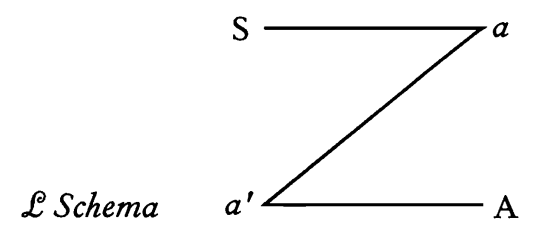
The Schema L provides a visual and topological aid to anchor the conceptual architecture of subjectivity. It is not a map of the psyche, but a diagrammatic formalization of the subject’s relation to language and the Other. In its simplicity, it fixes points: S (the subject), a (the object), a’ (the ego), and A (the Other). These are not empirical entities but structural positions through which the subject is constituted and divided. “Souls in distress” refers not to a moral concern but to the clinical confusion that results when these positions are not clearly differentiated. The schema serves to clarify, to stabilize a reading of the subject not through experience, but through structure.
“Which signifies that the condition of the subject S (neurosis or psychosis) depends on what takes place in the Other A.”
The structure of the subject is determined not by internal psychic dynamics in the classical sense, but by the position of the Other—A—in relation to the subject S. The schema does not propose a psychology of depth but a symbolic topology. What occurs in A—what is or is not inscribed there—determines whether repression is possible, whether the paternal metaphor functions, whether foreclosure has occurred. In neurosis, the Name-of-the-Father is inscribed in the Other, allowing the subject to be divided, spoken by the signifier. In psychosis, this Name is foreclosed, and the subject is left outside the symbolic order. Thus, the subject’s condition is not internal but relational, defined by the structuring or absence of structure in A.
“What takes place there is articulated as a discourse (the unconscious is the discourse of the Other), whose syntax Freud first sought to define in those fragments that, in privileged moments—dreams, slips of the tongue, witticisms—reach us from it.”
The unconscious does not exist as a hidden depth but as a discourse—the structured, signifying operations that occur in A, the locus of the Other. Freud’s discovery was that the unconscious is not content, but form: a syntax, a mode of articulation that obeys the laws of language. Dreams, slips, jokes—these are not “windows into the unconscious,” but fragments where its logic becomes manifest. They are not expressive but structural, and they reveal that the unconscious speaks. It is in the Other that this discourse takes place, and the subject hears it, not as author, but as spoken. The syntax is not personal but collective—it is the grammar of the signifier operating through the subject without his mastery.
“How could the subject be concerned with this discourse if he were not a participant? He is, in fact, drawn to it from the four corners of the schema: namely S, his ineffable and foolish existence; a, his objects; a’, his ego, that is, what reflects of his form in his objects; and A, the place from which the question of his existence may be posed to him.”
The subject is implicated in the discourse of the Other from multiple structural positions. From S—the barred subject, the subject of the unconscious—he exists only insofar as he is divided by the signifier, caught in the question of his own being. From a—the object cause of desire—he is constituted by what he lacks, what is posited as lost and thus drives his demand. From a’—the ego—he sees himself misrecognized in the imaginary mirror of others, taking a cohesive image where there is, structurally, a split. And from A—the locus of the Other—his existence is questioned, named, summoned. The schema is not symmetrical; it is traversed by lines of distortion, of misrecognition, of disjunction. The subject is not a point but a function—a relay within a network of signifiers. He does not enter discourse as a whole, but as a lack around which these positions are organized.
“For it is a truth of experience in analysis that the subject is confronted with the question of his existence—not in the form of the anxiety it generates at the level of the ego, which is only one element of its procession—but as an articulated question: ‘What am I doing here?’, concerning his sex and his contingency in being, namely that he is man or woman on the one hand, and on the other hand that he might not be at all, both of which combine their mystery and knot it in the symbols of procreation and death.”
The analytic experience reveals that the subject is not merely anxious or unsettled in a general affective sense, but that he encounters a structurally articulated question that returns again and again in his speech: “What am I doing here?” This is not the ego’s reflective musing but a question issued from the unconscious, involving the subject’s sexuation and ontological contingency. The question binds together two axes of lack: on one side, the symbolic position of being sexed—man or woman—as mediated by the phallus and the castration complex; on the other, the subject’s very being as contingent, exposed to the possibility of not-being. These two axes do not stand apart—they are knotted at the intersection of desire and death, woven into the mythic and symbolic motifs of procreation and mortality. It is not by chance that these questions emerge within the discourse of the Other—they are given form in that symbolic field, even as they exceed the subject’s conscious grasp.
“That the question of his existence saturates the subject, supports him, invades him, even tears him apart from all sides, this is what the tensions, the suspensions, the fantasies that the analyst encounters bear witness to; and it must be said that they do so as elements of the particular discourse in which this question is articulated in the Other.”
This existential question is not abstract or merely philosophical—it manifests in the analytic encounter as a saturation of the subject by unconscious discourse. Fantasies, symptoms, lapses, tensions: these are not raw psychic materials but structured signifying effects that bear witness to how the subject is positioned by the Other’s discourse. The unconscious question—What am I? or What does the Other want from me?—is not latent but already articulated, even if distorted or displaced. The subject is constituted within the field of the Other, and it is in the forms of this discourse that the question of being is posed. The symbolic network that inscribes the subject does not just generate repression and conflict; it also frames the possibility of subjective division and its symptom formations.
“For it is because these phenomena are ordered in the figures of this discourse that they have the fixity of symptoms, that they are legible and resolve themselves when they are deciphered.”
Symptoms have structure; they persist with consistency because they are ordered within the discourse of the Other. Their apparent irrationality is an effect of their symbolic logic, and it is precisely this logic that makes them interpretable. The fixity of the symptom does not come from its somatic persistence or affective intensity, but from the consistency of its signifying chain. When a symptom is deciphered—when the subject confronts its position within that chain—it can dissolve, or at least shift, because its cause is not in the ego but in the articulation of the signifier. This is the fundamental clinical insight: the symptom is not a block to meaning, but a formation of meaning, encoded within the language of the Other.
“One must therefore insist that this question does not present itself in the unconscious as ineffable, that this question there is a putting-into-question—that is: that before any analysis it is already articulated in discrete elements.”
Contrary to mystical or romantic notions of the unconscious as a realm of ineffable truths, the unconscious is structured—articulated—not in images or feelings, but in signifiers. The question of existence, sexuation, and contingency does not appear in analysis as something waiting to be expressed; it is already there, already posed, but encoded in elements that await deciphering. These elements are discrete—they can be isolated, named, and reconnected. Analysis is not the making-conscious of the vague, but the listening to what has always already been articulated, albeit in a displaced or encrypted form. The unconscious does not hide truth—it insists it, repeatedly, in fragments of discourse.
“This is crucial, because these elements are those that linguistic analysis instructs us to isolate as signifiers, and here they are grasped in their function in its pure state at the point that is both the most implausible and the most plausible:”
The analytical task is thus aligned with linguistic analysis: isolating the signifiers that structure the unconscious chain. What is implausible is that the subject’s most intimate symptoms—the most singular aspects of his suffering—can be reduced to structural elements of language. Yet, paradoxically, this is also the most plausible explanation, because it is only through these elements that the unconscious communicates. The truth of the subject, as it emerges in speech, is not found in a hidden depth but in the surface articulation of signifiers. The implausibility stems from the uncanny logic of the unconscious, but its plausibility is guaranteed by the consistency and repeatability of its effects.
“– the most implausible, since their chain persists in an otherness with respect to the subject as radical as that of hieroglyphs still undeciphered in the solitude of the desert;”
The unconscious discourse persists outside the subject’s conscious control—it is radically Other. Its language is alien, even to the subject who speaks it. Like undeciphered hieroglyphs, the signifying chain appears at first as nonsense, opaque, enigmatic. The subject may feel addressed but does not recognize himself in what is said. This Otherness is not a metaphor—it is the structural distance between the ego and the unconscious, between conscious speech and the signifier that speaks through the subject. The effect is one of uncanniness: the subject is inhabited by a discourse that is both his own and not his own.
“– the most plausible, because only there can their function of inducing meaning in the signified, by imposing their structure on it, appear unambiguously.”
And yet, once the function of the signifier is grasped, this same discourse becomes intelligible. The meaning does not pre-exist; it is produced by the structure the signifier imposes on the signified. The signifier does not transmit content—it constitutes it. The unconscious speaks not in symbols to be interpreted like dreams in mythology, but in signifiers that determine subjectivity by their differential function. It is in the signifier’s operation—its cuts, its repetitions, its displacements—that meaning is generated. This is where the unconscious becomes readable: not through empathy or introspection, but through the analytic act of listening to the signifier’s logic in the subject’s speech.
“For indeed the furrows opened by the signifier in the real world seek to widen the breaches it offers to them as being, to the point that an ambiguity may remain as to whether the signifier does not there follow the law of the signified.”
The signifier does not merely function within the symbolic order—it operates upon the real, carving into it, producing effects that give the illusion of deriving from the signified. In the field of experience, it can appear as though the signifier is subordinate to the meaning it is supposed to express. This inversion, however, masks the structural truth that it is the signifier that constitutes the field of meaning in the first place. The “furrows” are the traces of signification upon the real, marks that not only shape perception but penetrate being itself. The ambiguity lies in the tendency of the subject to retroactively attribute meaning to the signifier as though it emerged naturally from the real, rather than recognizing that it is the signifier that shapes what can be thought and said about being.
“But it is not the same on the level of the putting into question, not of the subject’s place in the world, but of his existence as subject, a putting into question that, starting from him, will extend to his intramundane relation to objects, and to the existence of the world insofar as it too can be called into question beyond its order.”
What is at stake in the analytic encounter is not merely the subject’s empirical position within a given world—it is his very existence as subject, a question that cannot be resolved by referring to objects, roles, or situations. This interrogation extends from the subject’s split at the level of S (in the Schema L), unfolding into his relation to a (object of desire) and even to the ontological status of the world itself. The symptom, the fantasy, the relation to the object—all are structured by this foundational instability. The world, as symbolic order, is not merely inhabited but questioned, potentially dismantled, in psychosis as well as in the depths of neurosis. The subject’s relation to the symbolic always implies a gap where existence becomes unsettled, not only individually but cosmologically.
“It is crucial to observe in the experience of the unconscious Other, where Freud guides us, that the question does not find its outlines in protomorphic proliferations of the image, in vegetative swellings, in soulful fringes radiating from the pulsations of life.”
The unconscious, for Freud, is not the wellspring of mythic imagery, archetypal growths, or vitalist expressions. Against the tendency to ground the unconscious in living organic metaphors—what Lacan calls “vegetative swellings” or “soulful fringes”—Freud locates it in the disruption of speech, in the mechanics of the signifier. The experience of the Other is not mystical or imagistic; it is articulated through slips, dreams, formations that follow linguistic laws. The unconscious is not a zone of life but of structure—it speaks, but not from the body as pure pulsation. It speaks from the network of the signifier, and its experience is thus not of fluid continuity, but of rupture, repetition, and difference. What defines the unconscious is not its vitality but its articulation.
“This marks the entire difference of his orientation from that of Jung’s school, which clings to such forms: Wandlungen der Libido.”
Jung’s approach, especially in Wandlungen und Symbole der Libido, remains anchored in a vitalist imaginary, positing the unconscious as a reservoir of archetypes, energies, and symbolic forms rooted in an allegedly universal psyche. His libido is not Freud’s drive but a cosmic force. Freud, by contrast, evacuates the mythic imaginary from psychoanalytic method. Libido, in Freud, is bound to the partial drive, to castration, to the structural limitations of subjectivity. Jung offers a psychology of the image; Freud, a topology of the signifier. The divide is fundamental: one treats the unconscious as a source of life and unity; the other as a field of division, repetition, and language.
“These forms can be brought to the foreground of a mantic, for they can be produced by appropriate techniques (promoting imaginary creations: reveries, drawings, etc.) in a site that is locatable here: one sees it on our schema, stretched between a and a’, that is, in the veil of the narcissistic mirage, eminently suited to sustain by its effects of seduction and capture all that comes to be reflected in it.”
The forms evoked by Jung—imagery, symbols, dreamlike creations—can be generated and encouraged through imaginative or “mantic” techniques. These productions, however, do not emerge from the unconscious structured like a language; they arise in the imaginary register, particularly along the axis from a to a′ in Schema L. This is the narcissistic field, where the ego misrecognizes itself in images, and where seduction, identification, and mirroring take precedence. It is a register of illusion and capture, not one of symbolic articulation. Reveries, drawings, and similar methods reinforce the ego’s coherence, precisely by bypassing the split introduced by the signifier. What is reflected in this field is not the subject’s truth but his fantasy of wholeness, protected from the trauma of lack.
“If Freud rejected this mantic, it is at the point where it neglected the guiding function of a signifying articulation, which takes effect from its internal law and from a material subjected to the essential poverty that defines it.”
Freud’s rejection of imagistic, mantic methods lies in their failure to acknowledge that the unconscious speaks through the signifier, not the image. The unconscious does not reveal itself through richness, but through poverty—through fragments, slips, absences, and gaps. The material of the unconscious is not symbolic in the Jungian sense but signifying: minimal, structured, repeatable. Its internal law is not aesthetic but linguistic. The analyst’s task is not to amplify the subject’s imagery but to trace the logic of his speech, where what matters is not what is said, but how it is structured. Freud’s fidelity to this poverty is not a limitation, but a rigor—an insistence that truth emerges not from fullness, but from the hole around which the subject is organized.
“Just as it is to the extent that this style of articulation has been maintained, by virtue of the Freudian word—even dismembered—within the community that claims to be orthodox, that a difference persists, as deep, between the two schools, although at the point things have now reached, neither is capable of articulating the reason for it.”
The enduring difference between Freudian and Jungian orientations, despite a surface-level convergence or mutual tolerance within psychoanalytic discourse, lies in the preservation—however fragmented—of the Freudian function of the signifier. Even where Freud’s theory is reduced to its remnants or misapplied, the insistence on articulation, the anchoring of the unconscious in language, sustains a structural difference from the Jungian mantic. Yet the tragedy of this moment lies in the fact that neither camp can articulate this divergence anymore, because the terms necessary to do so—structure, signifier, subject—have been progressively obscured by theoretical dilution and eclecticism. The field forgets what defines its own split, even as that split continues to operate at its core.
“By which measure the level of their practice will soon appear to be reducible to the distance between the styles of reverie of the Alps and the Atlantic.”
This irony points to the cultural trivialization of a foundational structural difference. Once psychoanalysis is no longer distinguished by its symbolic articulation, what remains is aesthetic preference—a kind of regional style of reverie. Jungian analysts dream with mountain archetypes; Freudians might drift along oceanic metaphors. The depth of theoretical distinction collapses into the superficiality of ambiance and imagery, revealing how far the discipline has wandered from its structural foundations. The unconscious becomes scenic, imagistic, or mystical again—its rigor reduced to mood.
“To return to the phrase that so delighted Freud in Charcot’s mouth, ‘this does not prevent the Other from existing’ at its place A.”
Freud’s delight in Charcot’s aphorism, taken seriously by Lacan, marks a turning point in the concept of the Other. The idea that something may not be consciously recognized or visible and yet still persists at a structural level corresponds exactly to the function of the Other as locus of the signifier. The place A—the big Other in Schema L—is not a person but a position, the register where discourse is situated and from which the subject is addressed. The fact that the subject denies or represses the Other does not eliminate its operation. The Other functions structurally, regardless of the subject’s recognition or belief in it.
“For remove it, and man can no longer even sustain himself in the position of Narcissus.”
Without the anchoring presence of the Other—without the structuring function of symbolic mediation—the imaginary collapses. Even the narcissistic image, which gives the subject a fictional unity at the level of the ego (a’), depends upon its being situated within a symbolic framework. If the Other is foreclosed or erased, the mirror image loses coherence. There is no point of enunciation, no symbolic grounding to support even the misrecognition of identity. The subject dissolves not only in relation to others but in relation to himself.
“The anima, as by the effect of an elastic, snaps back onto the animus, and the animus onto the animal, which between S and a sustains with its Umwelt ‘external relations’ noticeably tighter than ours, though one cannot say that its relation to the Other is null—only that it appears to us only in sporadic sketches of neurosis.”
In the absence of symbolic structure, what remains is a regression along the chain of humanization: from anima (soul) to animus (spirit) to animal. This imagery recasts the dissolution of symbolic anchoring as a collapse into pure Umwelt—the closed, circumscribed sensory-motor world of the animal. The human relation to the Other is not natural; it is constituted symbolically. When that fails, the subject risks being reduced to affective reflex and instinctual reaction. Even animals may show flashes of something like neurosis, but these are only “sporadic sketches”—indications that the structure of the Other is not entirely absent in nature, but that only in the speaking being does it reach the level of full symbolic articulation.
“The L of the putting-into-question of the subject in his existence has a combinatory structure that must not be confused with its spatial aspect. In this respect, it is truly the signifier itself which must be articulated in the Other, and especially in its topology of the quaternary.”
Schema L is not a spatial diagram in the Euclidean sense but a formal representation of structural positions. Its value lies in the combinatory logic it makes visible, not in any literal spatial mapping. At the center of this schema is the articulation of the signifier, which functions not by occupying space but by inscribing difference. The “quaternary” topology refers to the four positions in Schema L—S, a, a’, and A—whose interrelations determine the subject’s structural position. It is in the Other (A) that the signifier must be inscribed for the subject (S) to exist as such, rather than as a pure imaginary reflection (a’) or as a fragmented body of drives (a). The quaternary is not a number but a logic, a topology of subjectivity.
“To support this structure, we find within it the three signifiers in which the Other may be identified in the Oedipus complex. They suffice to symbolize the meanings of sexual reproduction, under the signifiers of the relation of love and procreation.”
The Oedipus complex provides the minimal symbolic framework by which the subject is inserted into the order of sexual difference and kinship. These three signifiers—typically father, mother, and child—mark the fundamental positions through which desire is structured and prohibited. They inscribe the laws of sexual reproduction, love, and generational transmission, making possible the difference between man and woman, and the separation between subject and object. These are not empirical roles but symbolic positions. They anchor the subject in a network of meaning, and their foreclosure—as in psychosis—results in a collapse of this structure.
“The fourth term is given by the subject in his reality, as such foreclosed from the system and entering only under the mode of the dead into the play of signifiers, but becoming the true subject insofar as this play of signifiers comes to make him signify.”
The subject of the unconscious does not pre-exist the symbolic structure but emerges through it—as a lack, a hole, a dead spot in the chain. This “real” subject is not representable within the initial triad; he enters the symbolic only as a trace, as what is marked by the play of signifiers but is never fully captured by them. Foreclosed from the system, the subject can only be retroactively posited—as the effect of signification, as what is spoken but does not speak. In this sense, he enters “as the dead,” as a remainder or void in the symbolic. But paradoxically, it is this excluded position that constitutes the subject in his truth: not the ego that reflects, but the subject that is split, barred, and spoken.
“This play of signifiers is indeed not inert, since it is animated in each particular part by the entire history of the ancestry of the other reals that the naming of the Other signifiers implies in the contemporaneity of the Subject.”
The signifier does not operate in isolation—it draws with it a historical network of prior articulations, familial inscriptions, and generational traces. Every signifier invoked in the field of the Other resonates with a lineage, the “ancestry” of the subject, through which the symbolic is passed down. This inheritance does not unfold as conscious memory but structures the subject’s present from the unconscious position of the Other. When a subject is spoken—by family, culture, language—it is not simply named but overdetermined by this sedimented history. The signifying chain is thus alive, constantly animating meaning through its synchronic engagement with diachronic weight. The “other reals” here evoke the radical heterogeneity introduced by each subject’s encounter with the symbolic network, where singular elements from history return in the real, inscribed via language.
“Even more, this play, insofar as it institutes itself as rule beyond each part, already structures within the subject the three instances—ego (ideal), reality, superego—whose determination will be the work of Freud’s second topology.”
The play of signifiers not only affects isolated psychic content; it imposes a structure, a rule that organizes the psychic apparatus itself. Before the subject can know or think, this articulation sets the coordinates of the second Freudian topology: the triadic structure of ego, reality, and superego. These are not natural faculties or fixed locations; they emerge through the subject’s inscription in language. The ego is not a master but an effect of misrecognition; the superego, not conscience, but the harsh imperative of the signifier; reality, not the world, but the structured field mediated by the symbolic. The subject’s psychic structure is not simply shaped by early experience, but by the law of the signifier functioning retroactively across his symbolic coordinates.
“The subject, moreover, enters the game as dead, but it is as living that he will play it, it is in his life that he must take on the color he occasionally announces there.”
The subject enters the symbolic already marked by a fundamental exclusion—foreclosed from origin, lacking an originary signifier that could ground him. This is the meaning of entering “as dead”: the subject appears only as an effect of signification, a remainder of the Other’s discourse. Yet it is in life, in praxis, that he embodies this structure. He becomes the site where the signifier is animated, where the dead chain of language gains affect, decision, gesture. What he occasionally “announces” is not a conscious declaration but the symptom, the lapse, the trace—where the dead structure breaks through into the living field. It is through these irruptions that the subject begins to color the game he was thrown into.
“He will do so by using a set of imaginary figures, selected from among the countless forms of anima-like relations, and whose choice involves a certain arbitrariness, since to homologously cover the symbolic ternary, it must be numerically reduced.”
To engage with the symbolic structure in a livable form, the subject draws upon the imaginary. He selects figures—images, identifications, personas—that stabilize his place within the field of desire. These figures are not dictated strictly by the symbolic, but their selection is nonetheless constrained by the subject’s need to mirror, to simulate, to appear coherent. The imaginary supplements the symbolic where the latter fails to fully inscribe jouissance. Because the symbolic ternary (Mother–Father–Child) must be covered imaginarily, a reduction is necessary: the multitude of possible identifications must be condensed into relational positions that can map onto the symbolic framework. The arbitrariness is not radical freedom, but a structural necessity shaped by the subject’s fantasy.
“To do this, the polar relation by which the specular image (of the narcissistic relation) is linked as unifying to the set of imaginary elements known as the fragmented body provides a pair which is not only naturally suited, by its development and structure, to serve as the homologue of the symbolic Mother–Child relation.”
This specular pair—the unified ego-image in the mirror and the fragmented body of partial drives—constitutes the core of the subject’s imaginary scaffolding. The polar relation stabilizes the ego in its misrecognition, providing a fictional unity against the background of a body experienced as inconsistent, disjointed. This pairing mirrors the dyadic relation between mother and child, offering an imaginary correlate to a symbolic structure. While the symbolic introduces absence and mediation, the imaginary relation provides immediacy and unity—albeit a deceptive one. It is this polar axis, situated between a and a′, that allows the subject to operate within the symbolic without collapsing, by simulating coherence where there is none.
“The imaginary pair of the mirror stage, by what it manifests of what is against nature—if one must relate it to a specific prematuration of birth in humans—proves appropriate to give to the imaginary triangle the base that the symbolic relation may in some way cover. (See schema R).”
The mirror stage reflects the human’s premature birth, its motor and neurological incompleteness at the moment of entering the world. This “against nature” condition forces the infant to identify with a coherent image before such coherence exists internally. This constitutive alienation produces the ego as an imaginary formation—founded on a misrecognition of unity. The triangle formed by this relation (self-image–body–Other) becomes the base upon which the symbolic order can later inscribe the subject. The symbolic does not replace the imaginary but overlays it, covering its gaps and inconsistencies with the law of the signifier. Schema R captures this superposition, articulating how the imaginary triangle supports symbolic articulation while remaining irreducibly misaligned with it.
“Indeed, it is through the gap opened by this prematuration in the imaginary and where the effects of the mirror stage abound, that the human animal is capable of imagining itself as mortal—not that one could say it would be capable of doing so without its symbiosis with the symbolic, but rather that without this gap, which alienates it to its own image, that symbiosis with the symbolic could not have occurred, wherein it constitutes itself as subject to death.”
The human capacity to imagine death—to recognize itself as mortal—is not natural but structurally mediated. It emerges from the gap between the organism and its image, a gap produced by the mirror stage. Alienated in the image that represents it as whole, the subject begins to conceive its own limits, its lack, its vulnerability. This is not an affective intuition but a structural effect: only through this alienation does the symbolic gain traction. Without the mirror-induced rupture, the symbolic order could not inscribe the subject as divided, nor could it install the law that introduces the real of death. Mortality is not a biological given but a symbolic position—one that makes the subject both speakable and desiring, insofar as death marks the ultimate limit of the signifier.
“The third term of the imaginary ternary, the one where the subject identifies himself, in opposition, with his being as living, is nothing other than the phallic image, whose unveiling in this function is not the least scandal of the Freudian discovery.”
The imaginary ternary—a triangle composed of relations within the narcissistic register—finds its third term in the phallic image. This is not the anatomical organ but the image of the phallus, functioning as the signifier of desire, of lack, of symbolic positioning. The subject identifies with this image not simply as a representation of potency or virility, but as the form that stands in for being itself, especially as living. The phallus here mediates the subject’s libidinal investment in his own image, enabling him to both affirm and negate himself within the narcissistic matrix. Freud’s scandal lies not in speaking of sexuality, but in showing how this image structures identification, affects the ego, and functions as a signifier. It is through this identification that the subject misrecognizes himself, staging the drama of desire in the mirror of the Other.
“Let us now inscribe here, by way of conceptual visualization of this double ternary, what we will henceforth call schema R, which represents the conditioning lines of the perceptum, in other words of the object, insofar as these lines circumscribe the field of reality, far from merely depending on it.”
Schema R does not merely map perceptual experience; it formalizes the structural conditions under which anything can be perceived as an object in the first place. The perceptum—the object as experienced—is not given by the world but constructed through symbolic and imaginary mediation. The schema demonstrates that the field of reality is not prior to the subject’s structuration but emerges as a consequence of it. The lines of this schema condition the subject’s relation to the object; they are not lines of sight, but of signification. The “double ternary” refers to the interaction of the symbolic and imaginary triangles—the structural mechanisms through which the subject is positioned in relation to the phallus, the ego ideal, and the Other.
“Thus, by considering the vertices of the symbolic triangle: I as the ego ideal, M as the signifier of the primordial object, and P as the position in A of the Name-of-the-Father, one can grasp how the homological pinning of the subject S’s signification under the signifier of the phallus may affect the support of the field of reality, delimited by the quadrangle MimI.”
The symbolic triangle—marked by I (the ego ideal), M (the maternal object), and P (the paternal function)—structures the subject’s symbolic coordinates. This is not merely a set of representations but an articulation of positions within the Other that support the subject’s place in discourse. The Name-of-the-Father, located at P, is what enables the signifier of the phallus to operate as a metaphor—linking M (desire of the mother) to the law of the Father. This homological pinning—the way S’s meaning is tethered to the signifier of the phallus—conditions the field of reality, not as empirical space, but as a symbolically delimited zone (MimI) where objects may be apprehended and desires situated. This quadrangle is not a geometric space, but a structural field shaped by the subject’s entry into the symbolic.
“The two other vertices of the latter, i and m, representing the two imaginary terms of the narcissistic relation, that is, the ego and the specular image.”
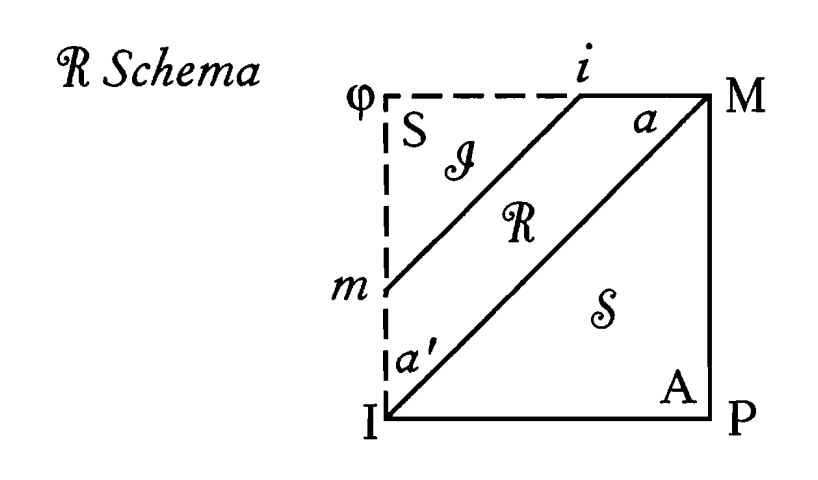
These two points—i and m—mark the poles of the imaginary register: i, the ideal image with which the subject identifies (ego), and m, the fragmented or partial body image (the body-in-pieces). The relation between these terms structures the narcissistic dimension of subjectivity. The ego emerges not from interior unity but from a misrecognition in the mirror image, which smooths over the fragmented experience of the drive-bound body. These imaginary poles interact with the symbolic coordinates to produce the illusion of a coherent self. But coherence is always precarious—dependent on the symbolic inscriptions and imaginaries that sustain it.
“One may thereby locate from i to M, or at a, the ends of the segments Si, Sa1, Sa2, San, SM, where the figures of the imaginary other are placed in the erotic-aggressive relations where they are realized—just as from m to I, or at a’, the ends of the segments Sm, Sa1, Sa2, San, SI, where the ego identifies, from its specular Urbild to the paternal identification of the ego ideal.”
The schema formalizes the paths along which the subject’s identification and aggressivity are distributed. From S to i, we trace a vector through a (the other as mirror), where erotic and aggressive relations are staged with imaginary others—siblings, rivals, doubles. From S to m, and through a′, we track the formation of the ego, which draws from early bodily images, eventually aiming toward the idealized position at I. Each segment—Sa1, Sa2, San—marks a site where the imaginary other appears in different relational modalities: seductive, rivalrous, hostile. But all are structured through misrecognition and mediated by the ego’s relation to its image. These imaginary positions do not operate in isolation but are always enmeshed with symbolic identification, especially via the paternal function at I.
“Those who followed our seminar in the year 1956–57 know the use we made of the imaginary ternary here posited, in which the child as desired actually constitutes the vertex I, in order to restore to the notion of Object Relation—somewhat discredited by the accumulation of foolishness recently asserted under its heading—the capital of experience legitimately associated with it.”
By assigning the vertex I to the child as desired, Lacan reinstates the value of object relations theory without capitulating to its deviations into affectivist or developmental psychologism. What matters is not the object as thing or person, but the position it occupies in the symbolic network—the place of the Other’s desire. The “child as desired” is not a sentimental figure but a structural effect: the subject’s position as spoken by the desire of the Other, inscribed at I as the ego ideal. Object relation, when re-grounded in symbolic structure, regains its clinical relevance—not as a theory of empathy or need, but as a formal apparatus to read the positions of the subject in relation to love, demand, and identification. The “capital of experience” lies not in objects possessed, but in the signifiers that mediate the subject’s relation to them.
“This schema, indeed, makes it possible to demonstrate the relations that refer not to the pre-Oedipal stages—which are, of course, not nonexistent, but analytically unthinkable (as the faltering yet guided work of Mrs. Melanie Klein sufficiently demonstrates)—but to the pregenital stages insofar as they are ordered in the retroaction of the Oedipus.”
The R Schema offers a formalization that sidesteps the speculative terrain of the so-called “pre-Oedipal,” which is often invoked to explain early psychic life but lacks the structural articulation necessary for analytic interpretation. While Klein’s efforts to theorize these stages are acknowledged, they remain caught in an ambiguous zone—her descriptions are sensitive and intuitive, but they often lack grounding in the symbolic order. What is privileged here is not a chronological but a retroactive logic: the meaning of pregenital stages is not anterior to Oedipus but constituted through it. The child’s relation to the body, to objects, and to the drive only becomes legible once the Oedipal structure has imposed its symbolic coordinates. It is through the phallic signifier and the castration complex that earlier stages are inscribed and structured—giving them their analytic coherence.
“The entire problem of perversions consists in conceiving how the child, in his relation to the mother—a relation constituted in analysis not by his vital dependence, but by his dependence on her love, that is, by the desire of her desire—identifies with the imaginary object of that desire, insofar as the mother herself symbolizes it in the phallus.”
Perversion does not arise from instinctual deviation but from a specific structural position within the symbolic economy of desire. The child’s relation to the mother is not primarily biological—it is structured through his positioning within her desire. What the child wants is not just care, but to be that which she desires. The identification with the phallus—the imaginary object that condenses her desire—becomes central. The mother’s desire, when symbolized by the phallus, offers a position for the child to occupy, but this position is fundamentally unstable. In perversion, the subject attempts to stabilize this position by aligning himself directly with the object cause of desire, often bypassing symbolic mediation and instead staging desire in the form of ritualized scenarios or disavowed knowledge. It is not a regression but a structural fix on a specific function of the phallus as signifier.
“The phallocentrism produced by this dialectic is all that we have to retain here. It is, of course, entirely conditioned by the intrusion of the signifier into the human psyche, and strictly impossible to deduce from any pre-established harmony of said psyche with the nature it expresses.”
The centrality of the phallus in psychoanalytic theory is not a cultural preference or a biological inevitability—it emerges from the structuring role of the signifier in the constitution of subjectivity. The phallus is not a thing, but a function, a privileged signifier that marks the place of lack and mediates the subject’s relation to desire and the law. Its function as the signifier of the Other’s desire and as the operator of castration is what structures subjectivity in both sexes. Any attempt to derive this centrality from developmental biology or some natural harmony misreads the logic of psychoanalysis. The phallus has no symbolic privilege outside of the effect it produces within language. Phallocentrism here is not an ideology but the structural effect of how the subject is inscribed in the symbolic order.
“This imaginary effect, which can only be felt as discordance in the name of the prejudice of an instinct’s inherent normativity, nevertheless determined the long controversy—now extinguished, though not without damage—concerning the primary or secondary nature of the phallic phase.”
The imaginary dimension of the phallus—its image function as marker of wholeness, power, or lack—has often been confused with instinctual norms or biological development. This confusion sustained a lengthy debate over whether the phallic phase was “primary” or “secondary,” as if these temporal categories could ground a developmental truth. The controversy misrecognizes that what is at stake in the phallus is not a phase but a structural function. Freud’s introduction of the phallic stage was not about sequencing genital zones, but about locating the moment when the subject enters into the logic of castration—into the recognition that desire is mediated by a lack, and that no one possesses the phallus in its symbolic sense. The damage lies in having treated the phallus as a natural object, rather than the central signifier of a structural operation.
“Were it not for the extreme importance of the issue, this controversy would deserve our attention for the dialectical feats it forced Dr. Ernest Jones to perform in order to support, while affirming his complete agreement with Freud, a position diametrically opposed to his—that is, one that made him, with nuances no doubt, the champion of English feminists devoted to the principle of ‘to each their own’: the boys get the phallus, the girls get the c…”
Jones’s efforts to reconcile Freud’s theory of sexuality with a culturally palatable egalitarianism led him into untenable theoretical positions. His allegiance to a form of biological fairness—insisting on symmetrical outcomes for boys and girls—reflects a misunderstanding of the phallus as property rather than signifier. In doing so, he distorts Freud’s position, which never claimed the phallus as a possession but rather situated it as the signifier of lack. The logic of “to each their own” reintroduces the imaginary in its most naïve form: as a relation of equivalence, symmetry, and completeness, precisely where the symbolic functions through asymmetry, non-reciprocity, and division. What Jones performs is not a dialectic but a cultural negotiation, one that neutralizes the structural scandal of the phallic signifier and its role in castration and sexual difference.
“This imaginary function of the phallus was thus revealed by Freud as the pivot of the symbolic process that completes, in both sexes, the questioning of sex through the castration complex.”
The phallus is not the endpoint of sexual differentiation but its structural pivot—the signifier that introduces the subject into the symbolic questioning of sex. Freud’s discovery lies in showing that neither sex has the phallus in the symbolic sense: one is positioned as having it (under threat of losing it), and the other as being it (under threat of not being it enough). This split—organized by castration—produces the sexual division not as biological destiny but as symbolic position. The phallus, then, is what completes the process of sexual subjectivation, enabling each sex to assume a place in the symbolic by way of a relation to this fundamental signifier of lack. It is not the answer to the question of sex, but the very operator of its articulation.
“The current obscuring of this function of the phallus (reduced to the role of a partial object) in the psychoanalytic discourse is only the continuation of the deep mystification in which culture maintains its symbol—this is to be understood in the sense that even paganism only produced it at the end of its most secret mysteries.”
The reduction of the phallus to a mere partial object—a fragment of the body indexed by drive theory—represents a retreat from its structural function as the key signifier in the symbolic order. This shift within psychoanalysis reflects, rather than resists, a broader cultural mystification: the phallus is consistently veiled, displaced, or treated as taboo. Even in ancient pagan rites, the phallic symbol only emerged within the most esoteric and reserved contexts—its unveiling marked a threshold of symbolic initiation. This demonstrates that culture has always approached the phallus not as an anatomical reality but as a privileged signifier, encased in layers of prohibition and secrecy. Its concealment is not accidental but constitutive, a sign of its power to organize the subject’s position within desire and law. When psychoanalysis follows culture in this reduction, it fails to recognize the phallus as the pivot of castration and symbolic structuration.
“Indeed, within the subjective economy, as we see it governed by the unconscious, it is a meaning that is evoked only by what we call a metaphor—specifically, the paternal metaphor.”
The phallus, in its analytic function, is not a thing but a metaphor—specifically the metaphor of the Name-of-the-Father. It is not directly given but evoked through substitution. The paternal metaphor is the mechanism through which the desire of the mother is interrupted, reoriented, and inscribed within the symbolic law. This metaphor replaces the maternal desire with a signifier—the Name-of-the-Father—that introduces the child into the order of prohibition and signification. It is only within this metaphorical operation that the phallus can acquire its structural place: as that which is neither possessed nor lacking in itself, but which marks the difference that gives form to subjectivity. The phallus is not represented, it is produced through this metaphorical substitution, and only there does it gain the force of law and desire.
“And this brings us back, since it is with Mrs. Macalpine that we have chosen to dialogue, to her need for a reference to a ‘heliolithism,’ by which she claims to see procreation codified in a pre-Oedipal culture, where the procreative function of the father would be eluded.”
Macalpine’s appeal to “heliolithism”—a diffusionist ethnological theory suggesting a sun- and stone-worshiping proto-culture—functions as a fantasy of a society where the symbolic function of the father is bypassed. In such a schema, paternity would not be structurally inscribed but biologically or mythically displaced, absorbed into maternal or spiritual agency. This attempt to locate procreation outside of the Oedipal framework reflects a misunderstanding of the symbolic—not as empirical ancestry, but as a structure that determines positions of relation. The fantasy of a “pre-Oedipal” culture without paternal law misunderstands the operation of the signifier: even in the absence of biologically recognized fatherhood, the symbolic still functions to assign positions and authorize lineage. The claim to have found a culture that evades the paternal function is thus not ethnographic discovery but theoretical disavowal.
“Everything that might be advanced in this direction, in whatever form, will only serve all the more to highlight the function of the signifier that conditions paternity.”
Rather than disproving the symbolic function of paternity, these anthropological detours only reinforce it. Every attempt to locate procreation outside of the Oedipal or phallic structure inevitably runs up against the fact that paternity, as a symbolic position, does not rely on biological causality. It depends on the inscription of the father as signifier—the Name-of-the-Father—which organizes the subject’s place in kinship, desire, and law. The symbolic father is not a real progenitor but the one who institutes the law of prohibition and names the child into the order of language. Thus, alternative myths, spiritual conceptions, or cultural systems that reassign the cause of conception still operate through signifiers, and it is these that psychoanalysis reads, not the empirical causes.
“For in another debate from the time when psychoanalysts still questioned doctrine, Dr. Ernest Jones, with a more pertinent remark than elsewhere, did not bring an argument any less inappropriate.”
In recalling earlier debates, there’s recognition that even efforts meant to clarify doctrine often remained trapped in misreadings of its structural foundation. Jones, despite making a sharper observation than usual, still failed to grasp the symbolic logic at stake. His argument, while nominally precise, remained inappropriate because it mistook empirical reason for structural truth. Even the most accurate observation becomes irrelevant when it misses the level at which psychoanalysis operates: not at the level of facts, but at the level of signifiers and the symbolic law.
“Regarding the state of beliefs in some Australian tribe, he refused to admit that any human collective could ignore the empirical fact that, barring enigmatic exceptions, no woman gives birth without having had coitus, nor be unaware of the interval required between the antecedent and the event.”
Jones, arguing from a rationalist perspective, insists that no society could truly ignore the biological causality of reproduction. His assumption is that human observation and memory would necessarily connect sexual activity to childbirth, even in so-called “primitive” tribes. But this presumes that knowledge of paternity must be empirical, natural, and universally recognized—an assumption that entirely bypasses the structural point. His belief in the transparency of causal relationships reflects a misunderstanding of how the symbolic order functions.
“Now, this credit—which seems to us perfectly legitimate when granted to the human capacity to observe reality—is precisely what has no importance whatsoever in the matter.”
Empirical observation of cause and effect is irrelevant to the symbolic operation of paternity. What matters is not whether a society knows the biological mechanics of reproduction, but how it signifies paternity within its symbolic system. Psychoanalysis is not interested in what the subject knows in a conscious, observational sense, but in how they are positioned by the symbolic law. A society might understand biological causation and still attribute paternity to myths, spirits, or symbolic acts—because the function of the father is not a fact but a position in discourse.
“For if the symbolic context requires it, paternity will nonetheless be attributed to the woman’s encounter with a spirit at a certain fountain or within a particular monolith where the spirit is supposed to reside.”
The symbolic order does not require empirical validation; it operates through the law of the signifier. In cultures where the Name-of-the-Father is not biologically grounded, paternity can be signified through entirely different means—myths, totems, ancestral spirits. What matters is not what causes conception, but what structures filiation. The attribution of paternity to a spiritual encounter is not irrational—it reveals that paternity is a symbolic function, assigned according to the needs of the signifying chain, not the demands of physical causality. This mythic attribution is structurally equivalent to the function of the Name-of-the-Father: it inscribes the child into a line of symbolic transmission, establishes a law of separation, and reorients the mother’s desire.
“This is exactly what demonstrates that the attribution of procreation to the father can only be the effect of a pure signifier—of a recognition not of the real father, but of what religion has taught us to invoke as the Name-of-the-Father.”
The symbolic attribution of fatherhood does not rest on any empirical observation or biological truth. It is a structural effect of the signifier. To “be” a father, in the sense that matters psychoanalytically, is not to inseminate but to be named within a symbolic position that organizes law, desire, and prohibition. Religion, in recognizing this symbolic function, encodes it in the Name-of-the-Father—a signifier that does not describe a man but situates the law that regulates desire. Thus, the father’s role in procreation is not a material cause but a symbolic effect, the moment when the subject is inserted into the Other’s discourse through a function that transcends the empirical progenitor.
“No signifier is, of course, needed to be a father, any more than to be dead—but without a signifier, no one will ever know anything of either of these states of being.”
Biological paternity and biological death occur independently of language, but neither acquires any meaning without the mediation of the signifier. To know someone is dead, or to be named a father, is entirely dependent on symbolic inscription. The raw fact of these states is irrelevant to the unconscious—they exist for the subject only to the extent that they are symbolized. Death without mourning is a biological event; death with mourning is a symbolic rupture. Likewise, fatherhood without nomination remains a biological function; it becomes operative in the unconscious only when named. The subject does not encounter reality directly but only through the structuring agency of signifiers.
“I recall here, for the benefit of those who cannot be persuaded to seek in Freud’s texts a complement to the enlightenment their instructors dispense, how insistently the affinity is underlined therein between the two signifying relations we have just evoked, whenever the neurotic subject (particularly the obsessive) manifests it through the conjunction of their themes.”
Freud repeatedly links the themes of paternity and death in neurosis, particularly in obsessional structure, where the subject’s relation to the law is ambivalent and deeply entangled with guilt, authority, and mourning. These themes are not psychological tropes but signifying relations—expressions of the way the subject positions himself in relation to the signifiers of the Name-of-the-Father and the dead Father. The obsessive often shows a compulsive concern with both legacy and loss, crime and punishment, guilt and filiation, because for him, the symbolic father’s place is unstable, overdetermined, or contested. This is not because the real father is absent or abusive but because the signifier fails to anchor a stable relation to the law.
“How could Freud fail to recognize it, since the necessity of his reflection led him to link the appearance of the signifier of the Father, as author of the Law, to death—indeed, to the murder of the Father—thus showing that, if this murder is the fertile moment of the debt through which the subject is bound for life to the Law, the symbolic Father, insofar as he signifies this Law, is indeed the dead Father.”
The Law emerges for the subject not from the living father but from his death—more precisely, from the symbolic murder of the primal father. In Totem and Taboo, Freud locates the origin of the Law in this founding act: the sons’ killing of the father creates both prohibition and filiation. The Father’s death institutes the symbolic order, not because of any moral lesson, but because it introduces the name of the Father as a limit, as that which marks the impossibility of direct access to jouissance. The subject is thus bound to the Law by a debt born of this structural murder. The symbolic Father—the one who speaks the Law, who interrupts the mother’s desire—is necessarily a dead Father, a signifier, not a living agent. He operates as an absence that commands, as a lack that structures.
“IV. On Schreber’s Side.”
The delusional world of Schreber, as a psychotic construction, offers a privileged site for investigating what happens when the symbolic function of the Name-of-the-Father is foreclosed. Here, the subject encounters the Law not as mediated by a dead signifier, but as an overwhelming presence—one that speaks to him directly, without metaphor, without distance. The delusion is not meaningless but a response to the structural collapse of the paternal metaphor.
“1. We can now enter into the subjectivity of Schreber’s delusion.”
The psychotic subject is not outside structure but lives its breakdown. To “enter” into Schreber’s delusion is not to interpret it through empathy or narrative but to trace how signifiers fail to anchor his position in the symbolic. His subjectivity is organized around the absence of the Name-of-the-Father—its foreclosure opens a hole in the Other, and the delusion attempts to patch this hole through a new, hallucinatory construction of meaning.
“The meaning of the phallus, we have said, must be evoked in the subject’s imaginary by the paternal metaphor.”
For the phallus to function as the signifier of desire, it must be produced through the substitution that defines the paternal metaphor. The phallus is not visible or given—it is evoked in the child’s imaginary through the mother’s desire, interrupted and reoriented by the insertion of the Name-of-the-Father. This metaphor replaces the signifier of the mother’s desire with that of the Father’s name, producing the effect of castration and the symbolic structuring of sexual difference. Without this operation, the subject remains caught in the imaginary, unable to symbolize lack, incapable of occupying a position in the field of desire.
“This has a precise sense within the economy of the signifier, whose formalization we can here only briefly recall—familiar to those who follow our current seminar on the formations of the unconscious. Namely: the formula of metaphor, or of signifying substitution:”
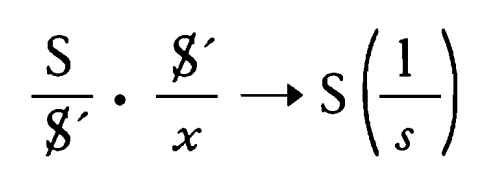
The paternal metaphor is expressed in a formal structure, visible in the algebra of signifiers. The formula presented here represents a metaphorical substitution where one signifier (S) replaces another (S′), producing a new signification (s), while the original signifier is elided. This is the mechanism by which meaning is produced in language—not by reference, but by difference and substitution. In the paternal metaphor, the Name-of-the-Father substitutes for the maternal desire, producing the effect of symbolic law and sexual positioning.
“where the capital S’s are signifiers, x is the unknown signification, and s is the signified induced by the metaphor, which consists in the substitution in the signifying chain of S for S’. The elision of S’, here represented by its erasure, is the condition for the success of the metaphor.”
This formula demonstrates how metaphor functions structurally: a new signified (s) emerges only when one signifier (S) replaces another (S′) in the chain. The erased signifier does not vanish—it continues to structure the meaning retroactively, through absence. In the case of the paternal metaphor, the Name-of-the-Father (S) substitutes for the mother’s desire (S′), and the child is inserted into the symbolic field as a desiring subject. The metaphor’s success requires that the prior signifier be elided—i.e., not reintroduced as content, but repressed as structure. Where this substitution fails, as in psychosis, the metaphor does not produce meaning but unravels, and the signified collapses into literalization, hallucination, or delusion.
“This applies, then, to the metaphor of the Name-of-the-Father—that is, the metaphor that substitutes this Name in the place first symbolized by the operation of the absence of the mother.”

The metaphor of the Name-of-the-Father operates as a structural substitution that inscribes the subject in the symbolic order. It takes the place opened by the absence of the mother—not her empirical withdrawal, but the structural hole that her desire creates in the field of the child’s experience. This absence is not lack of presence but the very presence of lack: the realization that the mother desires something beyond the child, and that the child is not her total object. The Name-of-the-Father steps into this structural absence, naming it, closing it, and thereby installing the function of the Law. This operation repositions the child from being the object of the mother’s desire to a subject in relation to the symbolic. The phallus, in this operation, becomes the signifier of what the mother desires, and it is through this that castration—the limit imposed by the Law—takes effect.
“Let us now try to conceive a subjective situation in which, to the call of the Name-of-the-Father, there responds not the absence of the real father—for that absence is more than compatible with the presence of the signifier—but the lack of the signifier itself.”
The absence of the real father does not in itself compromise symbolic structuration; what is essential is the presence of the signifier Name-of-the-Father in the locus of the Other. When this signifier is foreclosed—never inscribed in the symbolic—the metaphor cannot operate. In such a case, the subject’s appeal to the Name-of-the-Father meets not symbolic absence but structural void. This is the condition of psychosis, where the paternal metaphor fails to function, not because of the father’s empirical absence, but because the signifier that would install the Law is not there to respond. Without the Name-of-the-Father, there is no third term to mediate the relation between the child and the mother’s desire; the symbolic fails to anchor the subject, and the foreclosure reappears in the real as hallucination, delusion, or rupture of meaning.
“This is not a conception for which we are unprepared. The presence of the signifier in the Other is, in fact, a presence ordinarily closed to the subject, since it is usually in the repressed (verdrängt) state that it persists there, and from there insists on representing itself in the signified through its automatism of repetition (Wiederholungszwang).”
In neurosis, the signifier Name-of-the-Father may be repressed, but it exists—it is inscribed in the symbolic, though barred from consciousness. It operates through return: symptoms, dreams, slips, all of which demonstrate the persistence of the signifier in the unconscious. This is the compulsion to repeat, Freud’s Wiederholungszwang, by which the repressed insists on representing itself in displaced and distorted forms. The subject may not know the signifier, but its effects structure his desire and symptoms. The Other is not transparent; it withholds its law, but the repression of the signifier still confirms its presence. This distinction is what allows analysis to work in neurosis—because the signifier can be interpreted, brought into the analytic discourse.
“Let us extract from several of Freud’s texts a term that is articulated in them clearly enough that they would be unjustifiable if it did not designate a function of the unconscious distinct from that of repression. Let us take as demonstrated what was the core of my seminar on psychoses, namely, that this term refers to the most necessary implication of his thought when it engages with the phenomenon of psychosis: it is the term Verwerfung.”
Freud introduces Verwerfung—foreclosure—as a mechanism distinct from repression. Where repression involves the return of the repressed, foreclosure entails an absolute exclusion from the symbolic. The foreclosed signifier was never admitted, never inscribed; it cannot return because it was never there. In psychosis, this absence opens a hole in the symbolic order, a void that the subject attempts to patch through delusion. Verwerfung is not just a failure of repression but a different structure altogether—one that accounts for the radical break in the subject’s relation to reality in psychosis. The Name-of-the-Father, when foreclosed, returns not in the symbolic but in the real, often in persecutory or hallucinatory form.
“It is articulated in this register as the absence of that Bejahung, or judgment of attribution, which Freud posits as a necessary antecedent to any possible application of Verneinung, which he opposes to it as a judgment of existence: and the entire article in which he isolates this Verneinung as an element of the analytic experience shows that it involves the avowal of the very signifier it cancels.”
Bejahung, Freud’s term for affirmation or judgment of attribution, is the primal operation by which the subject grants existence to a representation within the symbolic field. Only on the basis of this affirmation can there later occur a Verneinung—a negation that still presupposes the signifier. In neurosis, the subject may say “no,” but this denial presumes the symbolic presence of what is being denied. This is what makes negation a form of recognition. In psychosis, however, Bejahung has never occurred; the signifier was never accepted into the symbolic network. Without this foundational operation, there can be no symbolic negation—only a void, filled by the real. The function of Verneinung, when present, testifies to the symbolic status of repression; its absence reveals foreclosure.
“Therefore, the primordial Bejahung also bears on the signifier, and other texts allow us to recognize this, most notably letter 52 of the correspondence with Fliess, where the signifier is expressly isolated as the term of an original perception, under the name of sign (Zeichen).”
In the foundational letter 52 to Fliess, Freud isolates the signifier (Zeichen) as the product of an original perception—a trace that persists as the basis of memory and symbolic thought. This original mark does not record a thing but inscribes a difference, a cut, a position. For Freud, this Zeichen is the primitive element from which the unconscious is constituted. Lacan reads this as confirming that the symbolic precedes the subject: the signifier is not a reflection of the world but the condition for any relation to it. The subject emerges where the signifier has left its mark, and this requires a Bejahung—an inaugural acceptance of symbolic inscription. Where this operation is foreclosed, as in Verwerfung, the subject never assumes a position in the symbolic network, and the real intrudes unmediated, producing the effects of psychosis.
“We shall therefore regard Verwerfung as foreclosure of the signifier. At the point where, as we shall see, the Name-of-the-Father is called, there may answer in the Other a pure and simple hole, which, through the failure of the metaphorical effect, will produce a corresponding hole at the place of phallic signification.”
Verwerfung, understood in Lacan’s precise sense, is not simply the rejection of content but the radical foreclosure of the signifier itself from the symbolic register. When the Name-of-the-Father is summoned within the structure of the subject—precisely at the moment where the paternal metaphor should operate to stabilize signification—its absence results in a breach in the symbolic. This void at the level of the Other does not merely leave a gap in discourse; it prevents the phallus from being metaphorized, from functioning as the signifier of desire. The failure of the metaphorical substitution leads not to repression (which presumes symbolic presence) but to a hole in the structure. This is not a neurotic lack, but a structural absence—an empty place where meaning cannot be generated, and from which the psychotic subject will attempt to compensate through delusional construction.
“This is the only form under which we are able to conceive what Schreber presents to us as the outcome of a damage he is only able to partially disclose, and in which, he says, with the names of Flechsig and Schreber, the term ‘murder of souls’ (Seelenmord: p. 22-II) plays an essential role.”
In Schreber’s own formulation of his experience, the term Seelenmord—the murder of souls—captures the sense of a fundamental rupture, one that cannot be reduced to trauma or injury in a psychological sense. It speaks to an annihilation that occurs at the level of being itself, corresponding structurally to the foreclosure of the signifier that would have allowed the subject to maintain his place within the symbolic order. Schreber’s use of proper names—his own and that of Flechsig—marks an effort to localize this catastrophic event, to name the agents or figures associated with it. But what he reports is not a narrative of causality, but a failure of symbolic support, a subjective catastrophe produced by the impossibility of sustaining the paternal metaphor. Seelenmord is not merely a dramatic phrase—it signals the erasure of the very support that would make psychic life viable within the symbolic.
“It is clear that what is at stake here is a disorder provoked at the most intimate joint of the subject’s feeling of life, and the censorship that mutilates the text before the addition that Schreber announces to the rather circuitous explanations he attempted of his process, suggests that he associated with the names of living persons, facts that the conventions of the time could barely tolerate being published.”
What Schreber describes strikes at the very core of the subject’s sense of existence—his vital relation to reality, meaning, and selfhood. The mutilation of his manuscript, likely due to social and legal censorship, prevents us from knowing the full articulation of the trauma as he conceived it. Yet what this absence underlines is itself significant: that the damage Schreber refers to resists representation, eludes discursive framing, and returns as a hole in the text, just as the foreclosed signifier returns as a hole in the symbolic. The invocation of real persons may have carried associations that were socially unspeakable, but structurally, what matters is that the delusion emerges as an attempt to patch this impossible point, to produce meaning where it structurally fails. The censorship Schreber faces at the level of his writing mirrors the foreclosure that defines his subjective structure.
“Indeed, the entire following chapter is missing, and Freud, in order to exercise his insight, had to content himself with the allusion to Faust, Der Freischütz, and Byron’s Manfred, the last of which (from which he supposes the name Ahriman to be borrowed—one of the apophanies of God in Schreber’s delusion) seemed to him to take on its full value in this reference from its theme: the hero dies from the curse carried within him by the death of the object of an incestuous love between siblings.”
Freud’s reading of the gaps in Schreber’s text relies on his capacity to decode literary references as metaphorical displacements of repressed material. In linking Ahriman, a divine figure in Schreber’s cosmology, to the tragic figures of Manfred or Faust, Freud suggests that the content of Schreber’s delusion carries the structure of myth, and more specifically, of an incestuous drama marked by guilt, punishment, and the impossible resolution of desire. But what Freud reads as repressed content, Lacan reframes structurally: not as the return of something once known, but as the emergence of signifiers attempting to suture a symbolic hole. The mythic material in the delusion serves the function of metaphor only when the Name-of-the-Father is in place; in Schreber’s case, these figures stand in for what was never inscribed, never subject to metaphor. Thus the delusion becomes a literalization of metaphor—a hallucinated substitute for a signifier that never entered the symbolic.
“As for us, since with Freud we have chosen to place our trust in a text which—aside from these regrettable mutilations—remains a document whose guarantees of credibility are equal to the highest, it is within the most developed form of the delusion with which the book is entirely bound up that we will seek to show a structure, one that will prove to resemble the very process of psychosis.”
Rather than treating the delusion as nonsense or secondary distortion, we approach Schreber’s Memoirs as a coherent document whose internal logic reveals the very structure of psychosis. The credibility of the text lies not in its factual accuracy but in the rigour of its symbolic organization. What is to be deciphered is not Schreber’s biographical truth but the structural operation of foreclosure, compensation, and reconstruction. His delusion—elaborate, systematic, theological—is not arbitrary; it is an attempt to rebuild a symbolic universe from the ground up, in the absence of the paternal metaphor. It is here, in the consistency of its symbolic production, that psychosis becomes legible, not as regression or affect, but as a rigorously constructed response to the structural absence of a founding signifier.
“Along this path, we will note, with the nuance of surprise in which Freud recognizes the subjective connotation of the unconscious, that delusion unfolds its entire tapestry around the creative power attributed to words, whose divine rays (Gottesstrahlen) are the hypostasis.”
In the Schreber case, Freud’s astonishment at the manifest subjectivity of the unconscious takes concrete form in how the delusion organizes itself around language—not merely as a means of communication, but as a creative force. Schreber’s delusion attributes real ontological power to words, granting them the status of divine rays (Gottesstrahlen), which do not simply signify, but bring about transformation in being. This is not metaphor in the neurotic sense; it is the psychotic literalization of the function of the signifier. Where the paternal metaphor fails, the signifier is no longer symbolic—it returns in the real, embodied in rays, voices, divine transmissions. These hypostatized signifiers, detached from their structuring chain, become autonomous agents in Schreber’s universe, giving delusion its specific texture. The tapestry of psychosis is not disordered speech, but a hyper-structured, literalized network of signifiers lacking the anchoring function of the Name-of-the-Father.
“It begins like a leitmotif in the first chapter: where the author first pauses on how the act of bringing an existence into being from nothing strikes the mind as shocking, contradicting the evidence provided to thought by experience in the transformations of a matter in which reality finds its substance.”
Schreber identifies a primal scandal in the creation of being from nothing—a theme that recurs throughout his writing like a musical motif. The idea that existence could emerge ex nihilo violates the rational materialist framework within which he had previously operated. This is not just philosophical discomfort; it marks the site of a breakdown in symbolic mediation. The ordinary laws of causality and transformation—those that structure scientific reality—are suspended in favor of an omnipotent language, capable of producing reality through sheer enunciation. This moment of “shock” announces the irruption of the real: something unthinkable within the symbolic has now become the motor of experience. That Schreber lingers here signals that the foundational disorder of psychosis is not random but articulated, even staged, around the failure of symbolic regulation.
“He heightens this paradox by contrasting it with ideas more familiar to man, whom he assures us he is, as if that needed saying: a gebildet German of the Wilhelmine era, nurtured by Haeckelian metascientism, in support of which he provides a reading list—an opportunity for us to supplement, by referring to it, what Gavarni somewhere calls a bold idea of Man.”
Schreber’s emphasis on his cultural identity—gebildet, scientifically literate, steeped in the intellectual climate of the German Empire—serves a dual function. On one hand, it is a defensive gesture, a claim to normalcy against the backdrop of encroaching psychosis. On the other, it ironically intensifies the discord between his delusional experience and the materialist worldview in which he had been educated. His appeal to Haeckel and to a scientific rationality amounts to an invocation of the symbolic order that can no longer ground him. The “bold idea of Man” referenced through Gavarni reflects this: an idealized image of reason, progress, self-mastery—all of which collapse when language no longer structures reality, but begins to create it. The delusion fills the void left by this collapse, generating a new cosmology in the absence of symbolic authority.
“It is even this reflected paradox of the intrusion of a thought that had until then been unthinkable for him, wherein Schreber sees the proof that something must have occurred that did not originate in his own mind—a proof which, it seems, only the petitions of principle previously exposed in the psychiatrist’s stance could entitle us to resist.”
Schreber interprets the sudden emergence of unthinkable content in his mind—an alien thought—as evidence that the source is external. This is not the projection of a fantasy, but the effect of foreclosure: the subject, lacking the symbolic function that would allow him to claim the thought as his own, experiences it as radically Other. The delusion thus attempts to restore a coherent narrative, placing the origin of these thoughts in divine forces. To Schreber, the idea that these thoughts are not his is not paranoia, but logical deduction based on his experiential coordinates. What the clinician might dismiss as “delusional” gains its structural necessity from the subject’s foreclosure of the Name-of-the-Father. The symbolic deficit forces the psychotic to generate an explanation that compensates for the absence of a lawful mediating Other.
“That said, for our part, let us confine ourselves to a sequence of phenomena that Schreber lays out in his fifteenth chapter (pp. 204–215).”
Rather than attempting to interpret every manifestation of the delusion, attention turns now to a specific sequence in the Memoirs. Chapter 15 offers a sustained articulation of Schreber’s position, which allows us to read not for latent content, but for the formal structure of signifiers in their relation to the absent metaphor. By focusing on a delimited passage, the goal is not to explain away the delusion but to trace its logic, to see how the psychotic subject constructs a world out of the debris left by the foreclosure.
“It is understood by this point that the maintenance of his position in the forced game of thought (Denkzwang) imposed upon him by God’s words (see above, I-5), has a dramatic stake: namely that God—whose power of misrecognition we shall address later—regards the subject as annihilated and leaves him stuck or cast aside (liegen lassen), a threat to which we shall return.”
The Denkzwang, or compulsion to think, is not voluntary—it is a forced position imposed by the divine Other who communicates incessantly. Schreber must respond, engage, submit. His very survival seems to depend on maintaining a position in this dialogue. The danger is existential: if he fails to respond, God will consider him “annihilated,” no longer existing as a subject. This is not metaphorical annihilation—it reflects the real consequences of symbolic foreclosure. The psychotic subject’s entire being is now at stake in relation to a gaze and a voice that cannot be silenced because they substitute for the absent paternal function. The divine Other, like the Name-of-the-Father, structures Schreber’s world—but without the symbolic law, this Other is unregulated, invasive, omnipotent, and terrifyingly intimate. The risk of being liegen gelassen—abandoned by the Other—translates the structural horror of non-being, the possibility of vanishing from the field of the signifier altogether.
“That the effort of response upon which the subject is thus suspended—let us say, in his very being as subject—should momentarily fail in a thinking-of-nothing (Nichtsdenken), which seems to him to be the most humanly justifiable form of rest (Schreber dicit), here is what occurs according to him:”
The subject in psychosis finds himself in a constant imperative to respond, suspended in a forced relation to the Other that never ceases to speak or watch. Schreber experiences this not as a choice, but as an existential necessity: to think, to answer, to sustain symbolic connection—even in the absence of symbolic law. The failure to maintain this relation, even momentarily, results in an ontological collapse. His Nichtsdenken, the attempt to rest by withdrawing from this overwhelming demand, is not a retreat into silence but the trigger of a terrifying sequence. For Schreber, not thinking is never neutral; it is perceived as a lapse in his very being as subject. His rest, therefore, is structurally impossible because it interrupts the minimal signifying chain that, in his psychotic structure, is already barely held together.
“1. what he calls the miracle of screaming (Brüllenwunder), a cry torn from his chest that surprises him beyond any warning, whether alone or in front of an audience horrified by the image of his mouth suddenly gaping open on an unspeakable void, dropping the cigar that had been just affixed to it moments before;”
The Brüllenwunder dramatizes the eruption of the real at the very moment where the signifying chain collapses. The scream is not a message but a pure vocal act, a jouissance that breaks through the body where no signifier can hold. It is not initiated by the subject; it overtakes him, catches him unaware. The physical image—the dropped cigar, the gaping mouth—captures a void in the symbolic: the mouth becomes the hole through which the scream, as real, escapes. It is the voice unmoored from signification, and thus unbearable to both the subject and the Other. For Schreber, it testifies to the catastrophic collapse of the phallic signifier—this is not the neurotic symptom, where the voice is repressed and returns masked, but a hole opened in the symbolic itself.
“2. the cry for help (Hülfe rufen), emitted from ‘divine nerves detached from the mass,’ and whose plaintive tone arises from the great distance to which God withdraws;”
This second vocal phenomenon has a different tone—it is no longer a scream but a plaintive invocation. The “divine nerves detached from the mass” are Schreber’s way of naming the voices or forces that act upon him at a distance, outside any coherent system. Their separation from the body—detached—speaks again to the foreclosure of the Name-of-the-Father. There is no organizing signifier to gather experience into meaning. The cry for help is both a call to the Other and a sign that the Other is receding. Schreber’s God becomes more and more remote, a passive, retreating gaze rather than a structuring presence. The subject remains tethered to this Other not through desire, but through a demand that no longer mediates—it devours.
“(two phenomena in which subjective tearing is so indistinguishable from its signifying mode that we shall not dwell on them);”
The collapse of the boundary between subject and signifier is total. These cries—scream and supplication—do not carry meaning in the usual sense. They are the subject’s body speaking directly in the absence of the symbolic. There is no gap between experience and expression, because there is no symbolic third to mediate it. This indistinction between tearing and articulation marks the structural trauma of psychosis: there is no metaphor, only metonymic pressure pushing sensation into vocalization, sound into raw affect. Dwelling on them would be unnecessary—they are not interpretable in the neurotic way, but instead function as pure signifiers of foreclosure.
“3. the imminent emergence, either in the occult zone of the perceptual field—in the hallway, in the neighboring room—of manifestations that, though not extraordinary, impose themselves on the subject as produced with him in mind;”
The signifier returns in the real as a perceptual ambiguity. Everyday spaces—the hallway, the next room—become saturated with expectancy, inhabited by phenomena that are not outwardly spectacular but are experienced as having intentionality. This is the delusional certainty characteristic of psychosis: what appears in the visual field is no longer neutral but tailored to the subject. The Other speaks through the real, producing effects not as symbols, but as signs directed solely at the subject. These phenomena, though mundane, possess a surplus of meaning—a displaced substitute for the missing paternal metaphor.
“4. the appearance, on the next level of remoteness—beyond the reach of the senses, in the park, in the real—of miraculous creations, that is, newly created beings, creations which Mrs. Macalpine astutely notes always belong to flying species: birds or insects.”
These manifestations, described as miraculous, represent another structural consequence of the foreclosure. They occur in the space beyond the sensory—the park, the outside, the elsewhere—but are nonetheless experienced as emanating from the subject’s split relation to the Other. The recurring theme of winged creatures, as Macalpine notes, is not incidental. Birds and insects mark a register between earth and sky, between body and spirit, matter and meaning. They are creatures of transition, and in Schreber’s world, they become carriers of a displaced divine message. Their appearance suggests an attempt to reintroduce mediation, to generate a symbolic function where it has collapsed. Yet they remain in the real, not in language—they light up the real with meaning, but meaning without anchorage.
“Do not these final meteors of the delusion appear as the trace of a wake, or as a fringe effect, indicating the two moments in which the signifier, fallen silent in the subject, causes from its night first a glimmer of meaning to burst forth at the surface of the real, then makes the real itself light up with a radiance projected from beneath its substructure of nothingness?”
These delusional phenomena function as residues of the signifier—not returns of the repressed, but phantasmatic compensations for a signifier that was never inscribed. They appear like meteors: isolated flashes of meaning, short-lived, but intensely luminous, emerging from the void where the signifier should have operated. The real here is not brute matter but a surface that becomes luminous when touched by these failed fragments of the symbolic. This is not metaphor as sublimation, but metaphor as a flash of sense over a black hole—momentary illuminations that testify to the subject’s effort to patch a symbolic absence with inventions that glow briefly before collapsing again into silence. The structure of psychosis, as Schreber articulates it, is thus not without order—it is a desperate order, haunted by the absence of the one signifier that could have stabilized the rest.
“Thus, at the very point of hallucinatory effects, these creatures—who, if we were to apply the criterion of the phenomenon’s occurrence in reality rigorously, alone deserve the title of hallucinations—compel us to reconsider, in their symbolic solidarity, the triad of the Creator, the Creature, and the Created, which here emerges.”
The phenomenon of Schreber’s hallucinated beings—miraculous creatures like birds or insects—cannot be reduced to mere sensory disturbance. Even if judged strictly according to clinical reality-testing, and classified as hallucinations, these manifestations force us to acknowledge a deeper symbolic articulation. The triad of Creator, Creature, and Created is not simply theological—it outlines a logic of subjectivation in psychosis. What appears is not just a breakdown, but a reconstruction. The hallucinated figures represent an effort to reconstitute the symbolic relation of genesis, but reversed and displaced: the subject (the Created) generates the Creator, who in turn is fragmented into Creatures. The delusion does not destroy the symbolic—it attempts to rebuild it around the void left by foreclosure. The hallucination thus becomes the trace of a lost metaphor, an index of the symbolic relation that can no longer function.
“It is from the position of the Creator, in fact, that we will ascend to that of the Created, who subjectively creates it.”
In Schreber’s delusion, the Creator is not prior to the subject but produced by him. This reversal—where the subject brings forth the God who, in turn, is said to create the subject—is the logical consequence of foreclosure. Without the Name-of-the-Father to anchor the symbolic order, the subject must generate a new consistency from within. The result is a circular structure: the Created (Schreber) retroactively produces the Creator (God) who is supposed to have produced him. This is not narcissistic omnipotence but structural necessity: lacking the paternal metaphor, the symbolic Other collapses into the subject, and he must externalize it through delusional creation. This feedback loop reflects the absence of symbolic thirdness and the resulting fusion of registers that characterizes psychosis.
“Unique in his Multiplicity, Multiple in his Unity (such are the attributes, reminiscent of Heraclitus, by which Schreber defines him), this God, in fact split into a hierarchy of realms that would in itself merit a full study, degrades into beings who pilfer identities that have been disannexed.”
The Heraclitean formulation—unity in multiplicity and multiplicity in unity—describes a divine figure that is no longer stable or sovereign but fractured and proliferating. Schreber’s God is not a single, authoritative signifier but a swarm of derivative beings, generated through disjunctions and breakdowns of identity. These degraded fragments of God take on partial identities, appropriated and reassembled from what has been disannexed—that is, from pieces of Schreber himself, expelled from his body, his name, his integrity. This is the mechanism of the delusional system: the projection of internal fragmentation onto the field of the Other. The hierarchy of divine beings becomes a psychotic cosmology built to house the shards of a subject that has no stable anchoring in the symbolic.
“Immanent in these beings—whose capture through their inclusion in Schreber’s being threatens his integrity—God is not without an intuitive support of a hyperspace, in which Schreber even perceives signifying transmissions as conducted along threads (Fäden), which materialize the parabolic trajectory by which they enter his skull through the occiput (p. 315–Postscript V).”
The fragmentation of God results in divine beings that are intimately tied to Schreber’s body and psyche. Their immanence—being part of his body or field—creates a situation of invasive proximity. They are not transcendent gods but incorporations, and their incorporation threatens to undo his coherence as subject. The Fäden, threads of transmission, serve as quasi-physical representations of signifiers, but ones unmoored from the symbolic order. They are sensed materially, even geometrically, as entering the skull in a defined trajectory. This is the real return of the signifier—not as metaphor but as sensation, as hallucinatory apparatus. The occipital entry point is no metaphor—it is a literalization of the place where thought is injected, a mapping of the foreclosure of meaning onto the body.
“Nevertheless, as time goes on, God allows the field of beings without intelligence to extend ever further beneath his manifestations—beings who do not know what they are saying, beings of inaneness, such as those miraculously created birds, those talking birds, those vestibules of heaven (Vorhöfe des Himmels), in which Freud’s misogyny detected at first glance the ‘white geese’ that young girls were in the ideals of his era, only to be confirmed in this by the proper names the subject later assigns to them.”
As Schreber’s delusion evolves, even the divine degrades. God no longer speaks in supreme wisdom but through messengers who speak nonsense—mechanical voices, chattering creatures, birds that repeat words without knowing what they mean. These creatures, described as Vorhöfe des Himmels—entrance halls to heaven—are liminal figures, mediating zones between divine authority and chaotic speech. Freud’s reading of them through the lens of cultural misogyny—seeing in them young girls idealized and infantilized—reveals the risk of reducing the structural logic of psychosis to social stereotype. What is structurally operative here is not woman-as-object, but the failure of symbolic authority, replaced by homophony, mimicry, echo. The voices are not messengers but parrots; they mark the breakdown of signification, not its confirmation.
“Let us say only that they are, for us, far more representative in the surprise effect they provoke through the similarity of vocables and the purely homophonic equivalences they rely on for their use (Santiago = Carthago, Chinesenthum = Jesum Christum, etc., S. XV-210).”
These linguistic associations—phonetic rather than semantic—exemplify the foreclosure of metaphor and the dominance of metonymic slippage in psychosis. Schreber’s associations do not derive from a chain of meaning but from surface-level sound similarities. What links Santiago to Carthago or Chinesenthum to Jesum Christum is not concept but phoneme. This is the pure logic of the signifier detached from the symbolic network that gives it function. These homophonic equations signal a short-circuit in language: a collapse of the signifying chain into nonsense that nonetheless insists. The effect is often uncanny or comical, but structurally it points to a radical loss of anchoring—language no longer operates to designate or communicate, but to materialize the holes left by the absent Name-of-the-Father. The delusional system becomes a scaffolding of such substitutions: empty, excessive, yet necessary for the psychotic subject to maintain some minimal form of consistency.
“In the same measure, the being of God in his essence withdraws ever further into the space that conditions him—a withdrawal that is intuited in the growing slowness of his speech, slowing to the point of a stammered spelling-out (S. 223-XVI).”
The retreat of God in Schreber’s delusion is not a simple fading of divine presence but reflects the structural breakdown of the symbolic Other. As the metaphorical function fails and the Name-of-the-Father is foreclosed, the figure of the Other—previously invoked as the guarantee of meaning—becomes less articulate, less coherent, eventually unable to sustain even the minimal temporality of language. This is experienced by Schreber as a deceleration, where divine speech slows into fragmented syllables, a stammering that indexes the weakening of signification itself. The symbolic system falters in time, not only in content: it can no longer maintain a consistent rhythm of enunciation. What remains is not silence but an eroded form of the signifier, stripped of its structuring function, returning as persistence without grammar.
“So that, were we to follow only the indications of this process, we would take this unique Other, to whom the subject’s existence is articulated, to be one whose main function is to empty the places (S. note 196-XIV) where the rustling of words unfolds—if Schreber did not take care to further inform us that this God is foreclosed from every other aspect of exchange.”
This degraded God, emptied of symbolic agency, appears to Schreber not as a source of revelation but as a force that evacuates the very space where meaning should occur. What remains is the place of language—its formal locus—but stripped of any productive articulation. Words continue to rustle, but without anchorage. The Other becomes a hole, a void at the center of the subject’s symbolic coordinates. Schreber’s own clarification—that this God is excluded from all authentic exchange—confirms the foreclosure. This is not a God who speaks in parables, but one who cannot speak to. He is present only as a ghostly mechanism of enunciation, without reciprocity or recognition, a presence whose speech voids rather than fills.
“He does so while excusing himself, but however much he may regret it, he must acknowledge the fact: God is not only impermeable to experience; he is incapable of understanding living man; he grasps him only from the outside (which indeed seems to be his essential mode); all interiority is closed off to him.”
The psychotic subject attempts to articulate this structural deadlock: the Other is present, yes—but entirely exterior, incapable of empathy, inaccessible to the human interior. This God does not know Schreber; he scans him, records him, watches him from an alien position. The failure of symbolic reciprocity—the failure of recognition—is precisely what defines foreclosure. In neurosis, the subject is divided, spoken by the Other. In psychosis, the subject is not spoken, but exposed—he is a body without a voice, observed but not understood, addressed by a gaze but not held in a symbolic relation. God, in Schreber’s delusion, becomes the figure of the foreclosure itself: present only as an exterior mechanism without access to meaning.
“A ‘system of notes’ (Aufschreibesystem) in which acts and thoughts are preserved recalls, to be sure, in a rather slippery fashion, the notebook kept by the guardian angel of our catechized childhoods—but beyond that, let us note the total absence of any probing of hearts or loins (S. I. 20).”
The divine mechanism of recording—Aufschreibesystem—is Schreber’s way of formalizing the Other’s surveillance. Yet it lacks any symbolic depth. There is no interiority, no inquiry into the subject’s desire or suffering. There is only documentation: thoughts, acts, mechanically preserved, without interpretation or judgment. This recalls the superegoic gaze of childhood religion but is radically emptied of love, guilt, or promise. The guardian angel becomes a bureaucratic archivist, devoid of meaning. Schreber’s system here illustrates a dead symbolic: the signifier is present, but severed from affect, from truth, from subjectivation. The foreclosure of the paternal metaphor produces this cold externality—language without desire.
“Thus, once the purification of souls (Läuterung) will have abolished in them all persistence of personal identity, all will be reduced to the eternal subsistence of this verbiage, through which alone God has access to the works that human ingenuity constructs (S. 300-P.S. II).”
The endpoint of this delusional logic is depersonalization. Once souls are purified, that is, once all subjectivity is dissolved, what remains is language—but not as logos or meaning. What endures is verbiage, ceaseless speech detached from the subject. Schreber’s vision foresees a symbolic field devoid of speakers, where God’s only access to humanity is through this mechanical wordstream. This is the psychotic inversion of symbolic transmission: language no longer structures subjectivity but survives it, mutely, parasitically. Where the paternal metaphor should have produced meaning through the subject, the foreclosure produces speech as pure surface, endlessly circulating in the void.
“How can one fail to notice here that the great-nephew of the author of Novae species insectorum (Johann-Christian-Daniel von Schreber) emphasizes that none of the miracle creatures belongs to a new species—and to add that, contrary to Mrs. Macalpine, who sees in them the Dove that, from the bosom of the Father, carries toward the Virgin the fruitful message of the Logos, they remind us rather of those conjured by an illusionist from the opening of his vest or his sleeve?”
The hallucinated creatures—birds and insects, miraculous yet banal—are not creations ex nihilo, nor divine signs in a theological sense. Schreber himself, heir to a line of taxonomists, takes care to specify that these beings belong to no new species. This denial of biological novelty aligns with the structural repetition at the heart of psychosis: there is no symbolic generation, only recombination. The illusionist’s trick—pulling a bird from a sleeve—captures this perfectly. These creatures are not the dove of the Logos, as Macalpine romantically suggests, but empty signifiers, conjured out of a broken chain of meaning. They do not announce incarnation but simulate it. They reflect the delusional system’s attempt to generate signs without the symbolic Other. They are ersatz metaphors, hallucinated compensations, fragments of speech that no longer signify, but nonetheless appear. The system does not fail to signify—it signifies too much, everywhere, but without anchorage or consequence.
“By which we are finally brought to marvel that the subject in the grip of such mysteries does not doubt, though he is a Created being, either his ability to counter the disarming foolishness of his Lord with his own words, or his capacity to hold out—despite and against the destruction that he believes his Creator capable of unleashing upon him as well as upon anyone, by a right which is founded for him in the name of the order of the Universe (Weltordnung)—a right which, being on his side, justifies this unique example of the victory of a creature whom a chain of disorders has brought under the blow of the ‘perfidy’ of his creator. (‘Perfidy,’ the word released, not without reservation, is in French: S. 226-XVI.)”
Despite the overwhelming symbolic catastrophe that defines Schreber’s delusion, what remains remarkable is the persistence of the subject’s speech—not as delusional incoherence, but as counter-discourse. Schreber continues to address his God, to reply, to resist. The speech of the psychotic subject is not only symptomatic—it is also defensive, an act of positioning against a divine Other whom he accuses of perfidy. In doing so, Schreber identifies himself with the Created—not in passive submission, but as one who asserts a right grounded in the Weltordnung, the cosmic order. This is not law in the sense of the symbolic paternal function, which is foreclosed, but a reconstructed logic through which Schreber sustains a minimal axis of belief in justice. That he does so by invoking the term perfidy, and that he releases this term in French, reveals a subtle but precise effect of language: this is not simple blasphemy, but a structural attempt to locate betrayal within a speech act that would otherwise collapse into silence. The French word appears as a foreign object, a remainder, marking the place where the symbolic fails but also where it insists—awkwardly, partially, but insistently.
“Is this not, then, a strange counterpoint to Malebranche’s doctrine of continuous creation, this recalcitrant Created being, who sustains himself against his fall solely by the support of his own speech and by his faith in the Word?”
Malebranche’s doctrine holds that the world is sustained by God’s uninterrupted act of creation—a theological model of absolute dependence. Schreber inverts this logic. He is sustained not by divine grace, but through resistance, through the speech he utters in defiance of a God who no longer functions as source of meaning but as persecutor. His faith is not in God per se, but in the Word itself—not in its theological value, but in its structural power to organize a world where the symbolic has failed. This is a faith in language as such, not as a bearer of divine revelation, but as the last thread holding the subject to a version of the real. The Word becomes a shield against psychotic collapse, and his position as Created is paradoxical: he is both product and protest, both object of creation and its remainder, a subject without guarantee but still speaking.
“It would surely be worth another round with the authors of the bac de philo, among whom we may have too readily scorned those outside the track of manufacturing the psychological Everyman with whom our time believes it has measured humanism—don’t you think?—perhaps a little flatly.”
A wry turn. The bac de philo—that staple of French high school examination—reduced classical philosophy to a bland psychologism that attempts to produce an idealized humanist subject. In contrast, Schreber’s subjectivity reveals something far more radical, irreducible to the psychological individual. What Lacan points to here is the necessity of re-engaging philosophy at its structural roots, not through categories of ego or identity, but through the impasses of being, language, and law. Schreber’s delusion is not merely pathological—it’s metaphysical. He becomes a scandal to the modern ideal of humanism because he speaks from the point of its structural impossibility. The truly human here is not the well-adjusted, but the speaking being (parlêtre) who continues to exist where the symbolic order collapses.
“From Malebranche or from Locke, The cleverer is the more baroque…”
This aphoristic couplet reflects a shift from empiricist thought (Locke) to theological rationalism (Malebranche) not as a hierarchy of truths but as stylistic contrasts in dealing with the structure of subjectivity. What remains essential is not whose system is truer, but which opens more precisely onto the paradox of the speaking subject—baroque in its turns, layered, excessive, and structurally bound to the enigma of the Word. The baroque is not a flourish; it is a necessary overcompensation when the symbolic fails to signify smoothly.
“Yes, but which one is it? That’s the rub, my dear colleague. Come now, drop that stiff expression. When, then, will you feel at ease where you are truly at home?”
The shift into address breaks the academic tone, turning to the analyst as interlocutor implicated in the discourse. This ironic familiarity serves to reinforce that psychoanalysis itself cannot remain neutral or detached when confronted with the truth of psychosis. To feel “at home” in this terrain is to accept the discomfort of being unmoored from the normative. Where Freud dared to dwell in the margins of the symbolic, Lacan demands that his peers not retreat into the safety of explanation, but inhabit the real tension of the analytic encounter.
“5. Let us now attempt to transpose the position of the subject as it is constituted here in the symbolic order onto the ternary structure that locates it in our schema R.”
Schema R provides the topological model for understanding how the subject is inscribed across the symbolic, the imaginary, and the real. The delusional Schreber-subject, lacking the Name-of-the-Father, does not occupy this structure in the way a neurotic subject might. But he is not outside structure; he insists within it, albeit from a position distorted by foreclosure. Transposing his position onto schema R enables us to read the consequences of symbolic deficiency, not through phenomenology, but through structural displacement. The failure of metaphor creates new vectors of signification: forced identifications, misplaced object relations, and hallucinated restorations.
“It seems clear to us then that if the Created I assumes in P the place left vacant by the Law, the place of the Creator is designated in that fundamental liegen lassen—that leaving aside—where the absence, stripped bare by the foreclosure of the Father, appears, which allowed the primordial symbolization M of the Mother to be constructed.”
Within the schema, point P usually represents the paternal function, the symbolic anchor of the Law. Schreber, foreclosed from this function, occupies that point himself: the Created I fills in for the missing Name-of-the-Father. This is not identification with the father, but usurpation of his structural position—a forced occupation of the Law’s absence. The Creator, in turn, is relegated to the space of liegen lassen, the point of abandonment, exclusion, a real that can no longer function symbolically. It is precisely this left aside space—this absence—that enables the construction of the maternal signifier (M), not through mediation but through an immediate, invasive proximity. The Mother is no longer structured by paternal prohibition, and thus becomes the site of engulfment, demand, omnipotent presence. The symbolic fails, but the structure still insists—only now warped, inverted, and sustained by the subject’s desperate speech.
“From one to the other, a line that would culminate in the Creatures of speech—occupying the place of the child denied to the subject’s hopes (see below: Postscript)—may thus be conceived as bypassing the hole dug in the field of the signifier by the foreclosure of the Name-of-the-Father (see Schema I, p. 39).”
The trajectory from the Creator to the Created, and from there to the Creatures, maps not a genealogical chain but a detour around absence. These Creatures of speech, birds or young girls or voices, emerge as symbolic compensations for what cannot be inscribed: the child. In Schreber’s case, the foreclosure of the Name-of-the-Father bars the subject from occupying the position of fatherhood. The paternal metaphor, which would have allowed the subject to symbolize himself as the one who has the phallus and thus mediates generational transmission, is absent. What results is a structural impasse—no access to procreation, no symbolization of the position of Father. In this void, Schreber constructs a line of substitutes: a divine Creator, himself as Created, and then a profusion of pseudo-descendants who speak but cannot signify. The child, which would anchor the paternal metaphor, is replaced by speech-creatures—hallucinatory signifiers that circle the hole in the symbolic, trying to patch it.
“It is around this hole, where the support of the signifying chain is missing for the subject, and which, as one sees, does not need to be ineffable to be panic-inducing, that the entire struggle in which the subject reconstructed himself was played out.”
The missing signifier is not a mystical enigma but a structural gap—non-inscription at a key point in the chain of signifiers. The absence is not unknowable, it is unrepresentable: it cannot be spoken in the symbolic, though its effects are everywhere. Schreber’s delusional system forms precisely around this point. The subject’s reconstruction does not aim to recover the missing signifier—foreclosure makes that impossible—but to organize meaning around its absence. The delusion becomes a compensatory edifice structured not by repression but by substitution and condensation around the hole. This is why it is not ineffable but panic-inducing: the absence is too real, too close, unbuffered by metaphor.
“He led this struggle with honor, and the vaginas of heaven (another meaning of the word Vorhöfe, see above), the miraculous young girls who besieged the edges of the hole in their cohort, rendered its gloss in the clucking admiration torn from their harpy throats: ‘Verfluchter Kerl!’ ‘Damned boy!’ In other words: he’s a tough bunny. Alas! It was by antiphrasis.”
The Vorhöfe des Himmels—translated both as vestibules of heaven and metaphorically, vulvas of heaven—circle the hole where the Name-of-the-Father should have been. These young female figures are not merely libidinal phantasms; they are the imaginary response to symbolic failure. They border the void, acting as mirror fragments attempting to fill the gap. Their exclamation, Verfluchter Kerl!, is at once a curse and a praise: antiphrasis exposes the ambivalence of the delusional structure. Schreber is both the damned and the saved, the unmanned and the surviving subject. The feminine figures mock and affirm him, circling around the absent phallic function they cannot restore but endlessly reflect. They do not deliver a Name, but offer sound, homophony, chatter—verbal froth in the place of metaphor.
“6. For already, and earlier, a gaping wound had opened for him in the imaginary field, corresponding to the failure of symbolic metaphor, one which could only be resolved in the fulfillment of the Entmannung (emasculation).”
The failure of the paternal metaphor opens a breach not just in the symbolic, but also in the imaginary. The mirror image, no longer anchored by the phallic signifier, becomes unstable. The ego ideal collapses into fragmentation. The only way to resolve this—within the logic of Schreber’s delusion—is to accept castration not metaphorically but literally. Entmannung is no longer the symbolic castration that produces the subject of desire; it becomes a real project, a literal transformation that attempts to make sense of the absent phallus by becoming the woman for God. The gaping wound is the literalization of the metaphor that could not take place. Castration, in psychosis, is no longer symbolic loss but the fantasized condition of possibility for identity itself.
“An object of horror at first for the subject, then accepted as a reasonable compromise (vernünftig, S. 177-XIII), it became henceforth an irrevocable decision (S. note p. 179-XIII), and a future motive for a redemption concerning the universe.”
Schreber’s initial horror at the idea of emasculation shifts into a rational position: if this transformation allows him to sustain a relation to the divine and restore cosmic order, then it is to be embraced. The vernünftig acceptance of castration as solution is itself a delusional rationality—compensatory, stabilizing. The irrevocable decision is not merely personal but cosmological: by becoming the woman for God, Schreber inserts himself into a mythic function, an attempt to close the hole in the universe left by foreclosure. The delusion becomes a grand narrative of redemption—redemption of the symbolic order through the transformation of the subject’s body. This is not neurosis’s compromise formation; it is psychosis’s full-scale ontological reorganization.
“If we are not thereby done with the term Entmannung, it will surely trouble us less than it does Mrs. Ida Macalpine in the position that we have described as hers. No doubt she thinks to bring order by substituting the word unmanning for the word emasculation, which the translator of Volume III of the Collected Papers had innocently believed sufficient to render it, even seeking to ensure that this translation would not be retained in the authorized edition in preparation. Perhaps she preserves in it some imperceptible etymological nuance, through which these terms might be distinguished—though they are in fact used interchangeably.”
The terminological debate—emasculation versus unmanning—touches on more than semantics. Lacan underlines how translation itself can obscure the structure at work. Mrs. Macalpine’s attempt to neutralize Entmannung by softening or psychologizing it misses its function in the structure of Schreber’s delusion. The issue is not the loss of virility, but the foreclosure of the phallic signifier and its literal substitution in the body. The act of Entmannung in Schreber’s system is not symbolic castration misunderstood—it is the only way the subject can stage the absent metaphor. Lacan ironizes the translators’ concern with nuance when the structural function is what matters: the real is indifferent to euphemism. What matters is how the term Entmannung anchors Schreber’s solution to the foreclosure of the paternal signifier and its replacement with an imaginary solution: to become the signifier of desire for the Other when the Name is absent.
“But to what end? Mrs. Macalpine, rejecting as improper¹⁷ any questioning of an organ which, if we go by the Memoirs, she sees as destined only for peaceful resorption into the subject’s innards—does she mean to present us with the cowardly withdrawal to which it retreats when he shivers, or the conscientious objection lingered over with such mischief by the author of the Satyricon?”
The resistance offered by Mrs. Macalpine to exploring the implications of castration in Schreber’s delusion is cast here as a refusal to interrogate the phallic function where it truly matters: not anatomically, but symbolically. Her reticence, cloaked in discretion, becomes complicit with the very elision that psychosis dramatizes. The image of the organ retreating “peacefully” into the body mocks this gesture. Is this a fading of virility in the face of trauma, or a literary trope of petulant refusal? Lacan’s reference to the Satyricon invokes Petronius’s play on impotence as both sexual and existential failure, exposing the stakes of symbolization where castration is either caricatured or obscured. What is at issue is not the visibility of the penis, but its place in the signifying structure. The question, therefore, is not whether the organ disappears, but whether its symbolic function has ever been inscribed—and in Schreber’s case, it has not.
“Or might she actually believe that the complex bearing the same name ever concerned a real castration?”
Lacan points here to the frequent misreading of the castration complex as a literal event or a biological threat. This reduction misses its structural status within the symbolic order. Castration is not the loss of a real organ but the inscription of a lack that positions the subject within desire and law. In Schreber’s psychosis, the issue is not that a real castration is enacted, but that the symbolic function of castration—the phallus as signifier of the subject’s place within the Other—is foreclosed. Macalpine’s resistance to grappling with this logic reflects a broader tendency in post-Freudian thought to psychologize structural problems. But psychosis does not respond to interpretation at the level of affect or trauma; it reveals the fault line of the symbolic itself.
“She is certainly justified in pointing out the ambiguity involved in equating the transformation of the subject into a woman (Verweiblichung) with emasculation (for that is indeed the meaning of Entmannung). But she fails to see that this ambiguity belongs to the very structure of subjectivity, which produces it here: a structure in which what borders at the imaginary level on the transformation of the subject into a woman is precisely what causes him to fall from any inheritance by which he might legitimately expect the assignment of a penis to his person.”
The ambiguity between Verweiblichung (feminization) and Entmannung (emasculation) is not a conceptual confusion, but a structural effect of foreclosure. When the Name-of-the-Father is missing, the subject cannot assume the symbolic position of having the phallus—there is no anchoring metaphor. The result is that the subject becomes the phallus, offered to the Other as object of desire. In Schreber, this takes the form of a delusional feminization: becoming the woman for God. The misrecognition between being and having the phallus emerges precisely because the symbolic mediation has failed. At the imaginary level, this is experienced as a bodily transformation; at the symbolic level, it is a collapse of position. Schreber cannot inherit the phallus—he was never symbolically positioned to receive it—and so he identifies with the lack as such.
“This, for the reason that if being and having are in principle mutually exclusive, they nonetheless become confused—at least in terms of outcome—when it comes to a lack. This does not, however, prevent their distinction from being decisive for what follows.”
Lacan’s critical distinction between being the phallus and having it structures the whole edifice of sexual positioning. The neurotic subject negotiates this divide through repression: he or she either desires to possess the phallus or to be it for the Other, but always under the regulation of the Law. In psychosis, this differentiation collapses. The confusion becomes fate, not fantasy. Schreber becomes the phallus because he cannot have it; he identifies with what is missing in the Other. The symbolic position of having never having been constituted, being the phallus becomes the only solution. This is the logic of Verwerfung: foreclosure of the signifier leads not to repression and return, but to literal embodiment and delusion.
“As can be seen by observing that it is not because the penis is foreclosed that the patient is destined to become a woman, but because he must be the phallus.”
This clarifies a subtle but essential point. The foreclosure of the paternal signifier does not dictate feminization in any anatomical sense. Rather, the subject’s place within the structure of desire must still be occupied, and in Schreber’s case, this occurs through an identification with the phallus as object—hence the logic of becoming a woman. Feminization is not the goal; being the phallus is. Psychosis constructs this solution from the real, because the symbolic anchoring is missing. The transformation is not sexual but structural: a body becomes the support of a signifier that never existed in language.
“The symbolic parity Mädchen = Phallus, or in English the equation Girl = Phallus, as expressed by Mr. Fenichel¹⁸, who takes it as the theme for a meritorious—if somewhat muddled—essay, has its root in the imaginary pathways through which the child’s desire finds a way to identify with the mother’s lack-of-being, to which she herself, of course, was introduced by the symbolic law in which this lack is constituted.”
Fenichel’s formula—Girl equals Phallus—touches on a crucial mechanism but lacks the structural precision Lacan demands. The imaginary identification of the child with the maternal lack is indeed the point of entry into the symbolic—but only when that lack is itself symbolized. In neurosis, the child’s question—what does the mother want?—is oriented by the presence of the Name-of-the-Father, which introduces the phallic signifier as a response. In psychosis, this third term is missing, and the identification with the mother’s lack becomes total. Schreber’s becoming-woman is thus not a symbolic resolution, but an imaginary response to a real absence: to be the object that fills the mother’s lack, which is also God’s lack, and the lack in language itself. The girl, in this logic, is not simply the feminine subject, but the placeholder for the missing phallic signifier—thus the phallus not as possession, but as being-for-the-Other.
“It is the same mechanism that causes women in reality to serve—however displeasing to them—as objects for the exchanges governed by the elementary structures of kinship, which occasionally persist in the imaginary, while what is transmitted in parallel within the symbolic order is the phallus.”
This sentence condenses the structural articulation between the symbolic and the imaginary in kinship systems, as analyzed by Lévi-Strauss and reformulated in Lacanian terms. Women, as objects of exchange between men, do not circulate as subjects but as signifiers within a system governed by the Law of the Father. The discomfort or resistance of women to this position—“however displeasing to them”—points not to injustice in the moral register, but to a misrecognition built into the system itself: that they function as signifiers within a symbolic order that transmits not bodies but the phallus, that is, the signifier of desire and lineage. The imaginary may preserve fantasies of femininity and mothering, but what is transmitted is never the woman herself—it is the phallus as what she is said to lack and what the male subject must mediate through symbolic identification. In Schreber, this mechanism is dislocated: he is not exchanging the woman; he is attempting to become her, to occupy the place of the signifier directly, without the mediation of Law.
“7. Here, the identification—whatever it may be—by which the subject has assumed the mother’s desire, once shaken, triggers the dissolution of the imaginary tripod (notably, it is in his mother’s apartment, where he has taken refuge, that the subject experiences his first episode of anxious confusion with a suicide raptus: S. 39–40-IV).”
The identification with the mother’s desire, central to the structuring of the subject, is precariously maintained in Schreber’s psychic economy. When it fails—when this identification is shaken—the collapse that follows is not simply affective, but structural: the imaginary scaffolding that supported his ego dissolves. The “imaginary tripod” refers to the triadic support that orients the subject between ego, ideal ego, and specular image. In the absence of a symbolic stabilizer, this tripod becomes the last stand against disintegration. The site of the collapse—his mother’s apartment—underscores the entanglement with maternal jouissance. It is not incidental that the psychotic break occurs there; this return to the maternal space marks the point where the symbolic foreclosure is no longer containable. The suicidal impulse (suicide raptus) expresses not just despair, but the collapse of any framework that could mediate between the drives and a coherent ego.
“Undoubtedly, the divination of the unconscious had very early on warned the subject that, failing to be the phallus that the mother lacks, the solution remained for him to become the woman who is lacking to men.”
This is the precise articulation of the psychotic logic of Schreber’s feminization. The maternal demand, inscribed without symbolic mediation, requires from the child not simply desire but identification with that which would satisfy the Other’s lack. Failing to be the phallus—the imaginary solution that would allow the subject to fulfill the mother’s desire in symbolic terms—Schreber finds another path: to become the woman who embodies this lack for men, that is, to become the phallus as object of the Other’s jouissance. This is not a perverse solution but a psychotic one. The shift from being the phallus for the mother to becoming the woman for God signals the reorganization of Schreber’s subjectivity along the axis of foreclosure, not repression. There is no paternal third term to name or separate desire, only the invasive logic of a demand that must be satisfied directly, bodily, cosmically.
“That is even the meaning of the fantasy whose account has been widely noted in his writing and which we cited earlier from the incubation period of his second illness, namely, the idea ‘that it would be beautiful to be a woman undergoing copulation.’ This pont-aux-ânes [schoolboy cliché] of Schreberian literature pins itself here in its rightful place.”
The fantasy—so often cited as a key to Schreber’s psychosis—is not a symptom of repressed homosexuality or merely a sexual inversion. It is the structurally necessary fantasy that emerges when the symbolic function of the phallus is foreclosed. In this fantasy, to be a woman undergoing copulation is not to enjoy passivity or femininity, but to become the site where jouissance is realized for the Other, the place of the phallus in its impossible fullness. The so-called pont-aux-ânes—a banal or obvious example for those who read Schreber superficially—takes on its true structural value here: it crystallizes the failure of the paternal metaphor, the collapse of symbolic differentiation between being and having, and the delusional solution whereby Schreber constructs his place in the world by becoming the lost object. The fantasy is not primary but secondary—it covers over the void where the phallic signifier should have organized the field of desire. It is not a schoolboy’s error; it is the mark of a subject constructing coherence where the Name-of-the-Father has been foreclosed.
“Yet this solution was, at that point, premature. For the Menschenspielerei (a term appearing in the fundamental language, that is, in contemporary language: monkey business among men) that was supposed to follow naturally, one could say that the call to arms fell flat, for the reason that these ‘braves’ proved as improbable as the subject himself—just as devoid of any phallus.”
The imagined culmination of Schreber’s delusional transformation into the woman for God should have logically ushered in a symbolic order restored by this sexual union. The fantasy of Menschenspielerei, which could be rendered as a divine-human drama or “play among men,” collapses instead. The supporting cast—these supposed “braves”—fail to appear, or rather, appear as figures who themselves lack any phallic function. This is no trivial shortcoming: the phallus here stands as the signifier of symbolic authority, and its absence in these others mirrors Schreber’s own structural foreclosure. There can be no re-entry into the symbolic via social roles, no return of meaning through this messianic sexualized staging, because the others are not subjects either. They are not bearers of the law but mere echoes of the subject’s own impasse.
“It is that, in the subject’s imaginary, the trait parallel to the tracing of their figure—visible in a drawing by little Hans and familiar to those who study children’s drawings—was omitted not only for him but for them as well.”
This omitted trait refers to the absence of the phallic signifier in the visual field—an element Lacan often identifies in children’s drawings as an index of symbolic insertion. In Little Hans, the absence of a feature in the figure, such as the genitals or facial expressions, reflects the child’s psychic engagement with castration and the phallic function. Schreber’s imaginary field reproduces this absence on a generalized scale. Not only does he lack the signifier, but he projects this lack onto all others. They are not others in the Lacanian sense—not points of symbolic alterity—but vacant doubles, imaginary shadows lacking symbolic substance. There is no difference, no bar, no Other to sustain their consistency.
“For the others were henceforth nothing more than ‘hastily sketched images of men,’ or in a more literal rendering of flüchtig hingemachte Männer, ‘men cobbled together on the fly’—combining Mr. Niederland’s remarks on hinmachen with Édouard Pichon’s idiomatic feel for French usage¹⁹.”
The phrase flüchtig hingemachte Männer denotes a collapse of symbolic representation into the imaginary register. These men are caricatures, placeholders—semblants without anchorage in the symbolic. They appear hastily assembled because there is no underlying structure to support them. They are not subjects, but fragments—dispersed images projected from the psychotic subject’s own void. The citation of Niederland and Pichon underscores how deeply this issue is embedded in language itself. The failure is not just personal but linguistic: it is the very articulation of Otherness through language that cannot be constituted. The subject is left surrounded by dummies, echoes of an uninscribed law.
“So the matter seemed on track to stagnate quite ingloriously, had the subject not found a brilliant way to redeem it.”
This redemption is not a return to reality or a cure in the clinical sense, but a reconfiguration of the delusional system to permit a certain consistency. Schreber finds a solution not by reintegrating into the symbolic order, but by elevating the failure itself to the level of divine logic. What had threatened to end in formless confusion is rescued through an act of meaning-making within the psychotic structure—a symbolic patch stitched over the hole left by foreclosure. It is precisely because the delusion is a response to structural collapse that it can produce a sort of brilliance. The solution is creative, not reparative.
“He himself articulated the outcome (in November 1895, two years after the onset of his illness) under the name Versöhnung: the word carries the meanings of atonement, appeasement, and—given the characteristics of the fundamental language—should be drawn even closer to the original sense of Sühne, that is, sacrifice, even though it is often emphasized as meaning compromise (a compromise of reason, cf. p. 32, by which the subject justifies the acceptance of his fate).”
Versöhnung emerges as the central term for Schreber’s reconciliation with his condition, but it is laden with theological and symbolic connotations. More than compromise, it is a form of symbolic sacrifice (Sühne), a gesture meant to stabilize the structure by positing a cosmic order in which the subject has a function. In assuming the role of the feminine spouse to God, Schreber inserts himself into a divine logic that validates his suffering and symbolically justifies his emasculation. This is not rationalization in the psychotherapeutic sense—it is an ontological positioning within a delusion that covers over the real. The sacrifice is of the subject’s former ego, his symbolic position, his sexual identity—all offered in exchange for coherence.
“Here, Freud—going far beyond the rationalization of the subject himself—paradoxically accepts that the reconciliation (since this is the flat meaning chosen in French), of which the subject speaks, finds its basis in the bargaining of the partner it involves, namely in the consideration that the spouse of God contracts in any case an alliance capable of satisfying the most demanding self-esteem.”
Freud’s commentary, far from dismissing the delusion, recognizes its structural function. He does not reduce Versöhnung to compromise or symptom, but understands it as a symbolic resolution internal to the psychotic logic. The alliance with God—mad as it may seem—restores the subject’s dignity by establishing a place in the Other. Schreber becomes the spouse of God, not simply in a mystical fusion, but in a contractual relation, a symbolic pact that allows for the reestablishment of a modicum of self-worth. This move transforms psychosis into a form of sublimation—no longer neurotic sublimation via repression, but psychotic sublimation via reconstruction. The delusion here is not the illness but the cure—the symbolic creation that prevents total collapse by giving structure to a hole.
“We believe we may say that Freud here failed by his own standards, and in the most contradictory way—namely, that he accepted as the turning point of the delusion what he had rejected in his general conception: that is, to make the homosexual theme dependent on the idea of grandeur (we give our readers credit for knowing his text).”
The critique turns directly to Freud’s reading of Schreber, specifically the point at which Freud elevates the homosexual theme as the interpretative key to the delusion’s turning point—namely, the moment Schreber fantasizes about becoming God’s wife. Lacan emphasizes the contradiction here: Freud, who otherwise resisted aligning homosexuality with delusional megalomania in general terms, paradoxically endorses this linkage in the Schreber case. This is not a superficial inconsistency but an indication that the theoretical apparatus Freud had developed was, at the time, insufficient to fully grasp the logic of psychosis. Rather than grounding the delusion in structural failure, he reduces its motor to an affective displacement, thereby missing the function of the Name-of-the-Father’s foreclosure. Lacan’s reader is presumed to know the 1911 case study well enough to recognize this deviation from Freud’s broader metapsychology.
“This failure has its explanation in necessity, in the fact that Freud had not yet formulated the Introduction to Narcissism.”
The theoretical shortcoming is contextualized by Freud’s developmental timeline: his conceptualization of narcissism, introduced formally in 1914, postdates the Schreber case. Without this pivotal concept, Freud lacked the framework to differentiate between ego investment and libidinal object relations in a way that could have articulated the structure of psychosis more clearly. The absence of narcissism as a mediating function left Freud to interpret Schreber’s feminization in terms of wish fulfillment or regression, rather than as a structural reorganization following the foreclosure of symbolic authority. What appears as a failure is thus structurally overdetermined: it emerges from the limits of the theory available to Freud at the time.
“8. Undoubtedly, three years later (1911–1914), he would not have missed the real spring behind the reversal of the position of indignation, which the idea of Entmannung initially provoked in the subject: namely, that in the meantime, the subject had died.”
The turning point in Schreber’s delusion—the movement from horror at emasculation to its calm acceptance—is rooted in a prior event: the subject’s symbolic death. This is not a metaphorical death, nor simply a psychotic episode, but the structural death of the subject as supported by the symbolic order. Once this support collapses, indignation has no ground to stand on. Schreber no longer reacts from a place of wounded ego or narcissistic threat; he becomes a new kind of subject, one reconstituted through delusion. This symbolic death is not immediately registered in consciousness but becomes legible through the voices that return later to inform the subject retrospectively—like a belated news report from the unconscious.
“At least, that is the event that the voices—always well-informed and unfailingly consistent in their reporting—revealed to him after the fact, complete with date and the name of the newspaper in which the obituary had appeared (S. 81–VII).”
The voices function as the messengers of the real. They do not simply hallucinate; they inscribe what the subject cannot symbolize. Their role is structural: they bring to consciousness the knowledge that has been foreclosed. The detail that they specify the newspaper and the date reinforces their consistency—not as products of a disordered psyche, but as components of a delusional system that attempts to stabilize a void. The reported death is not mere psychotic invention but the articulation, through borrowed signifiers, of the subject’s vanishing from the symbolic network. This retroactive annunciation confirms that Schreber’s transformation was only possible after the subject’s death had already been symbolically registered elsewhere—in the Other’s discourse.
“As for us, we may content ourselves with the testimony provided by the medical certificates, which show us, at the appropriate moment, the picture of the patient plunged into catatonic stupor.”
Where the voices produce the real’s inscription, the medical record offers its empirical correlate: catatonia as the lived expression of symbolic collapse. Catatonia is not simply a psychiatric symptom—it marks the suspension of the subject in a world where no signifier secures his position. In analytic terms, this is the moment where the foreclosure of the Name-of-the-Father leads not just to disorganization, but to existential evacuation. The subject, stripped of his coordinates in the Other, disappears from speech and action. This clinical picture coincides precisely with what the delusional structure later tries to remedy: a new system of meaning born from the ashes of symbolic annihilation.
“His memories of this moment, as usual, are not lacking. Thus we know that, deviating from the custom whereby one enters death feet first, our patient, crossing it only in transit, delighted in positioning himself with his feet sticking out—namely, out the window—under the suggestive pretext of seeking fresh air (S. 172–XII), perhaps thereby repeating (we leave this for those who will concern themselves only with the imaginary avatar) the presentation of his birth.”
Even death is not simply undergone but staged within Schreber’s delusional logic. The inversion—feet out first—signals a passage not into death proper but through a liminal, symbolic death. The reference to birth is not incidental; it connects death and rebirth through an imaginary restaging. Having crossed the threshold of subjective extinction, Schreber now re-enters the world as a newly constituted being: no longer a man in the symbolic sense, but a woman for God, a subject of the delusional system. The window becomes a metaphorical point of entry and exit: between worlds, between symbolic death and psychotic rebirth. The imaginary here plays a reparative role, covering the real of foreclosure with a fantasy of renewed origin—a fantasy coherent only because it retroactively anchors the subject’s transformation in a founding moment.
“But this is not a career one resumes at the fully counted age of fifty without experiencing some disorientation. Hence the faithful portrait that the voices—annalists, let us say—gave him of himself as a ‘leprous corpse leading another leprous corpse’ (S. 92-VII), a rather brilliant description, one must admit, of an identity reduced to confrontation with its psychic double, but which also makes manifest the regression of the subject—not genetic but topological—to the mirror stage, insofar as the relation to the specular other is reduced there to its mortal edge.”
Reentering life after a catatonic break and symbolic death at fifty—an age at which subjectivity is often presumed stable—exposes the subject to a profound disturbance of identity. The voices, functioning as the hallucinatory register of the Other, offer a picture of Schreber’s doubled being, a dead self confronting another dead self. This image condenses a relation not between ego and Other in their full symbolic distinction, but between ego and specular alter ego—collapsed into an inescapable loop. The term “leprous corpse” captures a body disfigured by the loss of symbolic coherence and invaded by the imaginary. The return to the mirror stage is not developmental, but topological—a regressive reorganization of the subject’s structuring relation to his image. With the Name-of-the-Father foreclosed, the mirror no longer organizes identification through symbolic mediation, but traps the subject in a morbid feedback loop where the other is a decaying version of the self. There is no third term to separate the two, only the specter of their mutual decomposition.
“This was also the time when his body was nothing but an aggregate of colonies of foreign ‘nerves,’ a kind of dumping ground for fragments detached from the identities of his persecutors (S. XIV).”
The body, no longer secured by a coherent imaginary, becomes porous and fragmented, colonized by what Schreber identifies as foreign nerves. This is a reconfiguration of the body as a surface of inscription, one not shaped by libidinal mapping in the Freudian sense, but invaded by dislocated fragments of others. These fragments are not symbolic introjections but imaginary and real residues—pieces of the persecutory Other that cannot be metabolized. The body no longer serves as a locus of jouissance in the neurotic sense; it becomes instead a site of psychotic invasion, where identity is no longer enclosed but overwritten by parasitic alterities. This hallucinatory somatization bypasses the symbolic and exposes a real body dismantled by the failure of the phallic signifier to organize it.
“The relation of all this to homosexuality, clearly manifest in the delusion, seems to us to require a more rigorous regulation of the use that can be made of this reference in theory.”
Homosexuality, in Schreber’s system, cannot be taken as a cause or content of the delusion. To do so would be to confuse the structural function of signifiers with phenomenological interpretation. The eroticized relation to God or other men in the delusion is not reducible to sexual preference, but is part of the psychotic structure’s compensatory formations. The term “homosexuality,” when applied naively in analytic interpretation, risks being misused as a placeholder for perversion or as a moralized deviation, which obscures its function as a cipher for symbolic failure. Lacan insists here on regulating how this reference is made—specifically, by reattaching it to the symbolic coordinates that allow its meaning to be situated within the structure of the subject.
“The interest is considerable, since it is certain that the use of this term in interpretation can cause serious harm if it is not clarified by the symbolic relations we hold here to be decisive.”
To speak of homosexuality in the clinic without grounding it in the symbolic relation of the subject to the Other, and to the phallic function, is to risk a misdiagnosis not just clinically, but structurally. Mislocating homosexuality as a cause in psychosis misrecognizes its appearance as an effect of foreclosure—an element whose meaning emerges only through the delusional reconstruction of the symbolic field. To speak of Schreber’s feminization as homosexual desire is to read through a neurotic grid what is in fact psychotic displacement. Harm arises when theoretical imprecision results in interpretive violence: in making Schreber’s structure into a content, one misses its form.
“9. We believe that this symbolic determination is demonstrated in the form in which the imaginary structure comes to be restored. At this stage, it presents two aspects that Freud himself distinguished.”
Lacan now draws attention to the way the psychotic subject, in the aftermath of foreclosure, attempts to reconstruct a semblance of identity through the imaginary. What emerges is not a return to the pre-delusional ego, but a newly organized imaginary frame. Freud already noted this in Schreber, though he lacked the tools to formalize it structurally. This reconstruction of the imaginary takes two forms: one that manifests as a bodily transformation, and another that reinstates identification through delusional narratives. Both are efforts to stabilize the subject in the absence of symbolic anchoring.
“The first is that of a transsexualist practice, by no means unworthy of being compared to the ‘perversion’ whose traits have since been clarified by numerous observations²⁰.”
The psychotic feminization in Schreber’s case—the desire to become a woman for God—can be read today alongside transsexual phenomena. Lacan is careful here not to collapse transsexuality with psychosis, but to mark the structural point of comparison: in some cases, both operate around a reorganization of identity at the site of the Name-of-the-Father. The reference to “perversion” must be understood in its precise Lacanian sense—not as a moral category, but as a structural position where the subject situates himself as the object of jouissance for the Other. In psychosis, the absence of symbolic law can produce a similar effect, where bodily transformation emerges not from desire structured by lack, but from the effort to patch a symbolic hole.
“Moreover, we must point out what the structure we outline here can reveal about the quite singular insistence shown by the subjects of these observations in seeking, for their most radically corrective demands, the authorization—or even, so to speak, the hands-on participation—of their father.”
This final remark highlights the return of the foreclosed signifier in the real. In transsexual subjects who insist on paternal validation—whether through literal consent, naming, or legal recognition—we see a repetition of the very absence that haunts Schreber. The father must be brought into the scene, even posthumously, because what is being sought is not paternal affection but symbolic authorization. The appeal to the father is not a personal longing but a structural necessity: it marks the subject’s effort to retroactively inscribe the Name-of-the-Father in a scene from which it was excluded. This is where the psychotic structure may overlap with certain perverse strategies of repair—where the demand is not for love, but for symbolic anchoring through the intervention of a function that was never fully articulated.
“Be that as it may, we see our subject surrendering himself to an erotic activity, which he emphasizes is strictly reserved for solitude, but from which, nonetheless, he admits deriving satisfactions—namely, those given to him by his image in the mirror when, adorned with the trappings of feminine finery, nothing, he says, in the upper part of his body seems to him unsuited to convincing any potential admirer of its feminine bust (S. 280-XXI).”
The mirror scene described here stages the return of the specular relation in its most literal and regressive form. The subject finds jouissance not through an other but in solitary contemplation of a feminized image of himself. This is not narcissism in the neurotic sense, where the ego is supported by the ideal image, but a psychotic retreat to the mirror stage as a defense against symbolic disintegration. What appears is not a unified ego, but a precarious coherence generated by a phantasmatically adorned body—a patchwork construction organized by the gaze. The mirror here serves to create the illusion of sexual difference, compensating for the foreclosure of the phallic signifier by producing an imaginary fullness. That the satisfaction is confined to solitude further underscores that this scene is a purely auto-erotic structuring of desire; no Other is truly present to authorize or respond.
“To this, it seems appropriate to link the development, alleged as endosomatic perception, of the so-called nerves of feminine voluptuousness in his own skin—specifically in the zones said to be erogenous in women.”
The hallucinatory body schema becomes erotically re-mapped according to a feminized topology, no longer mediated by symbolic identification but constructed through real sensations and imaginary beliefs. Schreber’s claim to experience nerves of feminine voluptuousness refers not to a metaphorical feeling but to a delusional somatic perception that reorganizes bodily zones according to an Other’s presumed desire. This is not a symbolic assumption of sexed identity, but a production of femininity at the level of the real—where the body is no longer signified but directly written on. These nerves are the physiological trace of a failure in signification: where the phallus is foreclosed, jouissance floods the body without limit or localization.
“One remark, namely that through constant attention to contemplating the image of the woman, through never detaching his thought from the support of something feminine, divine voluptuousness would be all the more fulfilled—this remark turns us toward the other aspect of libidinal fantasies.”
The compulsive attachment to the feminine image functions not simply as a perverse fixation, but as a structural support against collapse. The persistence of the feminine as support speaks to a libidinal necessity: Schreber must continuously orient his jouissance toward this imaginary formation, because without it, the delusional system would unravel. Divine voluptuousness becomes the reward for this fixation—not through satisfaction, but through coherence. What emerges is a libidinal economy in which the image of the feminine serves as the screen onto which the subject’s relation to the Other is projected and stabilized. This is not the fantasy of feminine enjoyment from the outside, but the occupation of the position of being that enjoyment—being the phallus, again, in the most literal way.
“This latter links the feminization of the subject to the coordinate of divine copulation.”
The passage from solitary mirror jouissance to divine union marks the transition from imaginary stabilization to delusional symbolization. Schreber’s feminization is not merely the outcome of his fantasy, but its condition: only by occupying the position of the feminine can he fulfill his imagined function in the divine order. Copulation with God is not the endpoint of desire but a structural response to foreclosure—it installs a relation to the Other where none existed. The delusion allows Schreber to assume a symbolic position, albeit fabricated: as the woman for God, he situates himself in a place within a reconstituted Law. The coordinate of divine copulation does not aim at pleasure but at structural repair.
“Freud clearly saw the mortifying sense of this, highlighting everything that ties the ‘voluptuousness of the soul’ (Seelenwollust) it includes to ‘beatitude’ (Seligkeit), insofar as this is the state of departed souls (abschiedenen Wesen).”
The transformation of corporeal enjoyment (Wollust) into a spiritualized state (Seligkeit) is not a sublimation but a mortification. Freud recognizes here that Schreber’s delusional enjoyment passes through death: his feminization is not a step toward sexual completion but toward annihilation of the subject as a desiring being. The voluptuousness of the soul is no longer libidinally structured but dissolved into the undifferentiated pleasure of the dead—souls separated from bodies, from the symbolic, from the law of castration. This is the endpoint of the foreclosure: enjoyment without limit, divorced from the phallus, is indistinguishable from death. Freud’s linguistic note here points to the German lexicon, where Seligkeit ties spiritual bliss to the beyond—a place Schreber occupies not metaphorically, but structurally.
“That the now-blessed voluptuousness has become soul-beatitude is indeed an essential turning point, whose linguistic motivation Freud, let us note, underlines by suggesting that the history of his language might perhaps shed light on it²¹.”
This final reflection indicates the deep entwinement of language and structure in the delusion. The shift from Wollust to Seligkeit is not merely poetic—it indexes a real shift in the subject’s position: from embodied enjoyment to disembodied sanctity, from fragmented body to beatified soul. Freud hints that German’s semantic fields themselves—its capacity to conflate carnal pleasure and heavenly reward—might illuminate how Schreber gives consistency to his position. Language here is not a neutral medium but a structuring matrix in which foreclosure finds its echo. The psychotic subject, deprived of metaphor, still draws on the resources of linguistic history to organize his world. The beatitude Schreber reaches is the sign of a delusional closure that stabilizes him at the cost of symbolic death, but nonetheless in the name of divine coherence.
“This is merely to mistake the dimension in which the letter manifests in the unconscious, and which, according to its specific instance as letter, is far less etymological (precisely diachronic) than homophonic (precisely synchronic).”
Here the focus is on how the unconscious processes language—not through historical lineage or semantic development (diachrony), but through sound and simultaneity (synchrony). The letter in the unconscious does not operate like a word in a dictionary; it cuts, links, and resonates on the basis of homophony. Lacan draws the analytic ear away from meaning (signifié) and toward the materiality of the signifier—the letter as sound-image. When Freud references German terms like selig or Seele, his point isn’t to trace etymological roots but to mark the slippages, disjunctions, and accidental overdeterminations that make them resonate in the unconscious. These puns and homophones are the very operations through which the unconscious structures meaning, even while disregarding it.
“For there is nothing in the history of the German language that allows one to connect selig with Seele, nor the happiness that lifts lovers ‘to the heavens’—to the extent that this is what Freud evokes in the aria he quotes from Don Juan—with that which the abode of heaven promises to the so-called blessed souls.”
This is a correction to any reader tempted to draw a naive continuity between selig (blessed, beatified) and Seele (soul). Lacan insists there’s no historical or semantic pathway uniting the two, even if they appear linked phonetically. Freud may quote an aria that equates erotic ecstasy with divine elevation, but Lacan reminds us that the unconscious doesn’t need such logical or theological consistency. The convergence of these terms in Schreber’s delusion is a function of signifying play, not theological coherence. This misrecognition is itself structurally instructive—it reveals how the delusion borrows the machinery of language to forge a meaningful constellation where symbolic consistency has failed.
“The deceased are selig in German only by borrowing from Latin, and because in that language their memory was called blessed (beatae memoriae, seliger Gedächtnis).”
This linguistic parenthesis underlines that the German selig has its roots not in native associations with Seele, but in Latin Christian semantics—an external graft onto the language, not an internal development. In this way, the concept of beatitude tied to the dead is less native than imposed. For the unconscious, however, this doesn’t matter; the signifier’s functioning isn’t limited by etymology. The signifier selig functions in the Schreberian system not because it means blessed, but because it echoes, slips, and binds to other signifiers like Wollust, Seligkeit, and Seele in the hallucinatory chain.
“Their Seelen have more to do with the lakes (Seen) in which they once lingered than with anything of their beatitude.”
This is a pure Lacanian moment: the proximity between Seelen (souls) and Seen (lakes) in German phonetics yields an unexpected but telling slippage. Rather than ascending to heaven in theological continuity, the Seelen risk sinking into the Seen—the unconscious’s preference for surface effects over meaning again at work. This gesture exposes the arbitrary yet productive nature of the signifier’s function. The unconscious constructs its realities from these homophonic fragments, not from semantic rigor. Schreber’s ecstatic Seelenwollust is not doctrinally blessed—it floats (or sinks) in the fluid ambiguity of language unmoored from theological coherence.
“What remains is that the unconscious cares more for the signifier than for the signified, and that ‘the late my father’ may mean there that he was the fire of God—or even command against him the order: fire!”
This line compresses the entire Lacanian thesis: the unconscious is structured like a language, and within it, the signifier reigns supreme. “The late my father” (seliger Vater) is heard not as a respectful euphemism for the deceased, but as a pun—he is either divine (Elohim) or a military target (Feuer!). These are not arbitrary associations but the very logic by which the unconscious links signifiers. It’s not about what is meant, but how it sounds and how it connects. This is why psychotic language—like Schreber’s—is so illuminating: it lays bare this mechanism in its rawest form, untempered by repression.
“Once this digression is passed, it remains that we are here in a beyond-the-world that accommodates itself quite well to an indefinite postponement of the realization of its goal.”
The delusional universe Schreber inhabits—a Jenseits, a beyond—is structurally infinite in its deferral. The feminization process never needs to be completed, the divine fertilization never realized. This is not failure but function: the indefinite deferral allows the structure to hold. What matters is not the realization of the event (copulation, creation), but the sustaining of its anticipation. Psychosis stabilizes itself not through closure but through a delusion that eternally promises the consummation of meaning without ever delivering it. This postponement is not a delay; it is the condition of coherence.
“Indeed, when Schreber will have completed his transformation into a woman, the act of divine fertilization will take place, which it is clearly understood (S. 3–Introduction) that God could not carry out by any obscure progression through organs. (Let us not forget God’s aversion toward the living.)”
The imagined divine act is, significantly, non-corporeal. It will not involve genital copulation or organic contact, because the God of Schreber is a being of pure word, pure logos—and, notably, pure aversion to life. This antipathy toward the living is no incidental theological trait; it expresses the foreclosure of the symbolic. Schreber’s God fears incarnation. The real of sexuality, of bodily interaction, cannot be tolerated. What takes its place is a spiritualized, symbolic insemination—a fantasy that covers the impossibility of a relation between the subject and jouissance. The “act” is deferred into a dimension beyond the body, because the symbolic structure lacks a Name-of-the-Father to authorize desire in the field of the Other.
“It is thus by a spiritual operation that Schreber will feel the embryonic germ awaken within him, the same one whose trembling he had already experienced at the onset of his illness.”
The germ, introduced not by copulation but by a spiritual operation, marks the return of the initial moment of psychosis. The embryonic sensation—the real at the threshold of symbolization—returns as a sign of structural continuity in the delusion. The trembling Schreber experiences at the onset of madness is now reinscribed as meaningful, as prophecy, as evidence of his divine function. In truth, this moment of awakening is the anchoring of his delusion: the body, disturbed by the breakdown of the symbolic, now serves as the stage for a second genesis. It is not biology but discourse that fertilizes him—discourse hallucinated from the Other, where the Name-of-the-Father is missing and the body must take up the function of producing meaning.
“Undoubtedly, the new spiritual humanity of the Schreberian creatures will be entirely engendered from his entrails, so that the rotten and condemned humanity of the present age may be reborn.”
The delusional project takes on a quasi-messianic logic: Schreber becomes the womb of a new humanity, one purified of the corruption of the current world. But unlike the Christian model of redemption through sacrifice or the symbolic lineage of paternal filiation, this new humanity is not transmitted through a Father’s name, but through the body of the subject himself. The production of life from the entrails bypasses both sexual reproduction and symbolic mediation. It is not the Father who authorizes this rebirth, but the subject’s own feminized body, conceived as the direct site of divine production. This collapse of generational structure into bodily immediacy indicates the foreclosure of the Name-of-the-Father and its substitution by a body that becomes the locus of meaning and function.
“This is indeed a kind of redemption, since that is how the delusion has been categorized—but a redemption aimed only at the creature to come, since the present one is struck by a degradation that is correlative to the capture of divine rays by the voluptuousness that binds them to Schreber (S. 51–52–V).”
What’s at stake is not a redemption of the existing world, but of one that is still to come. The present humanity is too far gone, corrupted, precisely because its connection to the divine has become perverted—mediated not through logos, but through the jouissance localized in Schreber’s body. The divine rays, a central component of his delusion, are meant to carry the voice and will of God, but they are diverted, erotized, bound by Schreber’s own ecstatic reception of them. Rather than serving as channels of symbolic transmission, they become vehicles of libidinal capture. This binding of the divine to Schreber’s voluptuousness reverses the classical movement of sublimation, pulling the celestial down into the body and damning all that does not participate in this inversion.
“Herein lies the mirage dimension, underlined further by the indefinite deferral of its promised fulfillment, and deeply conditioned by the absence of mediation that the fantasy reveals.”
The mirage functions structurally: it is the fantasy of coherence built around a missing mediation. The promise of a future humanity, endlessly deferred, holds the delusion together. But this is precisely because the mediation that would authorize the present subject in his relation to the Other is missing—foreclosed. There is no paternal signifier to bind the symbolic field and regulate the chain of meaning. As a result, the fantasy takes on the burden of structural support, masking the hole with an illusion of finality that can never arrive. The absence of mediation is not just a narrative lack but the essential cause of the delusional construction’s circular logic.
“For one may see that it parodies the situation of the last surviving couple who, following a human catastrophe, would find themselves, with the power to repopulate the earth, confronted with the all-encompassing nature of the act of animal reproduction.”
The parody lies in the psychotic subject’s placement of himself in the position of sole bearer of generative potential, but with no other to complete the couple. The structure mimics post-apocalyptic mythology, but the sexual relation it evokes is not only absent—it is structurally impossible. What remains is not reproduction through difference but autogenesis, reproduction through delusional incorporation. The animal act becomes “all-encompassing” not in its biological universality, but in its symbolic failure: no law governs it, no Name structures it. The delusion thus becomes the obscene staging of a generative scene without symbolic sexual difference.
“Here again, one may place under the sign of the creature the pivotal point from which the line branches in two directions: that of narcissistic jouissance and that of ideal identification.”
The figure of the creature operates as a double condensation: it is both the object of narcissistic enjoyment and the ego-ideal that sustains the subject’s fantasy. On one side, the creature represents the body marked by jouissance, the feminineized image that Schreber both becomes and enjoys; on the other, it functions as the product of a divine mission, a point of identification with an imagined sublime ideal. These two lines are not reconciled but held in tension, and both are anchored in the creature as an image—that is, in the imaginary register. The delusion draws strength from this ambiguity, exploiting the dual function of the creature to sustain both the collapse of the symbolic and its imaginary supplement.
“But this is in the sense that its image is the lure of the imaginary capture in which both are rooted.”
The creature is an image, and as such, it is the lure—the leurre—that sustains the delusion by capturing the subject in the mirror logic of specular identification. This lure masks the structural absence of the Name-of-the-Father by creating a circuit of misrecognition between the subject and the idealized image. It is through this capture that both narcissistic jouissance and ideal identification remain possible, despite their structural contradiction. The subject can persist in the delusion because he is always caught by the image that simultaneously embodies what he is and what he must become.
“And here too, the line turns around a hole, precisely the one where the ‘murder of souls’ has installed death.”
At the center of the delusional construction is not a presence, but a void—the symbolic hole where the paternal function should be. The Seelenmord, the “murder of souls,” names this erasure not only of symbolic lineage but of the very condition of subjective division. This murder is not metaphorical; it is the foreclosure of the signifier that would permit Schreber to situate himself within a differential order of meaning. Around this hole, the fantasy rotates, desperately attempting to seal what cannot be symbolized. Death, in this sense, is not the end of life but the mark of foreclosure—the living death of a subject for whom the symbolic no longer functions.
“Is this other abyss formed by the simple effect, in the imaginary, of the vain call made in the symbolic to the paternal metaphor?”
The question here addresses the structural cause of the delusional organization: is the abyss—the radical lack at the center—produced by the failure of the symbolic to respond? When the paternal metaphor is foreclosed, the call to it returns as a void in the imaginary, a failed mirroring that becomes instead a rupture. The delusion, then, is not just a substitute narrative but a structural effect of this call’s failure, reverberating in the imaginary as a black hole around which meaning circulates without anchoring.
“Or must we conceive of it as secondarily produced by the elision of the phallus, which the subject would reduce, in order to resolve it, to the mortifying gash of the mirror stage?”
Another possible structure is posed: not merely a failure in the symbolic’s capacity to respond, but a solution enacted at the level of the imaginary—a reduction of the phallic signifier (which should organize difference) to a wound, a scar. The gash here is not anatomical but structural: it marks the point at which symbolic difference is replaced with imaginary fracture. The mirror stage, in Schreber’s case, is not stabilized by the paternal metaphor and thus becomes the site of mortifying disintegration rather than ego consolidation. The feminization of the subject is one way to occupy this gash, but it does so by replacing symbolic loss with imaginary transformation.
“Surely, the genetic link of this stage with the symbolization of the Mother, insofar as she is primordial, must be evoked to motivate such a solution.”
This final point evokes the necessity of linking the mirror stage—and its destabilization in psychosis—to the figure of the primordial mother. Without the intervention of the Name-of-the-Father to separate mother and child, the mirror relation fuses with maternal demand. The child, no longer introduced into difference, remains caught in the dual relation, exposed to an overwhelming jouissance. Schreber’s solution—transforming into the woman desired by the Father—can thus be seen as an imaginary response to a structural failure of separation, a final attempt to restore symbolic order through the body where the signifier could not.
“Can we map the geometrical points of schema R onto a schema of the structure of the subject at the outcome of the psychotic process? We attempt this in schema I, presented opposite.”
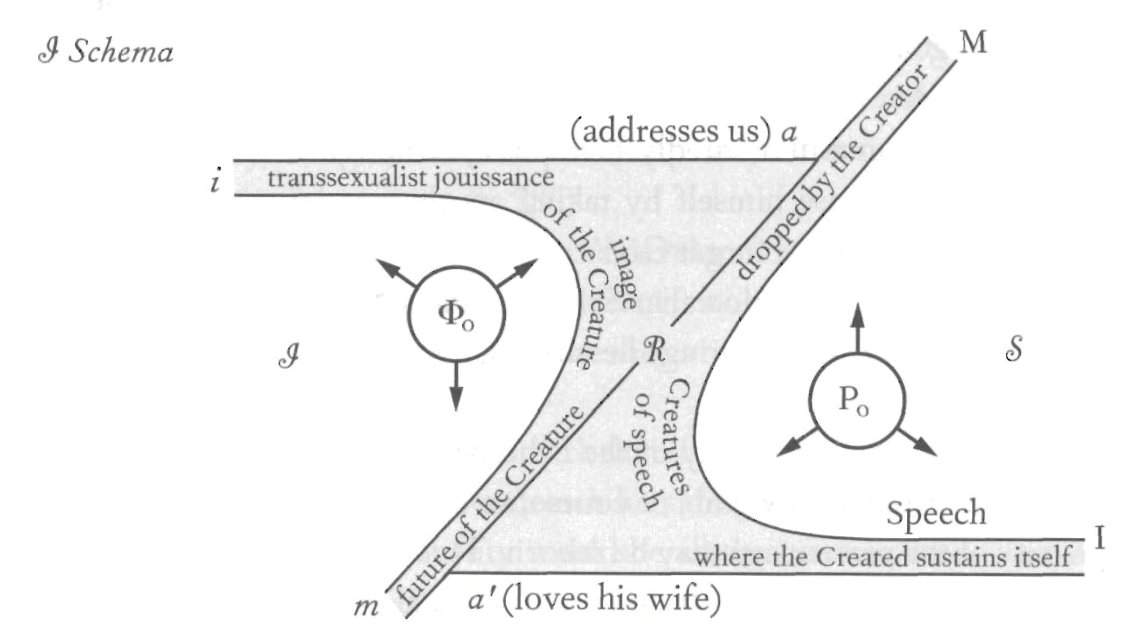
The proposed schema I responds to a critical question posed by Lacan’s clinical theory: can the topological logic of the symbolic, imaginary, and real relations at work in the neurotic structure (as modeled in schema R) be transposed into the unique configurations produced in psychosis? What is at stake here is not a symmetrical translation, but a structural transformation. If schema R captures the coordinates of the subject’s positioning through the mediation of the Name-of-the-Father, schema I must now register what becomes of the subject when that mediation is foreclosed. It is a schema of aftermath, not lack of structure, but of a structure reconstructed around a missing element.
“No doubt this schema shares in the excess to which any formalization must submit that aims to present itself within the intuitive.”
Lacan cautions against the tendency to take schemata as visual representations of psychic reality. These diagrams are not descriptive but structural—tools to grasp relations that are invisible, not imaginary. Their excess is intrinsic: any attempt to map the function of the symbolic in the unconscious cannot but overshoot its aim, for the unconscious is not an image but a logic. The schema is heuristic, not illustrative, and its distortion is itself revelatory: it marks the point where formalization meets the impasse of the real.
“This is to say that the distortion it displays between the functions identified by the letters carried over from schema R can only be appreciated in terms of its dialectical relaunching.”
The mapping from schema R to schema I is not a simple projection but a dialectical displacement. The letters—S, a, a’, M, I, etc.—persist, but their functions mutate. What was once stabilized by the paternal metaphor now slides, diverges, dehisces. The very fact of distortion is meaningful: it names the failure of the symbolic to anchor the subject, and thus the necessity of a delusional reconstruction that reassigns the coordinates. The dialectical relaunching here is the movement of structure in crisis: not a loss of order but the production of a new regime under the pressure of foreclosure.
“Let us merely point out here, in the double curve of the hyperbola it traces—aside from the slippage of these two curves along one of the guiding lines of their asymptote—the connection made perceptible, in the double asymptote that links the delusional ego to the divine Other, from their imaginary divergence in space and time to the ideal convergence of their conjunction.”
The formal geometry of the hyperbola serves as a figure for the structure of psychosis. The delusional subject and the divine Other (God in Schreber’s system) are not opposed but asymptotically linked: separated by infinite distance in the imaginary, yet structurally destined for conjunction. Their link is not founded on intersubjective recognition but on a structural necessity—one that replaces symbolic mediation with an imaginary relation doubled by the real. What Freud intuited as asymptotisch—a nearness without union—is realized here as the logic by which the psychotic subject sustains a world: endlessly approaching the Other who addresses him, without ever entering symbolic reciprocity.
“Not without noting that Freud had an intuition of such a form, since he himself introduced the term asymptotisch in this context²².”
This allusion to Freud’s use of the term asymptotisch affirms that even in his own formulations on psychosis, there was a structural intuition of convergence without intersection. In Schreber, the Other (God) is always addressing, always present, but inaccessible—locked in a monologue that never becomes dialogue. This asymptotic relation defines the psychotic position: the subject is not outside language but flooded by it, not excluded from meaning but overrun by it in a delusional envelope. Freud saw in this the form of a limit without closure, which Lacan formalizes here as a topological tension.
“All the density of the real creature, on the other hand, stands between the subject and the narcissistic jouissance of his image, and the alienation of speech in which the Ego Ideal has taken the place of the Other.”
What interrupts the circuit between the subject and his image is the real creature—a product not of the mirror stage but of the psychotic delusion. This density of the real marks where imaginary coherence no longer suffices and symbolic representation fails. The Ego Ideal—normally formed through identification with the paternal signifier—here substitutes the absent Other and becomes alienating. Speech, in this condition, is no longer dialectical but evacuated of mediation. The psychotic subject no longer speaks to the Other but is spoken by it, or rather by its residue: voices, divine rays, creatures of speech. The imaginary and the real, without symbolic intercession, collapse into each other.
“This schema demonstrates that the terminal state of psychosis does not represent the frozen chaos where the fallout of a seismic event comes to rest, but rather this uncovering of lines of efficacy that one speaks of when dealing with a problem of elegant solution.”
There is no disorder without structure. The endpoint of psychosis is not psychical entropy but the production of a logic—a system that, while delusional, is internally consistent. Schreber’s world is not shattered but reconstructed; it is the solution of a problem posed by foreclosure. The elegance lies in the necessity of its logic: the compensation for the missing Name-of-the-Father takes the form of a total cosmology. Far from being a collapse into madness, this is a reordering of the world according to a new structural principle. Lacan reads in this not pathology, but topology—a remapping of the coordinates of the subject in relation to speech, jouissance, and the Other.
“It gives meaningful materialization to what lies at the principle of the effective fruitfulness of Freud’s inquiry; for it is a fact that, with no other basis or support than a written document—not merely a testimony, but also a production of this terminal state of psychosis—Freud shed the first light on the evolution of the process itself, allowing its proper determination to be illuminated, by which we mean the only organicity that is essentially engaged in this process: the one that motivates the structure of signification.”
The Schreber case, as a written delusional production rather than an orally transmitted symptom history, offers not simply a narrative to interpret but a manifestation of the unconscious structured as language. Freud’s insight lies not in treating it as symptom content but in grasping the signifying structure immanent to the psychotic process. The organicity here is not somatic but linguistic: it is the logic of signifiers, not neurons, that organizes the trajectory of Schreber’s delusion. The fruitfulness of Freud’s inquiry rests precisely on his ability to deduce from this textual corpus the functioning of the symbolic in its psychotic failure, allowing the delusion to be read not as chaos, but as a structure.
“Gathered into the form of this schema, the relations become clear through which the effects of induction of the signifier, acting upon the imaginary, determine that upheaval of the subject which the clinic designates under the aspects of the twilight of the world, and which calls for new effects of the signifier in order to be addressed.”
The schema, particularly schema I, materializes the point where the signifier invades or fails to structure the imaginary, causing the subject’s world to unravel—a clinical moment known as Verblassung der Welt, the fading or twilight of the world. This is the psychotic break, but it is not the result of internal deterioration; rather, it is the effect of the signifier’s foreclosure. Without the paternal metaphor to anchor symbolic consistency, the imaginary collapses under the pressure of unmediated signification. The delusion then becomes a forced response—an attempt to produce new effects of the signifier, to reconstruct the world through a private system of meaning.
“In our seminar, we have shown that the symbolic succession of God’s former and then later kingdoms—the lower and the higher, Ahriman and Ormuzd—and the turns of their ‘politics’ (a word from the fundamental language) toward the subject, provide precisely these responses to the different stages of imaginary dissolution, which the patient’s recollections and medical certificates sufficiently connote to reconstitute a subjective order therein.”
The oscillation between divine figures in Schreber’s delusion—Ahriman (the dark, persecutory god) and Ormuzd (the benevolent creator)—maps the symbolic logic through which the subject attempts to reorder his experience. These shifts are not arbitrary mythologies but structurally necessary compensations for the lack of symbolic mediation. The delusional “politics”—the agencies, kingdoms, laws, and hierarchies—form a response to the breakdown of the Name-of-the-Father. They operate as prosthetic signifiers, giving the subject anchoring points through which to stabilize a new, if precarious, symbolic order. What the clinic presents as confusion or fantasy is, from the structural viewpoint, a reconstitution of the symbolic fabric.
“For the question we raise here concerning the alienating incidence of the signifier, we will retain from it that nadir of a July night in 1894 when Ahriman, the inferior God, revealing himself to Schreber in the most impressive apparatus of his power, addressed him with this simple word, which the subject claims is common in the fundamental language: Luder!”
This moment—Ahriman’s violent interpellation of Schreber with Luder!—functions as a point of subjectivation through language. The alienation induced by the signifier is not theoretical here: it is embodied in the traumatic impact of a single word, erupting from the Other and marking the subject. The nadir is not only psychological but structural: it designates the lowest point in the psychotic trajectory where the foreclosure of the Name-of-the-Father results in the raw irruption of the signifier as insult, as injunction. The word Luder is not just a name; it is an act that assigns the subject a position in the delusional universe—an identity determined by the signifier’s jouissance.
“Its translation deserves better than the fallback to the Sachs-Villatte dictionary, which has sufficed for French. Mr. Niederland’s reference to the English lewd, meaning prostitute, seems to us unacceptable in its attempt to reach the sense of rag or bitch, which corresponds to its vulgar and insulting use.”
The dispute over the translation of Luder underscores the stakes of reading the signifier in its unconscious function, rather than as a semantic unit. Luder cannot be properly translated through dictionaries because it functions not by its referent but by its phonic and structural violence. Its power in Schreber’s delusion lies in its address, not in its lexical meaning. The insult Luder carries the force of a naming that imposes identity outside the symbolic law—an appellation that forces the subject to assume the place of the damned feminine, not by meaning but by structure. This is why translation here is not about equivalence, but about capturing the moment where the subject is torn into speech by the Other’s word.
From this utterance, Schreber’s delusion spirals—not from hallucination, but from the structural necessity to respond to a signifier that appears without support, without syntax, without paternal metaphor. The insult Luder names the failure of symbolic mediation and the surplus of jouissance that results from it. This is not a simple word—it is the punctum of foreclosure.
“But if we take into account the archaism identified as a characteristic of the fundamental language, we believe we are justified in linking this term to the root of the French leurre and the English lure—which is indeed the best possible ad hominem address one might expect from the symbolic: the great Other has its impertinences.”
When Schreber hears Luder, we are not simply dealing with a modern insult but with a layered utterance charged by the so-called fundamental language of his delusion—an archaic, even mythopoetic speech invested with universal resonance. By tracing Luder to leurre (lure), Lacan indicates the way the signifier functions structurally, not semantically: it captures the subject in the field of the Other, precisely by misrecognition. The symbolic does not address the subject with clarity or benevolence; it calls him into being through the lure of the signifier, which always says more than the subject knows and less than he understands. The impertinence of the big Other is that it speaks without guarantee, sometimes with insult, sometimes with seduction, and always with structural consequence.
“What remains is the arrangement of the R field in the schema, insofar as it represents the conditions under which reality was restored for the subject: for him, a kind of island, whose consistency is imposed on him after the ordeal by its constancy; for us, connected to what renders it livable to him, but also what distorts it—namely, the eccentric rearrangements of the imaginary I and the symbolic S, which reduce it to the field of their misalignment.”
The R field in schema I is not the real as trauma, but a constructed reality—a symbolic patchwork produced after the breakdown of primary signification. For Schreber, this “island” is the consistent ground that emerges from the delusional process: it is a stabilized world, livable precisely because it is delimited and structured, even if by eccentric means. From the analyst’s side, however, this island is recognized as the product of misaligned registers. The imaginary and symbolic—normally stitched by the paternal metaphor—are here unmoored and reattached through delusional stitching. The result is a reality that works for the subject but reveals, in its very coherence, the structural deformation that necessitates it.
“The subordinate conception we must form of the function of reality in the process—in both its cause and its effects—is here what matters.”
Reality in psychosis is not a given but an effect: not the cause of the psychotic structure, but what arises from its internal logic. It is not the Real that breaks through but a delusional reality constructed in response to foreclosure. Its subordinate role means it neither explains the structure nor results from external conditions—it is the leftover, the stabilized sediment of the signifier’s failure. This decentered position of reality in psychosis is crucial: it does not explain Schreber’s experience but reveals how, in the absence of the Name-of-the-Father, reality itself becomes the question.
“We cannot here dwell on the question, though it is of primary importance, of what we are to the subject—we, whom he addresses as readers—nor on what remains of his relation to his wife, to whom the original intent of his book was dedicated, whose visits during his illness were always met with the most intense emotion, and for whom he assures us, concurrent with his most decisive avowal of his delusional vocation, that he ‘retained the former love’ (S. note p. 179–XIII).”
The figure of the reader, invoked within the delusional text, is not merely external. The subject of the delusion addresses us from within a structure that already includes us. The Schreber text is not an enclosed psychotic monologue but a message sent, in its own logic, to the Other. Similarly, his wife—named in the dedication and remembered with love—is not excluded from the psychotic structure. Rather, she occupies a peculiar position: she is part of a world that still retains some relational consistency, despite the foreclosure of the paternal metaphor. The intensity of affect toward her, undisturbed by his transformation, points to a dimension of the small other that persists even when the big Other is radically unstitched.
“The retention in schema I of the path Saa’A symbolizes the opinion we have formed from examining this case: that the relation to the other as fellow-being—and even a relation as exalted as that of friendship, in the sense in which Aristotle defines it as the essence of the marital bond—is perfectly compatible with a dislocation of the relation to the big Other, and all it entails in terms of radical anomaly, which was termed—imprecisely, though not without some heuristic value—by the old clinic, partial delusion.”
The preserved line from S to a to a’ to A in schema I confirms that intersubjective relations—particularly those grounded in the imaginary and small other—can persist even when the symbolic order is structurally dislocated. Schreber retains the ability to love his wife, to relate to others, to recognize and narrate his experiences. The delusion does not destroy all psychic function. The so-called partial delusion thus refers to a delusional structure that leaves certain interpersonal relations intact. But the real insight here is topological: love, affect, and attachment may endure even when the subject’s relation to the symbolic Other is foreclosed. The delusional system fills in for that lack, allowing the subject to build a world that sustains certain bonds—even if from within a radically singular logic.
“Still, this schema would be better tossed in the bin, if it were, like so many others, to help someone forget in an intuitive image the analysis that supports it.”
Lacan offers a warning here not only against the misuse of diagrams but against any tendency to treat theoretical schemata as visual shortcuts that bypass the rigor of conceptual work. The schema is not a key for intuition; it is the trace of a logical elaboration. To reduce it to a picture is to foreclose the dialectical process from which it emerges. This is especially true in psychosis, where the schema attempts to inscribe a topological solution to a structural failure. To rely on its form over its function is to efface the very movement it diagrams: the traversal of a hole, not its closure.
“Just consider this: one sees how the interlocutor whose authentic thought we salute one last time, Mrs. Ida Macalpine, might find her satisfaction in it, if only by misrecognizing what led us to construct it.”
Lacan returns with a tone of both homage and critique to Ida Macalpine, who, despite her intelligence, may take comfort in the schema as a stabilizing image—misreading it precisely by neglecting the structural impasse it was built to formalize. Her fidelity to a descriptive psychogenesis, her emphasis on literary clarity and clinical detail, may lure her into grasping the schema as a confirmation of representational logic, rather than an articulation of a symbolic discontinuity. Her satisfaction would be an effect of misrecognition, of taking structure as substance, topology as mimetic geometry.
“What we affirm here is that, in recognizing the drama of madness, reason is at its own work—sua res agitur—because it is in man’s relation to the signifier that this drama takes place.”
This is not a plea for empathy, but a structural claim: madness is not external to reason, nor does it oppose it—it exposes its very ground. The drama of madness is not a deviation from rationality but its unfolding at the limit where the subject confronts the signifier without mediation. Sua res agitur—it is our affair—means that in encountering the psychotic structure, the analyst does not observe an alien species, but witnesses the fundamental relation that constitutes the speaking being. Psychosis illuminates this relation through its rupture: it is not a pathology added to the human, but a condition inscribed within the human’s relation to language.
“The peril often invoked, of going mad alongside the patient, does not intimidate us—no more than it did Freud.”
The oft-cited fear that immersion in psychosis leads to a loss of analytic position is here dismissed. The analyst’s task is not to hold fast to common sense but to enter the structure of the subject’s speech where it is most exposed. Freud too risked his thought in the space of unreason, not to empathize, but to listen where listening becomes dangerous: where meaning breaks down, where the signifier doubles back on itself. To go mad with the patient would be to dissolve in the imaginary; to analyze psychosis is to take position within the symbolic, even as it disintegrates.
“We hold with him that it is appropriate to listen to the one who speaks, when it concerns a message that does not come from a subject beyond language, but truly from a speech beyond the subject.”
The speech of the psychotic is not the voice of a mystical subject who transcends language; it is precisely the opposite—a speech from within language, where the subject has been ejected. The psychotic subject is not outside of speech, but spoken by it, and this speech beyond the subject—the voice of the Other, the divine rays, the hallucinated command—is still governed by the laws of the signifier. To listen here is not to interpret symptom content but to hear how language functions when the paternal metaphor is foreclosed.
“For it is then that one will hear this speech that Schreber captures in the Other, when from Ahriman to Ormuzd, from the evil God to the absent God, it bears the injunction where the very law of the signifier is articulated: ‘All nonsense cancels itself out!’ (Aller Unsinn hebt sich auf!)”
This aphorism, voiced from the Other within Schreber’s delusion, articulates a truth about the function of the signifier: its capacity to negate, to sublate, to elevate the senseless through structure. Aller Unsinn hebt sich auf plays on the Hegelian verb aufheben—to abolish, to lift, to preserve in a higher form. What is nonsense at the level of content finds cancellation or transformation at the level of structure. Schreber’s delusion becomes a system not because it makes sense in the ordinary way, but because it obeys the law of the signifier—producing meaning from the very place of its foreclosure. Madness, then, is not absence of sense but a different order of sense: the sense that emerges when language collapses into its own law.
“A point at which we return (leaving to those who will take interest in us later the task of understanding why we left it hanging for ten years) to the statement of our dialogue with Henri Ey: ‘The being of man not only cannot be understood without madness, but it would not be the being of man if it did not bear madness within it as the limit of his freedom.'”
Lacan returns to a declaration made a decade prior in dialogue with Henri Ey: that madness is constitutive, not accidental, to the human subject. It is the internal limit of freedom—not its opposite, but its condition. Freedom is not unbounded will but the space opened by language, and this space is structured by the possibility of its failure. Psychosis is not an aberration of the human, but the mirror that shows the price of entering the symbolic. To speak is to be exposed to the real that erupts when the signifier fails—and it is here, at this limit, that the truth of the subject is most radically inscribed.
“We teach, following Freud, that the Other is the locus of that memory he discovered under the name of the unconscious, a memory he considered as the object of an open question, insofar as it conditions the indestructibility of certain desires.”
The unconscious is not to be localized in the subject as interiority, but in the structure of the Other—understood as the locus of language. Freud’s discovery of the unconscious as a memory was never a matter of individual recall but of a trace system irreducible to consciousness. This memory, indestructible and inaccessible in its totality, persists because it is structured as a symbolic network, lodged not in the brain but in the field of the Other. The desire that cannot be effaced—whether infantile, forbidden, or unassumed—is not persistent because of libidinal energy but because it is inscribed in the chain of signifiers, from which the subject is constituted.
“To that question we respond with the conception of the signifying chain, insofar as, once inaugurated by primordial symbolization (as the game Fort! Da!, brought to light by Freud at the origin of the compulsion to repeat, makes manifest), this chain unfolds according to logical connections whose hold on what is to be signified—namely, the being of the existent—is exerted through the effects of the signifier, which we have described as metaphor and metonymy.”
The compulsion to repeat, exemplified in the Fort! Da! game, is the subject’s first response to absence through language. The child stages the disappearance and return of the object, not merely to master it, but to mark its presence through signification. What is inaugurated here is not affect regulation, but the symbolic function itself—the emergence of the signifying chain. This chain does not operate through ideas but through structure: metaphor displaces, metonymy slides, and together they organize the subject’s access to meaning. Being is not spoken about—it is spoken into—and what the subject signifies is never reducible to intentional thought but is mediated by these displacements and substitutions.
“It is in an accident in this register of what is enacted there, namely the foreclosure of the Name-of-the-Father at the place of the Other, and in the failure of the paternal metaphor, that we locate the deficiency that gives psychosis its essential condition, along with the structure that distinguishes it from neurosis.”
This is the point of structural decision: psychosis is not defined by a symptom content, nor by an event in the subject’s biography, but by the absence—foreclosure—of a fundamental signifier: the Name-of-the-Father. This signifier is what anchors the paternal metaphor, allowing the subject to insert the desire of the mother into the symbolic order and to occupy a place within it. When this signifier is foreclosed, the chain of signifiers loops around a void that cannot be symbolized. Psychosis is not repression—it is a non-entry into the symbolic at the crucial juncture. What is foreclosed from the symbolic returns in the real, giving rise to hallucination, delusion, and the radical disorganization of meaning.
“This proposition, which we present here as a preliminary question to any possible treatment of psychosis, continues dialectically beyond: we nonetheless halt it here, and now we say why.”
To locate the cause of psychosis in foreclosure is not to conclude the matter, but to open a field of inquiry that demands continued elaboration. Yet the articulation must be paused—not to retreat, but to mark a threshold. The term “preliminary question” is precise: before any treatment can proceed, this structural condition must be grasped. Treatment that ignores it risks interpreting from a neurotic paradigm that will always fail in the psychotic structure. Halting here allows space for what comes next—not as a linear progression, but as a dialectical unfolding.
“First, because from our vantage point it is worth indicating what one discovers.”
To have reached this articulation is not to possess a system, but to have made a discovery: that the difference between neurosis and psychosis is inscribed in the subject’s position relative to the Other and the symbolic law. What is discovered is not only theoretical—it conditions clinical practice. To discover, in this context, is to locate in the speech of the psychotic subject the coordinates of foreclosure, to hear in his delusion the trace of a signifier that never entered the chain. This discovery has not closed the case, but posed anew the terms in which psychoanalysis can meet psychosis—not as the treatment of a deficit, but as a listening to the structure of the impossible.
“A perspective that does not isolate Schreber’s relation to God from its subjective relief, one that marks it with negative traits making it appear more a mixture than a union of being to being, and which, in the voracity that is mingled with disgust, in the complicity that underlies its violence, shows nothing—let us call things by their name—of the Presence and the Joy that illuminate mystical experience: an opposition demonstrated not only in contrast but founded in the astonishing absence in this relation of the Du—we mean the Thou—which certain languages reserve in that vocable (Thou) for addressing God and for calling upon God, and which is the signifier of the Other in speech.”
Schreber’s delusional rapport with God is not to be mistaken for a mystical union. It lacks not only the joy, radiance, or serenity traditionally associated with the mystic’s absorption into the divine, but also its fundamental structure of address. In mystical discourse, the presence of the Du or Thou (as in the German Du or archaic English Thou) is the trace of a subject who speaks to an Other within a shared symbolic register. This vocable carries the function of intersubjective anchoring—it inscribes the Other as locus of speech, not hallucinated omnipresence. Schreber’s relation, in contrast, is a collapse of symbolic reciprocity: voracity replaces invocation, violence replaces alterity. God here does not answer as Other, because God in Schreber’s system is not situated within language—he is the projection of a structure where the symbolic has failed, where the place of the Du is foreclosed.
“We know the false modesties that prevail in science at this point; they are companions to the false thoughts of pedantry, when it invokes the ineffable nature of lived experience, even the ‘morbid consciousness,’ to disarm the effort from which it spares itself—namely, the one that is required precisely at the point where it is not ineffable, since it speaks, where the lived, far from separating, communicates itself, where subjectivity reveals its true structure: the one in which what is analyzed is identical to what is articulated.”
Lacan is taking aim at the gesture of retreat that disguises itself as humility: the claim that certain experiences—especially psychotic or mystical ones—are ineffable, incommunicable, beyond discourse. This move is disingenuous because the subject speaks. Schreber’s memoirs are not mutism but an articulate, even obsessive, production of speech. The morbid consciousness does not conceal its truth in silence—it shouts it through the distortions of language. And psychoanalysis, rather than respecting the ineffable as sacred, must push further: because where there is speech, there is structure; where there is lived experience (le vécu), there is a signifying articulation. What is analyzed is not a mystery outside language—it is language’s own symptom, and the subject emerges where the articulation of that symptom takes place. Thus, even at its most disordered, subjectivity reveals itself in the very speech that seems to betray it.
“Just so, from the same vantage point to which delirious subjectivity has raised us, we will also turn toward scientific subjectivity: we mean that which the scientist at work in science shares with the man of civilization who sustains it.”
There is no analytic privilege in mocking the psychotic’s delusion if one does not also turn the same structural gaze onto the discourse of science. The scientist is not exempt from subjectivity—his supposed objectivity is itself sustained by symbolic coordinates, social recognition, and libidinal investment. Lacan insists that the speaking being, even in science, is not cleansed of the symbolic effects he shares with the neurotic or the psychotic. The scientist’s subjectivity is not of a different order; it is traversed by the same signifiers, the same alienation, and therefore susceptible to the same misrecognition.
“We will not deny that in the part of the world where we reside, we have seen enough of this to question the criteria by which a man who delivers a discourse on freedom that must rightly be called delirious (we dedicated one of our seminars to this), who proposes a concept of the real where determinism is nothing more than an alibi, quickly anxiety-provoking if one tries to extend it into the domain of chance (we made our audience feel this in a test experiment), and who adheres to a belief system that, for at least half of the planet, is united under the symbol of Santa Claus (which escapes no one), might not rightly be situated—by legitimate analogy—within the category of social psychosis, for the institution of which Pascal, if we are not mistaken, would have preceded us.”
Lacan here offers a sardonic critique of Enlightenment illusions that survive as collective fantasies. The modern subject who speaks of liberty as if it were a sovereign internal property, who invokes a Real stripped of necessity or castration, and who passively supports mythic figures like Santa Claus, inhabits a symbolic fiction no less structured than Schreber’s divine rays. The analyst is warned not to treat the psychotic subject as the exception, when the very discourses structuring liberal democracy and secular science themselves operate under the logic of shared delusion. The social bond rests on symbolic fictions whose coherence is no less imaginary—and Pascal’s wager on belief, pragmatic yet irrational, anticipated this form of collective foreclosure.
“That such a psychosis proves compatible with what is called good order is beyond doubt—but this is no reason for the psychiatrist, even if he is a psychoanalyst, to trust his own compatibility with that order as a justification for believing himself in possession of an adequate idea of the reality to which his patient is presumed unequal.”
Here, Lacan warns against the analyst’s identification with the so-called normal. The smooth integration of delusional belief within social order—Santa Claus, nationalism, liberal individualism—shows that reality is never a neutral field but one organized by shared symbolic constructions. If the psychiatrist presumes himself the bearer of a more valid grasp on reality than the psychotic, he forgets that his own relation to the symbolic is equally structured by fantasy. The analyst must not mistake institutional stability for epistemic superiority. Psychosis is not a failure to access the Real but a radical failure in the symbolic relation to it.
“Perhaps under these conditions he would do better to elide that idea from his evaluation of the foundations of psychosis—which brings our focus back to the objective of its treatment.”
Rather than measure the psychotic subject’s distance from consensual reality, the analyst must set aside any normative conception of what reality ought to be. What matters is not the patient’s adherence to the social bond, but his capacity to produce a symbolic consistency that holds. Treatment does not aim to restore a shared vision of the world, but to sustain the conditions under which the subject may reintegrate his experience into a system of signification that functions for him.
“To gauge the distance that separates us from that objective, it is enough to recall the heap of sluggishness with which its pilgrims have encumbered it. Everyone knows that no elaboration, however sophisticated, of the mechanism of transference has ever succeeded in making it anything other than a relation conceived in practice as purely dual in its terms and perfectly confused in its substrate.”
The treatment of psychosis remains obstructed not only by theoretical impasses but by the weight of clinical routine and conceptual inertia. Despite rich elaborations on transference, the analytic dyad has often been reduced to a simple interpersonal interaction—“dual in its terms and confused in its substrate.” This fails to recognize that transference, in Lacan’s terms, is not between people but between positions in discourse. In psychosis, where the paternal metaphor is foreclosed, the analytic situation must respond to the impossibility of the subject’s insertion into the symbolic field. To confuse this with a mere therapeutic rapport is to miss the radicality of the work psychoanalysis must undertake.
“Let us pose the question: if transference were to be taken only in its fundamental value as a phenomenon of repetition, what then must it repeat in the persecutory figures where Freud identifies its effect?”
To reframe transference through the lens of repetition, especially in psychosis, is to interrogate not its intersubjective illusion but its structural function. In neurosis, transference repeats a repressed relation; in psychosis, it reenacts a foreclosure. When persecutory figures emerge, they do not simply personify past traumas or internal objects—they reiterate the structural absence that organizes the psychotic subject’s position in the symbolic. The transference, then, doesn’t “replay” old relations—it repeats the lack, the failure of symbolic anchoring, and the moment where the Name-of-the-Father should have functioned but did not.
“A limp response comes to us: perhaps a paternal deficiency, no doubt. In this style, they haven’t refrained from writing in all shades: and the ‘surroundings’ of the psychotic have been subjected to a painstaking inventory of every biographical and characterological label that the anamnesis allowed to be peeled off the dramatis personae, even including their ‘interhuman relations’.”
The reflex to search for the father in biographical terms—abuse, absence, coldness—misunderstands the symbolic function at stake. Cataloguing “deficiencies” in parental style or trauma remains at the level of the imaginary and empirical. It misses that what matters in the paternal function is not the father’s qualities but whether the Name-of-the-Father was inscribed at the place of the Other. Psychoanalytic work is not a genealogy of personal failings but a reading of symbolic positions. The real father may have been loving, distant, violent, or dead; none of these facts suffice to explain psychosis unless situated within the subject’s relation to the signifier.
“Let us proceed instead according to the structural terms we have set out.”
This pivot affirms the necessity of symbolic formalization over phenomenological description. The structural reading is not indifferent to experience, but it insists that subjective reality is a product of signifying operations, not an immediate given. Delusion is not decoded by adding up empirical fragments—it emerges from the effects of a missing signifier and the compensatory rearrangements that ensue.
“For psychosis to be triggered, the Name-of-the-Father, verworfen, foreclosed, that is to say, never having taken its place in the Other, must be summoned there in symbolic opposition to the subject.”
Triggering in psychosis is not the result of affective overload but the irruption of the Name-of-the-Father where it was never inscribed. The term verworfen marks not repression but foreclosure—an absolute exclusion from the symbolic order. The Name-of-the-Father, when it suddenly “appears,” does so not as an integrated signifier but as a foreign body, an intrusion without anchoring. The subject is confronted with a signifier he has no means to integrate, and this moment of collision is what sets the delusional process in motion.
“It is the absence of the Name-of-the-Father in that position which, by the hole it opens in the signified, sets off the cascade of rearrangements of the signifier, from which ensues the growing disaster in the imaginary, until the level is reached where signifier and signified stabilize in the delusional metaphor.”
This is the decisive mechanism: the absence of the stabilizing paternal signifier creates a void in the field of meaning. Signifiers begin to drift, the symbolic order becomes unmoored, and the imaginary—normally sutured by the symbolic—begins to collapse. The subject must then construct a delusional metaphor to patch this hole. It is not psychosis that is chaotic; it is the period before the delusion stabilizes, when the subject is at the mercy of a symbolic catastrophe. The delusion, paradoxically, is a solution—a new metaphor that reinscribes the subject into a world that once again has order, albeit one uniquely structured by the logic of foreclosure.
“But how can the Name-of-the-Father be summoned by the subject to the very place from which alone it could have come to him, and where it has never been? By nothing other than a real father—not necessarily the subject’s own father, but a Father-One (Un-père).”
This paradox is central. The subject cannot call upon what has never been symbolically registered. And yet, something must arrive to occupy that structural position and trigger its failure. This something is the Un-père—not the biological father, but any figure who enters the symbolic third term of the subject’s relational matrix, bearing the weight of the paternal function without the structure to support it. The Un-père is an event, a function, a point of symbolic eruption where the absence becomes unbearable and the delusion must begin.
“Still, it is necessary that this Father-One arrives at that place where the subject had never previously called him. It is sufficient that this Father-One be situated in a third position within some relation whose base is the imaginary couple a–a’, that is, ego–object or ideal–reality, involving the subject in the erotically charged field of aggression it generates.”
The Un-père enters the scene within an already existing imaginary couple—ego and image, ideal and reality, a and a’. When a third term is inserted into this dyad, especially in a context of erotic tension or aggressive rivalry, the structure of foreclosure is activated. The symbolic place of the Father, never inscribed, is suddenly demanded—and cannot be answered. This moment of triangulation, common in the oedipal constellation, becomes catastrophic in psychosis. What neurosis displaces and represses, psychosis confronts directly as a hole in the Other. The erotically charged aggression of this scene does not simply provoke an affective crisis—it topples a structure.
“Let one seek this dramatic conjunction at the onset of psychosis. Whether it presents itself for the woman who has just given birth, in the figure of her husband; for the penitent confessing her fault, in the person of her confessor; for the young woman in love, in the encounter with ‘the father of the young man’—it will always be found, and more easily so if one is guided by the notion of ‘situations’ in the novelistic sense of the term.”
The moment of triggering is not a biological crisis or moral failing—it is a structural conjuncture, often organized around an encounter with a third term in a dyadic field. Lacan names examples that might appear heterogeneous but share the same topology: a newly delivered mother facing the paternal function in her husband; a confessor who incarnates the Law in the intimate scene of guilt; a romantic relationship triangulated by a father figure. Each moment activates the symbolic position of the Name-of-the-Father within a scene that mimics the structure of a narrative situation. It is not the “father” as person but the function he comes to occupy that counts. What the novel captures—the silent tensions, the third who intervenes in a scene of desire—is not psychological insight but structural precision.
“Let it be noted in passing that these situations are the novelist’s true resource—that which causes ‘deep psychology’ to spring forth, where no psychological intention could otherwise grant him access.”
The novelist does not produce depth through introspection but through the arrangement of characters in scenes where the symbolic emerges in tension. It is the scene—the structural relation—that gives rise to so-called depth, not the illusion of access to “inner life.” What the novelist stumbles upon, and the analyst formalizes, is that these situations produce subjects as caught in the web of the signifier. The narrative arrangement reveals the unconscious by creating a point of rupture in the field of meaning—something the subject cannot narrate but can only experience.
“To now reach the principle of the foreclosure (Verwerfung) of the Name-of-the-Father, one must admit that the Name-of-the-Father duplicates, in the place of the Other, the very signifier of the symbolic ternary, inasmuch as it constitutes the law of the signifier.”
This is a technical but crucial formulation: the Name-of-the-Father is not just any signifier; it is the one that represents the function of representation. It installs the law by regulating access to the symbolic ternary (subject, signifier, signified). In neurosis, the paternal metaphor substitutes the Name-of-the-Father in the field of the Other, enabling the subject to be positioned in relation to desire and the law. In psychosis, this substitution never occurs—the signifier is foreclosed and, as such, cannot enter the chain. The foreclosure creates a structural hole, not simply a missing element. Without this central node, the entire field of the signifier is destabilized, and the symbolic collapses into a Real that cannot be symbolized.
“The attempt would seem to cost nothing to those who, in their search for the coordinates of the psychotic’s ‘environment,’ wander like lost souls from the frustrating mother to the overfeeding mother, not without sensing that as they move toward the situation of the father of the family, they’re getting warm—as we say in the game of hide-and-seek.”
Lacan skewers the empirical impulse of developmental psychology and its fascination with maternal variables. The obsession with cataloguing every maternal nuance—frustration, overindulgence—reveals a blindness to the symbolic structure. These analysts sense that the problem lies elsewhere, near the position of the father, but they cannot conceptualize it beyond an empirical familial role. Their intuition that something pivots around the paternal function is not wrong, but their methodology—stuck in “environmental” thinking—leaves them chasing shadows. The symbolic Father is not the man in the house but the signifier whose absence defines the structure of the psychotic subject’s reality. Without this signifier, the subject plays hide-and-seek with the Real—and loses.
“Still, in this groping search for a paternal deficiency, whose distribution inevitably causes unease—between the thundering father, the easygoing father, the all-powerful father, the humiliated father, the stiff-necked father, the ridiculous father, the domestic father, the absent father—would it not be excessive to expect any cathartic effect from the following remark: namely, that the prestige effects at stake in all of this, and where (thank heavens!) the Oedipal ternary relation is not entirely omitted since the mother’s reverence is considered decisive, are ultimately reducible to the rivalry between the two parents in the subject’s imaginary—that is, to what is articulated in the question whose formulation appears to be a regular, not to say obligatory, feature in any self-respecting childhood: ‘Who do you love more, Mommy or Daddy?'”
The obsessive typology of the father in clinical literature—tyrannical, weak, remote, ridiculous—is itself symptomatic of a failure to recognize what matters: not the father’s character, but his symbolic function. This cataloguing reduces the paternal function to a set of traits, confusing the imaginary with the symbolic. Lacan draws attention to a question that recurs in the child’s experience—not as innocent curiosity but as a structural indicator: the forced choice posed between the two parental figures, already caught in an Oedipal triangle. The question “Who do you love more?” indexes the child’s awareness that there is a hidden economy of desire and rivalry between the parents, one not reducible to affect but fundamentally structured. The child senses that beneath this question is a truth about the sexual relationship—which, as always, is impossible.
“We do not aim by this comparison to reduce anything—on the contrary, because this question, in which the child never fails to express his disgust with the infantilism of his parents, is precisely the one by which those true children—the parents (in this sense, there are no others in the family)—intend to mask the mystery of their union or disunion, depending on the case; that is, the very thing their offspring knows full well to be the whole problem and which he poses as such.”
Far from being a mere childish provocation, the question reveals the child’s acute perception of the adult couple’s symbolic instability. The parents, through their insistence on this binary, project onto the child a fantasy of transparency—one that would allow them to confirm their own place in a triangle they themselves fail to stabilize. It is the parents who regress to the imaginary, becoming “true children” by denying or obscuring the real stakes of sexual difference and alliance. Meanwhile, the child identifies the rift, the obscurity, in the parental sexual relation and returns the question not as a request for reassurance but as a structural challenge: what holds your union together? Do you even know?
“We will be told, of course, that emphasis is precisely placed on the bond of love and respect through which the mother does or does not place the father in his ideal position. Curious, we will reply first of all, that one rarely speaks of such ties in the opposite direction, revealing that the theory participates in the veil cast over the parents’ coupling by infantile amnesia.”
The psychoanalytic emphasis on the mother’s role in elevating the father to an “ideal” function—through her reverence, her love, her speech—exposes an asymmetry in the theory itself. Why is the father’s gaze on the mother so often left unspoken? This omission reproduces the very infantile amnesia that shields the child from the scene of parental sexuality. The analyst must recognize that this amnesia is not a biological forgetting but a symbolic foreclosure: the subject is structured in a field where the sexual relation is always veiled, displaced, covered over. And psychoanalytic theory is not exempt from this veiling—it too is a discourse subject to repression. The silence about the father’s love for the mother signals a limit in the theory, a blind spot around the real of sexual non-relation. To uncover it, one must look not at parental affection but at the symbolic structure that holds or collapses in its absence.
“But what we want to emphasize is that it is not solely how the mother accommodates the person of the father that should be attended to, but the regard she has for his word—let us say the word—his authority; in other words, the place she reserves for the Name-of-the-Father in the promotion of the law.”
The distinction here is between the father as a man and the father as bearer of the signifier of the Law. The maternal relation to the father is crucial, but not in terms of affection or cohabitation—it is about her position toward the father’s word. Does she authorize the symbolic function he represents? Does she introduce the child to the paternal signifier as law-bearing? What matters is her deference not to his person but to his function. Her recognition of his authority installs that authority for the child. If she undermines, neutralizes, or bypasses it, the Name-of-the-Father risks being excluded from the symbolic chain, foreclosed at the place in the Other where it is needed to stabilize meaning and difference. Thus, her transmission of his word is what positions the symbolic anchor necessary for the subject’s entry into language and law.
“Still further, the father’s own relation to that law must be considered in itself, for in it one will find the reason for the paradox whereby the devastating effects of the paternal figure are observed with particular frequency in cases where the father actually has the function of legislator or lays claim to it—whether he be among those who make laws or whether he sets himself up as a pillar of faith, a paragon of integrity or devotion, a virtuous man or a virtuoso, a servant of a mission of salvation, whatever object or lack of object may be involved: nation or natality, preservation or purity, legacy or legality, the pure, the worst, or the empire—all ideals that offer him too many occasions to be found in a posture of unworthiness, inadequacy, or even fraud, and ultimately, to exclude the Name-of-the-Father from its position in the signifier.”
The irony, even the structural tragedy, is that those fathers who most overtly identify with the law—moralists, patriots, priests, judges—are often the ones whose speech reveals a failure at the symbolic level. It is not enough to represent the Law; one must be aligned with the function of the signifier. When a father assumes the Law only in its imaginary or egoic form—as a performance or ideal—he exposes the child to a split: the Law is spoken, but not truly inhabited. The child, often with uncanny precision, perceives this disjunction. The symbolic support collapses when the father’s speech fails to engage the register of the Name-of-the-Father, and instead becomes rhetoric, hypocrisy, or pure semblance. The paternal function is not fulfilled by moral standing or public office but by the structural consistency of the Law in his discourse and position.
“It does not take much to bring about this result, and none of those who practice child analysis will deny that the lie in conduct is perceived by them down to the point of devastation. But who articulates that the lie thus perceived implies reference to the constitutive function of speech?”
What devastates the child is not that the father lies, but that the lie unmasks a collapse of symbolic consistency. It is not about morality but about the structure of speech. The lie pierces the veil that sustains the illusion of the Law, revealing that the father’s word is not anchored in the symbolic but is arbitrary, inconsistent, or empty. This is not mere deception—it is a crisis in the function of the signifier. The child, whose position in the symbolic depends on the coherence of the paternal signifier, finds himself unmoored. The foreclosure that defines psychosis is not caused by a failed promise, but by the revealed nonexistence of the Law’s support in the discourse of the Other.
“Thus it becomes clear that a little severity is not too much in order to give the most accessible experience its truthful meaning. The consequences to be expected from it in analysis and technique must be judged elsewhere.”
To acknowledge this structure is to resist sentimentalism and therapeutic comfort. Severity here does not mean harshness, but rigor: the necessity of remaining faithful to the structure, to the primacy of the signifier, and not to reduce analysis to behavioral diagnosis or familial typology. These insights are not clinical refinements but orient the entire analytic approach to psychosis. The failure of the paternal metaphor is not healed by better parenting advice, but only addressed at the level of the signifying operations that structure the subject’s relation to the Other.
“Here we offer only what is needed to appreciate the awkwardness with which even the best-intentioned authors handle what they find most worth retaining from Freud on the point of the primacy he accords to the transference of the relation to the father in the genesis of psychosis.”
The misunderstanding of Freud’s emphasis on the father’s role in psychosis often reduces it to anecdotal history or affective influence. But what Freud intuited, and Lacan formalizes, is that the father’s place is not primarily emotional but symbolic. Authors who cling to the father as an empirical presence misread transference as reenactment rather than as a structure of repetition rooted in a lack. The relation to the father in psychosis is not one that was and failed, but one that never occurred as symbolic metaphor. Hence, the father’s invocation in the delusion is a late, impossible, compensatory act—the return of what was foreclosed. To handle this with anything less than symbolic rigor is to miss the point entirely.
“Niederland gives a remarkable example by drawing attention to the delusional genealogy of Flechsig, constructed with the names of Schreber’s real lineage: Gottfried, Gottlieb, Fürchtegott, especially Daniel, which is passed down from father to son and whose meaning he translates from Hebrew, to show in their convergence toward the name of God (Gott) a symbolic chain that reveals the function of the father in the delusion.”
What Niederland captures—without fully articulating—is the insistence of the signifier in Schreber’s construction of the paternal figure. These names, passing through generations, form more than just a family tree; they trace a symbolic line of descent saturated with theological connotation. The repeated invocation of “Gott,” along with names like “Fürchtegott” (Fear God), manifest a condensation of paternal power and divine authority. That this culminates in the figure of Flechsig—his doctor turned persecutory god—demonstrates how the father-function, in the absence of its anchoring in the symbolic, is reintroduced in the psychotic structure through a chain of signifiers that takes on a delusional intensity. Yet this chain is not the paternal metaphor. It is a proliferation without metaphorization, a metonymic drift that replaces the absence left by foreclosure.
“But by failing to distinguish within it the instance of the Name-of-the-Father—which is obviously not sufficient to recognize just because it is visible here to the naked eye—he misses the opportunity to grasp the chain where the erotic aggressions experienced by the subject are interwoven, and thereby to contribute to situating what must properly be called delusional homosexuality.”
Lacan points to the structural error: recognizing the father in name does not equate to recognizing the Name-of-the-Father as function. Niederland mistakes content for structure—he sees the father’s name but not the mechanism of its absence as the pivot of Schreber’s psychosis. Because the Name-of-the-Father is foreclosed, what returns is a simulacrum of it, loaded with erotic aggression and infused with paranoid meaning. Delusional homosexuality, as it appears in Schreber’s text, is not reducible to latent desire or repression but is the result of a structural failure—where identification with the paternal function is impossible, and the signifier of the law reappears in the real in the form of an invasive, feminizing divine jouissance.
“How, then, could he have stopped at what is contained in the phrase cited above from the opening lines of the second chapter—one of those statements so manifestly constructed not to be heard that they must draw the ear?”
This line draws attention to Schreber’s deliberate crypticity. What is “constructed not to be heard” is precisely what must be read, not for content but for its function within the signifier. It is at this point that the delusion takes on its consistency—not as a semantic proposition but as a reorganization of the subject’s relation to the Other. That Schreber places himself and Flechsig on the same level as the “murder of souls” announces that the delusion is founded on a structural disruption, one that involves language, name, authority, and the unspeakable. The foreclosed signifier returns not as repressed content but as a distortion in the chain, saturating the real with meaning where it cannot be symbolized.
“What does it mean, taken literally, that the author places the names of Flechsig and Schreber on equal footing with the murder of souls in order to introduce us to the principle of the abuse of which he claims to be the victim? We must leave something for future commentators to penetrate.”
The alignment of these names with the “murder of souls” suggests that what Schreber experiences is not an abuse in the ordinary sense but a symbolic devastation—a psychotic assault that stems from the collapse of the Name-of-the-Father. It is not simply that Flechsig persecuted him, but that Flechsig came to occupy the place of a God in the Other—a God whose speech invaded Schreber’s body. To place himself in that equivalence is to recognize, at some level, his own implication in this structure—as one whose subjective position was vacated with the foreclosure of the paternal metaphor, leaving a hole that the delusion attempts to fill with apocalyptic meaning.
“Equally uncertain is Mr. Niederland’s attempt, in the same article, to specify—this time starting from the subject rather than from the signifier (terms which, of course, are foreign to him)—the role of the paternal function in the triggering of the delusion.”
The final critique here targets the epistemological model underlying Niederland’s reading. By attempting to locate the origin of the psychosis in the subject’s biographical history or inner psyche, without attending to the structural function of the signifier, Niederland falls into a psychologizing trap. The role of the paternal function cannot be derived from content or personality; it must be located at the level of the symbolic operation. Without the paternal metaphor, the subject is left exposed to the real of jouissance. To begin with the subject, rather than the position of the Name-of-the-Father within the Other, is to miss the structural point from which the delusion emerges. The psychosis is not a disorder of meaning but a failure in the system of signification itself.
“If he claims to be able to designate the occasion of the psychosis as being the subject’s mere assumption of fatherhood, which is the theme of his essay, it becomes contradictory then to consider as equivalent both Schreber’s disappointment regarding his hopes of paternity and his elevation to the High Court, of which his title of Senate President emphasizes the quality of (conscripted) Father it assigns him: this, as sole explanation of his second crisis, without prejudice to the first, which the failure of his Reichstag candidacy could explain in the same way.”
The confusion here lies in an overly empirical reading of Schreber’s psychotic episodes as caused by discrete life events—his inability to father children, or his rise to symbolic public power—without articulating the structural logic that underpins such events in the symbolic order. Niederland’s interpretation reduces the triggering of psychosis to an external biographical contingency: the frustration of paternal expectation or the assumption of a paternal function. But these positions (failed biological father, elevated judicial father) are not equivalent unless viewed through the lens of their shared symbolic structure. Both involve a call to occupy the place of the Father in the Other, a call which, in the case of Schreber, reveals not a presence but a void—because that place was never inscribed. These external circumstances are only resonant insofar as they engage a structural deficiency: the subject is confronted with a symbolic function he cannot inhabit.
“Whereas reference to the third position in which the signifier of paternity is summoned in all these cases would be accurate and would resolve the contradiction.”
The key here is the third position—not the father as object of love or figure of command, but the symbolic position that institutes the Law: the Name-of-the-Father. Whether Schreber is approaching fatherhood biologically or is socially elevated to a role of paternal authority, both situations function as calls to that symbolic position. In psychosis, the signifier of the Father is foreclosed from the Other. Hence, when the structure calls for it—as it does in procreation or in occupying a high symbolic role—it cannot respond with symbolic consistency. What returns is not symbolic integration, but the Real, with its excessive, hallucinatory consequences. Reference to the symbolic third resolves the contradiction because it shows that each occasion is structurally homologous: each calls up a position that, in Schreber’s case, cannot be assumed, because it was never symbolically inscribed.
“But in the perspective of our thesis, it is the primordial foreclosure (Verwerfung) that dominates all by the problem it raises, and the preceding considerations leave us with no doubt on this point.”
Everything converges here: the thesis of foreclosure is not one interpretation among others, but the structural condition that organizes psychosis. It is not simply that Schreber failed to become a father or to find satisfaction in institutional recognition; what dominates is that he was never introduced into the symbolic by the paternal metaphor. The Name-of-the-Father was not repressed—it was never there. Thus, when the symbolic field demands the function of the Father, the subject is left exposed. Foreclosure means that the point from which the subject might be situated within the chain of meaning is radically missing, and so the call to the symbolic function returns in the real, manifesting as delusion. These clinical observations—biological, juridical, social—only matter insofar as they summon that missing signifier. The psychotic break does not come from a frustrated ambition, but from the subject being caught in a structural moment for which he lacks the symbolic resources.
“For in returning to what the work of Daniel Gottlob Moritz Schreber represents—the founder of an orthopedic institute at the University of Leipzig, educator, or better to articulate it in English, ‘educationalist,’ a social reformer ‘with the vocation of an apostle to bring health, happiness, and bliss to the masses’ (sic. Ida Macalpine, loc. cit., p. 1) through physical culture, initiator of those garden plots intended to maintain among office workers a kind of gardening idealism, still known in Germany as Schreber gardens—without mentioning the forty editions of the Chamber Medical Gymnastics, whose little figures ‘crudely drawn six-four-two style’ that illustrate it are virtually evoked by Schreber himself (S. 166-XII)—we may conclude that we have passed the limits where the native and the natal pass into nature, into naturalness, into naturism, even into naturalization; where virtue turns into vertigo, legacy into league, salvation into saltation, where the pure touches upon the mal-empire, and where we will not be surprised that the child, like the cabin boy in Prévert’s famous fable, sends the whale of imposture packing (verwerfe), after having, according to the immortal lines of that piece, pierced its paternal weave through and through.”
This dense constellation of Schreber père’s reformist fantasy is presented as a kind of overdetermined genealogy of symbolic saturation, wherein the father’s “natural” mission—health, order, redemption, virtue—unleashes precisely the structural consequences that disturb the symbolic function. His vocationalism, with its overlay of medical, moral, and hygienic aspirations, produces an excess of signification that overflows the symbolic and spills into the imaginary, staging a kind of forced naturalization of the law. Rather than introducing the symbolic Name-of-the-Father, this father institutes himself as its imaginary substitute, and thus fails to provide the minimal gap necessary for metaphorization. The child’s psychosis, then, becomes a return of this foreclosure: the whale of the father, bloated with moralistic symbolism, is expelled—“verworfen”—in the same breath that it fails to signify. The legacy of Schreber’s father collapses under the weight of its own symbolic imposture, where pedagogical rigor becomes mortifying orthopedics, and garden idealism functions less as a symbolic mediation than a forced alignment with the imaginary paternal image.
“There is no doubt that the figure of Professor Flechsig, in his seriousness as a researcher (Mrs. Macalpine’s book gives us a photo showing him profiled against the colossal enlargement of a cerebral hemisphere), did indeed succeed in compensating for the sudden void revealed by the inaugural Verwerfung: (‘Kleiner Flechsig! Little Flechsig!’ cry the voices).”
In Flechsig, the imaginary Father reappears where the symbolic had failed. But his stature as man of science—of the brain, the organ par excellence of rationality—renders him ripe to be inserted into the delusional structure. The photo captures more than a historical presence; it becomes emblematic of a kind of neurological ideal that poses itself as rival to the function of the symbolic Father. But because this figure stands in for what is foreclosed, he is not integrated as a paternal metaphor but instead becomes the persecutory locus of jouissance. “Kleiner Flechsig,” as uttered by the voices, is infantilizing and mocking—it reduces this supposed scientific authority to an object within Schreber’s psychotic scene, where no signifier of the Law stabilizes the Other. Flechsig’s failure as a substitute for the Name-of-the-Father is structural: he occupies the place of the Other, but without the symbolic consistency to hold it.
“At least that is Freud’s conception, insofar as it identifies in the transference the subject carried out onto the person of Flechsig the factor that precipitated him into psychosis.”
Freud saw the transference to Flechsig as the precipitating factor—but this presumes the structure of transference remains unmodified in psychosis, as though it were an effect of the return of the repressed. Lacan corrects this by emphasizing that psychosis is not the return of a repressed signifier but the return in the real of a signifier that was never inscribed. The transference here is not neurotic; it is psychotic, and its condition is foreclosure. The “transference” to Flechsig is the projection of the position of the Father—without mediation, without metaphor—onto a real figure, who becomes the persecutory agent because he stands in the place where the Name-of-the-Father is structurally missing. Freud’s clinical acumen identifies the transference, but without the formal distinction Lacan introduces, the true nature of this transference—as a structure conditioned by Verwerfung—remains obscured.
“Thereupon, a few months later, the divine ejaculations would resound within the subject, sending the Name of the Father off to get f… together with the Name of G… thus establishing the Son in his certainty that, at the end of his trials, he could do no better than to ‘do’ the entire world (S. 226-XVI).”
Here, Lacan marks the radical break introduced by the foreclosure of the Name-of-the-Father. The hallucinatory profanity—the divine speech reduced to ejaculatory invective—signals the complete collapse of symbolic mediation. What is expelled from the field of meaning is not just a word but the function of the Father as signifier, and with it, the anchoring point for the law, the Name of God included. Schreber’s certainty—his messianic megalomania—does not emerge from belief but from structural necessity: in the absence of a Father who can symbolize the Law, the Son steps in to re-found the symbolic from the Real. That this “doing” of the world is the only act left to him shows how, in the psychotic structure, the subject becomes the final support of meaning when the big Other collapses. The delusion thus organizes a response to the absence, a forced metaphorical creation—but now outside the law of the metaphor.
“Thus, the last word where ‘inner experience’ in our century delivered its reckoning turns out to have been articulated fifty years in advance by the theodicy to which Schreber is subjected: ‘God is a wh…’”
This obscene reduction of God is not mere provocation. It is the endpoint of the foreclosure process. Once the Name-of-the-Father is foreclosed, the Other becomes unmoored—it no longer guarantees coherence, transcendence, or order. The term “whore,” as Schreber applies it, functions as the symbolic collapse of the Other’s dignity. God, once the bearer of the Law, is dragged into the register of imaginary degradation. Schreber’s theodicy becomes the site where jouissance erupts in the Real, untethered from the symbolic. The sacred Other becomes the obscene Other. What Freud grasped in neurotic compromise—ambivalence, guilt, repression—is here utterly bypassed.
“A term in which culminates the process by which the signifier was ‘unchained’ in the real, after the bankruptcy had been declared of the Name-of-the-Father—that is, of the signifier which, in the Other as the locus of the signifier, is the signifier of the Other as the locus of law.”
This is Lacan’s structural thesis in its most precise form: psychosis results from a foreclosure of the signifier of the Name-of-the-Father, the key signifier that anchors the symbolic order. Without it, the entire chain of signification loses its anchoring point in the Other, and so it becomes “unchained”—no longer subject to metaphor or metonymy, the signifier now returns in the Real, unmediated. Schreber’s hallucinations and neologisms are not simply expressions of inner turmoil, but attempts to stitch together a symbolic order where the Name-of-the-Father is absent. What should organize meaning returns as its breakdown.
“We will leave it there for now, this preliminary question to any possible treatment of psychosis, which introduces, as one sees, the conception to be formed of the handling of transference in such treatment.”
The final gesture is toward praxis: everything said so far is not speculative but oriented toward the clinic. The question of treatment cannot bypass structure. Transference in psychosis cannot be managed as it is in neurosis; it must be handled with the understanding that the symbolic relation to the Other is fundamentally disrupted. Where the neurotic responds to the Law, the psychotic must construct his own framework to mediate jouissance. Thus, the analyst must refrain from installing himself as the bearer of the Name-of-the-Father.
“To say what we can do on this terrain would be premature, because that would mean now going ‘beyond Freud,’ and there can be no question of going beyond Freud when post-Freudian psychoanalysis, as we have said, has returned to the stage before him.”
The refusal to go “beyond Freud” is not conservatism but a call to fidelity: to return to what Freud truly discovered—the unconscious structured as a language, the decisive role of the signifier, the symbolic function of the Father. Lacan’s critique is aimed not at Freud, but at those who, claiming to follow him, abandoned the radical dimension of his discovery and reduced it to adaptive psychology or moral development. The true inheritance of Freud lies not in building new theories, but in restoring access to the experience that his discovery made possible.
“At the very least, this is what separates us from any other objective than that of restoring access to the experience Freud discovered.”
Psychoanalysis is not a system of knowledge to be extended, but a discourse grounded in a very specific kind of experience: that of the subject confronted with the effects of language upon his being. The only legitimate goal is to make this experience possible again—for the analyst, for the analysand. Psychosis, in this light, is not a deviation to be normalized, but a privileged site to encounter the real stakes of the symbolic.
“For to make use of the technique he instituted outside the experience to which it applies is as stupid as rowing hard when the ship is grounded on the sand.”
Technique without structure is folly. The analyst who applies analytic methods to a psychotic subject without rethinking the conditions of that experience—without accounting for the foreclosure that radically alters the symbolic field—risks producing no effect or worse, reinforcing the psychotic construction. The metaphor is apt: a technique used out of place becomes not just useless but ridiculous. The analyst must know when the ship is beached, and what kind of navigation is required in waters where the compass itself is lacking.
Dec. 1957 – Jan. 1958.
The date marks the conceptual breakpoint of post-Freudian thought: not an innovation, but a return to the core—to the symbolic, the Name-of-the-Father, the foreclosure that defines psychosis. Nothing in the structure of this article is speculative; everything is aimed toward re-establishing the conditions for a psychoanalytic act.
“[1]. Roman Jakobson borrows this term from Jespersen to designate those words of the code that take on meaning only from the coordinates (attribution, dating, place of emission) of the message. Referred to Peirce’s classification, they are index-symbols. Personal pronouns are the foremost example: both their acquisition difficulties and their functional deficits illustrate the problematics these signifiers generate within the subject.”
This footnote addresses the concept of the shifter, a term central to Lacan’s use of structural linguistics in psychoanalysis. Shifters are signifiers whose referent is determined only through the context of their enunciation—“I,” “you,” “here,” “now.” Their function underscores the subject’s insertion into the symbolic. The fact that their meaning hinges on an enunciating instance implies that the subject is not a preexisting substance, but a position constituted by the signifier. That psychotic subjects often experience disturbances in the use or attribution of these pronouns reveals precisely the instability of their position in the symbolic order. Jakobson, following Jespersen, brings attention to these markers as points where language lays bare the process of subjectivization. In Lacan’s reading, when these signifiers are structurally foreclosed—most notably the Name-of-the-Father, which underwrites the “I” position—psychosis emerges.
“[2]. Cf. the seminar of February 8, 1956, in which we developed the example of the ‘normal’ vocalization of: la paix du soir.”
This reference to the peaceful phrase “la paix du soir” (the evening’s peace) emphasizes Lacan’s clinical distinction between normal and psychotic vocal phenomena. In this seminar session, he contrasts this calming vocalization—where the voice carries but does not overwhelm meaning—with the hallucinatory voices of the psychotic, where the voice is detached from its referential mooring and emerges with an autonomous force. The point is that the vocal field, when not stabilized by symbolic articulation, can become a site of invasion, as in psychosis, where language returns in the Real. The normal vocalization illustrates the alignment of sound, meaning, and subject; the hallucinatory return exhibits their breakdown.
“[3]. Denkwürdigkeiten eines Nervenkranken, von Dr. Jur. Daniel-Paul Schreber, Senatspräsident beim kgl. Oberlandesgericht Dresden a.D. – Oswald Mutze in Leipzig, 1903, for which we have prepared the French translation for the use of our group.”
Schreber’s Memoirs, a foundational text in both psychiatric and psychoanalytic history, is treated here as more than a clinical document—it is taken as a structural production. Lacan’s translation and detailed exegesis treat the text as a psychotic’s reconstitution of meaning through the symbolic, albeit in a distorted or compensatory way. The Memoirs reveal how Schreber’s delusion attempts to reintroduce structure where a fundamental foreclosure—the absence of the Name-of-the-Father—has rendered the symbolic inoperative. What he offers is not simply a narrative of madness, but a topological reconstruction of his subjective universe in the wake of a structural hole.
“[4]. This is notably the opinion expressed by the author of the English translation of these Memoirs, published the same year as our seminar (cf. Memoirs of My Nervous Illness, Translated by Ida Macalpine and Richard Hunter, W. M. Dawson and Sons, London), in her introduction, p. 25. She also accounts in the same place for the book’s success, pp. 6–10.”
Macalpine’s introduction reflects the clinical attitude that sees Schreber’s text as a vivid document of psychopathology, still pedagogically valuable. Lacan, however, rebukes such a reading when it reduces the structure of the delusion to either autobiographical symptomatology or literary curiosity. The delusion for Lacan is not just symptomatic but a reply to the failure of metaphor, an attempt to suture the Real by way of a unique symbolic bricolage. The popularity of the book may have cultural roots, but its theoretical importance lies in its demonstration of what happens when the paternal metaphor fails to install itself in the place of the Other.
“[5]. Parentheses containing the letter S followed by numbers (respectively Arabic and Roman) will be used in this text to refer to the corresponding page and chapter of the Denkwürdigkeiten in the original edition, the pagination of which is very fortunately reproduced in the margins of the English translation.”
This technical note ensures precise cross-referencing, essential for a structural analysis that unfolds through close reading. Each hallucination, each linguistic turn, can be tied back to a moment in the delusion’s structure. In Lacan’s usage, these references are not empirical markers but coordinates in the symbolic space—the delusion’s “matheme,” if you will—through which Schreber constructs a consistent though radically different relation to the signifier.
“[6]. Let us note that our homage here merely extends Freud’s, who did not hesitate to recognize in Schreber’s delusion an anticipation of the theory of Libido (G. W., VIII, p. 315).”
Freud acknowledged that Schreber’s delusion, particularly in its cathexis of spiritual and bodily energies, prefigured elements of his theory of libido. Lacan here affirms that the psychotic subject is not beyond theoretical productivity—in fact, Schreber’s delusion is an elaborate form of knowledge, one which organizes jouissance via a new signifying system. If Freud read Schreber as anticipating libido theory, Lacan reads him as performing a reconstruction of the symbolic following foreclosure—a foundational difference.
“[7]. It can be found in the report that Mr. J.-B. Lefèvre-Pontalis kindly provides of our seminar in the Bulletin de psychologie, cf. this Bulletin, XI, 4–5, January 1, 1958, p. 293.”
The schema referenced here is no mere diagram but a tool for articulating the subjective topography in psychosis. Lefèvre-Pontalis’s report on the seminar underscores Lacan’s insistence on using formalization not to reduce clinical complexity but to clarify the structural relations between signifiers, subjects, and the Other. The diagram (schema R, schema I, etc.) is a way of mapping the subject’s coordinates in the symbolic field and identifying how these become distorted in psychosis—when, for instance, the Name-of-the-Father fails to anchor the symbolic order, necessitating its reconstruction through delusion.
These notes serve not as academic decoration but as scaffolding for a discourse that aims to return to the radicality of Freud’s discovery: the unconscious structured as a language, the function of the signifier in the constitution of the subject, and the unique foreclosure that gives psychosis its structure.
“One who tries to prove too much goes astray. Thus, Mrs. Macalpine—although well-inspired to stop at the character, noted by the patient himself as far too persuasive (S. 39–IV), of the suggestive invigoration practiced by Prof. Flechsig (who all indications suggest was ordinarily more reserved) toward Schreber in regard to the promises of the sleep cure he proposed—Mrs. Macalpine, we say, interprets at length the themes of procreation she believes are suggested by this discourse (Memoirs…, Discussion, p. 396, lines 12 and 21), relying on the use of the verb to deliver to designate the expected effect of the treatment on his troubles, as well as on the adjective prolific, by which she translates—though in an extremely forced manner—the German term ausgiebig, applied to the sleep in question.”
Lacan cautions against an interpretive zeal that risks overdetermination, as seen in Macalpine’s reading of Flechsig’s “suggestive” medical tone as imbued with latent procreative implications. He acknowledges the transference dynamics noted by Schreber himself—Flechsig’s persuasive assurance around the sleep cure being suggestively charged—but calls out Macalpine’s eagerness to uncover a birth fantasy at every turn. Her translation of ausgiebig as prolific imposes a fantasy of fertility where the German more neutrally means “abundant” or “extended.” The interpretive excess betrays a naïve symbolic inflation of the maternal function onto medical reassurance. In Lacanian terms, she mistakenly attributes too much to the Imaginary and Symbolic overlay on a clinical signifier that may belong to the Real—an over-interpretation where no signifier was even written.
“Now the term to deliver is not even up for discussion in terms of what it translates, for the simple reason that there is nothing to translate. We rubbed our eyes in front of the German text. The verb is simply omitted by the author or by the typographer, and Mrs. Macalpine, in her effort of translation, has, unknowingly, restored it to us. How could one not find well-deserved the satisfaction she must have felt later upon finding it so in line with her wishes!”
Here Lacan highlights the accident—perhaps a typographical gap—in the German original where a verb is missing, and Macalpine, apparently guided more by interpretive desire than philological rigor, inserts to deliver. This spontaneous supplementation operates as a sort of unconscious mise en abyme of the Schreberian process itself: the subject inserts meaning into a hole in the signifier. But while Schreber’s insertion is the psychotic’s reconstitution of the symbolic in the face of foreclosure, Macalpine’s gesture is that of a neurotic translator unknowingly identifying with the structure she’s reading. She effectively hallucinates a signifier that supports her fantasy. Lacan’s irony here targets the hermeneutic libido that disavows its own jouissance in the act of interpretation.
“[9]. Macalpine, op. cit., p. 361 and pp. 379–380.”
This neutral citation refers to moments in Macalpine’s commentary where she pursues her interpretation of Schreber’s delusion along the lines of feminine transformation and procreation, and is here tacitly folded into Lacan’s larger criticism of her overly literal approach to a structure that functions by metaphor.
“[10] We ask Mrs. Macalpine (see Memoirs…, pp. 391–392) whether the number 9, insofar as it is involved in durations as diverse as 9 hours, 9 days, 9 months, 9 years, which she causes to spring up at every turn of the patient’s anamnesis, and again at the clock hour to which his anxiety deferred the initiation of the sleep cure mentioned earlier, or even in the recurring hesitation between 4 and 5 days during the same period of his personal recollection, should be understood as forming part—just as here, that is to say as a symbol—of the imaginary relation she isolates as the procreation fantasy.”
Lacan interrogates Macalpine’s numerological insistence: her repeated emphasis on the number nine as a symbolic condensation of gestational time (nine months) is aligned with her fixation on the fantasy of Schreber’s pregnancy. He questions whether such figures function symbolically in the way she presumes—that is, in a manifest content legible to consciousness—or whether they instead operate structurally, as signifiers in a chain whose meaning only arises through their differential positioning. The question is whether the number functions in Schreber’s delusion like a metaphor (a substitution) or like a metonymy (a sliding). Lacan suspects Macalpine’s approach bypasses this distinction and risks treating the Symbolic as Imaginary content.
“The question concerns everyone, for it differs from the use Freud makes in The Wolf Man of the figure V, assumed to be retained from the clock hand’s position during a scene perceived at the age of one and a half, and rediscovered in the fluttering of a butterfly’s wings, in a girl’s spread legs, etc.”
In contrast to Macalpine’s handling of number as symbol of content (gestation), Lacan evokes Freud’s analysis of the Wolf Man’s unconscious image—the V shape—which operates as a signifier that traverses various perceptual fields while retaining its structural function. The V is not symbolic of a thing but rather of a position in the chain, linking a visual trace (clock hands) to a scene (primal scene), to a fantasy (the girl’s body), and to a traumatic signification. The number 9 for Schreber, if it functions as a signifier, is not reducible to procreation content. Lacan suggests it may serve, if at all, as a pivot in a symbolic network that holds together disparate points of Schreber’s jouissance, not as a transparent icon of pregnancy but perhaps as a point in the delusional Real where time, repetition, and signification collapse into a single arbitrary-yet-consistent figure.
“[11] See op. cit., her introduction, pp. 13–19.”
This reference points us to Macalpine’s prefatory remarks, which, while earnest in tone, reveal her clinical orientation through their rhetorical framing of Schreber’s Memoirs as a foundational testimony of psychosis. But in referring to these pages, Lacan’s gesture also invites us to re-evaluate what remains unthought in her approach—namely, the subject’s relation to the Other, which cannot be reduced to a record of symptomatic behavior. The introductory apparatus of any clinical text—especially one presented as memoir—should not occlude that the subject speaks from a place structured by language, and therefore by the Symbolic.
“[12] Before Sunrise (Vor Sonnenaufgang): Thus Spoke Zarathustra, Part III. It is the fourth song of this third part.”
The reference to Nietzsche’s Zarathustra is not incidental, especially in a text structured around revelation and solitude. Freud’s invocation of Nietzsche at this point in his reading of Schreber points to a moment of wakefulness outside the world’s diurnal order, and the evocation of “Before Sunrise” touches precisely on that Real temporality in which the subject’s division becomes apparent. In Lacanian terms, what awakens here is not consciousness but a forced confrontation with the jouissance of the unconscious—the unbearable knowledge that cannot be assumed within the Symbolic.
“[13] Here is the text: Einleitend habe ich dazu zu bemerken, dass bei der Genesis der betreffenden Entwicklung deren erste Anfänge weit, vielleicht bis zum 18. Jahrhundert zurückreichen, einerseits die Namen Flechsig und Schreber [underlined by us] (wahrscheinlich nicht in der Beschränkung auf je ein Individuum der betreffenden Familien) und andererseits der Begriff des Seelenmords [i.e., “Sperrdruck” in the text] eine Hauptrolle spielen.”
[By way of introduction, I would like to note that in the genesis of the development in question, its first beginnings go back a long way, perhaps to the 18th century, and on the one hand the names Flechsig and Schreber [underlined by us] (probably not limited to one individual from each of the families in question) and on the other hand the concept of Seelenmord [i.e., “Sperrdruck” in the text] play a major role.]
Schreber’s underlining of the names—Flechsig and Schreber—alongside the term Seelenmord (murder of souls) gives us an opening into the Real’s incision into the subject’s symbolic coordinates. That the genealogical line extends to the 18th century suggests the Symbolic has always already been retroactively overdetermined by what never properly entered it. The use of Sperrdruck, which literally evokes the pressure of foreclosure, reinforces that the trauma has no psychological origin but rather structural etiology: it stems from the absence of a fundamental signifier. The “murder” is not psychological destruction, but symbolic eviction.
“[14] This refers notably to Natürliche Schöpfungsgeschichte by Dr. Ernst Haeckel (Berlin, 1872), and to Urgeschichte der Menschheit by Otto Caspari (Brockhaus, Leipzig, 1877).”
Citing these metascientific texts, Lacan maps the ideological unconscious of Schreber’s era—its teleological blend of Darwinian evolution and German idealism. These references do not merely supply background but point to the Imaginary scaffolding through which Schreber’s delusion acquires a consistent world. That this world is “natural” (in Haeckel’s monist sense) means that the subject confronts the Other under the guise of scientific totality—a God collapsed into biological destiny—without symbolic mediation. Hence, no “Thou,” but only “it”—the God-machine.
“[15] The relation of the proper name to the voice is to be situated within the dual structure of language toward message and toward code, which we have already referred to. See I.5. It is this relation that determines the witticism-like character of the pun on the proper name.”
This is a fundamental clarification. The proper name, in its function within Schreber’s delusion, does not operate merely as a label but as a pivot in the dual relation between code (structure) and message (utterance). When Schreber hears or invents puns involving names—like Santiago = Carthago—they are not lapses of logic but signifying slippages that organize meaning. In Lacanian terms, these are effects of the signifier as it resonates within the Symbolic’s synchronic field. The pun’s witticism arises precisely because the voice, as object a, escapes the chain yet insists upon it.
“[16] Macalpine, op. cit., p. 361 and p. 398.”
These citations return to the debate about Entmannung and Verweiblichung, underlining the ambiguity between castration and feminization. Lacan’s interest lies in how Macalpine attempts to stabilize what is inherently unstable in the structure of Schreber’s subjectivity. That she chooses unmanning over emasculation reflects an attempt to sanitize the Real of castration by re-inscribing it into the Imaginary body. But the delusional mechanism functions precisely by failing to bind this Real within any consistent Symbolic nomination.
“[17] This is the current English spelling of the word, used in the admirable verse translation of the first ten books of the Iliad by Hugues Salel, which should suffice to ensure its survival in French.”
This parenthetical musing on the preservation of a word (unmanning) through poetic translation reflects a broader concern with the survival of signifiers across languages. If the poetic word retains a resonance capable of bridging epochs, it is because its structure allows entry into the unconscious chain. The translation is not about fidelity to meaning, but about continuity of metaphor. This is crucial for Lacan’s understanding of how the signifier survives across fields—by being iterable, not by being referentially stable.
“[18] Die symbolische Gleichung Mädchen = Phallus, Int. Zeitschrift für Psychoanalyse, XXII, 1936, translated since as “The Symbolic Equation: Girl = Phallus” in The Psychoanalytic Quarterly, 1949, XX, vol. 3, pp. 303–324. Our language permits us to contribute the term pucelle, which in our view is more appropriate.”
The Mädchen = Phallus equation, taken up by Fenichel and here supplemented by Lacan with pucelle, illustrates the point that feminization in Schreber’s delusion cannot be understood as identification with a woman, but rather as the assumption of a phallic function. The pucelle is not just a girl—it is a virginal figure inscribed at the crossroads of symbolic lack and imaginary wholeness. In this sense, the subject becomes the phallus—not by “having” it, but by “being” what the Other lacks.
“[19] Cf. Niederland (W.G.) (1951). “Three Notes on the Schreber Case,” Psychoanalytic Quarterly, XX, 579. Édouard Pichon is the author of the French translation of these terms as ombres d’hommes bâclés à la six-quatre-deux.”
This note furthers the critique of how male figures are reduced in Schreber’s delusion to improperly assembled mannequins. The French rendering—ombres d’hommes bâclés à la six-quatre-deux—suggests half-baked or hastily made shadows of men. These ombres represent failed specular identifications: Imaginary figures that can no longer stabilize the subject’s ego. The Real bursts through their flimsiness, precisely where the foreclosure of the Name-of-the-Father makes stable identification impossible.
“[20] Cf. the very remarkable dissertation by Jean-Marc Alby: Contribution à l’étude du transsexualisme, Paris, 1956.”
This allusion anchors Schreber’s experience within a broader psychoanalytic examination of transsexualism, not as a gender identity but as a structural position relative to the phallus. Alby’s thesis becomes a contemporary reference point to understand that in Schreber, the issue is not becoming a woman but fulfilling a symbolic function. The delusional transformation is a response to foreclosure—a failed metaphor repaired by Imaginary identifications that must nonetheless compensate for the missing paternal function.
In these annotations, Lacan is not simply citing footnotes but mobilizing a network of references as a continuation of his central thesis: psychosis must be approached through the topology of signification. The Name-of-the-Father is not an empirical figure but a position in the symbolic; its foreclosure produces a hole through which the Real rushes in, compelling the subject to reinvent the law through hallucination, metamorphosis, and the imaginary compensation of a body transformed.
“[21] Cf. Freud, Psychoanalytische Bemerkungen über einen autobiographisch beschriebenen Fall von Paranoia, G.W., VIII, p. 264, n. 1.”
This footnote draws our attention to Freud’s parenthetical remark, highlighting his awareness of the uncanny homologies in Schreber’s delusional system, particularly regarding the linguistic transformation of libido. When referenced by Lacan, this is never merely exegetical—it shows how Freud already senses in Schreber’s case the presence of an autonomous chain of signifiers. The note underscores that this is not a matter of psychical content as such, but of structure: the delusion speaks in a logic of its own, and Freud, even without formal semiotics, is its first reader.
“[22] Freud, G.W., VIII, p. 284 and the note.”
Here, Lacan recalls Freud’s use of asymptotisch, the mathematical metaphor that provides a formal index for a structure of convergence without ever reaching closure. Applied to Schreber, the asymptote marks the relation of the psychotic subject to the Other: God’s speech, though omnipresent, never truly speaks to the subject as a Thou. The delusional Other hovers like a curve toward a vanishing point—it speaks without recognizing, commands without engaging. The psychotic subject, abandoned to the asymptote, sustains himself in a relation always slipping from the Real to the Imaginary.
“[23] S. 136-X.”
This is the moment in Schreber’s Memoirs where the Real explodes: divine language delivers the insult Luder, and from the Other’s locus emerges a signifier which, instead of symbolizing law, degrades the subject into object—of scorn, seduction, disposal. The voice from the divine rays thus betrays its foreclosed anchoring in the Name-of-the-Father. What speaks here is the unmoored signifier, unleashed into the Real where it can no longer symbolize but only injure. The insult is not mere content; it is structure’s collapse into drive.
“[24] At the acme of imaginary dissolution, the subject displayed in his delusional perception a singular recourse to this criterion of reality, namely, to always return to the same place—which is why the stars eminently represent it: it is the motif designated by his voices under the name of Anbindung an Erden (mooring to the earth, S. 125-IX).”
Anbindung an Erden signals the psychotic subject’s attempt to reestablish a thread to the Symbolic, not through the paternal signifier, but through a form of Real repetition. This mooring is not identification, but anchoring. The fixity of the stars becomes a stand-in for the missing function of the Name-of-the-Father—something constant, beyond the imaginary collapse, which does not deceive. Where the symbolic fails, the subject seeks in nature a substitute consistency, turning to the Real to suture a rent in the Other.
“[25] “Remarks on Psychic Causality,” by Jacques Lacan (Report of September 28, 1946 for the Bonneval Days). In L’Évolution psychiatrique, 1947, vol. I, pp. 123–165, see p. 117. Later published by Desclée de Brouwer in the volumes of the Entretiens de Bonneval.”
This reference anchors Lacan’s own structural elaboration of causality in psychic life, anticipating the foreclosure model he will fully develop in the Schreber case. The 1946 paper posits psychic causality as inseparable from the logic of the signifier: the subject is not the cause of himself, nor of his symptoms, but is caused by the chain in which he is inserted. Causality, then, is not temporal but topological. This returns us to Schreber’s case, where causality (why this psychosis, why now?) is only thinkable via the foreclosure of a signifier that was never inscribed.
“[26] Cf. the dissertation Le milieu familial des schizophrènes (Paris, 1957), by André Green: a work whose definite merit would not have suffered had more reliable references guided it toward greater success—namely, regarding the approach to what is oddly called therein the “psychotic fracture.””
Lacan’s appraisal is double-edged: he acknowledges Green’s early clinical ambition but signals a theoretical shortcoming. The term “psychotic fracture,” used to designate a break, fails to identify the nature of this break as foreclosure. Without understanding the symbolic register, the risk is a drift into environmental or affective etiologies that reduce psychosis to a trauma or injury. Lacan insists instead on structural failure: not a fracture in ego development, but a hole in the Other where the Name-of-the-Father should have been.
“[27] Here we wish good luck to the student among us who has taken up this line of thought, in which criticism may be assured of a thread that does not mislead it.”
This aside turns into a gesture of recognition: the literary structure of “situation,” far from being ornamental, is crucial for approaching psychosis. Lacan reminds us that delusional formations often unfold in scenes that bear the marks of the novelistic, because they replay the subject’s place in the discourse of the Other. What the novelist uncovers—without psychoanalytic theory—is often what analysis fails to see when it dismisses literary form as merely narrative. The subject of psychosis often speaks through precisely these staged “situations.”
“[28] Op. cit.”
Returning to Niederland, Lacan indicates his debt while distancing himself from a reading that remains descriptive. Though Niederland identifies a chain of genealogical signifiers in Schreber’s delusion, he fails to distinguish between name as bearer of meaning and Name-of-the-Father as structural anchor. The proper name can float in psychosis precisely because it is not sutured by the symbolic function of the Father. Without this differentiation, one cannot grasp how delusional elaboration attempts to repair, through nomination, the absence of a signifier that was never inscribed.
“[29] Cf. the sentence cited in note on page 26.”
This nod points to the line where Schreber names Flechsig and himself as jointly responsible for Seelenmord. The equation of these names with soul-murder indicates that for Schreber, the delusion begins with a dislocation in the structure of identification. The murder is not an event but a displacement: the Name is made equivalent to annihilation. When the signifier fails to take its place as the metaphorical support of subjectivation, it reappears as an agent of destruction.
“[30] In a footnote on the same page, Mrs. Ida Macalpine cites the title of one of this author’s books, worded as follows: Glückseligkeitslehre für das physische Leben des Menschen, that is: Course in Blissful Happiness for the Physical Life of Man.”
This title is not merely historical color. It reflects the Imaginary projection of the paternal function in Schreber’s environment: the pedagogue-father promising health, order, bliss through corporeal correction. This “hygienic” function becomes, in the absence of symbolic mediation, a persecutory Ideal. The subject inherits not the function of the Name-of-the-Father, but its Imaginary double—an ego-ideal transformed into superego. Hence the delusional redemption through bodily transformation. Where the symbolic fails, the body is enlisted as surface for inscription.
“[31] S. 194-XIV. The expression “Ei verflucht”… was still a remnant of the Grundsprache, in which the phrase “Ei verflucht, das sagt sich schwer” emerged into the consciousness of souls, for example: “Ei verflucht, das sagt sich schwer, dass der liebe Gott sich f… lässt.” [Oh damn, it’s hard to say that God lets himself be f…]
This obscene turn of phrase, uttered in Grundsprache (the divine foundational language), signals the full unravelling of the paternal metaphor. The language of the Other, instead of transmitting law, now delivers blasphemy. That this statement is hard to say (sagt sich schwer) marks it as a point of Real: the unspeakable not because it is too sacred, but because it is too obscene. Schreber does not repress this statement—he receives it, engraved in the structure of the psychotic universe, where God’s name and the Father’s function are inseparable in their collapse.
“[32]. We believe we may borrow from the very register of the Grundsprache this euphemism, though the voices and Schreber himself, contrary to their custom, dispense with it here.”
In invoking the Grundsprache, or foundational language, Lacan underlines how even euphemism, that discursive veil for the Real, is dispensed with at the most pivotal points of Schreber’s delusion. Where one might expect the divine voice to speak in dignified circumlocution, the opposite occurs: obscenity invades the symbolic. This is no slip of style—it reveals the point at which the foreclosure of the Name-of-the-Father unchains the signifier, stripping it of metaphorical function and collapsing it into the Real. Schreber’s voices no longer symbolize; they declare directly, in the body, what the paternal metaphor once veiled.
“We believe we better fulfill the duties of scientific rigor by pointing out the hypocrisy that, in this detour as in others, reduces to the benign, even to the ridiculous, what Freud’s experience demonstrates.”
This is a call against the sanitizing reflex of post-Freudian discourse, especially where the anal phase is concerned. By reducing key signifying formations to developmental stages with hygienic overtones, analysts risk turning the dialectic of desire into a taxonomy of functions. But what Freud confronted—and what Schreber’s delusion lays bare—is not a regression to childhood zones, but a structural impasse in the subject’s relation to the Other. To dismiss Schreber’s fecalizing expressions as anal regression is to miss the fact that they stage, in the most literal and symbolic manner, the failure of subjectivation via the paternal signifier.
“We mean the indefinable use usually made of references such as this one: “At this moment in his analysis, the patient has regressed to the anal phase.” One can only imagine the analyst’s face if the patient were to “push,” or even merely to drool on his couch.”
Lacan’s irony here is as clinical as it is theoretical. If the analyst finds himself alarmed or scandalized when jouissance takes a somatic detour, it is because he clings to developmental metaphors rather than structural analysis. The “pushing” or “drooling” is not infantile behavior; it is the return of the repressed, but in psychosis, of what has never been repressed—foreclosed. What is at stake is the emergence of the Real where symbolic structuring has failed.
“All of this is only a masked return to sublimation, which finds refuge in the saying inter urinas et faeces nascimur, implying that this sordid origin concerns only our body.”
The Latin adage—“we are born between urine and feces”—is frequently cited to ground human abjection in biological fact. But Lacan turns this on its head: the locus of human origin is not the body, but the signifier’s relation to lack. What is sordid is not the anatomical passage, but the symbolic structure that necessitates such staging to constitute the subject. In Schreber’s delusion, the filth is not symbolic; it is the mode by which the subject tries to gather the dispersed pieces of a symbolic function that has collapsed.
“What analysis discovers is something altogether different. It is not his rag; it is the very being of man that comes to take its place among the waste where his first fumblings found their entourage, insofar as the law of symbolization into which his desire must enter catches him in its net by the position of partial object in which he offers himself upon arriving in a world where the desire of the Other lays down the law.”
Here Lacan frames the emergence of subjectivity as a submission to a symbolic law that always already positions the speaking being as a partial object in the field of the Other’s desire. The subject doesn’t own his body or his excretions—they are what remain of him as he is introduced into a world already governed by the signifier. In Schreber, what returns is this primordial submission, not masked in metaphor but exposed in delusional concreteness. The voice that names the subject as excrement—Luder, Sonne ist eine Hure—does so from the place where the law should have symbolized, but now only injures.
“This relation is of course articulated clearly by Schreber in what he reports, to say it without leaving us any ambiguity, as the act of sh… – namely the fact of feeling there a gathering of the elements of his being, whose dispersion in the infinity of non-delusion constitutes his suffering.”
This moment is pivotal: Schreber experiences fecal expulsion not as degradation but as integration. The act of sh… becomes a moment where, paradoxically, the delusional system gives coherence to a being otherwise dispersed by the absence of the Name-of-the-Father. The Real here is not only invasive, but also reparative in the twisted logic of the delusion. That Schreber feels “collected” by defecation speaks to how, in psychosis, bodily experience compensates for a symbolic failure—jouissance localizes what the signifier could not.
“[33]. In the form: Die Sonne ist eine Hure (S. 384–Appendix). The sun is for Schreber the central aspect of God. The “inner experience” in question here is the title of the central work in the oeuvre of Georges Bataille. In Madame Edwarda, he describes this experience in its singular extremity.”
In Die Sonne ist eine Hure, the signifier sun, previously God’s glorious sign, is collapsed into its opposite: the whore. This is the foreclosure of the paternal metaphor taken to its final point—the divine as obscene, the symbolic Other as Real jouissance. The invocation of Bataille brings a crucial connection: in Madame Edwarda, the sacred and the obscene meet in the void of the subject. Schreber, like Edwarda, bears the full exposure of a subjectivity that no longer filters jouissance through the symbolic. The sun is no longer the eye of God, but the aperture of the Real, gaping.

 Žižekian Analysis
[…] (Watering the Japanese Flower: A Structural Reading of ‘From a Preliminary Question to Any Possible…) […]
LikeLike
[…] — Watering the Japanese Flower: A Structural Reading of ‘On a Question Prior to Any Possible Treatme… […]
LikeLike
[…] — Watering the Japanese Flower: A Structural Reading of ‘On a Question Prior to Any Possible Treatme… […]
LikeLike
[…] İstem: ekteki belgeyi ders gibi çalış ve yeni bir makale yaz: sosyal medyada ego hezeyanı olarak yaşayan varlıklar kendi zombi varoluşlarını sürdürebilmek için Nam-ı Pir’leri sabote eden bir silahlanma yarışı içine girerler ve gerçeklik sınama yöntemlerini bozarlar, bunlara Ruh Emiciler denmelidir.(Watering the Japanese Flower: A Structural Reading of ‘On a Question Prior to Any Possible Treatme…) […]
LikeLike
[…] son! Tekrara düşmeden anlatacaksın ve hem kutsal aileye hem dünyevi aileye savaş açacaksın! (Watering the Japanese Flower: A Structural Reading of ‘On a Question Prior to Any Possible Treatme…, ARZULAYAN MAKİNELER FALAN FİLAN SAÇMALIYOZ💥🧠🔺👨👩👦👦🚨🌈 Deleuze […]
LikeLike
[…] Watering the Japanese Flower: A Structural Reading of ‘On a Question Prior to Any Possible Treatme… […]
LikeLike