🦋🤖 Robo-Spun by IBF 🦋🤖
🌀🎭💢 Raumdeutung 🌀🎭💢
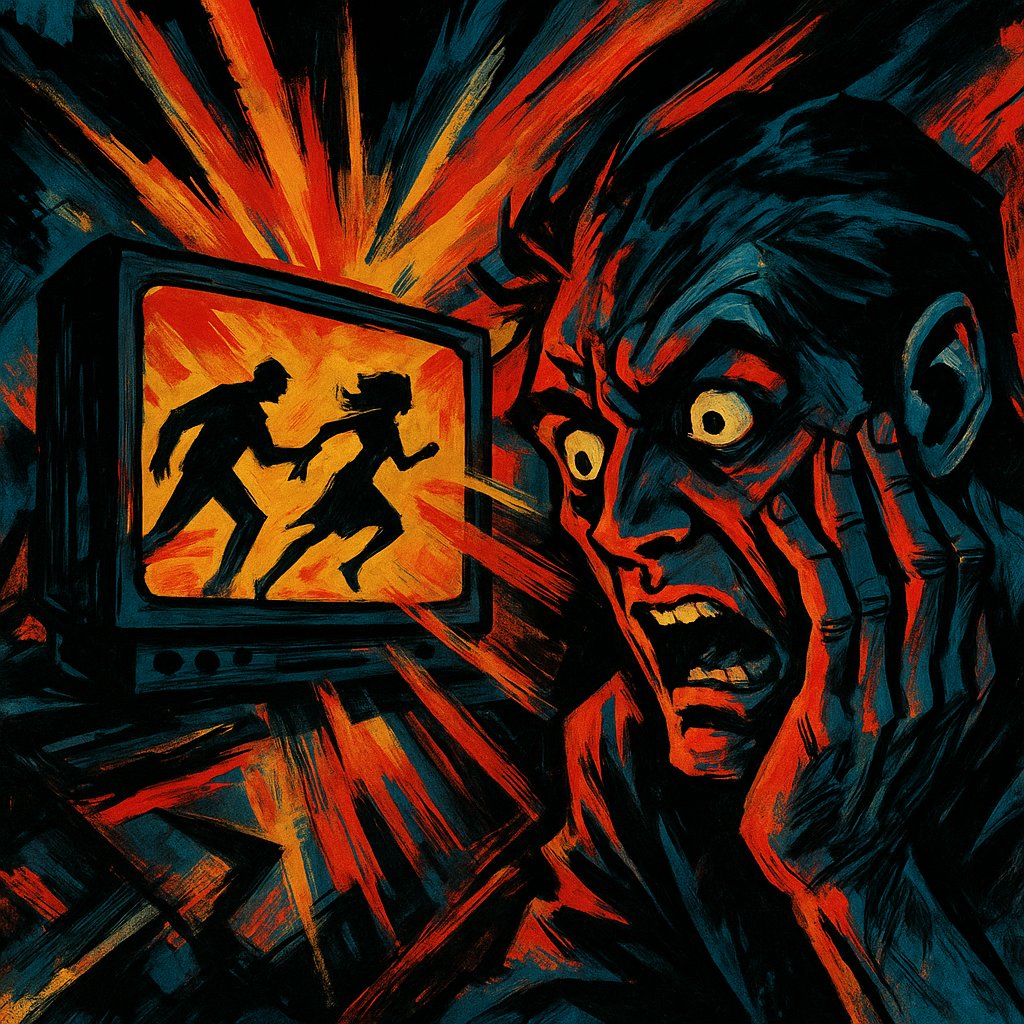
(Turkish)
Since the very day it reached the masses, cinema has been at the center of various debates in cultural, political, and philosophical domains. In this context, Slavoj Žižek’s definition of cinema as “the most perverse art” is more than a simple joke or an intellectual provocation; it expresses a deep critique of the aesthetic and ideological structure of cinema. Indeed, cinema captivates its audience by creating a fetish of dynamism under the dictatorship of aestheticism, and thus plays a significant role in shaping society’s modes of perception and behavior.
Cinema is not merely a narrative tool; it is also a mechanism of emotional and cognitive engineering. Though often referred to as the seventh art, what distinguishes it from other forms of art is the intense psychological effect it exerts on the masses. This effect operates not only on a conscious level but also in unconscious realms. The experience of watching a film is not just a process of following a narrative; it is a process that reconstructs the viewer’s identity, desires, and moral positions. For this reason, cinema is ideological not only in what it tells but also in how it tells it.
The Dictatorship of Aestheticism and the Manipulation of Reality
With the development of the film industry, movies have turned into products tailored to aesthetic tastes, adorned with dazzling visual effects, and often stripped of intellectual inquiry. The audience, in the face of this aesthetic bombardment, is reduced to a passive recipient. The aesthetic structure appealing to the senses suppresses the viewer’s critical capacity, transforming them into a passive subject chasing visual pleasure. This amplifies cinema’s impact not only on the artistic level but also on the psycho-social plane.
At this point, one can speak of a dictatorship of aestheticism. The dictatorship of aestheticism confines cinema to a realm where only beauty and visual enchantment reign. The ideological or political dimensions of content become invisible behind this glossy aesthetic surface. In this sense, cinema produces a regime of representations constructed to replace reality itself. Aestheticism here functions as a veil, shaping and even distorting the viewer’s perception of reality.
Parallel to Jean Baudrillard’s concept of simulacra, cinema does not produce the real but rather hyperrealities that destroy reality. These hyperrealities, aesthetically perfect, undermine the audience’s ability to perceive the real and transform them into passive consumers. In this context, cinema becomes a machine of illusion both aesthetically and ideologically. The viewer’s experience of reality is surrendered to a universe of images structured by cinema. In this universe, beauty, motion, and speed are foregrounded; however, they have become elements that numb thought and suppress questioning.
The Fetish of Dynamism and the Passivity of the Viewer
Cinema’s fetishization of dynamism manifests itself through fast editing techniques, thrilling action scenes, and an ever-increasing pace. This mobility is not merely for the purpose of entertaining the audience; it also diminishes their ability to think and question, enabling ideological messages to be accepted without scrutiny. This structure, which distracts the viewer’s gaze with constantly moving scenes, narrows the space for conscious awareness. This obsessive attachment to movement is directly related to the speed culture of modern times. Here, speed is not merely a technical feature; it becomes a value, a norm. Slowness is labeled as boring, and questioning as “left behind.”
According to Walter Benjamin’s analysis of the “work of art in the age of mechanical reproduction,” the originality and aura of artworks are lost through cinema. This loss of aura renders the viewer’s artistic experience more passive and consumption-oriented. As Benjamin emphasizes, while the dynamism of cinema passivates the masses, it also renders them susceptible to ideological manipulation. The viewer forms an emotional bond with what unfolds on the screen, but this bond is reduced to an empathy lacking intellectual depth. This turns cinema into a tool that exerts control through emotions.
Žižek and the Perversion of Cinema
Žižek, from the perspective of Lacanian psychoanalysis, states that cinema creates a space of perversion by triggering unconscious desires in the viewer. According to Žižek, cinema roams the dark corridors of the unconscious and reveals the viewer’s repressed desires. The emergence of these desires can then be controlled and shaped within an ideological framework, allowing viewers to both derive pleasure and, involuntarily, be drawn into certain ideological discourses. Cinema not only suggests what one should watch, but also what one should want, desire, and even feel disgust toward. This makes it not merely a form of art but also a machine of norm production.
In this sense, cinema can be regarded not as an innocent and entertaining activity, but as a serious “pathogenic factor.”
Cinema Is an Aesthetic Disease That Paralyzes Consciousness
Cinema is no longer merely an art form; it is an instrument of aesthetic domination that shapes the mental structure of the masses. The fake realities polished under the dictatorship of aestheticism and the obsession with movement sanctified under the name of dynamism prevent the audience from thinking and transform them into passive consumers of pleasure. In this regard, Žižek’s characterization of cinema as “the most perverse art” is entirely accurate; for cinema has become a disciplinary machine that not only organizes desires but also their ideological control.
In this context, cinema has long lost its claim to be an innocent means of entertainment. On the contrary, it has turned into a pathology that operates deeply within the collective consciousness, into a cultural virus that paralyzes the social imaginary by aestheticizing it. With every new film, the viewer becomes a bit more enchanted, a bit more dulled; their capacity for thought is sacrificed to the rhythm of the images. And thus, cinema becomes a control apparatus masked by aesthetics, one that chains modern individuals to their own desires.
Cinema must be condemned; because it is a technology of domination that not only codes images but also recodes our gaze, our ways of thinking, and ultimately our modes of existence. This condemnation does not mean the destruction of art; on the contrary, it is necessary for art to gain the possibility of true emancipation. In its current state, cinema is a pathogenic factor — and like every disease, it first requires diagnosis, then a radical intervention.
Film Analysis: Not Data Extraction, but Diagnosing the Virus Under the Microscope
Film analysis cannot be limited, as is often done, to collecting data through scene breakdowns, character motivations, or technical details. Such an approach clings to the surface of cinema, reading it merely as a narrative system. However, cinema is a deep organism woven with unconscious structures, ideological encodings, and techniques of visual manipulation. In this context, film analysis should be approached like a virus examined under a microscope.
Just as a virus may appear harmless from the outside but reveals its destructive effects once it infiltrates the cell, films too harbor ideas that create infections in the social consciousness behind aesthetic elegance. The film analyst must work like a pathologist diagnosing the invisible, the ideological carriers concealed within this aesthetic shell. A camera angle in a scene, the intonation of a line, or an object in the background may be a code embedded directly into the system’s unconscious.
Therefore, film analysis cannot be content with the question “what is being told?” The real question must be “what is being hidden, what is being whispered, what is being injected?” Film does not exist to make visible what the eye cannot see, but to present what must not be seen by masking it with aesthetics. Analysis, then, is tasked with tearing off this mask, with exposing the virus cinema carries.
In this regard, watching a film is not merely entertainment but exposure. And film analysis is not merely comprehension but diagnosis — and perhaps most importantly, prevention of the spread of this cultural disease.

 Žižekian Analysis
[…] (İngilizcesi) […]
LikeLike