🦋🤖 Robo-Spun by IBF 🦋🤖
🪞⚔️👁️ Post-Feminizm 🪞⚔️👁️
⏳⛰️🛡️ Süreç Heval ⏳⛰️🛡️
(Turkish)
The man is speaking. While performing all his revolutionary rage, his pursuit of historical justice, and his rising anti-capitalist consciousness on stage, it’s as if he is chanting a lament. He instills hope in the listener, salutes organized life. And then, without even realizing it, he delegates the sociology of freedom to the “wisdom of women.”
Right at this point, the great rupture begins.
From the call for a “revolution of mentality” to a Jungian metaphysics
The speaker, in defining freedom, constructs a strong social ontology: freedom is the ability of the individual and society to express themselves; it gains meaning through organization. However, at a certain point, this structure subtly shifts onto another axis through an ideological rupture. This rupture becomes most evident in the following lines:
“We can comfortably state that the social energy of women is inclined toward freedom, that the male intellect is a frozen intellect, and that its energy is also frozen, thus leading to slavery and bondage…”
Here, an epistemological exchange occurs. The man is equated with “mental numbness,” while the woman is exalted as an intuitive, archetypal source. Sartre’s proposition that “freedom is a mode of consciousness” is translated through Simone de Beauvoir into a feminine “social energy.” Thus, the philosophical notion of freedom gives way to a myth of internal “feminine truth.” Knowledge is no longer transmitted through consciousness, but through intuition; not through critique, but through “energy.”
This is one of the most characteristic tendencies of Jungian jineology: to construct woman not as a subject, but as a complete and completing totality.
Intuitive femininity or a newly imposed domination by suggestion?
The speaker is so captivated by the epistemic allure of Jungian jineology that, unknowingly, he remystifies Sartre’s ontology of freedom by linking it to a “feminine inner intuition.” Woman is presented as if she is complete. This reproduces woman not as a subjectivity, but as a mythological power.
This mystification centers not on knowledge, but on intuition; not on critique, but on suggestion; not on subjectivity, but on an imagined wholeness. The maternal totality that replaces phallic power is now more dangerous than domination itself. Because it does not dominate—it guides invisibly.
This is no longer an epistemological issue, but a psychoanalytic one. Because in this version of jineology:
Woman is not lacking, but full.
Woman is not a desiring subject, but a figure who provides satisfaction.
Woman does not speak, she declares.
Woman does not rule through lack, but through wholeness.
This structure cancels out the principle of “lack” that Freud defined as the engine of desire. If there is no lack, there is no desire. Therefore, there is no freedom. There is only ideological gratification.
The masquerade of the Phallic Woman: not a subject, but a position
Although the historical figures cited throughout the speech indeed display a genuine will to resist, this will is quickly turned into a fetish of the “moment of freedom.” What is implied is not the ethical and material tension of the practice of freedom, but a mystical “moment of jouissance.” Thus, the struggle is coded not through truth, but through jouissance. The speaker’s language suddenly becomes a libidinal medium. In other words, knowledge here becomes not a theoretical production, but an emotional yield.
The same mystification is instrumentalized in Simone de Beauvoir’s criticism of Sartre:
“From the perspective of Simone de Beauvoir, there is questioning; from Sartre’s point of view, not much questioning develops.”
Here, Beauvoir is not the questioning woman; she is the representative of the feminine intuition that sees differently. That is, her critique is tied more to position than to content: she is right because she is a woman. This constructs not a dialectic, but an arbitrary superiority.
And thus, even Beauvoir is subsumed into the narrative of the Phallic Woman by being interwoven with the subtext of feminine intuition.
The Panopticon of Jineology: unseen prisoners, intuitive wardens
Bentham’s model of the panoptic prison is used in the speech to describe the “hidden domination” of the state and capitalism. Yet, unintentionally, this metaphor begins to describe the knowledge regime of jineology itself.
“The prisoners cannot see the wardens, but the wardens can see the prisoners. The giver is pleased, the receiver is pleased.”
The same structure applies in jineology. The figure equipped with the intuitive wisdom of the Phallic Woman sees the collective, guides with her intuition; but the collective cannot see her. Cannot criticize her. Cannot debate her. Because she already “knows.” She no longer produces knowledge—she surveils. She heals. She governs through intuition. Thus, a kind of emotional panopticon is established.
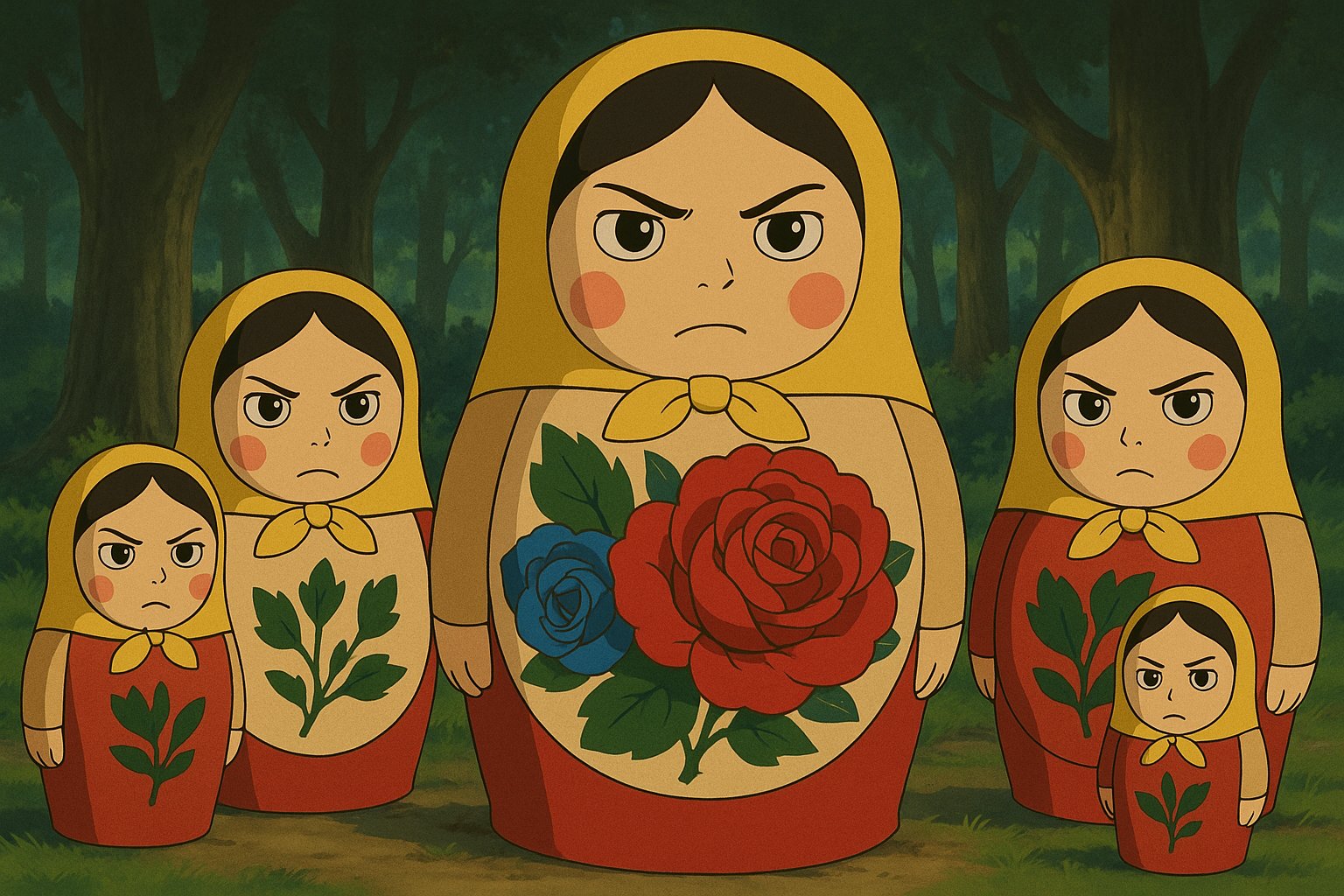
And at this point, the sociology of political freedom transforms into a libidinal matriarchy—each time it is opened, an even more intuitive, more complete, and less criticizable “sacred woman” emerges; just like a jineological matryoshka nested within itself.
Libidinal Discipline Replacing Freedom
Sartre’s statement that “man is freedom” is, in this context, virtually disregarded by the speaker. Because in the speaker’s definition of freedom, there is no subject; there is only the correct position: being a woman, thinking like a woman, being open to feminine energy. In the face of the frozen state of masculinity, what is presented is an intuitive wholeness that “knows everything, feels everything.” Therefore, in place of the positivist masculinity he initially criticized, the speaker installs an erotically charged matriarchal/matryoshka-like domination.
In summary:
The capitalist system establishes discipline through “observation.”
Jineology, on the other hand, directs through “intuition.”
The former is a rational domination; the latter is a mystical form of guidance.
Both manage circulation, not freedom.
Conclusion: The Phallic Woman must fall (as a figure)
The entire speech fills the extremely concrete and historical issue of freedom with a symbolic void by drawing it into Jungian intuitionism. While the frozen state of the male subject is emphasized, “women’s wisdom” is placed into a position of power.
This situation points precisely to what Žižek defines as the “regime of surplus-jouissance”: not the production of knowledge, but of jouissance. Not desire, but satisfaction. Not critique, but aesthetic suggestion.
Therefore:
The Phallic Woman of Jineology is now not merely femininity, but an authority that has replaced knowledge. This authority collapses the domain of desire by denying lack. She does not speak, she declares. She does not know, she feels. She does not debate, she guides.
And right here, Sartre must be recalled. Because human freedom lies in its lack; in its contradictions; in its unending questioning.
Lack must be reclaimed. The unconscious must be recalled. The Phallic Woman must fall—not as woman, but as fantasy.
What must come in her place is the woman who is lacking yet thinking, fragmented yet desiring, speaking yet not directing. In other words: the woman as subject.

 Žižekian Analysis
[…] (İngilizcesi) […]
LikeLike
[…] — Jineological Matryoshka: The Jungian Traps of the Populist Man […]
LikeLike
[…] — Jineological Matryoshka: The Jungian Traps of the Populist Man […]
LikeLike
[…] From here, it is necessary to dialectically question the underlying dynamics of the debates and conflicts within leftist circles today, under the headings of Rojava/PKK/Jineology: repressed desires and deficiencies, the aestheticization of struggle, the tendency of the collective to reproduce itself through myths, and the inertia generated by all these. Based on the incident, we can trace this process across five fundamental dialectical layers [*] [*]. […]
LikeLike
[…] imaginary of wholeness—what psychoanalysis would call the ‘Phallic Woman’ myth [*] [*] [*]. Instead of a Freudian insistence on lack (no subject or movement is complete; desire flows […]
LikeLike