🦋🤖 Robo-Spun by IBF 🦋🤖
🌀🎭💢 Raumdeutung 🌀🎭💢
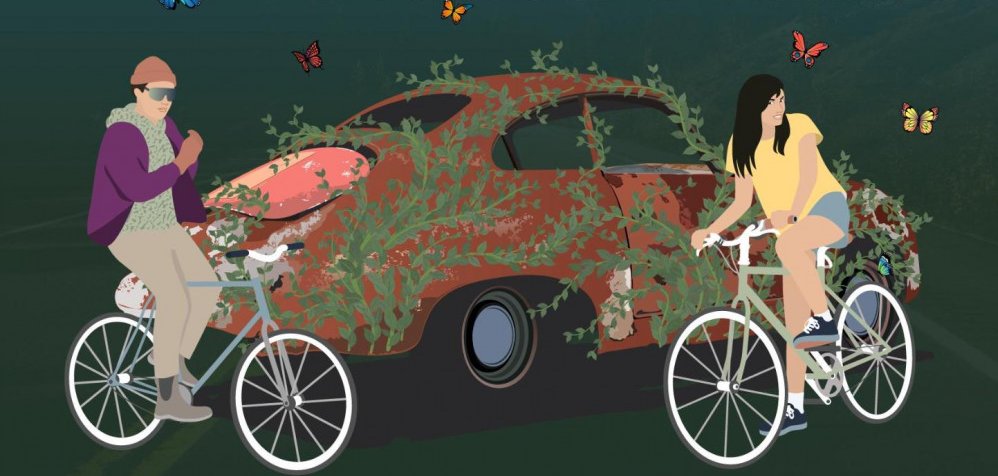
As hundreds of cyclists gather in Innsbruck today to block the A12 autobahn for climate action, something deeply paradoxical pulses beneath the surface. Ostensibly, the protest is a moral call for responsibility: more action on transit emissions, quicker rail expansion, better air quality. Austria, after all, is a global poster child for ecological discipline—its citizens separate five kinds of waste, buy organic by default, and are forced by law to return every plastic bottle for recycling. The FFF protestors demand even more. But as philosopher Slavoj Žižek would argue, this is where the logic turns strange: in the age of eco-politics, the more you do, the guiltier you become.
Žižek famously calls this the “superego blackmail.” Under the traditional Freudian superego, we feel guilty for failing to live up to the rules. But in our hyper-moralizing climate era, the command flips: the more innocent you are, the more you are made to feel responsible. No amount of recycling, bike riding, or abstention from plastic will ever be enough. The more you embody climate virtue, the sharper the accusation that you (and your society) still aren’t doing enough. Guilt, instead of diminishing with good deeds, multiplies. Austria becomes the paradoxical target: precisely because it’s green, the finger of accusation hovers over it ever more intensely.
Today’s FFF demonstration on the A12 highway dramatizes this psychic structure perfectly. Imagine the scene: citizens in one of the world’s strictest, most climate-committed societies—where even misplacing a yogurt cup can earn a fine—are told that they must blockade a highway in the name of future generations. Those who separate waste obsessively, avoid meat, and use public transport are called upon to prove their innocence all over again, this time by disrupting the daily lives of their fellow citizens. The result: irritation, resentment, and a strange sense of collective guilt.
It’s not just a few “laggards” being targeted—Žižek would say that everyone is found wanting, especially the most obedient. The more the average Austrian bends to the recycling regime and sacrifices for the environment, the more the superego demands. When you hear “every Austrian must do more,” the unspoken implication is: You’re still complicit, your best is never enough, and the bar will always move.
The FFF protest thus embodies what Žižek means by superego blackmail. Climate innocence is turned against itself. The logic is cruel: total virtue becomes the new guilt. The injunction is not just to “act,” but to enjoy your guilt—find satisfaction in the endless, self-punishing demand to do more. When protesters blockade a highway in one of the greenest countries on earth, it’s less a rational plea for change and more a kind of ritualized, moral spectacle—a public staging of perpetual guilt, both for the government and the public.
In the end, Žižek’s warning is not against climate action or protest, but against the fantasy that total innocence is achievable—or that blackmailing the “most innocent” will save us. If we are all guilty, especially the best among us, perhaps what we need is not more guilt, but a politics that recognizes the limits of moral perfection, and the danger of endlessly moving the target.
But here’s the real twist, and the true danger in this superego blackmail: it ends up vindicating the actually guilty countries.
By relentlessly demanding ever more sacrifice from Austria—already one of the strictest, most ecologically responsible societies—the spotlight shifts away from those states and corporations truly driving the climate crisis. The more the debate focuses on the “not quite enough” of the already-virtuous, the less attention falls on the colossal emissions of China, the United States, Russia, India, or the Gulf oil states, whose per-capita pollution and environmental indifference dwarf anything seen in Austria.
It’s a psychological diversion: Austria becomes a stage for public acts of penance and hyper-compliance, while the real culprits coast along, barely challenged. In fact, the performance of eco-guilt in Austria becomes an alibi for global inaction. It sends a double message: if even Austria is never green enough, then what hope is there for the rest? And for the big polluters, it’s the perfect cover—let the most innocent keep flagellating themselves, while business as usual continues elsewhere.
Žižek would argue this is no accident. The superego’s impossible demand generates a perverse satisfaction—both for the guilty, who are left unbothered, and for the innocent, who can endlessly perform their guilt. The cycle is self-reinforcing: every spectacular protest, every self-accusation in Innsbruck or Vienna, becomes a screen behind which the biggest emitters—coal giants, petro-states, unchecked industrial economies—continue their work in peace, rarely the focus of such public moral scrutiny.
In this way, the Fridays for Future highway blockade doesn’t just create anxiety and resentment among already-compliant Austrians—it unwittingly vindicates those countries who do the least. The lesson for the global community becomes: it’s the most innocent who should feel the most guilty, while the actually guilty get off almost scot-free.
If ecological politics becomes a theater of superego blackmail, Austria risks turning into a “model victim”—publicly punished, ritually self-sacrificing, always in the dock. Meanwhile, the real agents of planetary harm—those who could make the greatest difference—remain, in the words of Žižek, “invisible in their guilt.”
The paradox is complete. In demanding ever more from the already-innocent, we risk excusing the truly responsible—and lose sight of the real work to be done.

 Žižekian Analysis
[…] — The Fridays for Future A12 Protest: Superego Blackmail in the Age of Eco-Innocence […]
LikeLike
[…] ve yeniden yetersiz ilan ediliyor; sonuçta duygu rahatlama değil, tahriş ve hınç oluyor (🔗). Buradaki önemli nokta, çevre davasının yanlış olması değildir. Tam tersine, dava haklı […]
LikeLike
[…] again and again; as a result, the feeling produced is not relief, but irritation and resentment (🔗). The important point here is not that the environmental cause is wrong. On the contrary, even when […]
LikeLike
[…] erklärt; das Resultat ist dann nicht Erleichterung, sondern Gereiztheit und Ressentiment (🔗). Der wichtige Punkt hier ist nicht, dass die ökologische Sache falsch wäre. Im Gegenteil, obwohl […]
LikeLike