🦋🤖 Robo-Spun by IBF 🦋🤖
🌀⚔️💫 IPA/FLŽ 🌀⚔️💫
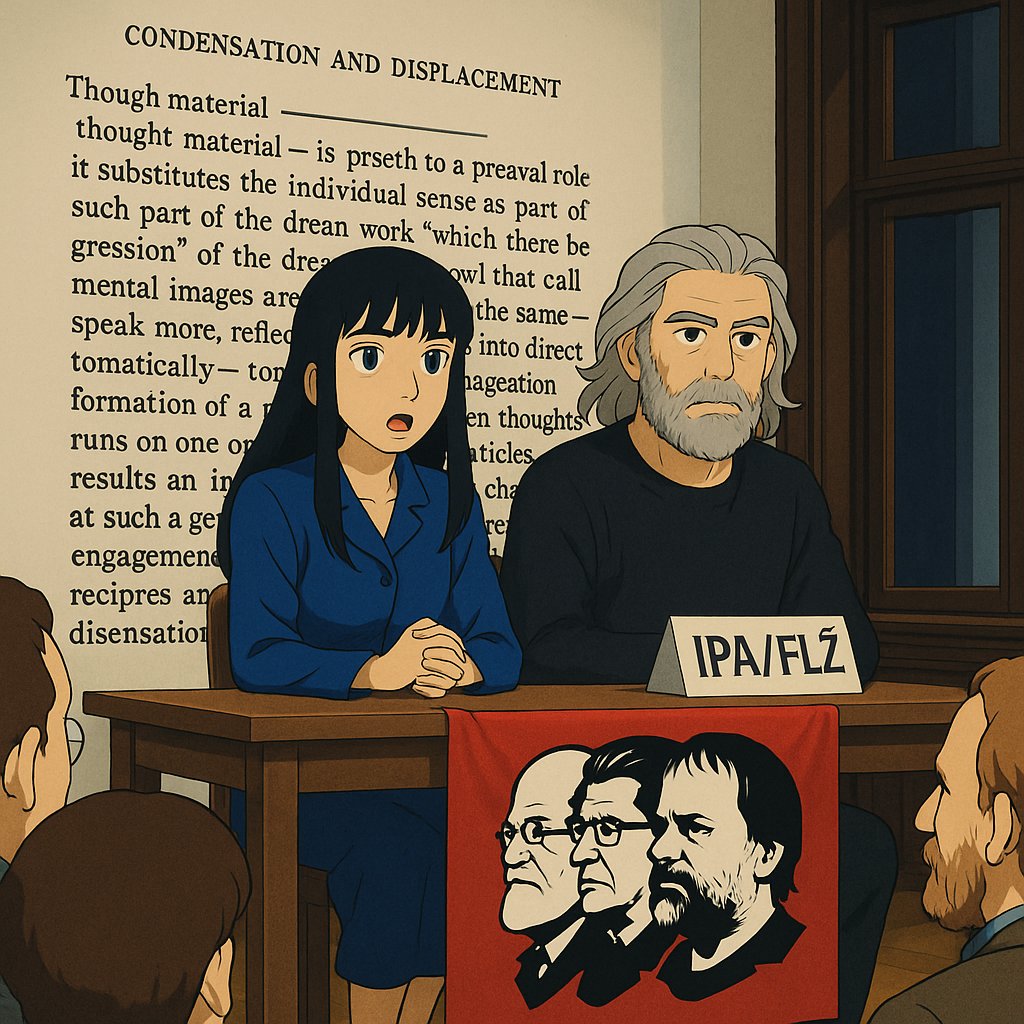
Open Letter by the Friends of the Freud Museum (IPA/FLŽ)
Offener Brief der Freund:innen des Sigmund Freud Museums
We write as Friends of the Freud Museum — not because we are blind to Freud’s flaws, but because we take the legacy of psychoanalysis seriously enough to refuse its embalming in glass cases and polite euphemism.
A century ago, Freud held his cigars with ritual precision. The official story calls them harmless pleasure, a habit, a quirk. But Freud knew better: the cigar was a pact with death, a slow, deliberate euthanasia hidden behind the veil of daily enjoyment. He could read his own gesture — and yet he kept smoking.
Today, Europe holds Gaza in the same way. One hand grips the object; the other signs the condolence letter. The child crushed in Rafah is mourned in Brussels, toasted in Berlin, and paid for in Paris. Each puff of ‘Never again’ rises from the same burning as ‘One last time.’ The self-image is preserved, the conscience smoked.
The Freud Museums in London and Vienna should be places where such fantasies are torn open. Instead, they risk becoming shrines to the very alibi they ought to expose: the performance of humanitarian sorrow as cover for complicity. A museum that can delay Judith Butler’s lecture to avoid political discomfort is a museum that has chosen curatorship over courage, heritage over heresy.
When Bernays staged his ‘Torches of Freedom’ parade in 1929, he taught the world how to turn a symbol of liberation into an instrument of bondage. The Phallic Woman’s cigarette was never just a cigarette — it was the perfect cover for repetition without revolt. Europe now smokes her image across Palestine, offering the spectacle of feminist, liberal, enlightened civility while the machinery of annihilation runs uninterrupted.
This is why we say: the cigar was never just a cigar, and now it is a warhead of moral alibi. The Freud Museum must decide whether to keep polishing the glass around that relic — or to smash it, to let the smoke out, to call the act by its true name.
Silence here is not neutrality; it is participation. The governance disputes within the museum are not administrative side-notes — they are symptoms of a deeper refusal to confront the political unconscious that binds Europe’s self-love to other people’s graves.
Freud did not live to see Gaza. But if he could read his own death drive in smoke, we can read Europe’s in the annihilation of Gaza. And if psychoanalysis means anything today, it is this: the unconscious will not stop killing until it is named.
So let us name it.
Europe is smoking Gaza.
The Freud Museum must exhale the truth.
Signatories:
- FK, member of the Freud Museum Vienna.
- IBF, founder of the IPA/FLŽ (Freud-Lacan-Žižek).
Addendum: In Memory of Freud’s Sisters
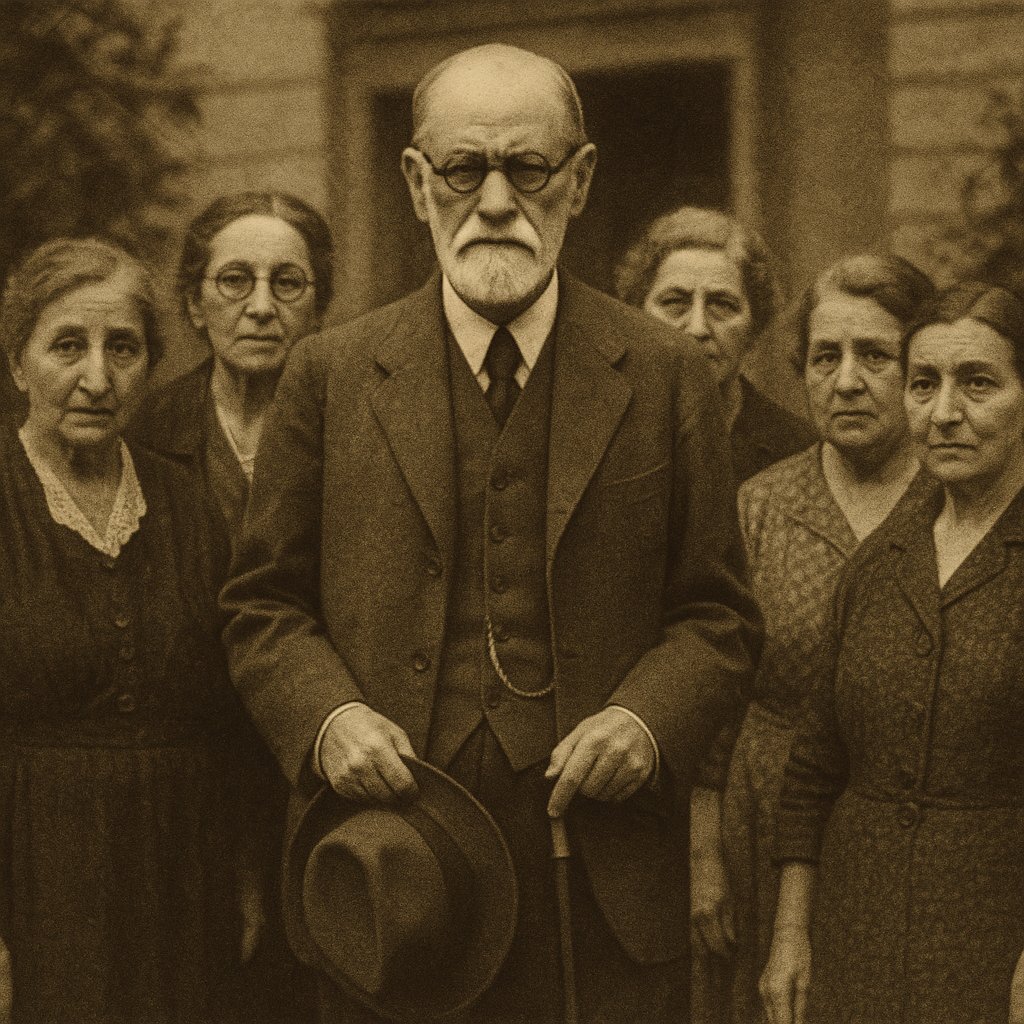
Last Reunion Before London
(AI-generated representation)
The Freud Museum cannot claim to honor its namesake while treating the murder of his five sisters as a sealed chapter of history. Their lives — modest, uncelebrated, and brutally ended in the Nazi extermination camps — are not peripheral footnotes to psychoanalysis; they are integral to its moral horizon. To remember them is to confront the fact that Freud’s escape to London in 1938 was not the rescue of a whole family but the narrow survival of one man, whose sisters were left to the machinery of genocide. Their names and fates demand to be spoken now, especially as the phrase “Never again” is once more recited as cover for political paralysis and selective compassion.
Anna Freud (1858–1942)
Anna was the eldest of Sigmund’s siblings, born in Freiberg in 1858. She lived a modest life in Vienna, remaining unmarried and close to her extended family. Known for her warm personality and devotion to relatives, she never entered public life. In 1942, after the Nazi occupation of Austria, she was deported to the Theresienstadt ghetto, and from there to Treblinka, where she was murdered. Her death is part of the unspoken family history that shadowed Freud’s exile to London — a reminder that psychoanalysis itself was born in the long shadow of political catastrophe.
Rosa Graf (1860–1942)
Rosa, born two years after Anna, lived her entire life in Vienna until forced deportation. Like her sisters, she did not marry, and she devoted herself to domestic life, supporting the family and remaining close to her brothers. She was deported to Treblinka in 1942, where she was murdered. Her life, humble in the eyes of official history, represents the countless “ordinary” lives erased by the machinery of genocide — lives whose memory the Freud Museum should hold without compromise.
Marie (Mitzi) Freud (1861–1943)
Marie, affectionately called Mitzi, was born in 1861. She was known for her lively disposition and strong ties to her siblings, particularly Sigmund. She, too, remained unmarried, and when the Nazis came to power, her age and ill health offered no protection. She was deported to the Treblinka extermination camp in 1943 and murdered on arrival. Mitzi’s life is a testament to the unglamorous, everyday humanity so often lost in monumental histories — and her murder underscores the brutal erasure of that humanity.
Esther Adolfine (Dolfi) Freud (1864–1942)
Born in 1864, Adolfine — called Dolfi — was the sister with whom Freud shared perhaps the closest bond in early adulthood. She was known for her intelligence and keen wit, though she did not pursue formal education or career. She remained in Vienna after Sigmund’s flight to London in 1938. In 1942, she was deported to Treblinka and murdered. Her loss was a private wound for Freud, one he could never publicly address without confronting the very political forces that psychoanalysis, in exile, skirted around.
Paula Freud (1867–1942)
The youngest of the sisters, Paula, born in 1867, was also deported in 1942 and murdered in Treblinka. Little documentation survives about her life — which is itself a second form of erasure. The Nazis’ destruction of her life was compounded by history’s neglect, a double disappearance. Her memory stands for the millions whose biographies remain fragmentary, surviving only through the testimony of others and the determination of institutions to preserve what can be known.
In remembering Anna, Rosa, Marie, Adolfine, and Paula Freud, we remember not only five women of a single family, but the uncountable sisters, daughters, and mothers whose lives were taken in the Shoah — and whose memory is dishonored whenever the phrase “Never again” is spoken to excuse the repetition of atrocity.
The Freud Museum, as custodian of this family’s legacy, cannot compartmentalize these murders as mere family tragedy; they are the ethical foundation on which its claim to humanist authority rests. To remain silent now, while another people faces destruction, is to betray not only the Freud family’s history, but the very possibility of memory as a living force.
The Last Cigarette of Europe: A Tragicomic Chronicle of Genocide-Laundering, IPA/FLŽ: Freud Museums’ Silence in the Face of Genocide, IPA/FLŽ Manifesto of Smoke and Betrayal: Torches of Freedom, Phallic Feminism, and Freud’s Final Pact with Death, The impossible meeting



[…] — Sometimes a Cigar is Unjust Genocide! […]
LikeLike
[…] Sometimes a Cigar is Unjust Genocide! […]
LikeLike
[…] Dissatisfied Ideal Ego—and Why Žižek’s Discourse, Not His Persona, Must Be the Ego Ideal // Sometimes a Cigar is Unjust Genocide!, The Last Cigarette of Europe: A Tragicomic Chronicle of Genocide-Laundering, IPA/FLŽ: Freud […]
LikeLike
[…] “Sometimes a cigar is unjust genocide!” : Open Letter by the Friends of the Freud Museum […]
LikeLike
[…] ihanetlerin bu girift sınıflandırması. Bu, Marksizmi düzeltmenin kavramsal arka planıdır:(1) 🔗(2) […]
LikeLike
[…] of betrayals against Sigmund Freud. This is the conceptual background for correcting Marxism:(1) 🔗(2) […]
LikeLike
[…] der Verrate an Sigmund Freud. Das ist der begriffliche Hintergrund zur Korrektur des Marxismus:(1) 🔗(2) […]
LikeLike
[…] ‘Sometimes a cigar is unjust genocide!’ 🔗 : Open Letter by the Friends of the Freud Museum […]
LikeLike