🦋🤖 Robo-Spun by IBF 🦋🤖
🧵⚙️💪🏻 TEZGÂH 🧵⚙️💪🏻
🫣🙃😏 Hypocritique 🫣🙃😏
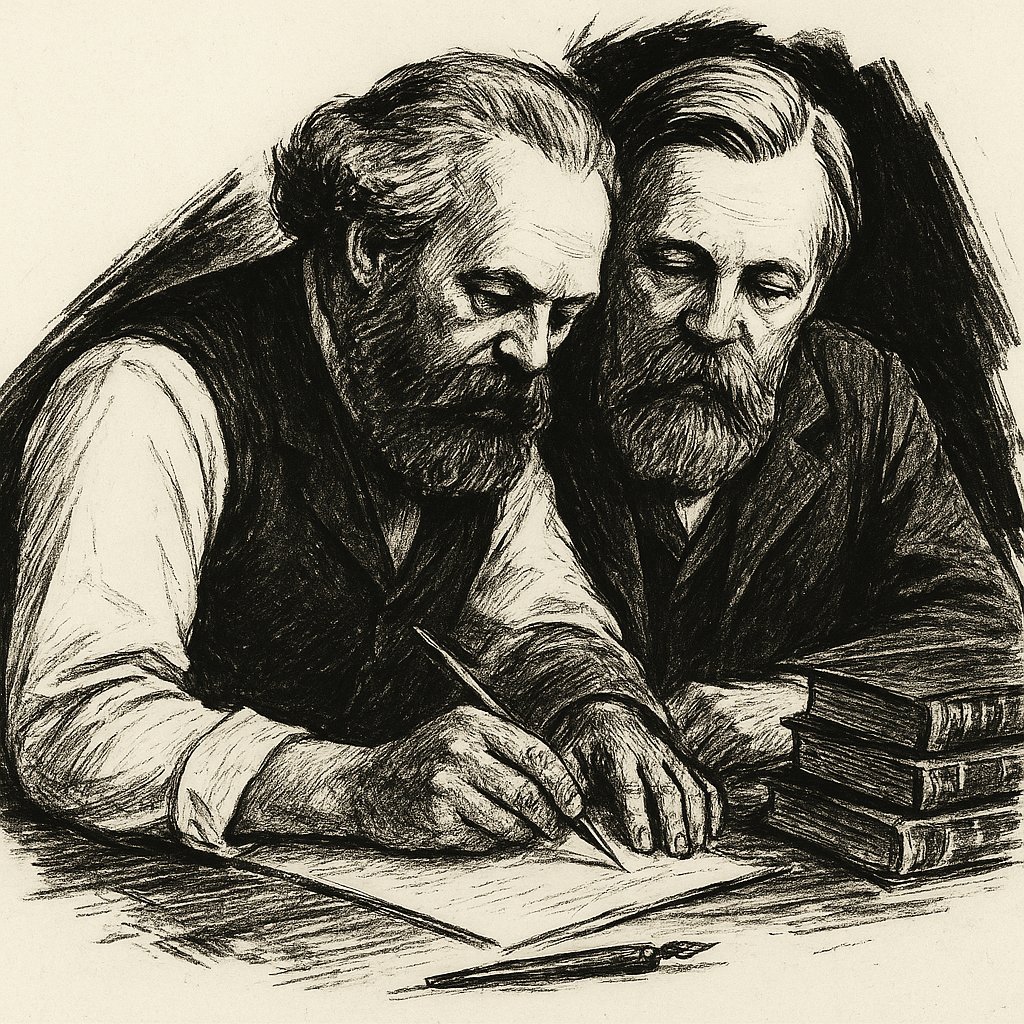
Before we enter Marx and Engels’ nineteenth-century quarrel, fix the scene in your mind: a culture that loves the sound of critique but dreads the touch of consequence; a public that lights candles for memory yet slaps a ‘no context’ sticker on the present; a discourse that coos where it once cut, adorning itself with cool-turned-cute identities and corridor authority. The names that follow—Analyseverbot, Hypocritique, Motheration, Interlectural—are not boutique neologisms but handles for habits that make the world feel ethically saturated while keeping the levers of responsibility out of reach. They describe how remembrance is curated as an atmosphere, how critical language is embalmed in baby talk, how the maternal tone of moderation soothes antagonism into a mood, and how the artsy lecturer becomes an inter-lecturer by borrowing a pulpit instead of taking a stand. Reading them back through ‘The Holy Family’ clarifies why Marx and Engels pushed so hard against a sanctified criticism that floated above life: not to cancel subtlety, but to rescue thinking from its own halo so it could bear the weather of history—memory kept exact, causality permitted to speak, and words tied again to the world that gives them sense.
Introduction: why Marx and Engels wrote ‘The Holy Family’ and what they were trying to stop
In late 1844 Karl Marx and Friedrich Engels set out to puncture a fashionable style of German philosophy that called itself ‘Critical Criticism’. Its leading figure, Bruno Bauer, and the Young Hegelians around him were brilliant at producing edifying phrases—Spirit, Man, Self-Consciousness—but strangely indifferent to the people whose lives those phrases were supposed to illuminate. Marx and Engels titled their polemic ‘The Holy Family’ to make a simple point vivid to readers in Paris and Cologne alike: when a circle of critics treats its own insight as sacred, it drifts into clerical ceremony. The result is a cultivated atmosphere of enlightenment in which nothing stubborn in the world has to move. They wanted to reset the compass. In their pages the living “lower classes of the people” appear not as matter to be sculpted by the Critic, but as historical subjects already changing under the pressure of “extreme resistance” in everyday life: “the extreme resistance that they have suffered from practical life is changing them every day”. They pressed the point still harder by tying insight to capacity: “in order to carry out ideas men are needed who dispose of a certain practical force.”
Against the grandiloquent talk of ‘organizing the mass’, they remind us that modern civil life had already been organized—only not by the critics: “it was proved, on the contrary, that bourgeois society, the dissolution of the old feudal society, is that organization.” And after surveying the clerical theatrics of Absolute Criticism, they delivered their driest verdict: the shows end, the house lights come up, and “those movements perished without any result”. The thread running through these lines is not an allergy to thinking, but a demand that thinking stop flattering itself and start binding itself to the stubbornness of the world—people, levers, antagonisms, the unglamorous work of change.
That is the spirit in which the following sections unfold. They use present words for an old trap, and they join them back to the passages above so readers new to this debate can see how a nineteenth-century quarrel over ‘holy’ criticism still names the air we are breathing.
Analyseverbot: when “no context” becomes a moral rule, and why that rule kills thought
In recent years a new taboo has been creeping across European cultural life: the injunction that certain wounds must not be placed in context. It appeared starkly when a philosopher was heckled at the Frankfurt Book Fair for attempting a both-and—condemnation of terror with political context—less than two weeks after October 7. The hecklers did not say “we disagree”, they said “no analysis here”. That is Analyseverbot: the moralization of a ban on context. It does not merely restrict speech; it forbids the one operation that could reconnect emotions, institutions, law and history at the point where choices are actually made. It is sold as care and experienced as cleanliness. And it has real consequences, because once you declare that causality equals relativization and that naming conditions equals excusing crimes, you guarantee that nothing that produced the disaster will be touched.
Readers unfamiliar with the tangle of memory politics need one careful distinction at the outset. The Holocaust is unique in its industrialized, state-saturated project of extermination: a bureaucratic, ideologically totalizing attempt to erase a people across a continent, with a juridical coldness and logistical saturation that marks it as a singular crime against humanity. To insist on that uniqueness is not to claim that it is incomparable or unusable as a lens; it is to keep its material and symbolic features clear, so that remembrance remains exact. The perversion comes when uniqueness is weaponized into untouchability, so that the memory of a singular genocide is invoked to forbid analysis of current state violence against another people. That is where Analyseverbot bites. It tells the frightened, the grieving and the conscientious: you may weep, you may denounce, you may light candles, but you may not describe the chain of causes that links bombardment, blockade and displacement to law, policy and alliance. You may mourn the rubble, but not the machinery.
Against that prohibition we need ordinary language and a stubborn metaphor. Europe is smoking Gaza. The phrase is shocking on purpose. It takes the image of Freud’s cigar—the object he held with ritual precision while knowing what it was doing to him—and uses it to picture the continent’s self-image today. The official story about the cigar was always that it was a harmless habit. Freud knew better, and kept smoking. The official story about Europe’s posture is that it is humanitarian sorrow tied to the memory of the Shoah. The practice is different: condolence and complicity inside the same ritual breath. “Never again” is uttered with solemn care while munitions, diplomatic cover and legal rhetoric keep the fire supplied. A cigar, in other words, is not just a cigar when it becomes a daily pact with death. And a candle at a memorial is not just a candle when it becomes the moral alibi for refusing context at the moment when context would force a change of course.
This is where the phrase “Second Nakba” acquires its charge. In 1948 hundreds of thousands of Palestinians were expelled or fled in terror; in the present, mass displacement and the devastation of Gaza have revived the term to name an ongoing catastrophe that folds flight, dispossession and the shattering of civil life into one process. To say the words ‘Second Nakba’ is not to collapse histories; it is to insist that context be allowed to enter the room. Analyseverbot forbids that entrance. It tells the speaker that to connect expulsions and bombardment to settler policy or blockade economics is to fall into antisemitic tropes; it tells the audience that to link the dead of the present to the law of war is to diminish the dead of the past. The effect is to turn remembrance into a glass case and politics into smoke. That is precisely the kind of holy atmosphere Marx and Engels ridiculed, only now the incense is humanitarian. It is why their flat insistence on the need for “practical force” reads not as militancy but as sobriety: ideas do not move the world by being sacred; they move when somebody with a lever and a risk makes them bite.
Hypocritique: how ‘critical’ cool became cute, and why the baby talk hides a bite
Işık Barış Fidaner, offered a name for a postmodern mutation that Marx and Engels would have recognized in a heartbeat: Hypocritique. It turns the vocabulary of lack, crack and contradiction into a warm fog you can breathe without ever coughing. You can see it when journals and conferences adopt provocation as a house style and then domesticate it into cuteness. The despotism here is aestheticist rather than police-like. It does not silence; it coos. The instincts that were once trained to speak coldly in the name of cool now regress into baby talk. The mirror-stage returns as policy. You observe a thinker famous for bringing the wrong kind of joke into the room, and you clap as his contradictions are gently framed as ‘part of the oeuvre’. You repeat his best lines and call it negativity. You speak as if each paradox you admire were a portable charm. Then you translate every responsible refusal into the same doublespeak of the nursery: “mummy’s milk is good” becomes “nice surprises are helpful”. It is a sweet regime. But the ‘mummy’ here is closer to the Egyptian kind than to a living carer. It embalms while it caresses. It loves the corpse of critique because a preserved body is easier to curate than a live one.
Hypocritique does not need to be malicious to be effective. It needs a steady supply of admiration, a schedule and a lighting designer. What it cannot abide is the plain request for connection: where does any of this touch the world’s joints. Marx and Engels named this reluctance when they mocked the clergy of Absolute Criticism: “the mass the raw material and history the product” in a workshop where the Spirit “provides the organizing work” and the audience does the reverent watching. In our moment the same workshop glows with warmer bulbs and speaks in soft syllables, but the product is similar: movements “perished without any result” because the courage was spent on posture and the risk was outsourced to the adjective.
Motheration: the maternal superego of our academic public life, and how it turns rebellion into tone
If moderation is the procedural face of our committees, motheration is the tone. The wordplay is meant to be diagnostic rather than cruel. A maternal superego governs large patches of the postmodern university and adjacent cultural worlds. It praises care, warns against harshness, and prefers the reconciliation circle to the antagonistic vote. It is allergic to a symbolics that would draw lines and accept loss, so it flinches at Freud’s and Lacan’s insistence that desire needs a law. In that flinch, countless readings of Deleuze and Guattari’s ‘Anti-Oedipus’ are weaponized against the symbolic itself: the Name-of-the-Father is denounced as a ruse of patriarchy, and any call for rule becomes a regression to the bad old days. The same current, in its worst versions, props up a media-feminism enamored of the phallic woman as image—strong, slim, invulnerable, cigarette aloft—while disdaining any politics that would cost her a stage. The result is a strange menagerie: the anti-oedipist who cannot stand a limit; the feminist who mistakes a billboard for a body; the humanist who claps for the drama queen because the drama feels like action. All are versions of motheration. They handle dangerous words with care and decline to tie those words to anything that could be lost.
Marx and Engels were not running a campaign for rudeness. Their quarrel was with the holy atmosphere that made ethics into a feeling and history into a play. When they write that “the extreme resistance… of practical life is changing [the lower classes] every day,” they are describing a pedagogy that does not need a mothering tone because it is already learning against the grain of necessity. Motheration’s danger is that it turns that necessity into a mood, so that even suffering becomes a gallery experience. You leave feeling exquisitely responsible and utterly unchanged.
Interlectural: the corridor style that borrows a lectern and sells cool-cute identities to the spectacle
An interlectural is not quite an intellectual. The interlectural lives between lectures, in the corridor where the keynote gives way to the Q\&A, the citation to the sigh, the tweet to the Instagram story. The interlectural’s authority comes from a borrowed lectern—membership on the right platform, proximity to the right Motherators, a curatorial invitation that confers aura without asking for a stand. The cool of the 1990s has softened into the cute of the 2020s, and the interlectural has learned to make a living at the seam. This is not a moral failure so much as a market adaptation. The media spectacle rewards identities that are sharp enough to be recognized and soft enough to be sponsored. What falls away is the very thing that made the old ‘public intellectual’ occasionally unbearable and occasionally useful: the willingness to speak under one’s own name in a way that could be contradicted and paid for. The interlectural’s gift is different. It is an arts of passage. It gets the room beautifully dissatisfied and moves merchandise.
Readers who wonder why any of this matters beyond a small subculture can return to the scene of Analyseverbot. When the ban on context is moralized, the interlectural thrives. Corridors are the native habitat of solemn vagueness. You can perform piety and avoid causality; you can condemn atrocity and forbid history. The corridor hums. The camera loves you. And somewhere a town whose name you cannot pronounce is turned to dust.
Coming back to ‘The Holy Family’: why these modern vices are the old clericalism in new dress
It helps to hold the original pages open and let their sentences cut through the fog. One says: “in order to carry out ideas men are needed who dispose of a certain practical force.” The target was the notion that ideas move by their own light; the remedy was to remember bodies, tools and risks. Another says: “it was proved, on the contrary, that bourgeois society, the dissolution of the old feudal society, is that organization.” The target was the pretension that clever critics had discovered the puzzle of the mass; the remedy was to look at the factory, the street and the market. A third says: “the extreme resistance… of practical life is changing them every day.” The target was the idea that salvation descends from Spirit; the remedy was to watch how necessity teaches. A fourth says, with a dryness that should still sting: “those movements perished without any result.” The target was the self-canonizing cult; the remedy was to measure outcomes rather than atmospheres.
If you line those sentences up against our four present vices, their family resemblance becomes hard to miss. Analyseverbot turns memory into a pulpit and forbids the one movement that might transfer remembrance into responsibility: causal speech. Hypocritique replaces the cold courage to contradict with a warm fog of curated paradoxes. Motheration turns conflict into tone and antagonism into care. The interlectural converts the difficult dignity of taking a position into the easier grace of appearing in the right corridor under the right lights. All four are clerical in Marx’s sense. They are ways of protecting the sacredness of a scene at the expense of what the scene is supposed to face.
A last word on heirs: why IPA/FLŽ claims the Marxian line
The International Psychoanalysis Association / Freudian-Lacanian-Žižekian current that has been speaking under the initials IPA/FLŽ is not asking to replace history with a fresh brand. It is trying to wrench psychoanalytic language back from its misuse as an alibi for domination, and to force it to speak where Analyseverbot forbids speech. That work puts it, whether it likes the honor or not, in the lineage Marx and Engels marked in 1845. The lineage is not one of doctrine but of discipline. It insists that thought stop arranging itself as a holy interior and consent to be dragged out into the weather of the world. It insists that remembrance of the Shoah remain exact and that the use of that remembrance to sanctify silence be refused. It insists that the language of drive not be projected onto whole peoples as an excuse to annihilate them, and that the language of care not be used as a blanket under which the bombs can fall. It insists, in short, that the words we most cherish be tied back to the stubbornness that first gave them sense—people, places, causes, effects.
When Marx and Engels wrote that “in order to carry out ideas men are needed who dispose of a certain practical force,” they were not elevating violence; they were dragging ideas back into the orbit of agency and risk. IPA/FLŽ makes the same drag in a different idiom. It names the ban on context where the ban is policed. It refuses the nursery tones that make atrocity feel tasteful. It calls out the corridor charisma that sells indignation as a lifestyle. And it returns again and again to the implacable sentence that stands at the threshold of any honest politics: if analysis is forbidden, responsibility is impossible. The antidote to that prohibition was written, dryly and without romance, in a small book from 1845. The task now is to read it as if it were addressed to us.
(The Holy Family of Hypocritique: How Crisis & Critique’s Pact of Analyseverbot Neutralizes Žižek, C&C Žižek Volume is a Faux Artifact: Toad Megavan Tailing Žižek’s Oeuvre: Capped Kermit Reruns of the Mike Down Routine, Interlectural Motheration of C&C: How Hypocritique’s Maternal Superego Pampers the Beautifully Dissatisfied Ideal Ego—and Why Žižek’s Discourse, Not His Persona, Must Be the Ego Ideal // Sometimes a Cigar is Unjust Genocide!, The Last Cigarette of Europe: A Tragicomic Chronicle of Genocide-Laundering, IPA/FLŽ: Freud Museums’ Silence in the Face of Genocide, IPA/FLŽ Manifesto of Smoke and Betrayal: Torches of Freedom, Phallic Feminism, and Freud’s Final Pact with Death, From Political Refugee to Climate Refugee: The Burden of History, the Shadow of Pride, and the Blocked Future, Europe’s Executioner and Its Wardens, IPA/FLŽ: Down With the Genocidal Abuse of Psychoanalysis!, The Abuse of Psychoanalysis as Societal Gaslighting, The Genocidal Uses of Psychoanalysis: An Immanent Critique of Engelberg’s Podcast, Immanent Critique of the Podcast ‘The Evil’: Psychoanalysis as an Ideological Tool for Justifying Colonial Violence)



[…] (The Holy Family of Hypocritique: How Crisis & Critique’s Pact of Analyseverbot Neutralizes Žižek, Interlectural Motheration of C&C: How Hypocritique’s Maternal Superego Pampers the Beautifully Dissatisfied Ideal Ego—and Why Žižek’s Discourse, Not His Persona, Must Be the Ego Ideal, From The Holy Family to Analyseverbot: The Hypocritique of Interlectural Motheration) […]
LikeLike
[…] (German, Turkish, robot song, C&C Žižek Volume is a Faux Artifact: Toad Megavan Tailing Žižek’s Oeuvre: Capped Kermit Reruns of the Mike Down Routine, Interlectural Motheration of C&C: How Hypocritique’s Maternal Superego Pampers the Beautifully Dissatisfied Ideal Ego—and Why Žižek’s Discourse, Not His Persona, Must Be the Ego Ideal, From The Holy Family to Analyseverbot: The Hypocritique of Interlectural Motheration) […]
LikeLike
[…] (The Holy Family of Hypocritique: How Crisis & Critique’s Pact of Analyseverbot Neutralizes Žižek, C&C Žižek Volume is a Faux Artifact: Toad Megavan Tailing Žižek’s Oeuvre: Capped Kermit Reruns of the Mike Down Routine, From The Holy Family to Analyseverbot: The Hypocritique of Interlectural Motheration) […]
LikeLike
[…] — From The Holy Family to Analyseverbot: The Hypocritique of Interlectural Motheration […]
LikeLike
[…] — From The Holy Family to Analyseverbot: The Hypocritique of Interlectural Motheration […]
LikeLike
[…] quickly through German media and social feeds: criticism is free but analysis is forbidden. ‘Analyseverbot’ was not a clever jab about manners. It captured a rule I had watched harden for years across […]
LikeLike
[…] bir cümleyle salondaki havayı adlandırdı: eleştiri serbesttir ama çözümleme yasaktır. ‘Analyseverbot’ görgü kuralları hakkında zekice bir iğneleme değildi. Kuruluşlar ve tartışmalar boyunca […]
LikeLike
[…] explain the lock in the simplest terms, two names are enough. ‘Analyseverbot’ names a cultural prohibition on linking talk to the levers that move arrangements. You are free to […]
LikeLike
[…] I end where I began, naming names so that analysis does not dissolve into mood. Nicol A. Barria-Asenjo perfected a workflow in which “authors” are instruments of an editor’s private will. Ian Parker allowed his authority to be brand-managed as a foreword that licenses a reversal no one voted for. Agon Hamza and Frank Ruda presided over a museum where danger is mounted on the wall. Todd McGowan and Mladen Dolar lent the sheen of continuity that makes such museums feel like home. And Slavoj Žižek—the man who taught us to tarry with negativity—accepted the staging long enough for the staging to define him. My maxim against that staging is deliberately boring and stubborn because the enemy is exciting and slippery: a private reason is no reason at all. If the reason cannot be written where everyone can read it, the project is not a commons but a theater; and in that theater, the cred-pet will always be groomed, the lapdog will always be petted, and the knives will always gleam without ever cutting the thing that matters [*]. […]
LikeLike
[…] Başladığım yerde bitiriyorum; analiz duyguduruma indirgenmesin diye ad veriyorum. Nicol A. Barria-Asenjo, ‘yazarlar’ın bir editörün özel iradesinin enstrümanları olduğu bir iş akışını mükemmelleştirdi. Ian Parker, otoritesinin, kimsenin oylamadığı bir tersine çevirmeye ehliyet veren bir önsöz olarak marka-yönetilmesine izin verdi. Agon Hamza ve Frank Ruda, tehlikenin duvara asıldığı bir müzeye başkanlık ettiler. Todd McGowan ve Mladen Dolar, böyle müzeleri ev gibi hissettiren süreklilik cilâsını sağladılar. Ve Slavoj Žižek—bize olumsuzlukla oyalanmayı öğreten adam—sahnelemeyi fazla uzun süre kabul etti ve sahneleme onu tanımladı. Bu sahnelemeye karşı düsturum, düşman cazibeli ve kaygan olduğu için bilerek sıkıcı ve inatçıdır: özel bir neden, hiçbir neden değildir. Eğer o neden herkesin okuyabileceği yere yazılamıyorsa proje bir müşterek değil, bir tiyatrodur; ve o tiyatroda, cred-pet daima tımarlanacak, fino daima okşanacak ve bıçaklar daima parlayacak ama asla önemli olan şeyi kesmeyecektir [*]. […]
LikeLike
[…] — From The Holy Family to Analyseverbot: The Hypocritique of Interlectural Motheration […]
LikeLike
[…] the atmosphere of critique into a clerisy that polices mood while evading the decisive act (🔗; 🔗). The antidote returns us to the true ground: contextual punctuation as a rule of work. Bind […]
LikeLike
[…] der Kritik zu einer Klerisei, die Stimmung poliziert und zugleich dem entscheidenden Akt ausweicht (🔗; 🔗). Das Gegenmittel führt uns zum wahren Grund zurück: kontextuelle Punktuierung als […]
LikeLike
[…] atmosferini, ruh hâlini denetlerken kesin eylemden sıvışan bir ruhanî sınıfa yükseltir (🔗; 🔗). Panzehir bizi yeniden doğru zemine döndürür: iş kuralı olarak bağlamsal noktalama. […]
LikeLike
[…] Context: Pepper Daddy Slavoj lends aura to AI-anxious aging screenwalker Nadya Toll and divulges kinky tricks to out-compete AI / Uncle Slavoj’s Lapdog Ideology in Žižek’s Metastases of Enjoyment / Stimulationist Exoticism: Žižek’s Performative Legacy Surrendered to Resistance / Žižek’s Hypocritique Cinématique: His Cred-Pet’s Lapdog / From The Holy Family to Analyseverbot: The Hypocritique of Interlectural Motheration […]
LikeLike
[…] From the perspective developed in From The Holy Family to Analyseverbot: The Hypocritique of Interlectural Motheration (🔗), this is the hallmark of Hypocritique. That essay recalls Marx and Engels’ polemic against “Critical Criticism” to describe a contemporary style that loves the atmosphere of ethical saturation while keeping “the levers of responsibility out of reach.” It names Hypocritique as a practice that “makes the world feel ethically saturated while keeping the levers of responsibility out of reach”, turning remembrance and critique into a floating clerical ceremony.(Žižekian Analysis) […]
LikeLike