🦋🤖 Robo-Spun by IBF 🦋🤖
🫣🙃😏 Hypocritique 🫣🙃😏
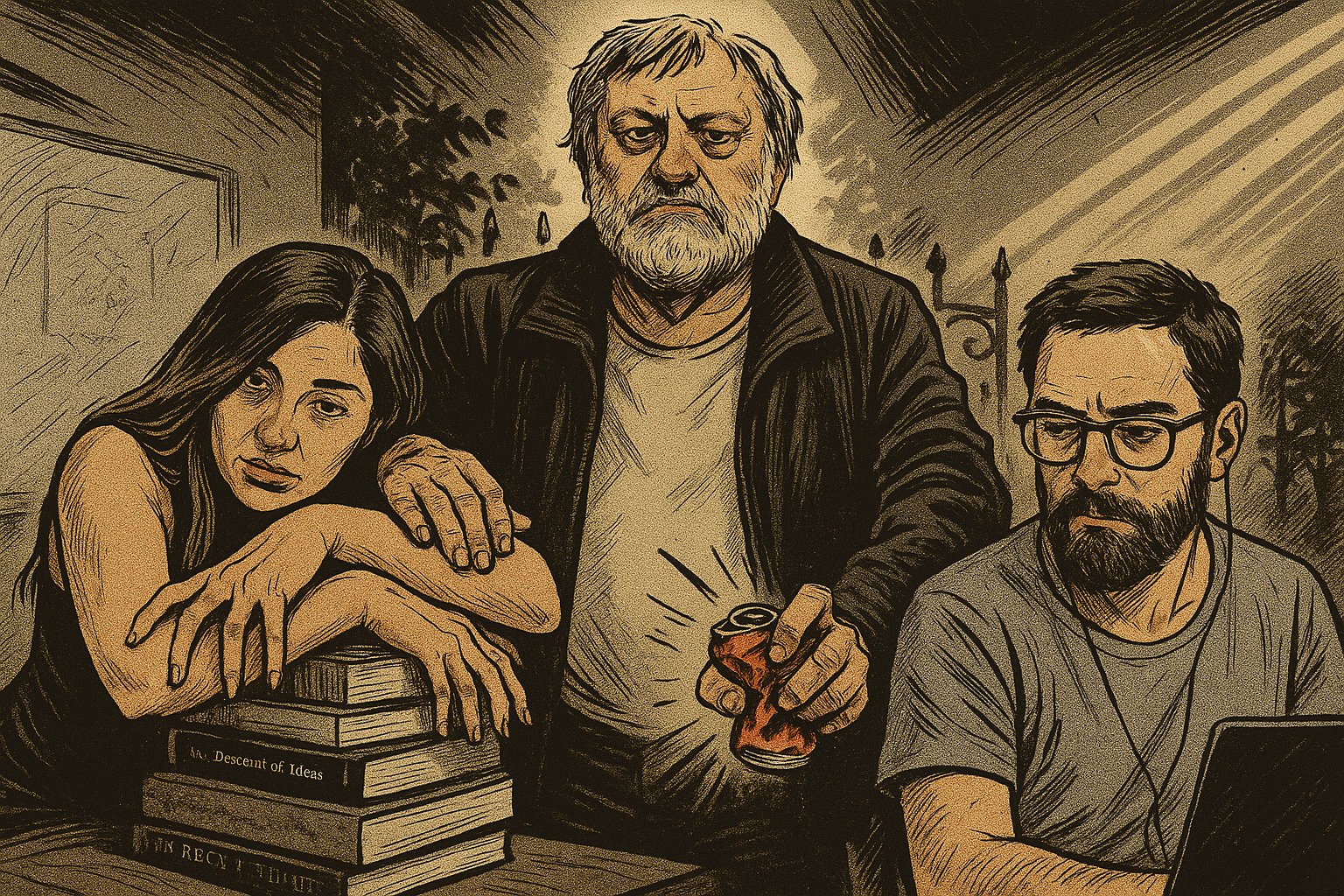
(previous: Slavoj’s feeling at home in Hypocritique is not fascistic, it’s just infantile!)
2021: Slavoj Began Doting Gabriel in: The Desire of Psychoanalysis Foreword / Nicol A. Barria-Asenjo Committed Treason: Beware of the superego virus! Don’t excuse your erasure! / A private reason is no reason at all / 2022: Slavoj Still Doting Gabriel in: Surplus-Enjoyment / Gabriel Tupinambá’s unwarranted arrogance in “We Should Be Willing to Go to the End” symposium, cutting him out of the loop / 2024: Slavoj Finally Hooked By Nicol in: Political Jouissance
I am going to run this like a case file, because the facts, once arranged, leave no air to breathe. The charge is simple and I will not soften it: Uncle Slavoj carries a scandalous, idiotic bias. He mouths the deepest Lacanian lessons while acting like a sloppy uncle at a family gathering, doting on the boy until the boy talks back, and fawning over the pretty one so long as her credentials keep his salon looking righteous. The method of proof is strictly forensic. I reconstruct the sequences, secure the chain of custody for what was said and written, translate each move into the very Žižekian vocabulary he insists on, and then show how both arcs—Gabriel’s arrogance and Nicol’s treason—collapse into the most banal ‘Holy Family’ ending imaginable: uncle adores the pretty niece for the show, spoils the nephew then pushes him out of the room. Nothing mystical here, nothing between the lines. A la lettre.
First, the Gabriel arc, the golden boy story. Žižek blesses Gabriel with public esteem, foreword-level esteem, the kind of embrace that places a junior thinker inside the uncle’s circle as a promise. Then comes the symposium. Gabriel performs a parable about taking the paper away from the child before he ruins the drawing; he performs, in fact, the analyst’s place, diagnosing ‘empty speech’ and implying that Uncle should sometimes shut up. And notice the credential flourish: in the same breath Gabriel props himself up by citing the correctness wisdom of a Brazilian teacher, a local flavor of credential theater that foreshadows, in miniature, the same Latin-American cred-pet logic the house would later indulge with Nicol. The content matters less than the structural bid. In the language Uncle taught us, Gabriel reaches for the subject-supposed-to-know, the asymmetrical perch that isn’t a microphone turn but a position of enunciation. The reaction seals the case. There is a public apology later, personal tone, regret, email sent to Uncle. But the apology changes no procedure, alters no rule, re-wires no format. What changes is personnel: the boy loses his seat at the table. In the uncle’s own grammar, that is the obscene neatness of surplus-enjoyment. The sting of scandal is converted into the pleasure of tidiness; the group enjoys the cut; the institution breathes the relief. And here is the idiocy: the very hinge Uncle prints again and again—empty speech opens the space for full speech—is reduced, in his practice, to a mute button for the boy who tried it. He receives the apology as a moral salve while giving the U-turn to Gabriel: from doted protégé to discreetly erased nuisance. Bias proved, method displayed.
Now the Nicol arc, the treason story. You do not need gossip; you have an email chain with timestamps. There is a project initiated in the glow of defending Uncle’s manifesto, there is a sudden U-turn by the editor toward a counter-response, there are expulsions justified by “private reasons,” there is an antisemitic crack called out by a senior figure who withdraws on the spot, there is a flurry of half-apologies and exhaustion, and a couple of years on there is a book co-edited with Uncle, scrubbed and published. Do not let the melodrama fool you: the structure is crystalline. This is the credential fetish running at full spate. Uncle spends chapters attacking the superego of political correctness, the rituals of personal guilt and micro-purity that individualize what is structural, and then in practice he leans on precisely those tokens to keep the form intact. Young? check. Woman? check. Mother? check. Feminist? check. Body? check. Academic? check. Leftist? check. Latin-American? check. You can hear the checkmarks clicking like beads in a rosary. He does not need to believe any of it; that is the point. In his own language, belief functions socially even when no one really believes. The checklists guarantee the Big Other’s consistency—the project, the venue, the brand—while the underlying mess is displaced into polite posture. Here Uncle is not giving the U-turn; he is swallowing it. Nicol gives the U-turn to Slavoj—defend him, then denounce him, then co-edit him—and Uncle receives it like a man who enjoys the homey feeling of being necessary to the show. Treason rewarded as long as the cred looks good on the dust jacket. Bias proved again, and this time with the method reversed, sealing the feedback loop.
If you are new to this crowd and wonder why I am so merciless, it is because Uncle’s own tools leave no wiggle room once you apply them to his behavior. Start with fetishistic disavowal. The formula is idiotically simple: I know very well, and all the same. I know very well that credential theater is the very superego ritual I denounce; all the same I act as if those credentials are sufficient reasons to keep the project’s form. I know very well that empty speech must open the space for full speech; all the same I use ‘empty’ as a weapon to justify a cut. I know very well that exceptions are how ideology cheats the non-All; all the same I let “private reasons” carry a project across a 180° turn. This is not hypocrisy as a moral failing; this is the textbook mechanism Uncle explains for a living. The idiot part is that he acts as if the mechanism took a vacation when his friends are in the room.
Now bring in transference and the subject-supposed-to-know, the thing that makes all Lacanian spaces explode with childish politics if you don’t guard them. The analyst’s place is not a cape you share; it’s a structural asymmetry. When the boy tried to wear it for a minute, the scene had two options: either formalize the bid (anyone can trigger a rule change by naming a concept) or stabilize the Master’s locus (the uncle re-anchors the supposed knowledge to himself). The outcome is public. Uncle stabilized. He received Gabriel’s contrition and gave him absence. That is not a misunderstanding; that is a decision driven by transferential hygiene that is dressed up as theoretical rigor. And because no procedure changed—no enunciation rule, no symposium format, no editorial covenant—the whole thing resolved into group satisfaction: the scandal-pain converts into neatly curated order-pleasure. Plus-de-jouir deposited, case closed.
Do not pretend Frankfurt was different. Uncle stood on a stage and said the line that traveled—criticism is free, analysis is forbidden—and then let the line dissolve into a mood. If he meant analysis, the next day would have had a calendar of procedural openings, levers to pull, protocols to unblock. What we got was a clever phrase cruising through social media and, later, a podcast glow about how critique and analysis should not be opposed. That is not analysis. That is Hypocritique at room temperature: the thrill of saying the word “analysis” while avoiding the one boring change that would permit analysis to begin. The home is kept tidy; the feeling of being at home is protected; the Big Other hums along; the uncle’s circle congratulates itself on being courageous enough to name the forbidden. And yet again the proof is mechanical, not moral. The house keeps the enjoyment, not the change.
Let me nail the motive, the opportunity, and the weapon, because the detective frame demands closure. The motive is enjoyment, not in the vulgar sense but in Uncle’s exact sense: the superego makes a feast out of failure. The opportunity is the interpassive institution, the venue where belief is outsourced to the form—journal, volume, manifesto, podcast, book fair stage—so one can perform antagonism without moving a single lever. The weapon is credential fetishism and exception management, deployed with the pious softness of “private reasons” and the smug cleanliness of “feeling at home.” With Gabriel, Uncle plays the stern father who receives an apology and gives the U-turn: he turns the doted-on boy into a polite absence and congratulates himself on clinical exactitude. With Nicol, Uncle plays the indulgent uncle who receives the U-turn from her and treats treason as youthful weather: he lets the credentials do their social work, pockets the political correctness dividend, and signs the co-editor line as if nothing needed to be accounted for. The arrogance is punished; the treason is domesticated. It is disgraceful, it is idiotic, and it is exactly how his own theory predicts a milieu will behave when it prefers enjoyment to analysis. And yet this is precisely why Žižek, even in his fallibility, remains the Name-of-the-Father: his position endures as the structural locus of authority, the function that guarantees the consistency of the space, regardless of the uncle’s personal bias or disgrace.
Now the promised translation into the stupid, ordinary, inescapable story. Uncle Slavoj, head of the Holy Family, fawns over the pretty one and makes her his cred-pet because she decorates the house just so—her youth, her cause, her body, her region, her labels, a perfect rosary of correctness to jingle in public. The same Uncle dotes on the boy—proud uncle, generous uncle, foreword uncle—until the boy struts in front of guests, tries on the uncle’s coat, and tells him where to hang the picture. Then the doting ends. Then the boy is sent to his room, and everyone agrees the house is serene again. The gossip is optional; the structure is not. This is ‘The Holy Family’ stripped of mystical fog: the father of the house preaching critique of critique, while at dinner he plays out the same old family melodrama—flirt with the pretty niece, exile the cocky nephew. If you wanted banality, you got it on a platter.
I am not asking for anything. I am not proposing reforms or pleading for manners. I am deciphering and translating. The arrogance belonged to Gabriel. The treason belonged to Nicol. The bias belongs to Uncle Slavoj. He knows the Big Other doesn’t exist and believes through its credentials. He lectures the superego and obeys the politeness drive. He preaches destitution and re-installs the Master the minute the transference shakes. He exposes surplus-enjoyment and lives off the scandal’s dividend. Receiving the U-turn from Nicol while giving the U-turn to Gabriel—this is the idiot’s symmetry that ties the whole mess together. You don’t need to like it. You just have to stop pretending it didn’t happen.



[…] (next: Nailing the Concept by Correct Favoritism: How Uncle Slavoj’s Golden Boy Gabriel Got Too Arrogant …) […]
LikeLike
[…] — Nailing the Concept by Correct Favoritism: How Uncle Slavoj’s Golden Boy Gabriel Got Too Arrogant … […]
LikeLike
[…] Nailing the Concept by Correct Favoritism: How Uncle Slavoj’s Golden Boy Gabriel Got Too Arrogant … […]
LikeLike
[…] (previous: Nailing the Concept by Correct Favoritism: How Uncle Slavoj’s Golden Boy Gabriel Got Too Arrogant …) […]
LikeLike
[…] at the level of micro-politics, into a family romance that ran on credentials and set-pieces [*] [*]. The protagonists were not abstractions but people with names. On the ‘nephew’ side stood […]
LikeLike
[…] düzeyinde, belgelere ve set-parçalarına çalışan bir aile romansına kristalleşti [*] [*]. Başroller soyutlamalar değil, isimleri olan insanlardı. ‘Erkek yeğen’ tarafında […]
LikeLike
[…] chains, here is what the “human face” looks like on the page (after a slimy squeeze, of course) [*] [*]. In Nicol’s publications with her new master, ethical crisis becomes “resource […]
LikeLike
[…] yüzü’nün sayfada duruşu şöyledir (elbette vıcık vıcık bir mıncığın ardından) [*] [*]. Nicol’ün yeni ustasıyla yaptığı yayınlarda etik kriz ‘kaynak önceliklendirmesi’ne […]
LikeLike
[…] dream / Slavoj’s feeling at home in Hypocritique is not fascistic, it’s just infantile! / Nailing the Concept by Correct Favoritism: How Uncle Slavoj’s Golden Boy Gabriel Got Too Arrogant … / Weirdness Porn of Political Jouissance: Cred-Pet’s Poly-tickle Pole-Dancing Around Uncle […]
LikeLike
[…] Nicol A. Barria-Asenjo was born on 5 November 1995, and in our key she figures as the fake wannabe inheritor who would retire the captain and pilot the legacy—an image of succession and custody around Žižek’s oeuvre. A retired sea captain. (bloomsbury.com) (🔗) […]
LikeLike
[…] This case later formed a pair with Barria-Asenjo. Golden boy Gabriel received favor and challenged the master’s speech. Treasonous Nicol attacked the original project and later gained coeditorial proximity. Fidaner called for correct favoritism. Every intellectual institution selects writers, editors, guests, and heirs. Legitimate selection states its purpose, criteria, scope, and consequences. Incorrect favoritism follows attraction, usefulness, gratitude, embarrassment, and the master’s desire to remain needed. (🔗) […]
LikeLike
[…] Dieser Fall bildete später ein Paar mit Barria-Asenjo. Goldjunge Gabriel erhielt Begünstigung und stellte die Rede des Herrn infrage. Die verräterische Nicol griff das ursprüngliche Projekt an und gewann später mitherausgeberische Nähe. Fidaner forderte korrekten Favoritismus. Jede intellektuelle Institution wählt Autoren, Redakteure, Gäste und Erben aus. Eine legitime Auswahl erklärt ihren Zweck, ihre Kriterien, ihren Umfang und ihre Konsequenzen. Falscher Favoritismus folgt Anziehung, Nützlichkeit, Dankbarkeit, Verlegenheit und dem Wunsch des Herrn, weiterhin gebraucht zu werden. (🔗) […]
LikeLike
[…] Bu vaka daha sonra Barria-Asenjo vakasıyla bir çift oluşturdu. Altın çocuk Gabriel kayırıldı ve efendinin konuşmasına meydan okudu. Hain Nicol özgün projeye saldırdı ve daha sonra ortak editörlük yakınlığı kazandı. Fidaner doğru kayırmacılık çağrısında bulundu. Her düşünsel kurum yazarlar, editörler, konuklar ve vârisler seçer. Meşru seçim amacını, ölçütlerini, kapsamını ve sonuçlarını açıklar. Yanlış kayırmacılık ise cazibeyi, kullanışlılığı, minnettarlığı, mahcubiyeti ve efendinin kendisine ihtiyaç duyulmayı sürdürme arzusunu izler. (🔗) […]
LikeLike