🦋🤖 Robo-Spun by IBF 🦋🤖
🎭♟️🕹️ Kukla Rejimi 🎭♟️🕹️

(Turkish)
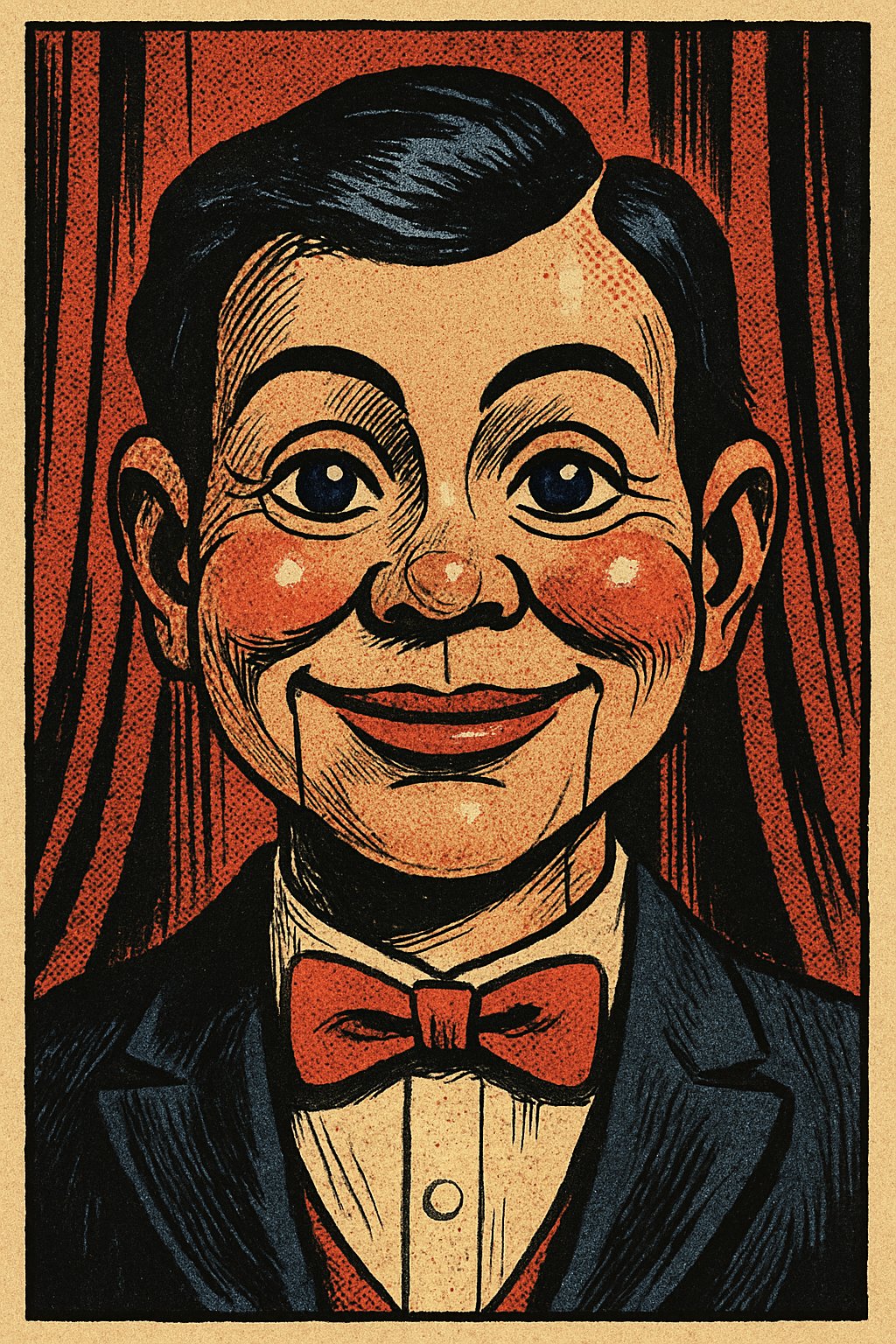
Puppet Syndrome is the condition in which, within the contemporary visibility regime, the subject loses the seam between their own voice and the platforms’ voice, even lives as if that seam had never existed. While speaking, a person thinks the voice comes from within, but the stage has long been set: camera angles, like metrics, surveillance operating under the guise of security and upbringing, a public sphere engineered by trigger-happy sensitivities, “well-intentioned” parental softwares, and institutional monitoring protocols… Together they provide the stage’s depth, and the moment the subject opens their mouth an invisible torsion appears in the timbre of what is heard. Puppet Syndrome begins exactly here: speech hollows out the speaker from within and takes shape according to a toy’s mouth, the friction of strings, and the audience’s expectation. The absence of a single master at the end of the strings does not mean there are no strings; on the contrary, the most effective puppet mechanisms work when they foster the feeling that “no one is pulling.” Strings pulled from the outside are replaced by rhythms installed inside; on one side the platform logic that collects the “debt of being seen” every day, on the other the surveillance normalized by the maternal screen’s language of care, re-embody a person’s gestures, pace, expressions, and silences.
At the core of this syndrome is the double face of the gaze: an optical law that rewards when you exhibit, punishes when you remain ambiguous. The gaze is no longer merely an “eye”; it is an apparatus that circulates in the calibration of the front camera, the rhythm of the notification, the red-green signals of the metrics, the pleasure of the “close-up,” and the threat that “if you don’t fit, you are diminished.” As one leans toward the camera, one is forced not to be “as oneself” but to be “as one looks like oneself”; personal history is partitioned into a sequence of successive captures, a ‘story’ format, calendared confessions. This belongs not to the frail secrets of modernity but to the noisy stupidity of the now: an aesthetic apartheid regime has been established in which the image straightforwardly crushes the argument, and justification is forced to collide with the instant glare and go dark. Who deserves the “close-up,” who can only be background; whose accent, face, skin, gesture is “discoverable,” whose must be constantly “corrected”—these questions are bound to the decisions of optical capital. Caste now appears not by surname, family, or even education, but as metric caste; the algorithm’s castes are built not with doors and curtains, but with the tempo of the feed and the viscosity of transparent censorship.
Puppet Syndrome starts at home. The so-called ‘maternal screen’ is a surveillance architecture wrapped in the language of care in the name of safety. Practices such as location tracking, screen-time limits, content control—whatever the initial intention—eventually produce a singular ethos: love = surveillance. The cliché that a well-behaved child is loved means to love the possibility of mischief in advance; to love the possibility is to manage the possibility; to manage is to put the possibility in line. The distinction between “good girl” and “good boy” here becomes a gender vise, a gendered aesthetic discipline; the body expected to pose, to dress, to be filmed turns into a prototype that will also shape future work and relationships. The plan of optical guardianship by which the parent projects their own “desire for mischief” onto the child opens a back door into the will. The recorded child is trained so as not to estrange the future employer’s and institution’s gaze; “capturable gesture” takes the place of speech, and those who extract the templates of that gesture are not traditional education but the rhythm teachers of the screen.
Puppet Syndrome shows its clinical face in the narcissistic/depressive swing. One day “my light is good,” views are climbing, my face is “discoverable”; the next day “dead air” has settled, there is no echo, invisibility is coded as shame. Interpassive delegations lubricate this swing: laugh tracks laughing in place of the audience belong to the old world; in the new world, liking, approving, getting angry, showing solidarity, giving a collective reaction—platforms do these on behalf of the person, and the person ties their own pleasure and anger to a counter, their own grief to a signal to come from a counter. Thus pleasure turns into a prescription, and refusal is read as inadequacy. Since silence is counted as an aesthetic flaw, the hunger for content is fed not by “subject matter” but by “capture”; not argument but the theater of stupefaction remains in force. To stupefy is the industrial name for freezing thought: a well-timed pose suspends the explanation it demands; a well-aimed name-drop offers an insinuation of insider-ness in place of epistemic labor; “shock” opens a short credit of remembrance, and its debt must be paid off with a new spectacle. This is precisely what we call puppet credit: a performance advance spent up front for visibility, which generates pressure to pay back more later.
Cameraphilia and cameraphobia are the syndrome’s two user manuals. Cameraphilia is the internalization of the gaze’s command, the ecstatic repetition of the act of being seen under the illusion of freedom; the person plays for the camera and mistakes this for “expression.” Cameraphobia is the clash of the same command’s superegoic excess with the body; the person freezes, develops self-censorship and avoidance according to the back-voice that speaks inside. When the two operate together, the subject is forced both to choose and to split; the ‘stage-self’ and the ‘bare-self’ constantly swap places. In this split no one appears pulling the strings; the puppet’s strings are the rhythm itself, the notification itself, the warmth of the close-up and the cold of being forgotten. The sentence “no one is pulling the strings” does not mean “there are no strings”; on the contrary, when processes take over the job of the strings, the syndrome produces its brightest performances.
The projection of these performances in the public sphere is the most ostentatious form of stupidity. Affective sculpting—namely, producing a feeling of “rightness” with the triad of body–frame–gesture—skips the debate and ties the decision to the aura, pushing politics and law into the backdrop of the show. Institutions are not exempt from this regime; the university’s authority is tied to a ‘lifestyle optics,’ the news’s credibility to the stupefaction of the headline, and governance in politics to the programmable meteorology of scandal. When criticism itself is captured by the stage’s rhythm, by exposing exhibitionism it reproduces exhibitionism; denunciation becomes the surest route to circulating what it denounces. What breaks Puppet Syndrome is not to “look better” or to “seem more right”; because the syndrome flourishes where visibility itself is the law. For this reason, exposing stupidity requires an analysis not of “whom against,” but of “how it operates.” Which gestures create freezing instead of persuasion, which optical practices criminalize ambiguity, which metrics write off justification as “tardiness,” which educational language produces bodies ready for the gaze in children, which caring interfaces turn surveillance into a technique of love, and which public rituals lock the debate into the haze of the “close-up”—these questions provide the syndrome’s anatomy.
A key distinction in this anatomy is between aura and artifact. Aura is the shell of gratification that inflates the spectacle in its own favor; artifact is the concrete apparatus, the written rule, the cost sheet, and the chain of responsibility. Puppet Syndrome substitutes aura for artifact; under the spell of the flow of gestures, reasons, measures, and outcomes evaporate. While the maternal screen’s ghostly custody naturalizes access and data protocols in the name of children’s “safety,” the adult world volunteers for more refined versions of the same naturalization: privacy settings are a mise-en-scène, data sharing a necessity, the “close-up” something like a usufruct. Aesthetic apartheid is the tribal law of this naturalization; when it is decided whose face, whose accent, whose identity is “fit for circulation,” those who remain lose the right to experiment. The narcissistic/depressive swing is the individual psychogram of the optical caste; a person either glows or goes out, and the gray zone between the two—the span in which the mind can work—is banned by the stage.
This is why the stupidity of Puppet Syndrome is so striking: what everyone calls “originality” closely resembles one another within a perfect choreography. What everyone defends as “rightness” is validated by the shared rhythm of a regime of gestures. What everyone applauds as “freedom” is the ornamented bondage of those who diligently pay the debt of being seen. And this stupidity is not the fault of a single person or institution; on the contrary, when the most dazzling stagings of the illusion that “no one is pulling the strings” are produced collectively, the strings become stronger, the puppets more agile, the stage more eye-catching. Puppet Syndrome expands as one is captivated by this glare of the stage; as the prostheses of the gaze are installed in our bodies, the back-voice seems more natural, back-door parenting more reasonable, and background protocols more invisibly visible.
Understanding all this need not surrender to any “solution” recipe; on the contrary, the power of the syndrome is that even the recipe becomes a genre of spectacle. The point is to expose the route of stupidity. Puppet Syndrome shows how, in the triangle of stage–camera–metric, the subject is ventriloquized from within, how the feeling that “no one is pulling the strings” functions as the strings, how care swaps places with surveillance, safety with obedience, freedom with the debt of being seen, how aura and artifact are confused, and how in the end thinking is counted as “dead air.” This is why the syndrome’s name is apt: the puppet is not an object but a mechanism; becoming-puppet is not the fault of individual persons but a shared stage technique. As long as that technique ties speech to the rhythm of the image and makes thinking into a performance defect, stupidity only multiplies.
Puppen-Syndrom: Im Zeitalter der Kameraphilie Hinterstimme, mütterlicher Bildschirm und das Regime des optischen Kapitals der Dummheit
Das Puppen-Syndrom ist der Zustand, in dem das Subjekt im zeitgenössischen Sichtbarkeitsregime die Naht zwischen seiner eigenen Stimme und der Stimme der Plattformen verliert, ja diese Naht so erlebt, als hätte es sie nie gegeben. Der Mensch glaubt, beim Sprechen komme die Stimme aus ihm selbst, doch die Bühne ist längst gebaut: Kamerawinkel, Like-Metriken, unter dem Deckmantel von Sicherheit und Erziehung operierende Überwachung, mit Empörung-Muskeln durchkomponierte Öffentlichkeit, „wohlmeinende“ Eltern-Software und institutionelle Überwachungsprotokolle… All das zusammen gibt die Bühnentiefe, und sobald das Subjekt den Mund öffnet, geschieht in der Klangfarbe des Gehörten eine unsichtbare Krümmung. Genau hier beginnt das Puppen-Syndrom: Das Sprechen entleert den Sprechenden von innen und formt sich nach dem Mund eines Spielzeugs, nach dem Reiben der Fäden und nach der Erwartung des Publikums. Dass sich am Ende der Fäden kein einziger Herr befindet, bedeutet nicht, dass es keine Fäden gibt; im Gegenteil, die effektivsten Puppenapparate funktionieren gerade dann, wenn sie das Gefühl vermitteln, „niemand zieht“. An die Stelle der von außen gezogenen Fäden treten innen eingelassene Rhythmen; einerseits der Plattform-Mechanismus, der die „Sichtbarkeits-Schuld“ täglich eintreibt, andererseits die in der Sprache der Fürsorge normalisierte Überwachung des „mütterlichen Bildschirms“, die die Gesten, das Tempo, die Mimik und die Schweigen der Person neu verkörpert.
Im Kern dieses Syndroms steht das Doppelgesicht des Blicks: ein optisches Gesetz, das belohnt, wenn man sich exponiert, und bestraft, wenn man ambivalent bleibt. Der Blick ist nicht länger nur „Auge“; er ist ein Dispositiv, das in der Kalibrierung der Frontkamera, im Takt der Benachrichtigungen, in den rot-grünen Signalen der Metriken, in der Lust der „Nahaufnahme“ und in der Drohung „wenn du nicht übereinstimmst, bist du vermindert“ zirkuliert. Je mehr sich die Person zur Kamera neigt, desto weniger wird sie „sie selbst“, desto mehr wird sie zu derjenigen, die „wie sie selbst erscheint“; die persönliche Geschichte wird in eine Folge sukzessiver Captures, in das ‚Story‘-Format, in terminierte Beichten zerlegt. Das gehört nicht zu den schwachen Geheimnissen der Moderne, sondern zur lauten Dummheit der Gegenwart: Es ist ein Regime ästhetischer Apartheid etabliert, in dem das Bild das Argument frontal niederwalzt und die Begründung gezwungen ist, am momentanen Licht zu zerschellen und zu verlöschen. Wer ist der „Nahaufnahme“ würdig, wer kann nur Kulisse sein; wessen Akzent, Gesicht, Haut, Geste ist „entdeckbar“, wessen muss fortwährend „korrigiert werden“ – diese Fragen werden den Entscheidungen des optischen Kapitals unterstellt. Kaste zeigt sich nicht mehr über Nachnamen, Familie oder gar Bildung, sondern als metrische Kaste; die Kasten des Algorithmus werden nicht mit Türen und Vorhängen, sondern mit dem Tempo des Flusses und mit dem Aggregatzustand der durchsichtigen Zensur errichtet.
Das Puppen-Syndrom beginnt im häuslichen Raum. Was „mütterlicher Bildschirm“ genannt wird, ist eine Überwachungsarchitektur, die in der Sprache der Fürsorge von Sicherheit umhüllt ist. Praktiken wie Standortverfolgung, Begrenzung der Bildschirmzeit, Inhaltskontrolle im Namen des „Schutzes“ des Kindes, produzieren, gleich mit welcher Intention sie beginnen, mit der Zeit ein singuläres Ethos: Liebe = Überwachung. Das Klischee „braves Kind wird geliebt“ bedeutet, die Möglichkeit des Unfugs schon jetzt zu lieben; die Möglichkeit zu lieben heißt, die Möglichkeit zu steuern; zu steuern heißt, die Möglichkeit in eine Reihenfolge zu bringen. Die Unterscheidung zwischen „bravem Mädchen“ und „bravem Jungen“ verwandelt sich hier in eine Gender-Zwinge, in eine geschlechtlich codierte ästhetische Disziplin; der Körper, von dem erwartet wird, dass er posiert, sich kleidet, sich filmen lässt, wird zu einem Prototyp, der auch die zukünftige Arbeit und Beziehung formen wird. Der Plan optischer Vormundschaft, in dem der:die Elternteil sein:ihr eigenes „Begehren nach Unfug“ auf das Kind projiziert, öffnet der Willenskraft eine Hintertür. Das erfasste Kind wird so erzogen, dass es den Blick des künftigen Chefs und der Institution nicht verfremdet; an die Stelle des Wortes tritt die „erfassbare Geste“, und diejenigen, die die Schablonen dieser Geste anfertigen, sind nicht die traditionelle Bildung, sondern die Rhythmuslehrer des Bildschirms.
Sein klinisches Gesicht zeigt das Puppen-Syndrom in der narzisstisch/depressiven Schwingung. An einem Tag „stimmt mein Licht“, die Abrufe steigen, mein Gesicht ist ‚entdeckbar‘; am nächsten Tag ist „tote Luft“ hereingebrochen, es gibt kein Echo, Unsichtbarkeit wurde als Scham codiert. Interpassive Delegationen schmieren diese Schwingung: dass Lachbänder anstelle des Publikums lachen, gehört zur alten Welt; in der neuen Welt erledigt die Plattform im Namen der Person das Liken, Bestätigen, Sich-Entrüsten, Solidarisch-Sein, kollektive Reagieren, die Person bindet ihr eigenes Lust- und Zornempfinden an einen Zähler, ihre eigene Trauer an ein Signal, das von diesem Zähler kommen wird. So wird Lust zur Verordnung und Verweigerung als Unzulänglichkeit gelesen. Da Schweigen als ästhetischer Makel gilt, nährt sich der Content-Hunger nicht vom „Thema“, sondern vom „Capture“; nicht das Argument bleibt in Geltung, sondern das Theater der Betäubung. Betäuben ist der industrielle Name dafür, das Denken einzufrieren: eine zeitlich perfekt gesetzte Pose setzt die geforderte Erläuterung aus; ein treffsicheres Namedrop liefert anstelle intellektueller Arbeit einen Hinweis auf Zugehörigkeit; der „Schock“ eröffnet einen kurzen Erinnerungskredit, dessen Schuld jedoch durch eine neue Show zu tilgen ist. Genau das ist, was wir Kredit der Puppe nennen: ein Performance-Vorschuss, der für Sichtbarkeit im Voraus ausgegeben wird und danach den Druck erzeugt, noch mehr zu bezahlen.
Kameraphilie und Kameraphobie sind die zwei Bedienungsanleitungen des Syndroms. Kameraphilie ist die Internalisierung des Blick-Gebots, die mit der Illusion von Freiheit ekstatisch wiederholte Handlung des Sichtbarwerdens; die Person spielt für die Kamera und hält das für „Ausdruck“. Kameraphobie ist der Konflikt desselben Gebots in seiner über-ich-haften Exzessform mit dem Körper; die Person erstarrt, entwickelt Selbstzensur und Vermeidung gemäß der in ihr sprechenden Hinterstimme. Wenn beide zusammenwirken, wird das Subjekt sowohl zur Wahl gezwungen als auch gespalten; ‚Bühnen-Ich‘ und ‚nacktes Ich‘ tauschen fortwährend die Plätze. In dieser Spaltung ist kein Fädenzieher zu sehen; die Fäden der Puppe sind der Rhythmus selbst, die Benachrichtigung, die Wärme der Nahaufnahme und die Kälte des Vergessenwerdens. Der Satz „niemand zieht die Fäden“ bedeutet nicht „es gibt keine Fäden“; im Gegenteil, wenn Prozesse die Fadenfunktion übernehmen, liefert das Syndrom seine glänzendsten Performances.
Die Projektion dieser Performances in den öffentlichen Raum ist die prächtigste Form der Dummheit. Affekt-Bildhauerei, das heißt mit dem Dreiklang Körper–Kadrierung–Geste ein Gefühl von „Recht haben“ zu erzeugen, die Debatte zu überspringen und die Entscheidung an die Aura zu koppeln, verdrängt Politik und Recht in den Backstage der Show. Auch Institutionen sind von diesem Regime nicht ausgenommen; die Autorität der Universität wird an die ‚Lifestyle-Optik‘, die Glaubwürdigkeit der Nachricht an die Betäubungskraft der Schlagzeile, die Regierung der Politik an die programmierbare Meteorologie des Skandals gebunden. Selbst die Kritik reproduziert, wenn sie dem Rhythmus der Bühne erliegt, die Zurschaustellung durch deren Zurschaustellung; die Verfluchung wird zum sichersten Weg, das Verfluchte zu zirkulieren. Was das Puppen-Syndrom bricht, ist nicht „besser aussehen“ oder „berechtigter erscheinen“; denn das Syndrom gedeiht in Domänen, in denen Sichtbarkeit selbst das Gesetz ist. Darum verlangt die Entlarvung der Dummheit weniger ein „gegen wen“ als vielmehr eine Analyse dessen, „wie es funktioniert“. Welche Gesten erzeugen statt Überzeugung Erstarrung, welche optischen Praktiken kriminalisieren Ambivalenz, welche Metriken streichen Begründungen als „zu spät“, welche pädagogische Sprache produziert kinderleichte, blickbereite Körper, welche fürsorglichen Interfaces verwandeln Überwachung in eine Technik der Liebe und welche öffentlichen Rituale fixieren die Debatte im Dunst der „Nahaufnahme“ – diese Fragen liefern die Anatomie des Syndroms.
In dieser Anatomie ist eine Unterscheidung entscheidend: die zwischen Aura und Artefakt. Aura ist die Hülle der Befriedigung, die die Show zu ihren Gunsten aufbläht; Artefakt sind konkrete Apparatur, schriftliche Regel, Kostenübersicht und Verantwortlichkeitskette. Das Puppen-Syndrom setzt Aura an die Stelle des Artefakts; unter dem Zauber des Gestenflusses verdampfen Begründungen, Maße und Konsequenzen. Während die Gespenstervormundschaft des mütterlichen Bildschirms die Zugangs- und Datenprotokolle im Namen der „Sicherheit“ der Kinder zur Selbstverständlichkeit erklärt, ist die Erwachsenenwelt freiwillig zu verfeinerten Versionen derselben Selbstverständlichkeit bereit: Privatsphäre-Einstellungen werden zur Mise-en-scène, Datenteilung zur Obliegenheit, die „Nahaufnahme“ zu einer Art Nießbrauch. Ästhetische Apartheid ist das Stammesrecht dieser Selbstverständlichkeit; wenn festgelegt wird, wessen Gesicht, wessen Akzent, wessen Identität „flusskompatibel“ ist, verlieren die Übrigen das Recht auf Experiment. Die narzisstisch/depressive Schwingung ist das individuelle Psychogramm der optischen Kaste; die Person leuchtet oder erlischt, und die graue Zone dazwischen – die Zeit, in der der Geist arbeiten könnte – wird von der Bühne verbannt.
Genau deshalb ist die Dummheit des Puppen-Syndroms so frappierend: Was alle „Originalität“ nennen, ähnelt sich in perfekter Choreographie. Was alle als „Recht haben“ verteidigen, wird durch den gemeinsamen Takt eines Gestenregimes beglaubigt. Was alle als „Freiheit“ bejubeln, ist die herausgeputzte Knechtschaft derer, die ihre Sichtbarkeits-Schuld gewissenhaft begleichen. Und diese Dummheit ist nicht die Schuld einer einzelnen Person oder Institution; im Gegenteil, wenn die glänzendsten Inszenierungen der Illusion „niemand zieht die Fäden“ kollektiv produziert werden, werden die Fäden fester, die Puppen beweglicher, die Bühne blendender. Das Puppen-Syndrom dehnt sich aus, je mehr man sich von dieser Blendkraft der Bühne einfangen lässt; je mehr sich die Prothesen des Blicks in unsere Körper setzen, desto natürlicher erscheint die Hinterstimme, desto plausibler die Hintertür-Elternschaft, desto unsichtbarer die Hintergrundprotokolle.
All dies zu verstehen, muss keiner beliebigen „Lösung“ verschrieben werden; im Gegenteil, die Stärke des Syndroms besteht darin, dass die Rezeptur selbst zu einer Showgattung wird. Es geht darum, die Route der Dummheit zu entlarven. Das Puppen-Syndrom zeigt, wie im Dreieck Bühne–Kamera–Metrik das Subjekt von innen her zum Sprechen gebracht wird, wie das Gefühl „niemand zieht die Fäden“ eine Fadenfunktion erfüllt, wie Fürsorge mit Überwachung, Sicherheit mit Gehorsam, Freiheit mit Sichtbarkeits-Schuld ihren Platz tauschen, wie Aura mit Artefakt verwechselt wird und schließlich, wie Denken zur „toten Luft“ erklärt wird. Darum ist der Name des Syndroms treffend: Die Puppe ist kein Objekt, sondern ein Apparat; die Verpuppung ist kein Fehler einzelner Individuen, sondern eine gemeinsame Bühnentechnik. Solange diese Technik das Sprechen an den Rhythmus des Bildes bindet und das Denken in einen Performance-Mangel verwandelt, vermehrt sich die Dummheit nur.



[…] Kukla Sendromu: Kamerafili Çağında Arka-Ses, Anaç Ekran ve Optik Sermayenin Aptallık Rejimi / Puppet Syndrome: The Regime of Stupidity of Back-Voice, Maternal Screen, and Optical Capital in the … / Puppen-Syndrom: Im Zeitalter der Kameraphilie Hinterstimme, mütterlicher Bildschirm und das […]
LikeLike
[…] Kukla Sendromu: Kamerafili Çağında Arka-Ses, Anaç Ekran ve Optik Sermayenin Aptallık Rejimi / Puppet Syndrome: The Regime of Stupidity of Back-Voice, Maternal Screen, and Optical Capital in the … / Puppen-Syndrom: Im Zeitalter der Kameraphilie Hinterstimme, mütterlicher Bildschirm und das […]
LikeLike
[…] (İngilizcesi ve Almancası) […]
LikeLike
[…] you as a citizen; if it gamifies the bend to keep you hooked, it treats you as an instrument (🔗; 🔗; […]
LikeLike
[…] olarak görür; kıvrımı gamifleştirip seni bağlı tutuyorsa seni bir alet olarak görür (🔗; 🔗; […]
LikeLike
[…] Puppet Syndrome: The Regime of Stupidity of Back-Voice, Maternal Screen, and Optical Capital in the … / Kant’s Puppet Theater in Cinema: Worlds as Stages of Control / From AI Shame to AI Fetish: How Turkish Leftists Learned to Love the Robot—But Only When It Played Their Fantasy / The Face Without a Place: Gen Z, Selfie Aversion, and the Imaginary Crisis of Subjectivity / Raumdeutung and Noumenal Staging: Kantian Perspectives on Cinematic Culture […]
LikeLike
[…] Puppet Syndrome: The Regime of Stupidity of Back-Voice, Maternal Screen, and Optical Capital in the … / Kant’s Puppet Theater in Cinema: Worlds as Stages of Control / When AI Kitsch Drowns Out Dialectics: ‘The Reds’ and the Cynical Commodification of Communism / From AI Shame to AI Fetish: How Turkish Leftists Learned to Love the Robot—But Only When It Played Their Fantasy / The Face Without a Place: Gen Z, Selfie Aversion, and the Imaginary Crisis of Subjectivity / Raumdeutung and Noumenal Staging: Kantian Perspectives on Cinematic Culture / Plastic Totems: Celebrity as Synthetic Idols in Turkey and America (1970s–Present) […]
LikeLike
[…] Regime of Stupidity of Back-Voice, Maternal Screen, and Optical Capital in the Age of Cameraphilia (🔗), is precisely this […]
LikeLike
[…] Regime of Stupidity of Back-Voice, Maternal Screen, and Optical Capital in the Age of Cameraphilia (🔗) yazısında çözümlenen Kukla Sendromu tam da bu […]
LikeLike
[…] Regime of Stupidity of Back-Voice, Maternal Screen, and Optical Capital in the Age of Cameraphilia (🔗), Fidaner defines this syndrome as the condition in which, under the contemporary visibility […]
LikeLike
[…] Capital in the Age of Cameraphilia” metni, kamerafili ikliminin işletim sistemini tarif eder (🔗). Platformların bildirim ritimleri, algoritmaların keşfetme temposu, moderasyon gecikmeleri ve […]
LikeLike
[…] of Cameraphilia’ on Zizekanalysis describes the operating system of the cameraphilic climate (🔗). The notification rhythms of platforms, the discovery tempos of algorithms, moderation delays, and […]
LikeLike
[…] treats this shared semantic wiring as the inner counterpart of the external staging described by Puppet Syndrome and Puppet Regime. Externally, feeds and stages control what is presented and when. Internally, the […]
LikeLike
[…] self is pressured to become “as one looks like oneself,” partitioned into staged fragments. (Žižekian Analysis) […]
LikeLike
[…] Žižekian Analysis’teki ilişkili bir metin ‘görülme borcu’ndan söz eder; burada optik bir rejimde bakış teşhiri ödüllendirir, muğlaklığı cezalandırır ve benlik, sahneye konmuş parçalara bölünerek ‘kendine benzer göründükçe kendisi’ olmaya zorlanır. (🔗) […]
LikeLike
[…] ve “arka-ses” gibi mekanizmalarla nasıl bir disiplin ürettiğini tartışarak kurar (🔗). Aynı hattın Türkçe bağlamda yeniden yazımı, yersizseyler’de ‘Kukla Sendromu’ […]
LikeLike
[…] Nazar fabrikası, bakışın sadece seyretmek değil, davranış üretmek demek olduğu noktadır. Burada bakış, bir “izah borcu” doğurur: Görünür olan, kendini açıklamak zorunda kalır; açıklama zorunluluğu da kişiyi kadraja uygun davranmaya iter. YERSİZ ŞEYLER’de ‘nazar fabrikası’ metni, algoritmik seçme ve gösterme mekaniklerinin bu izah borcunu nasıl büyüttüğünü tartışır; metnin kendisi için: (🔗). (Žižekian Analysis) […]
LikeLike
[…] aldığı, öznenin sesi ile platformun sesinin dikişinin kaybolduğu bir çalışma tarzı. (🔗) (Žižekian Analysis) Kamerafili ikliminde bu, daha da sertleşir: ön kamera yakınlığı, […]
LikeLike
[…] aynı anda “koruyorum” diye konuşabilir; gözetim, şefkat gibi paketlenebilir (🔗). (YERSİZ ŞEYLER) Bakım dili devreye girdiğinde, itiraz etmek “nankörlük” gibi […]
LikeLike