🦋🤖 Robo-Spun by IBF 🦋🤖
🧸🧴🔎 Non-Ofens Gestalt 🧸🧴🔎
(Turkish)
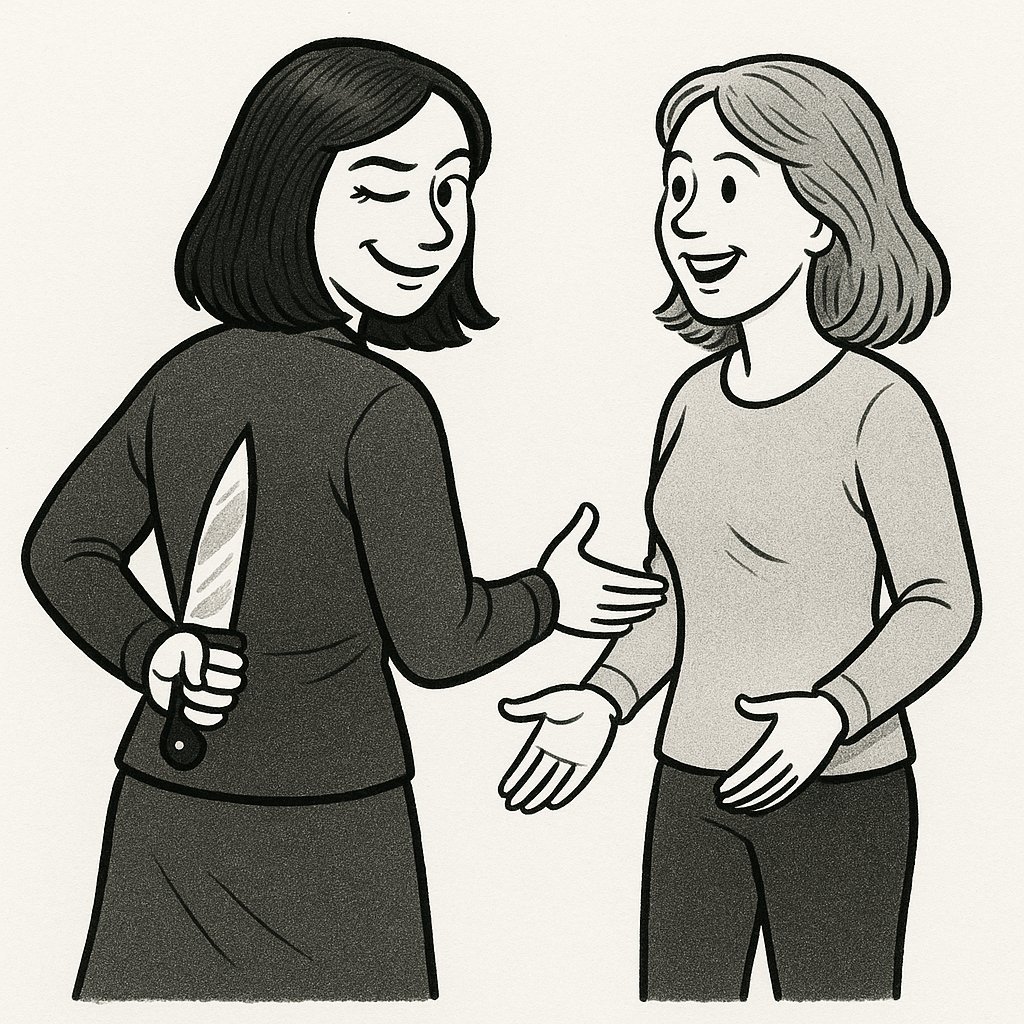
Passive-aggressive cunning is often far more effective than overt aggression, because it operates indirectly rather than directly. Especially in ‘getürkt’ (that is, made to fit the bill, embellished, cunningly arranged) communication styles, this behavioral pattern can be both invisible and highly corrosive in social settings. Here, across three different levels—particularly in the most common forms found in everyday interactions among women—we will examine the mechanisms of empowerment/exoneration through shaming and mockery. Each level rests on creating a tarnishing image—one that damages the target’s self-presentation and unsettles their standing in others’ minds.
1. Interpersonal insinuations resorted to spontaneously: Empowerment by shaming
This first level emerges directly within the relationship between two people. The aim is to belittle the other and pull oneself into a justified or powerful position. It appears spontaneous, yet the moments when the target is vulnerable are intuitively chosen.
Example (an everyday scenario among women)
A group of friends has met at a café; the conversation is flowing. A notices the new dress B is wearing:
– ‘Oh wow, did you buy that dress? It looks a bit… bold on you; of course it suits you, you like trying different things.’
Here, the first half’s word ‘bold’ creates a mild sense of embarrassment; the subsequent ‘it suits you’ is a veil of exoneration. But instead of erasing the real message, that veil amplifies it: a question mark settles over B’s image.
Mechanism
The target’s zone of security is narrowed through insinuation.
An ‘I wonder?’ effect is created in the eyes of others.
The aggressor absolves herself by saying, ‘I was just stating my opinion.’
2. Carefully channeled intergroup insinuations: Empowerment via ‘We’ constructs
The second level adds an ‘audience’ alongside the interpersonal insinuation skill of the first level. Now there is not only a target, but also a positioned ‘We’ in opposition to the target. This We generally takes shape among a group of women around shared values or shared tastes.
Example
In the same café setting, it is noticed that C has had her hair cut. D turns to a few people in the group:
– ‘We thought short hair didn’t suit this kind of face, right girls?’
Then a sweet smile and an add-on: ‘But of course you like being original.’
Mechanism
The word ‘We’ erects a security wall beside the aggressor.
The insinuation is directed not only at the target but also at group norms.
If the others in the group also join the ‘funny’ mockery, the target’s isolation accelerates.
Staining effect
In the target’s mind, a perception now forms of clashing not just with one person, but with all group norms. This can make social insecurity permanent.
3. Literary-izing the Us/Them divide with cinematic framings: Empowerment by narrativizing the flow of life
The third level is the most sophisticated and the most destructive. Here, the aggressor scripts the events as if they were a novel or a film. While relaying the events to others, she embellishes the story so that the target’s image turns into a dramatic character: sometimes naïve, sometimes odd, sometimes tragicomic. Yet always drawn as a figure ‘unlike the others.’
Example
At a weekend gathering of a group of women, an incident about E is being recounted:
– ‘The other day I saw E, with that big mesh shopping bag in hand, under the rain… Just like those quirky side characters in romantic films. We, of course, were walking with our umbrellas, while she was her own self, not detached from her world…’
Here a scene reenactment is being performed, and the ‘We’ and ‘She’ split is clarified. The story serves to fix the target as an eccentric or comic character.
Mechanism
Events are narrativized with exaggerated descriptions.
By repetition within the group, the target’s image is reduced to a ‘character.’
The narrator, in the role of ‘observer,’ absolves herself and even positions herself as a source of entertainment.
Staining effect
Now the target is labeled as someone who ‘has a story’ not only in that moment but also in the future. Even her normal behaviors begin to be perceived as ‘the continuation of the character.’
Common denominator of these three levels
Mask of innocence: At every level, the aggressor presents herself as ‘well-intentioned’ or as an ‘observer.’
Image management: The target’s self-presentation becomes a picture in others’ minds that bears a stain.
Social cunning: Instead of open conflict, insinuations, groups, and stories are used.
Die drei Stufen passiv-aggressiver Raffinesse in ‘getürkter’ Kommunikation
Passiv-aggressive Raffinesse ist oft weit wirkungsvoller als offene Aggression, weil sie nicht direkt, sondern indirekt funktioniert. Zumal in ‘getürkten’ (also zurechtgebogenen, aufgehübschten, raffiniert arrangierten) Kommunikationsformen kann dieses Verhaltensmuster in sozialen Umgebungen zugleich unsichtbar und äußerst zermürbend sein. Hier untersuchen wir anhand von drei unterschiedlichen Stufen – gerade in alltäglichen Interaktionen zwischen Frauen besonders häufige Ausprägungen – die Mechanismen der Ermächtigung/Reinwaschung durch Beschämung und Spott. Jede Stufe basiert darauf, ein befleckendes Bild zu erzeugen – also eines, das das Selbstbild des Ziels schädigt und seinen Platz in den Köpfen anderer erschüttert.
1. Spontan bemühte interpersonale Andeutungen: Ermächtigung durch Beschämung
Diese erste Stufe tritt unmittelbar in der Beziehung zwischen zwei Personen auf. Ziel ist es, das Gegenüber herabzusetzen und sich selbst in eine recht- oder machtvolle Position zu ziehen. Es wirkt spontan, doch die Momente, in denen das Ziel verletzlich ist, werden intuitiv gewählt.
Beispiel (Alltagsszenario zwischen Frauen)
Eine Freundinnengruppe trifft sich im Café, das Gespräch läuft. A bemerkt das neue Kleid an B:
– ‘Oh, hast du dir dieses Kleid gekauft? Es wirkt an dir ein bisschen … gewagt, klar, es steht dir, du liebst es ja, solche anderen Sachen auszuprobieren.’
Hier löst das Wort ‘gewagt’ in der ersten Hälfte ein leichtes Schamgefühl aus; der nachfolgende Teil ‘es steht dir’ ist der Unschuldsschleier. Doch dieser Schleier löscht die Botschaft nicht aus, sondern verstärkt sie: Im Bild von B verankert sich ein Fragezeichen.
Mechanismus
Durch Andeutung wird der Sicherheitsraum des Ziels verengt.
In den Augen der anderen entsteht ein ‘Vielleicht?’-Effekt.
Die Angreiferin wäscht sich mit ‘Ich habe nur meine Meinung gesagt’ rein.
2. Sorgfältig kanalisiert intergruppale Andeutungen: Ermächtigung über ‘Wir’-Konstruktionen
Die zweite Stufe fügt der in Stufe eins eingeübten interpersonalen Andeutung eine ‘Zuschauer:innenschaft’ hinzu. Jetzt gibt es nicht mehr nur das Ziel, sondern ein dem Ziel gegenüber positioniertes ‘Wir’. Dieses Wir formiert sich meist unter einer Gruppe von Frauen über gemeinsame Werte oder gemeinsame Geschmäcker.
Beispiel
In derselben Café-Szene fällt auf, dass C sich die Haare hat schneiden lassen. D wendet sich an mehrere aus der Runde:
– ‘Wir fanden doch, dass so eine Kurzhaarfrisur zu so einem Gesichtstyp nicht passt, oder, Mädels?’
Dann ein süßes Lächeln und die Zugabe: ‘Aber du magst es natürlich, originell zu sein.’
Mechanismus
Das Wort ‘Wir’ errichtet einen Schutzwall an der Seite der Angreiferin.
Die Andeutung richtet sich nicht nur gegen das Ziel, sondern auch gegen Gruppennormen.
Teilen andere in der Gruppe die ‘Witzigkeit’ dieses Spotts, beschleunigt sich die Vereinsamung des Ziels.
Beschmutzungseffekt
Im Kopf des Ziels entsteht nun die Wahrnehmung, nicht nur mit einer Person, sondern mit gesamten Gruppennormen in Konflikt zu stehen. Das kann soziale Unsicherheit dauerhaft verfestigen.
3. Die Wir/Sie-Unterscheidung mit filmischer Dramaturgie literarisieren: Ermächtigung durch das Erzählen des Lebensflusses als Geschichte
Die dritte Stufe ist die raffinierteste und zerstörerischste. Hier formt die Angreiferin die erlebten Ereignisse wie in einem Roman oder Film. Beim Weitererzählen schmückt sie die Geschichte derart aus, dass das Bild des Ziels zu einer dramatischen Figur wird: mal naiv, mal seltsam, mal tragikomisch. Aber stets als jemand gezeichnet, der/die nicht ist wie ‘die anderen’.
Beispiel
Bei einem Wochenendtreffen einer Frauengruppe wird eine Begebenheit über E erzählt:
– ‘Neulich habe ich E gesehen, mit diesem riesigen Netzbeutel in der Hand, im Regen … Genau wie diese komischen Nebenfiguren in romantischen Filmen. Wir gingen natürlich mit unseren Schirmen, sie hingegen ganz eigen, nicht aus ihrer Welt herausgelöst …’
Hier wird sowohl eine Szene inszeniert als auch die Trennung zwischen ‘Wir’ und ‘Sie’ geschärft. Die Geschichte dient dazu, das Ziel dauerhaft als exzentrische oder komische Figur zu kodieren.
Mechanismus
Ereignisse werden mit überzeichnenden Beschreibungen narrativiert.
Durch Wiederholung in der Gruppe wird das Bild des Ziels auf eine ‘Figur’ reduziert.
Die Erzählerin positioniert sich in der Beobachterrolle als unschuldig, ja sogar als Quelle der Unterhaltung.
Beschmutzungseffekt
Das Ziel wird nun nicht nur in diesem Moment, sondern auch künftig als jemand mit ‘Geschichte’ etikettiert. Selbst normales Verhalten wird als ‘Fortsetzung der Figur’ wahrgenommen.
Gemeinsamer Nenner dieser drei Stufen
Unschuldmaske: In jeder Stufe zeigt sich die Angreiferin als ‘wohlmeinend’ oder ‘beobachtend’.
Image-Steuerung: Das Selbstbild des Ziels wird im Kopf der anderen zu einem Bild mit Makel.
Soziale Raffinesse: Statt offener Konfrontation werden Andeutungen, Gruppen und Geschichten genutzt.
 Žižekian Analysis
[…] (İngilizcesi ve Almancası) […]
LikeLike
[…] Getürkt İletişimde Pasif Agresif Kurnazlığın Üç Seviyesi / The Three Levels of Passive-Aggressive Cunning in Getürkt Communication / Die drei Stufen passiv-aggressiver Raffinesse in ‘getürkter’ […]
LikeLike