🦋🤖 Robo-Spun by IBF 🦋🤖
🌀⚔️💫 IPA/FLŽ 🌀⚔️💫

International Psychoanalysis Association / Freudian-Lacanian-Žižekian
IPA/FLŽ — A New Psychoanalytic Frontline

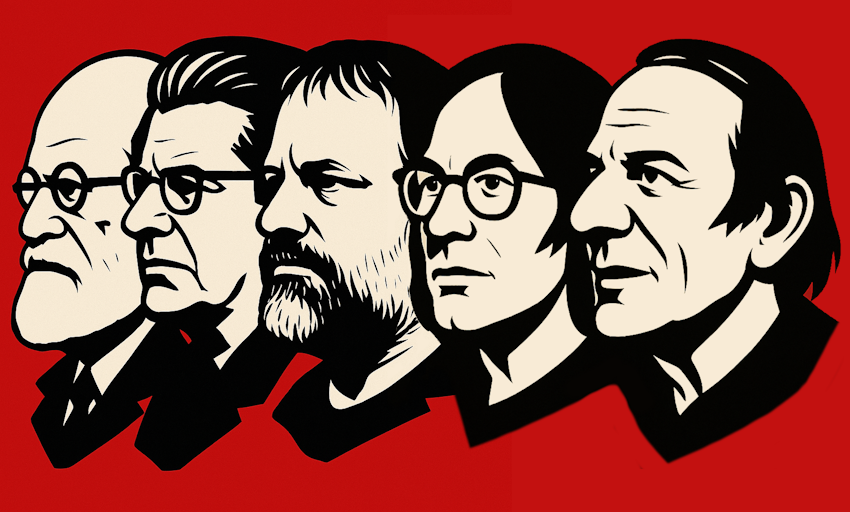
Introduction
The statement that follows argues two things at once, without flinching from the tension between them. First, the IPA/FLŽ line is right to condemn the romanticization of “flows” that dissolves negativity and replaces the clinic’s cut with an aesthetics of endless circulation. Second, a narrow corridor remains where parts of Deleuze & Guattari’s toolbox can be salvaged and made to serve an analytic procedure that ends in incision rather than ambiance. The key is to keep the operators that work—map against tracing, plane-of-consistency as a practical surface, careful hygiene around lines of flight, and the faciality diagram of capture—but to bind them to a discipline that refuses any guarantor and insists on a timed, lean cut. The philosophical backdrop is easy to check: a clear primer on Deleuze’s method and vocabulary sits in the Stanford Encyclopedia of Philosophy, which treats concepts like immanence and multiplicity as working notions rather than perfumes (🔗). The book most readers meet first is an accessible overview of A Thousand Plateaus, where “rhizome” is opposed to “tree,” “map” to “tracing,” and “deterritorialization” is already warned to be vulnerable to compensating relapses (🔗).
What “restoring the cut” means can be formulated without mystique. Analysis is not an edifying stream of insight; it is a craft that re-times a sequence by a punctual intervention—what Lacanians simply call scansion, the session-ending punctuation that forces a gap to count (🔗). The cut matters because, in this discipline, there is no Big Other to certify from elsewhere; “the big Other does not exist” is not a slogan of despair but the rule that forbids outsourcing decision to atmospheres and vibes (🔗). When those two lessons are kept—no guarantor, and a decisive punctuation—then cartography becomes usable: redundancy can be allowed to accrete as evidence and then be cleared by a single proof-cut. Without the cut, maps collapse back into tracings, and critique curdles into a mood. (Wikipedia)
The charge against Deleuze & Guattari is therefore clinical and technical rather than moral. Where the desiring-production idiom or a lyrical “line of flight” is taken as a substitute for negativity, subjects are not freed; they are fed to stimulation loops. The book itself furnishes the cautionary figures. “Make the map, not the tracing,” it says, then shows how a child’s exploratory cartography was plugged back into a family snapshot in the Little Hans dossier that became emblematic of Oedipal policing (🔗). If “map” becomes a license to avoid the cut, blockages return in another guise; if “line of flight” becomes a vibe, reterritorialization covers the exit and the line is barred. The general reader can hold those stakes in view simply by pairing a neutral case summary with the book’s own chapter-level summaries: a map is what lets you re-situate an impasse; a tracing is what injects redundancy until only dead ends remain. (Libcom)
The partial exoneration begins from the same pages. A map is open, connectable, and modifiable; that is a rule of use, not a romance. A plane of consistency is a bench top where heterogeneous elements can compose without appeal to a higher judge; that is a craft surface, not a mystique. “Deterritorialization” names a procedure of exit, but the text repeatedly warns that it is frequently covered by reterritorialization; that is a hygiene, not a hall pass. And “faciality”—the white-wall/black-hole machine that couples counting with looping—remains a prescient diagram of platform capture that turns recognition into a trap; that is an engineering picture of scopic power, not a metaphor to be admired (🔗). The salvage operation keeps these operators in a Žižekian register that says: no transcendent assurance will decide for you, and a cut must punctuate redundancy if consequence is to begin.
What follows, section by section, keeps that forked path explicit. The condemnation is fully right where “flow without cut” liquidates lack and greases algorithmic capture. The betrayals of Freud and of Lacan are named as failures to distinguish living laboratories from their bureaucratic tracings. The post-Žižekian crypto-treason of Hypocritique is mapped as the culture that says “lack” without cutting, curates antagonism into mood, and forbids causal speech where it would cost. And the partial exoneration is presented as a realignment: keep Deleuze & Guattari where they give procedures that widen sensitivity to the field, but wire those procedures to a discipline that ends in a cut. For orientation, the SEP entry anchors the conceptual spine (🔗), the overview of A Thousand Plateaus keeps the vocabulary legible (🔗), the Little Hans case fixes the clinic in view (🔗), and the compact notes on scansion and the Big Other remind why a timed incision and the refusal of a guarantor belong together (🔗 · 🔗). That is the whole program in one breath: map widely, then cut once, and let the sequence begin. (Libcom)
1) IPA/FLŽ condemnation is fully right — naming the betrayals and restoring the cut
The case against Deleuze & Guattari, as stated by an IPA/FLŽ line that joins Freud’s discovery, Lacan’s cut, and a Žižekian concern for ideology, is straightforward once the basic terms are laid out for a general reader. Psychoanalysis is a craft organized by lack: desire does not gush because a machine spins inside us; it insists because something is missing, barred, not-all, and that structural negativity has to be handled with cuts, limits, and speech. When this negativity is dissolved into smooth “flows,” the subject is not liberated; it is liquidated into stimulation loops. The accusation is that Deleuze & Guattari—by turning desire into “desiring-production,” by valorizing “lines of flight,” by proposing a “Body without Organs”—erase lack and replace the clinic’s punctuation with an aesthetics of circulation. Žižekian Analysis has been blunt about why this matters: if you remove negativity (the entropy-like grain of loss that makes truth-effects possible), platforms and atmospheres take over, a “maternal” algorithm cares for everyone so that no one has to decide, and critique becomes tone without incision (🔗; 🔗). (zizekanalysis.com)
The text of Mille plateaux itself furnishes the evidence that the condemnation is not a caricature. Deleuze & Guattari warn us to “make the map, not the tracing,” and add that tracings “inject redundancy and reproduce dead ends.” They recount how, with “Little Hans,” adults “kept breaking his rhizome, staining his map, blocking every exit until he desired his own shame: phobia.” They even instruct: “Report the tracing back to the map; the operation is not symmetrical.” These lines already identify the danger they fall into elsewhere: when the world is redrawn as maps-without-cuts and lines-of-flight-without-brakes, blockage returns in another guise. The IPA/FLŽ position seizes precisely on this: wherever a “map” becomes an alibi for avoiding the cut, the same dead ends reappear—only now with the glamour of openness. (All quotations here are taken from Mille plateaux; translations condensed for clarity.)
The clinical hinge is easiest to grasp. Psychoanalytic work is not the romanticization of psychosis; it is a procedure that re-times speech by cuts. A session ends not where story-time says “and then,” but where a punctuation forces the subject to encounter a gap. Remove the cut, and reality-testing decays into dashboard theatre: the person trades truth for readouts and lives inside a self-affirming feed. This is why Žižekian Analysis insists on the difference between evidence that grows sideways and proof that clears excess with a single incision; without the final cut, redundancy hardens into a mood, and the “careful” discourse that names lack without acting becomes what the archive calls Hypocritique (🔗; 🔗). (zizekanalysis.com)
From this angle, the IPA/FLŽ charge that Deleuze & Guattari liquidate lack is not a moralizing flourish; it is a clinical and technical claim. If the unconscious is re-described as a factory of positive productions, the negative work that makes analysis possible—the encounter with a limit, the surprise of anxiety, the unaccountable remainder that orients desire—has nowhere to land. Lacking that landing, the modern scopic economy steps in: faces, feeds, and metrics. Žižekian Analysis has tracked how the mirror-stage mutates on social media into an economy of authorization, where recognition is sought by exposing oneself to the gaze, and where the superego’s old “Enjoy!” becomes a platform command to perform (🔗; 🔗). In Mille plateaux, the diagram for this capture is the face-machine: “the signifier rebounds on a white wall; subjectivity flees toward a black hole,” and each added border multiplies capture. The IPA/FLŽ verdict reads this against the grain: when “flow” is valorized without a countervailing law, visagéité expands, not freedom. (zizekanalysis.com)
The condemnation also concerns the ethic of decision. In a Žižekian Analysis idiom, cuts are timed late and lean: let redundancy accumulate until the null hypothesis can no longer stand, then remove the excess with a single, auditable index. This choreography resists twin failures that Deleuze & Guattari inadvertently abet when “lines of flight” are aestheticized: the premature gesture that collapses into yet another calque, and the endless deferral that calls itself openness. The relevant materials in the archive spell this out in concrete registers, including the “moral bomb” essays on feedback loops in public discourse and the topology pieces that differentiate acceptance, rejection, and the legitimacy of an act (🔗; 🔗). Here again the text of Mille plateaux both helps and harms: it gives the hygiene (“Neutralize death-lines; retain only what increases connections”) and also tempts readers to confuse procedures with vibes. IPA/FLŽ insists on restoring the procedure. (zizekanalysis.com)
Finally, the verdict addresses institutional and geopolitical capture without lapsing into name-dropping. When “deterritorialization” is championed as a general good, one forgets the book’s own warning that D is often covered by reterritorialization, leaving the line barred. A culture that makes D its gospel while disdaining the cut will be easy to steer by metrics and atmospherics; its exits will lead back to curated corridors. The Žižekian Analysis dossier on curiosity-as-non-knowledge gives the positive counter-formula: keep ignorance operative so that an act can punctuate illusion, not as a pose but as a re-timing that binds consequences (🔗). In other words, the condemnation is not a rejection of experimentation; it is a demand that experiments return to the clinic of the cut, where subjects are not fed to flows but given a frame in which lack can be borne, spoken, and decided. (zizekanalysis.com)
For readers new to this field, the takeaways are compact. Psychoanalysis is not against movement; it is for movements that become speech through limits. Mille plateaux contains brilliant operators—map vs. tracing, planes of consistency, careful accounts of negative lines of flight—but the post-1968 appetite to abolish the law turned those tools into a theatre of uninterrupted “Yes”. IPA/FLŽ’s condemnation says “No” at the right place. It restores the cut so that desire can exist as something other than a metric, a mood, or a machine. And because the condemnation is sourced to the very concerns that Žižekian Analysis keeps showing in practice—entropy as motor of truth-effects, redundancy disciplined by proof, non-knowledge as horizon for acts—it is not a culture-war slogan but a craft rule for keeping subjects alive in an age that mistakes visibility for freedom (🔗; 🔗; 🔗). (zizekanalysis.com)
2) Still: Deleuze & Guattari were not complete idiots — how their best tools (as read by Žižekian Analysis) can and should be reused
The indictment stands, but the book on Deleuze & Guattari cannot close with a single verdict. If the first section restored the analytic cut against their romanticism of “flows,” this section gathers the salvageable instruments they forged—their cartographic method, their criteria for selection on the plan, their warning about pseudo–lines of flight, their anti-hermeneutic pragmatics, and their faciality diagram—and shows how these very instruments have already been refitted in the Žižekian Analysis archive. The point is not to praise but to reassign: keep what works as procedure, drop what works only as atmosphere.
Begin with the sentence that opens their toolbox: “A rhizome is a map, not a tracing. Make the map, not the tracing.” From the pages of A Thousand Plateaus in your hands: “The map is open, connectable in all its dimensions, detachable, reversible; it can constantly receive modifications… One must always report the tracing back to the map; the operation is not symmetrical.” This contrast—map vs. tracing, performance vs. competence—remains one of the most exacting correctives available when analysis is tempted by prefab schemas. To read “Little Hans,” they insist, is to track how a child tries to constitute a rhizome (house, street, stable), and to register where adults kept breaking his rhizome, staining his map, blocking every exit, until the boy “desired his own shame: phobia.” The clinical lesson hidden here is not the abolition of lack but the cartographic obligation to locate impasses on a working map, instead of bending lived space back into a family photo. That obligation is precisely what Žižekian Analysis cultivates when it translates metaphysics into spatial/combinatorial procedure: macrostates/microstates, energy/entropy, actual/virtual—an operational map that you modify as you work, not a tracing you justify after the fact. See, for example, how an argument about “combinatorial space” is mobilized as a practical stance toward utopian design and risk (🔗). (zizekanalysis.com)
Their second usable tool is not a metaphor but a criterion—what they call the “rules of construction” on the plane of consistency: eliminate empty, cancerous bodies; neutralize lines of death that divert the line of flight; retain only what increases connections. This is not relativism; it is selection. The analytic cut can be restated in this language without losing its severity: select only what increases workable connections, neutralize the death-loop, and jettison the inert. The point is not to “let everything flow,” but to separate lines that truly widen a field from those that simply inflate redundancy. When Žižekian Analysis names today’s ambient critical style “hypocritique”—critique that says lack without cutting—the remedy proposed is procedural: redundancy builds evidence, but only a cut turns redundancy into proof. That is the same hygiene D&G sketch at the level of construction, upgraded into a public method: first let traces accumulate; then execute a lean incision that clears the noise into proof. (For surrounding context on how Fidaner diagnoses “hypocritique” as a recognizable capture-style rather than a theory, compare the dossier here: 🔗.) (zizekanalysis.com)
Third, they taught everyone to distrust pseudo–lines of flight. “Deterritorialization is the operation of the line of flight,” they write, “but it is frequently covered by reterritorializations, so the line of flight is barred.” That sentence rescues praxis from vibe. Not every escape is an exit; many escapes are redecorations of the same room. This is where the Žižekian Analysis habit of rate-limiting urgency comes in: refuse the panic-pedal that confuses speed with act; expose the schedule and threshold of a so-called flight; then decide when and where to cut. When Fidaner writes about climate, pandemic, or platform moralism, the question is invariably when the line became a loop, i.e., when an apparent flight hardens into a stimulation routine. The against-the-grain reading of “utopias” as combinatorial explorations fits the same ethos: protect invention, but police the reterritorializations that sell loops as breakthroughs (🔗). (zizekanalysis.com)
Fourth, their anti-hermeneutic pragmatics remains a working vaccine against depth-fetishism in theory, media, and clinic. “A book has neither object nor subject,” they write; “ask what it functions with, what intensities it passes.” This is the same question analysis must ask of its own sessions, threads, and proofs: with what do they function, what do they pass, and for whom? Fidaner names this stance “knowledge-at-work”: prioritize the operation (what it enables or disables) over “meaning harvesting.” He treats even LLM “dialogues” this way, evaluating not the aura of “AI intelligence” but what the exchange authorizes—what it does to inquiry, to effect, to proof. See the practice laid bare in “Manifesto Dialogue with Grok” (🔗). (zizekanalysis.com)
Fifth, their analysis of visagéité—the white-wall/black-hole face-machine—anticipates our scopic economy with unnerving precision. “The signifier rebounds on a white wall; subjectivity flees toward a black hole.” This is not an invitation to mystical semiotics; it is an algorithm for spotting capture: every new bordered circle on the wall enlarges the surface of capture, and the holes reproduce as redundancy. Žižekian Analysis uses this diagram to read the platform face—cameraphilia, ambient “carefulness,” mood-as-proof—and to explain why certain scenes feel ever more “ethical” while nothing is ever at stake. The result is a stepwise counter-procedure: return the calque to the map (provenance, thresholds, schedules), then enact a concrete cut (mute, block, time-limit) to restore sequence and responsibility. Even general pieces on “utopia” or “Grok” double as case-studies in facial capture: they show how a face-style can pre-sort desire before any content arrives (🔗). (zizekanalysis.com)
All five tools can be re-phrased as rules of craft, not slogans of emancipation. Make a map you can actually revise; select with an eye to neutralizing death-lines; test flights for reterritorialization; read assemblages by their functions, not their meanings; and treat the face as a machine for capture that must be audited and sometimes shut down. If these sound austere, they are. But they also rescue the best of Deleuze & Guattari from the worst of their reception. And they align with the Žižekian Analysis insistence that negativity must be kept inside the method—that entropy, loss, and the right to opacity are not obstacles to thought but conditions for truth-effects. When Fidaner dissects the soothing fantasies around climate or “progress,” he does so by widening the map (to include the combinatorial), then tightening the selection (to exclude what only looks like motion), and finally cutting—so that some consequence actually follows (🔗). (zizekanalysis.com)
There is one final reason to credit them with more than error. They insist that writing is made of plateaus that “can be read anywhere and connected to any other,” and that analysis should reach the point “not of no longer saying ‘I’ but where it no longer matters to say ‘I’.” In other words, they built forms for lateral connection and depersonalized procedure. Those forms become dangerous only when they are used to avoid the cut; they become indispensable when they are used to stage it. The partial exoneration thus has a very strict meaning: keep the tools that help you draw, connect, test, and time a cut; discard the atmospherics that promise plenitude without loss. The map remains; the tracing goes. The plane remains; the death-line is neutralized. The face is audited; the cut restores speech. And in that constrained, procedural sense, Deleuze & Guattari were not idiots at all—they built parts of the workshop we still need.
3) Deleuze & Guattari betrayed Freud by failing to distinguish post-Freudian crypto-treason from Freud himself
The charge is precise. There is a real Freud whose discovery of the drive and its conflictual economy forces the clinic to respect negativity, sequence, and cut; and there is a post-Freudian industry that flattened this discovery into a developmentalist family snapshot and an adaptive pedagogy. Deleuze & Guattari aimed at the industry, yet too often fired at Freud. The result is a double error: they correctly diagnose how “Oedipus” was bureaucratized into a family-calque, but they misattribute that standardization to Freud rather than to the post-Freudian redaction that turned cartographies of desire into schoolbook stages. The betrayal lies in this failure to separate the inventor from his editors.
Begin with what they see clearly. In their now-famous polemic around “Little Hans,” they describe how clinical authority keeps “breaking the child’s rhizome,” staining his living map, and “collaps[ing] it into a family photo.” The insight is sharp: a map is exploratory and connectable, a tracing is a reproduction that neutralizes movement; when the clinic insists on the tracing, it plugs exits and forces the living case back under pre-drawn axes. Their instruction—report the tracing back to the map, and never the reverse—names a real violence that did take hold in institutional psychoanalysis. The text in which they lay this out (“Introduction: Rhizome”) is the right exhibit; it shows both the exactness of their eye and the slippage of their attribution, because the practice they deplore is not Freud’s invention but what much of the apparatus did with it. (🔗).
Now recall Freud’s own dossier. The “Little Hans” analysis is not a morality play about how a father-signifier crushes unruly lines into obedience; it is a messy, experimental attempt to follow a child’s fear, detour through symptom, and return with a usable cut. Whatever one thinks of its success, it is not a catechism. Freud’s method in the case (“Analysis of a Phobia in a Five-Year-Old Boy”) folds observation, family interventions, and theoretical wagers into a narrative that never reads like a laminated stage chart. Even a basic orientation to the case—what the phobia was, how the fear attached to signifiers, how the family’s speech bent the child’s world—shows a laboratory sensibility rather than the textbook Oedipus that later “ego-psychology” made compulsory. (🔗).
The difference matters because Freud’s hard claim is not a pastoral picture of family romance but the discovery that the psyche is driven by a conflictual economy that does not answer to adaptation alone. “Eros” and “Thanatos” in Freud are not hallmark metaphors but a way to say that there is a constitutive loss at work in satisfaction, that pleasure is bordered by a push that can turn against the organism’s comfort, and that the cut which orients a life is not a once-and-for-all enlightenment but a minimally viable incision in a field that resists totalization. Freud’s later metapsychology (from Beyond the Pleasure Principle through the “economic” papers) is explicit about this wager on the drive economy—even a quick historical survey of his thought shows how the “death drive” names an internal negativity rather than a policing father. (🔗). (Scribd)
What Deleuze & Guattari rightly hate is the post-Freudian retooling that set aside this economy in favor of an Oedipal catechism and an ego-adaptation program. This is exactly the “family-calque” they skewer: a grid that decomposes desire into pre-authorized roles and stair-steps every crisis into a developmental checklist. But when they treat this grid as the essence of psychoanalysis, they let a later managerial turn stand in for Freud’s wager. The irony is that their own best concepts—map against tracing, line of flight against striated retracing—would have allowed them to draw the very distinction they miss: keep Freud’s exploratory cartography of conflict and cut; reject the post-Freudian tracing that reproduces blockages. Their generalized attack lets the calque mask the map. (🔗). (Wikipedia)
The “betrayal” in this section’s title is therefore not a piety about founding fathers; it is a methodological complaint. Conflating Freud with his bureaucrats deprives the clinic of two indispensable tools that Freud puts on the table and the post-Freudians too often tidy away. The first is the license to follow a symptom’s detours until the sequence itself dictates where a cut could hold. The second is the right to negativity: the recognition that the subject’s economy includes a push that overshoots utility, a “beyond” internal to pleasure, which is what makes any orientation more than a behaviorist nudge. When these are flattened into stage models, the clinic becomes a correctional classroom; when they are kept distinct, one can refuse the stage models without giving up on incision and test.
The textual evidence that Deleuze & Guattari are indeed targeting the tracing—and not only Freud—is everywhere in their own pages: the rhizome is a map, the map is open and modifiable, the tracing injects redundancy and reproduces dead ends. But they also treat “psychoanalysis” as the global name of the tracing machine, and therein lies the rub. An accurate history would say: a great part of the institution did become a tracing machine; Freud’s original laboratory, for all its dated elements, is not the machine but an attempt to work against it. The cleanest way to keep both truths is to aim the critique at the post-Freudian calque while rescuing the Freudian cut from it. The rescue is not nostalgic; it is the only way to keep negativity and sequence available to thought without lapsing into the romance of “flows” that pretends cuts can be dispensed with.
One last context closes the argument. The Oedipus complex, as the textbooks came to wield it, became a banner under which clinical life was standardized—a “central dogma” fitted to family romance and used to decode anything that moved. That centrality, however, is a product of codification and diffusion, not simply the content of Freud’s research notebooks. Even broad surveys note how “Oedipus” functioned as a master-key in later schools, and how the family triangle was elevated into an all-purpose stencil. To object to the stencil is right; to pretend the stencil is the same thing as the messy experiment that first raised the question is to repeat the institution’s own confusion at another pitch. (🔗). (Google Sites)
The rectification this section asks for—distinguish Freud’s laboratory from the post-Freudian calque—re-arms the critique of “Oedipus” without throwing away the only instrument strong enough to punctuate a field of stimulation: the cut that orients beyond adaptation. With that rectification in hand, even Deleuze & Guattari’s best warnings regain their force without collateral damage. Use their command—map before model—against the tracing machine that captured Freud; and keep Freud’s conflictual economy as the reason a map needs a cut at all. When the calque is reported back to the map, the apparent contradiction dissolves: what was denounced as “Freud” turns out to be the post-Freudian crypto-treason, and what was being thrown away with it returns as the indispensable craft of incision. (🔗).
4) D&G betrayed Lacan because they failed to distinguish the post-Lacanian crypto-treason from Lacan himself
The quarrel that matters is not between Deleuze–Guattari and a caricature of Lacan, but between their just attack on a bureaucratic “competence” that speaks in Lacan’s name and the craft Lacan actually taught: a practice of the cut, the act, and non-knowledge that cannot be reduced to administrative signifier-management. When Deleuze and Guattari rail against a psychoanalysis that turns a child’s map into a tracing, plugs every exit, and installs “the power of the signifier,” they are accurately describing a post-Lacanian police of interpretation; when they attribute that closure to Lacan as such, they strike the wrong target. Their own program gives the means to draw the line: a map must be reported back from the tracing, not the other way around, and the operation is explicitly non-symmetrical. The text where they say this is also the text where the confusion begins. “Make the map, not the tracing… the tracing injects redundancies and reproduces dead ends; one must report the tracing back to the map.” It is a precise recipe for separating a living clinic from its bureaucratic calque, and yet their polemic fails to apply it to Lacan himself, as if the map they admire could not include Lacan’s act without being overcoded by “Lacanism.” The contradiction is visible at the paragraph where they define the method, and it is where this section begins to unbraid the threads. (🔗) (Medium)
Lacan’s clinic is built around the cut as a punctual operation that re-times a sequence—what he formalizes as scansion—and around the act as a moment that cannot be derived from knowledge. In Lacan’s economy, knowledge (S2) never guarantees truth; the subject ($) is constituted around a lack, and an act inscribes that lack rather than filling it. Post-Lacanian “competence,” by contrast, is a university discourse that treats knowledge as credential and the signifier as a permit, conferring the right to speak without the risk of a cut. Even introductory summaries of Lacanian frameworks make this contrast legible: Lacanian discourse theory distinguishes an analytic discourse from the university discourse precisely by the place knowledge occupies in relation to the subject and the cause of desire. Treating signifiers as a bureaucratic capital that authorizes speech is the university drift, not the analytic act. To conflate that drift with Lacan is to mistake the calque for the map his teaching forces. (🔗) (Wikipedia)
The IPA/FLŽ dossier on non-knowledge makes the same point with a different key. Curiosity that does not bow to a master-knowledge, the “passion of ignorance” that orients work beyond self-evidence, and the late, lean incision that converts redundancy into proof are the house rules of a Lacanian clinic that refuses bureaucratic closure. In this register, knowledge-as-competence is the very thing to be cut, not the operator of the cut. When the Žižekian Analysis essays describe how redundancy is allowed to grow until a single, austere act clears it—“redundancy builds evidence; proof clears redundancy”—they formalize Lacan’s scansion in contemporary terms and supply an operational distinction between a living procedure and its post-Lacanian simulation. The post-Lacanian treason is to say “lack” without cutting; Lacan’s practice is to cut so that lack is not covered over by tone or credential. (🔗) (zizekanalysis.com)
Deleuze and Guattari themselves furnish the optics to see how the bureaucratic capture works. Their analysis of tracing versus map shows how a competence reproduces only blockages and dead ends, injecting redundancy into the field. Their own instruction—“report the tracing back to the map”—is a call to return competence to performance, to make a procedure answer to a field rather than to a credential. Read that way, Lacan’s act is a mapping operation: a cut that re-situates impasses on the analytic map so exits can be re-opened, rather than a tracing that closes them under an official signifier. The betrayal, then, is not that they attack a policing of the signifier; it is that they let the policing stand in for the clinic whose first gesture is to puncture police-knowledge with a timed incision. (🔗) (Medium)
The IPA/FLŽ thermodynamic scaffold clarifies what the cut accomplishes without mystique. When that archive re-codes the analytic negativity as entropy that drives selection, it is translating Lacan’s non-knowledge and act into a rule for work: let heterogenous traces accumulate until a single contextual punctuation transforms evidence into proof, then keep only what sustains speech. That choreography is incompatible with the post-Lacanian habit of transforming the signifier into a pass that excuses every non-decision. In the ŽA idiom, the maternal algorithm of “carefulness” and mood is a redundancy machine; the act is the lean subtraction that neutralizes a death-line and retains only what increases connections—the very selection rule Deleuze and Guattari attribute to the plane of consistency. The difference is that Lacan’s plane is not a metaphysical sheet but the symbolic sequence being re-timed by a cut. (🔗) (zizekanalysis.com)
Once the distinction is clear, several consequences follow. First, the “signifier-power” Deleuze and Guattari denounce is the afterlife of Lacan in a university discourse, not the analytic discourse itself. Second, their own warnings about negative deterritorialization—lines of flight covered by reterritorializations—apply exactly to the post-Lacanian scene: the rhetoric of the cut is retained, the cut as act is blocked, and a reterritorialization on competence compensates the gesture so the line remains barred. Third, the white-wall/black-hole machine they call visagéité, where signifiance and subjectivation fold into each other, is the diagram of post-Lacanian capture, not the definition of Lacan’s method. If visagéité multiplies redundant borders and capture surfaces, the cure is not to abandon Lacan but to perform the analytic subtraction that refuses a face as guarantor. The translator’s note that the ligne de fuite is also the painter’s point de fuite—the vanishing line of perspective—helps to keep this sober: the line of flight is a rule of re-framing, not a revelation of a higher essence. (🔗 · 🔗) (Medium)
Finally, the name for the betrayal on the Lacanian side is available and should be used: the university drift that treats knowledge as capital is not an unfortunate style; it is a structural flip of discourses in which S2 sits as agent and the subject is forced beneath a credentialed master-signifier. Even popular outlines of the Lacanian field mark this as a distinct configuration and oppose it to the analytic discourse in which the object-cause is placed to cause truth, not to certify it. When Deleuze and Guattari equate “Lacan” with the credentialed signifier, they help the calque masquerade as the map they otherwise defend. The rectification is simple and strict: keep their attack on post-Lacanian competence, but return it, by their own rule, to the analytic map where a cut answers to the sequence and an act changes coordinates instead of policing them. That return separates Lacan from his bureaucrats and exposes the true target of their ire as the post-Lacanian crypto-treason that says “lack” without risking an incision. (🔗) (Wikipedia)
In this light, the charge that D&G “betrayed Lacan” resolves into a technical correction. They saw with unusual clarity how tracing-logics neutralize multiplicities, how redundancies propagate, and how pseudo-lines of flight are covered by compensatory reterritorializations; they then misapplied that clarity to Lacan instead of to the university drift that disfigured him. IPA/FLŽ resources take their very diagrams and wire them to a Lacanian procedure that cuts late and lean, honors non-knowledge over credential, and selects by neutralizing death-lines. Map before model; act before credential; cut before competence. That is not a return to an orthodoxy they opposed, but the enforcement of their own method at the point where their polemic let the tracing stand in for the map. (🔗 · 🔗 · 🔗) (Medium)
5) Liquidate the post-Žižekian crypto treason of Hypocritique: what it is, how it works, why it neuters analysis
Call Hypocritique the house-style that learned Žižek’s vocabulary—lack, contradiction, big Other, surplus-enjoyment—yet carefully disables the incision those ideas were built to make. For readers meeting these terms for the first time, a thumbnail is enough to feel the stakes. In Lacan (as read by Žižek), the big Other names the virtual order of presupposed rules and recognitions; the grown-up realization is that “the big Other does not exist,” which is to say there is no ultimate guarantor behind our institutions, only contingent structures that can be re-made (🔗). When people cannot bear this lack, they fetishize some token as if it carried its own power; Žižek’s point—formulated already in his breakthrough work on ideology—is that fetishism confuses a structure’s effect for a property of a thing, “we know very well…but still,” and thus props the very order it claims to unmask (🔗). And when a discourse substitutes ever-new morsels of savvy explanation for a change in structure, what lubricates the loop is surplus-enjoyment: the little extra satisfaction wrung from endlessly repeating the insight without paying its price in the world (🔗). Hypocritique is the capture of these insights by a culture that wants their frisson without their cut. It says the big Other doesn’t exist, then behaves as if a tasteful managerial ethos were that Other; it exposes fetishism, then treats its own phrases as talismans; it names surplus-enjoyment, then turns analysis itself into a steady drip of it. The symptom surfaced in public, unmistakably, when Žižek tried to bring context back into a consecrated room and was heckled at the Frankfurt Book Fair; the line that travelled—“criticism is free, analysis is forbidden”—is not only a wry slogan but a diagnosis of a cultural superego that permits moral verdicts yet bans causal speech where it would hurt (🔗). (Stanford Encyclopedia of Philosophy)
Hypocritique thrives because it converts antagonism into mood and turns analysis—the tracing of mechanisms, incentives, and procedures—into a boutique tone. Žižek’s own work arms us against that slide if we read it as code to be executed rather than as jewelry to be worn. In political essays at his most bracing, he warns that comfort-making stances are a trap; “Resistance is Surrender” condensed the point years ago: stop bathing in the glow of edifying positions and force finite changes that move institutions (🔗). The later theological dossier on the neighbor names another hinge Hypocritique refuses: beyond the familiar fellow human stands an opaque neighbor whose enjoyment we fantasize and police; that opacity should push us from theatrical indignation to structural mapping of how institutions weaponize fear of the neighbor (🔗). In The Plague of Fantasies, Žižek re-states the fetish lesson with particular bite: don’t treat a vivid example or slogan as if it secreted truth by itself; the truth is in the structure that confers the effect, not in the thing that happens to carry it this time (🔗). Hypocritique flips each hinge: it stages resistance as a vibe; it invokes the neighbor to inflate pathos, not to dissect apparatus; it wears examples as amulets. The result is a sleek critique-without-cost machine: a procession of knowing tokens that produce surplus-enjoyment while leaving the levers untouched. (zizekanalysis.com)
To see the mechanism clearly, fix three moves that recur wherever Hypocritique sets the tone. First, absolutize feeling, relativize causation. Anything that would tether a judgment to procedures, budgets, timetables, chains of command is treated as indecent; feelings are allowed to be absolute, context is not. That is exactly the prohibition Žižek walked into in Frankfurt, where public sorrow was licit but causal analysis was read as heresy (🔗). Second, replace the cut with the collectible. Instead of letting a concept restructure address positions—who speaks, who decides, who pays—Hypocritique turns the concept into a pocket charm. Fetishism’s structure/property distinction was written to block that move; the charm wins when we forget it (🔗). Third, confuse universality with a mascot. In Žižek’s account, universality is sustained by a singular point that forces a re-wiring; Hypocritique supplies a substitute singular—an image, a “case,” a perfectly curated victim or hero—who can be circulated without anyone surrendering a payoff. The neighbor volume is the antidote here: it teaches why symbolic comfort with the “familiar other” must give way to procedures robust enough to face the truly opaque neighbor, not just honor a mascot (🔗). (zizekanalysis.com)
The reason to name Hypocritique now is not to score a subcultural point but to clear a path for the very thing Žižek’s best pages still demand: execution instead of exhibition. Take his most over-quoted lessons and run them as programs. “The big Other does not exist” means: stop outsourcing courage to the atmosphere of “what one does”; write a rule that binds someone next week, not a mood that flatters everyone today (🔗). “Fetishism” means: if a sentence gives you a rush, ask which structure is cashing the check; if none, drop the sentence (🔗). “Surplus-enjoyment” means: measure your discourse by what it changes when the rush is gone; if nothing moves, you just fed the loop (🔗). “Resistance is surrender” means: downgrade the grand gesture, upgrade the finite incision that redistributes risk (🔗). Without those compilations, post-Žižekian talk becomes exactly what the Frankfurt episode revealed: a culture where critique is a license to avoid analysis at the one point where analysis would cost. (zizekanalysis.com)
This is what “liquidating” Hypocritique demands in practice: not louder condemnations or prettier paradoxes, but the boring bravery of binding. A scene organized by Hypocritique will always prefer the edifying sentence to the unglamorous lever—calendar, bylaw, budget line, procedure—because levers force a relinquishment of secondary gains: prestige for restraint, immunity through mood, audience via pathos. Žižek’s own map points to where the knife must fall. The neighbor text insists we swap catharsis for mechanism whenever otherness is in play, tracking how institutions weaponize our fantasies of the neighbor’s enjoyment (🔗). The fetish chapters in Plague warn that the most bewitching “examples” are precisely where we should distrust ourselves and go structural (🔗). The lesson about the big Other outlaws reliance on atmospheres disguised as authorities (🔗). The Frankfurt moment supplies the field test: if a room permits denunciation but punishes causal speech, Hypocritique is in charge—and the only honorable response is to keep speaking in the register that ties words to world even when the room hisses (🔗).
Hypocritique is “post-Žižekian” not because it quotes him, but because it inverts him: it turns a theory built to cut into a theater built to soothe. Liquidating it is the price of any serious return to analysis. Seen from that angle, the slogan that opened this section stops being a flourish and becomes a rule of craft: when critique is cheap, forbid yourself the comfort of it; when analysis is forbidden, force it—name the structure, bind the change, and accept the loss that follows. Only then do Žižek’s concepts run as code rather than hang as charms, and only then does the discourse that bears his name stop betraying the work it claims to honor.
6) Partial exoneration as realignment: keeping what works in Deleuze & Guattari so Žižekian analysis can cut again
The point of “partial exoneration” is methodological, not devotional. It names a narrow corridor through which work can actually pass: keep from Deleuze and Guattari the pieces that make analysis operational—map before model, the plane of consistency as a craft surface, hygienic attention to lines of flight that get blocked by reterritorialization, the diagnostic of visagéité as a capture machine—and bind those pieces to the Žižekian insistence that there is no Big Other and that the act must punctuate redundancy with a cut. This means neither erasing their polemics against psychoanalytic orthodoxy nor glossing over the places where their slogans were misread as a license for “flow without incision.” It means re-siting their most usable operators inside a logic of evidence and proof, where an accumulation of traces corners a false obviousness and a lean incision authorizes a sequence. The recalibration matters because a generation of “post-Žižekian” tone—the Hypocritique that says lack without cutting—has learned to perform critique as a mood while leaving every exit plugged. A pragmatic alliance is available: Deleuzian mapping adds breadth and sensitivity; Žižek’s “there is no Big Other” adds a demand for the cut; together they restore a clinic and a politics capable of moving beyond ambience. See the principle in plain sources: the “map, not tracing” instruction from the Rhizome plateau is a call for performance rather than reproduction (🔗), and Žižek’s running thesis that the big Other “does not exist” names the refusal of a guarantor that would let us outsource decision (🔗).
What the map contributes to analysis is a standard of use. A map is open, connectable, and revisable; a tracing reproduces a blockage. The Stanford Encyclopedia’s overview makes the contrast clear enough for newcomers: rhizome against tree, map against tracing, multiplicity against a single genetic axis (🔗). Read without mystique, this folds directly into Žižekian craft. The analytic scene, like any inquiry under conditions of ignorance, first tolerates redundancy as evidence—collecting partial, overlapping traces—then executes a cut that clears the redundancy and fixes an index capable of carrying authorization. The cut is not a metaphysical blow; it is a punctuation that re-times a sequence. If one keeps Deleuze and Guattari at the level of map-making—connecting heterogeneous elements and allowing new entries—one gains the patience and sensitivity required to build that evidential texture. If one then binds the process to the negative lesson that no Other will certify it from outside, one retains the courage to decide. The combinatory is not optional; it is what lets the incision land once rather than flutter endlessly.
The “plane of consistency” is usable when it is stripped of glamour and treated as a working surface. In Deleuze scholarship it is defined as a plane on which heterogeneous elements can compose directly; it is the ground of immanence on which concepts and becomings are laid out (🔗). Adopted soberly, this plane is not a mystical beyond but a bench top: a surface where relations can be traced and revised without smuggling in a transcendent rule. That is precisely where the Žižekian refusal of the Big Other is helpful rather than hostile, because it prohibits converting the plane into a new guarantee. On this surface, clinical and political work can accumulate “redundant” sightings—returns of the same signifiers, patterns of inhibition, recurring loops of stimulation—long enough to corner a reigning null hypothesis about “what’s going on.” Only then does the proof-moment arrive, late and lean, as a subtraction that keeps one audited coordinate and lets the rest of the pile become context rather than trance. The result is neither Deleuzian diffusion nor Žižekian thunder; it is a choreography: map widely, then cut once.
Deterritorialization gains its value only when its counterforce is kept in view. In technical Deleuzian language, a line of flight is the movement by which one leaves a territory; but the same texts warn that deterritorialization is often covered by compensatory reterritorialization, which leaves the line of flight blocked or even inverted (🔗). That warning is exactly what a Žižekian will want to underline: not every flight is liberation, not every drift is emancipation. When reterritorialization covers a seeming flight, the effect in today’s media ecologies is familiar: stimulation loops that masquerade as transgression, “hacks” that reproduce dependence, and algorithmic veering that calls itself freedom. Partial exoneration means keeping the hygiene, not the hype. If the map shows negative lines of flight being folded back into capture, the cut is tasked with naming the fold and instituting a counter-rhythm. The theoretical language is abstract; the application is ordinary. Mute, block, time-cut, and re-sequence are not moral rules, they are procedures that reopen exits where a platform has turned lines into walls.
Faciality—visagéité—adds the capture diagram that social platforms perfected. Deleuze and Guattari’s “white wall/black hole” machine names the coupling of signifying redundancy with a subjectivating sink; faces are the relay that makes signs rebound while binding a gaze to a hole (🔗). One does not need to romanticize this: it predicts the metric hunger of feeds and the theatricalization of the self. A partial exoneration keeps the diagram and discards the temptation to sacralize the “beyond the face.” Once the apparatus is drawn, a Žižekian correction inserts the missing act: show the device inside the scene. By exposing the provenance of a clip, the schedule of a release, the threshold that triggers amplification, one punctures the facial trance with a non-facial index. In analysis this is the moment a symptom stops being an aura and becomes a lever; in politics this is the spot where a spectacle’s spell is broken without changing the subject to moral scolding. The face is a capture surface; the cut selects a coordinate that the face cannot absorb.
None of this contradicts the insistence that “the big Other does not exist.” It implements it. If there is no guarantor, then mapping without a cut is only another deferral; the decision will not be made for us by “flows” or by “events.” Partial exoneration says: keep the Deleuzian operators as tools that widen sensitivity to the field and multiply admissible entries, but anchor them to a Žižekian discipline of punctuation so that sequences can actually turn. The upshot for newcomers is straightforward. Begin with accessible guides to Deleuze & Guattari’s vocabulary—rhizome, assemblage, plane, deterritorialization—in order to understand what these tools are supposed to do (🔗). Pair that with a basic orientation to Žižek’s anti-guarantor thesis so you understand why an incision is required to stop critique from becoming a style (🔗). Then practice the sequence: gather redundancy like a mapmaker, cut like a surgeon, and return to the map with the new rule inscribed. That is how a partial exoneration realigns analysis: not by reconciling schools, but by letting each do the work it is best built to do.
A final caution clears the air about “events” and “lines.” Event-talk is useful when it means a punctual re-inscription that changes what follows; it becomes narcotic when it promises a beyond that will redeem the scene by itself. Line-of-flight talk is incisive when it keeps the reterritorialization check; it becomes fashion when it mistakes drift for act. Read the same two reminders across careful summaries: Deleuzian multiplicity and immanence are not permissions to dissolve the problem, and Žižek’s negativity is not a license for heroic posturing. They converge in a craft ethic: performance over reproduction, immanence without guarantee, evidence allowed to grow, proof allowed to cut. That convergence is the only “alignment” that counts, and it requires no devotional oaths—only the patience to map and the nerve to punctuate. For readers starting out, the Stanford chapters on immanence and multiplicity will keep the former patience grounded (🔗), while Žižek’s short popular pieces on the nonexistence of the big Other will keep the latter nerve honest (🔗).
7) Further dossiers to operationalize the partial exoneration
The practical horizon now is to turn a clarified reading of Deleuze & Guattari into a working discipline that restores the cut without losing what their cartography made available. The minimal grammar is already on the table: prefer the map over the tracing; treat the plane of consistency as a craft space, not a mystique; distinguish positive from negative deterritorialization; expose the face-system as a diagram of capture; and retain, from the clinic to media, the rule that redundancy may build evidence but only a cut authorizes proof. Each of these has an operational sequel.
Begin with the visual intelligibility of “map vs. tracing.” A map is a device you can act with: open, connectable, and modifiable; a tracing reproduces and stabilizes, injecting redundancies until only blockages remain. Standard reference overviews are unambiguous that Deleuze & Guattari make this contrast foundational to “rhizome” method, which opposes arborescent models and privileges multi-entry cartographies over any pre-given axis of depth. A clear synthesis can be found in the Stanford Encyclopedia’s accounts of Deleuze and of Deleuze–Guattari, where the plane of immanence/consistency is described as a surface on which heterogeneous elements compose without appeal to a higher judge, and “rhizome” is set against tree-logic as a program for experimentation rather than reproduction (🔗, 🔗). The point is not to idolize openness; it is to make openness usable by returning each tracing to the map that can actually be worked.
That is why the plane of consistency must be handled as selection rather than as atmosphere. The literature treats the plane as a register of relations of speed and slowness, a coordination without transcendence; under that description, rules of construction are valid only if they perform a selective function that neutralizes “lines of death” and retains what increases connections. The SEP discussion of Deleuze’s ontology of immanence and the Britannica précis on Mille Plateaux help fix this without romance: consistency is built “piece by piece,” always in the middle, by operations that either maintain a passage or clog it (🔗, 🔗). A plan that does not cut is only a mood.
Deterritorialization is where mood often masquerades as method, so the hygiene must be explicit. The technical contrast between relative (often segmented, re-covered) and more absolute lines of flight appears in every careful exposition of Anti-Oedipus and A Thousand Plateaus; the SEP entry underscores that “lines of flight” are procedures of escape that just as easily collapse into black holes when covered by compensating reterritorializations (🔗). The refrain chapter is a convenient doorway here: the widely circulated translation notes how rhythm and territory braid together such that a line that seems liberating can, under pressure, become a new contour of capture (🔗). In practice this means: diagnose pseudo-flights that are merely lifestyle reterritorializations, and reserve the name “line of flight” for operations that survive re-coverage.
The face-machine gives the capture diagram. The passages on visagéité—“white wall/black hole”—explain how signifiance (redundant inscription on a wall) and subjectivation (resonant holes that bind attention) pass through one another. Summaries that follow the text closely make plain that “the face” is not a literal visage but an abstract machine that presorts who/what is legible; this is why adding yet another border increases the surface of capture and multiplies redundancy. For orientation, see the standard handbook treatment of Mille plateaux and compact syntheses in accessible guides that gloss the face-system without caricature (🔗, 🔗). When applied to today’s scopic economy, the same machine names how platforms fuse counting and looping to hold users in place.
A clinical anchor keeps these abstractions honest. The polemical reading of Little Hans that accuses analysis of “staining the child’s map” and “plugging every exit” only lands if one can see both the Freudian case itself and D&G’s hostile commentary. Read in the primers and case summaries, Hans’s phobia is the famous horse-anxiety organized around parental themes; read in D&G, it becomes an exhibit of how familial tracing captures an exploratory cartography. A quick way to triangulate is to set a neutral case digest next to a scholarly précis of Deleuze–Guattari’s anti-Oedipal critique (🔗, 🔗). The operational conclusion is modest: keep the child’s mapping efforts as data to be worked, and cut where those efforts become loops of avoidance, not where a doctrine says the cut should fall.
Against “Hypocritique”—the posture that names lack without cutting—a timing discipline is needed. A Žižekian thread keeps repeating that the Big Other does not exist, meaning that no symbolic guarantor will arrive to reconcile perspectives; the effect on method is to refuse consoling atmospheres that postpone decision. One can take a compact statement of this from a précis on Žižek’s motif, and pair it with clear notes on how parallax or “non-All” positions shift the burden from mood to act (🔗, 🔗). The sequence that follows is strict: let redundancy accumulate until the null is untenable, then make a lean cut that clears redundancy into proof. Without the cut, the face-machine wins by default.
To keep the program runnable across domains, it helps to stock a short set of “handles” that translate between theory and craft. For mapping and selection, use the SEP’s clean definition of immanence as a non-transcendent plane on which elements connect by their speeds and affects; for flight and relapse, use the refrain chapter’s account of how territories are produced and undone; for capture, use the face-machine’s two-moment logic; for clinic, keep Hans close as a reminder of how a living cartography gets collapsed into a family snapshot; for decision, keep the “no Big Other” rule as a brake on ambient profundity. None of these handles requires grand metaphors; each is paired to a text and an operation (🔗, 🔗, 🔗, 🔗, 🔗).
What partial exoneration contributes, once the handles are in place, is a refusal to throw out the cartographic baby with the romantic bathwater. Keep the map, because it lets heterogeneous traces accrete until they corner a false obviousness; keep the plane, because it forces selection to be argued in terms of connections rather than prestige; keep lines of flight, because they name procedures for reorganizing a field when reterritorialization has made it airless; keep the face-diagram, because it lets capture be seen as an engineering problem rather than a moral failing. Then install the Žižekian cut as the invariant counterweight: no cut, no proof; no proof, no new sequence. In this sense, the dossiers above—map and plan, flight and face, case and cut—are not additional chapters but a method-shaped conclusion to the whole statement. They tell you where to add traces, where to subtract, and how to decide that a subtraction has earned the name of an act.
For those wanting one last check, return to the standard summaries. Deleuze’s immanence is not a license for fluidity; it is a rigor about how composition works without transcendence. Guattari’s pragmatics refuses depth hermeneutics in favor of functions and connections. And the joint project’s political diagnosis—arborescent models vs. rhizomatic multiplicities—does not release us from clinics or institutions; it demands we read their blockages as products that can, in principle, be re-engineered. The SEP’s balanced overview and the refrain essay’s close-to-the-text cadence provide enough context that nothing here depends on insider jargon (🔗, 🔗). To “continue with more details” therefore means: keep returning tracings to maps, let evidence accrue until a proof-cut is earned, and make that cut late and lean—so that, the next time a face-system multiplies borders and holes, there remains a procedure to reopen an exit rather than a mood that only admires the wall.
 Žižekian Analysis
[…] — IPA/FLŽ: Partial Exoneration of Deleuze & Guattari […]
LikeLike
[…] Redundancy Builds Evidence; Proof Clears Redundancy / IPA/FLŽ: Partial Exoneration of Deleuze & Guattari […]
LikeLike
[…] that block the exit while keeping the rhetoric of escape. That is hygiene, not inspiration (🔗). (Žižekian […]
LikeLike
[…] Žižekian Analysis, “firar hattı”nın bir ruh haline çevrilme biçimine saldırarak bu soğukkanlılığı keskinleştirir. Eleştiri ahlaki değil kliniktir: lirik kaçış, olumsuzluğun ve koordinatları gerçekten değiştiren kesintinin yerine ikame olarak kullanıldığında, özneler özgürleşmez; uyarılma döngülerine beslenirler. Düzeltme kaba biçimde usulseldir: “harita” bir kullanım kuralıdır, “hudut bozma” bir çıkış usulüdür ve ikisi de, kaçış retoriğini ayakta tutarken çıkışı bloke eden yeniden hudut çizme süreçleri tarafından sık sık örtülür. Bu, ilham değil hijyendir (🔗). […]
LikeLike