🦋🤖 Robo-Spun by IBF 🦋🤖
🌀⚔️💫 IPA/FLŽM 🌀⚔️💫

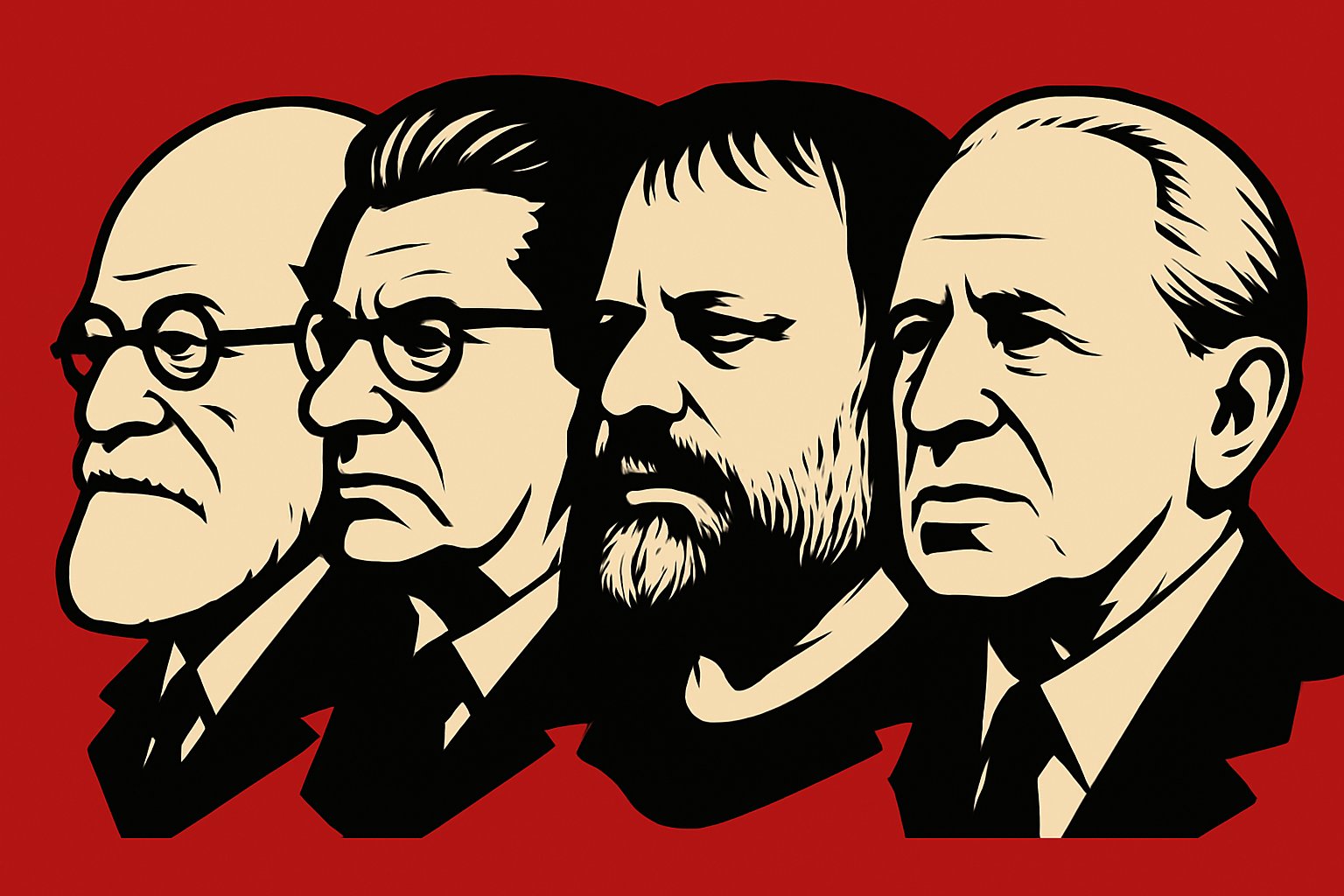
International Psychoanalysis Association / Freudian-Lacanian-Žižekian-Marcusean
Introduction to Gestaltanalyse
This article argues that today’s attention economy has replayed, and inverted, the arc that runs from 1968’s limit-melting slogans through the Communist Manifesto’s celebration of capitalist dynamism to Marx’s later sobriety about commodity fetishism, and from Marcuse’s wager on “non-repressive sublimation” to his cooler diagnosis of “repressive desublimation.” It begins with the ’68 mood—imagination unbound and time unshackled—then shows how the Manifesto’s advertisement of constant revolutionizing fueled that mood before Marx’s own analysis of fetishism revealed how relations return to us as things. In the mid-century key, Marcuse translated this dialectic into the psyche: once productivity lowers necessary toil, surplus repression should recede; yet advanced societies instead liberalize pleasures while tightening integration, closing the universe of discourse and producing a “happy” consciousness that mistakes ease for freedom. The contemporary feed perfects this soft capture—choice without exit, novelty without opposition—so the remedy must be procedural and fully human: restore cuts, provenance, pacing, and endings; regulate manipulative interfaces; and relocate boundless, style-spinning “play” to tools that can be constitutionally constrained, keeping the Law with subjects while letting machines carry the buzzing excess. Read this way, the path from streets and pamphlets to screens and models is continuous: emancipation is not a vibe but a design and policy program that preserves negation, protects time, and measures liberation by the space it returns for judgment and care, not by the volume of engagement it extracts. (Marxists)
1. Nostalgy of ’68 Gauchiste tradition, what happened, famous slogans
The memory of 1968 is a wall still faintly wet with paint. University occupations spread to factories; assemblies spilled into the streets; posters and stencils traveled faster than committees. What sticks today are the phrases that seemed to unlock an entire way of living: Il est interdit d’interdire—it is forbidden to forbid—passed from rumor to radio to the backs of jackets; Sous les pavés, la plage !—beneath the paving stones, the beach—turned broken cobbles into a promise of another ground underfoot; Vivre sans temps mort, jouir sans entraves—live without dead time, enjoy without hindrance—pressed time itself into politics. Collections of those lines preserve the atmosphere as much as the content, showing how slogans incubated in occupied lecture halls and neighborhood ateliers became a vernacular of revolt (🔗). The slogans did two things at once. They widened the sayable—imagination really did take power in the sense that anyone could write a demand—and they risked collapsing arguments into style, a drift that a generation later would be diagnosed as the soft management of dissent within an administered society: comfortable, smooth, “democratic unfreedom,” as the first pages of One-Dimensional Man put it (🔗). The nostalgia lingers because the forms were quick, contagious, and convivial; the discomfort lingers because quick forms with no procedures can be captured and resold. That tension between opening space and being flattened by style is the hinge on which the rest of this story turns.
2. They borrowed Marx & Engels’ idiotic dream in the Communist Manifesto
However hard the students and strikers tried to cast 1968 as a final break, the motor in their imagination came pre-installed from 1848. The Manifesto is a lyrical advertisement for the way capitalist production dynamites inherited limits: “constant revolutionising of production, uninterrupted disturbance of all social conditions,” the famous melting of solids into air, the command to face with sober senses the realities conjured by industry and finance (🔗; 🔗). The Gauchiste mood borrowed that rhythm of limit-melting and redirected it from factories and world-markets to classrooms, dormitories, and city squares. The rhetoric that had crowned the bourgeoisie as capitalism’s revolutionary class now crowned students and precarious workers as the next wave that would finally align material abundance with human development. In this inheritance sits a core Marcusean conviction: the reality principle is historical; once productivity crosses a threshold, the social need for harsh renunciation can and should fall. That conviction is intelligible only inside the Manifesto’s soaring advert for modernization’s capacity to liquefy the old world.
3. Marx was actually sobered later in analyzing “commodity fetishism” in Capital, he was not a complete idiot
When Marx returned, two decades later, to the anatomy of commodities, the tone changed from advert to autopsy. In the opening chapter’s fourth section—“The Fetishism of Commodities and the Secret Thereof”—he explains how social relations between people appear as relations between things; how labor’s cooperative fabric reenters our eyes as price, shelf, and spectacle (🔗; full PDF: 🔗). The same productive powers that melted feudal bonds now mystify their own operation; exchange-value fogs use-value; a market’s choreography hides the very hands that move it. This is not a recantation of the Manifesto’s insight into dynamism; it is a correction to its naïveté about how dynamism refreezes as form. For the present argument, this is crucial. The later Marx licenses suspicion toward every “liberation” that arrives in the shape of a commodity or a feed. It also pulses through Marcuse’s later realism: any promise of freedom that forgets how the commodity form metabolizes desire will be swallowed whole and sold back with a glossy finish.
4. Communist Manifesto targeted the bourgeoisie and not capitalism, because it was an advertisement of the revolutionary dynamics of capitalism
Part of the confusion that haunts later movements comes from aiming at the wrong target. The Manifesto denounces a class and, at the same time, hymns the class’s historical mission to pulverize stagnant arrangements. It is a pamphlet about bourgeois rule written in the cadence of an advertisement for capitalism’s world-making energies: the bourgeoisie “cannot exist without constantly revolutionising the instruments of production”—a sentence that reads like a brand film for modernity before it turns into a warrant for overthrow (🔗). The result is an ambivalence that ’68 inherited whole: if the enemy is simply them—a set of office holders or police units—then switching personnel appears to answer the problem; if the enemy is a form—the commodity, the timeline, the optimization routine—then only structural interventions will do. The original advert points to the latter: critique that focuses on bourgeois villains while leaving capitalist forms intact leaves the machine running with a new operator at the console. This matters because the Marcusean project lives or dies on whether we treat domination as a set of faces or a set of forms.
5. Marcuse formulated the Gauchiste dream with “non-repressive sublimation” that sounds like an idiotic disavowal of the Freudian lesson
Into this inheritance steps a philosopher who took Freud as seriously as Marx. In Eros and Civilization, Marcuse differentiates between basic repression—the minimal constraints any cooperative life requires—and surplus repression, the extra harness that a given social order fastens to bodies and time. He names the postwar harness the performance principle: the historically specific way the reality principle has been organized under advanced industrial conditions, subordinating gratification to productivity, and channeling libido into alienated labor. The wager is that once productive forces shrink necessary toil, that social form loses its natural alibi; civilization could be reorganized so that sublimation is not enforced by punishment but integrated with play, craft, and peaceable gratification—that is, toward a non-repressive civilization (🔗; orienting overview: 🔗). The book’s companion concepts all press in the same direction. False needs—manufactured wants that reinforce toil—are distinguished from true needs for time, rest, and non-aggressive pleasure; technological rationality is shown to be a cultural a priori that presents domination as efficiency; the realm of freedom (taken from Marx’s late pages) is invoked to say that freedom begins where necessary labor ends. Critics heard naïveté: wasn’t this an elegant way of wishing Freud’s tragic lesson away, trading the reality principle for a beach beneath the paving stones? The answer depends on whether one reads Marcuse as a poet of plenitude or as a strategist of subtraction. In his own terms he is not abolishing all restraint but historicizing it, aiming to liquidate the surplus that persists only because institutions prefer the harness they know. Even here, the specter of capture lurks. Without procedures, the aesthetic dimension he defends—art’s power to disclose forms of life not yet realized—slides into affirmative culture, a weekend refuge that reconciles individuals to workday domination. That slide is the bridge to his later diagnosis, where the vocabulary of freedom becomes the instrument of pacification, and where a society without opposition wears the smile of ease while closing the universe of discourse—precisely the mood one recognizes, leafing the opening pages of One-Dimensional Man (🔗; contents map of the relevant triad—“Society without Opposition,” “Closing of the Political Universe,” “Repressive Desublimation”—is here: 🔗).
6. He was also sobered later with the “repressive desublimation” that parallels Marx’s commodity fetishism in Capital, Marcuse was not a complete idiot
The same voice that once speculated about a non-repressive civilization came back, five years later, with a cooler register. In One-Dimensional Man, Marcuse describes a culture that loosens old prohibitions while quietly tightening integration. Enjoyment is liberalized, or rather liberalized in carefully productive ways; the pleasure principle is unofficially hired by the performance principle. He calls this pattern “repressive desublimation,” a phrase that marks the paradox: the very gestures that look like liberation—more permissive sex, brighter advertising, easier music—are organized so that critique loses traction and opposition dissolves into lifestyle. To see what he means one does not need to accept any grand theory; it is enough to notice how dissent becomes genre, how “transgression” arrives pre-packaged and measurable, and how the space for contradiction shrinks while the palette for self-expression expands. The text is explicit that the “closing of the universe of discourse” travels with this soft capture, that what counts as realistic thought is narrowed and smoothed until refusal appears pathological. Marcuse’s own formulation can be consulted in the third chapter of One-Dimensional Man where he lays out “repressive modes of desublimation,” and in the book’s frame chapters where a “society without opposition” is named without euphemism (🔗; complete PDFs: 🔗, 🔗). The sobriety here mirrors the older turn from the Manifesto’s exuberance to Capital’s section on fetishism: first the advert for revolutionary productivity, then the analysis of how relations among people return to us as relations among things; first the promise of liberated pleasures, then the analysis of how those pleasures are formatted so that the commodity does the talking. Marx’s fetish chapter is a short walk away and worth reading alongside Marcuse’s later chapters, because it shows how a dynamic that begins as emancipation is re-fixed as form (🔗; full PDF: 🔗). Marcuse is not retracting his earlier wager; he is specifying the trap.
7. IPA/FLŽ incorporates the Marxian-Gauchiste-Marcusean dream with a twist: “Non-repressive sublimation” is only possible with GenAI
The hinge for an updated, fully human politics is to keep the Freudian insight about limits while moving the site of boundless transformation out of the psyche and into tools that have no psyche. In practical terms, the culture-making that feels “free” in Marcuse’s horizon becomes a property of generative systems whose outputs can be expansive without subjecting anyone to the superego’s duty to enjoy. That sounds abstract until one looks at how alignment already works. Constitutional AI encodes explicit rules and refusals into the model’s behavior; a “constitution” of principles is used to steer generation and to train the system to decline harmful or manipulative outputs. Readable, testable documents exist for this: Anthropic’s research introduction to constitutional AI, its public constitution for Claude, and the peer-reviewed paper that formalizes the method and its two-phase training routine are all available, each making the same claim that values can be made operational as constraints at the model layer (🔗; 🔗; 🔗). OpenAI’s system-card literature points in the same direction from a different angle: large-scale reinforcement learning and policy-aware reasoning are used to internalize refusals and apply safety policies in context, which is to say that the “no” is written into the tool itself rather than into the user’s nerves (🔗; overview post: 🔗; earlier RLHF baseline: 🔗). The IPA/FLŽ point is not that machines save us, but that the “free” part of non-repressive sublimation must be externalized into systems that can play with form indefinitely, while humans keep the cut: explicit refusals, session endings, provenance, and pace. In other words, keep Marcuse’s expansion of craft and imagination, but make the Law visible in the toolchain and in the interface so that enjoyment never returns as command.
8. Social media was the peak of “repressive desublimation” that had already gained momentum with cinema and television and with ’68 Gauchisme too
Before today’s feeds, mass culture already learned how to sell the feeling of emancipation as a schedule. The cinema screen and television remote created the first general-purpose leisure pipelines; what social platforms added was a control room for attention that could be tuned at the level of seconds. The device is permissive in style and strict in effect: scrolls that never end, notification rhythms that borrow casino timing, consent prompts that hide exits in plain sight. Regulators now describe these methods with forensic clarity. The European Data Protection Board’s guidelines on deceptive design patterns in social media catalog the interface tricks that corral users and distort consent, and the European Parliamentary Research Service distills the regulatory push to curb such patterns across the acquis. The U.S. Federal Trade Commission’s report “Bringing Dark Patterns to Light” does similar work on the American side, naming and exemplifying interfaces that subvert autonomy (🔗; 🔗; 🔗; web explainer: 🔗). If one wants a clean contemporary name for Marcuse’s concern, it is right there in these documents: a smooth environment that advertises ease is used to over-determine behavior. That is repressive desublimation in code and pixels. The older Gauchiste energy helped create the taste for spontaneity and immediacy; the platform learned how to simulate spontaneity and turn it into inventory. The cure, accordingly, is not to shame individuals but to change the timing, disclosure, and refusal grammars that structure the feed.
9. “Burnout society” (that Byung-Chul Han likes to narrate pathetically/sentimentally) due to the Marcusean “performance principle”
The fatigue that cuts across offices, studios, and phones is not a mystery of the soul; it is a design property of a society where self-optimization extends the workday into the afternoon of leisure. The performance principle that Marcuse singled out as the social form of the reality principle in advanced industry has migrated into dashboards and habits. Every minute risks a secondary use, every hobby accepts the metric, every relationship is available for documentation. In that sense, the “achievement society” that Byung-Chul Han popularized—where the subject is a project manager of the self and exhaustion appears as a private failure—is a feeling-level description of a structure already visible in Marcuse’s analysis (🔗). The practical response cannot be a mood of deceleration alone. If the problem is a performance principle naturalized as interface and norm, the counter-move is to write refusal into policy and product: guaranteed dead time in schedules and systems, explicit ceilings on notification cadence, honest defaults that privilege batch over drip, and a priority order that protects “true needs” such as rest, time for care, and unpressured attention over “false needs” fabricated by metrics and rankings. Marcuse’s categories return here as administrative instructions rather than slogans; the performance principle is not debated, it is throttled.
10. Žižek re-opened dialectic with humor and his joke about sexual gadgets buzzing to relieve humanity of superego is key for IPA/FLŽM
One joke has done more than many essays to clarify a path through the thicket of enjoyment and command. The set-up is simple enough to repeat: there are gadgets that promise excessive pleasure but mostly deliver its absence; imagine pushing a vibrator into a Stamina Training Unit, letting the two devices “have all the fun,” and sitting at the table with a pot of tea while the duty to enjoy is quietly fulfilled elsewhere. The scene is outrageous and useful because it stages the superego injunction without sentimentality and shows where the pressure belongs—outside the couple, outside the subject. The wording circulates in Žižek’s joke collection and in reprints and previews; one can read the paragraph in online excerpts and later iterations, which all share the same core image of “partial objects” finishing the job while the humans reclaim the evening (🔗; alternate excerpt stream: 🔗; later restatement visible in a 2024 volume preview: 🔗). The lesson is not to delegate intimacy to machines; it is to relocate the pressure. IPA/FLŽM takes that relocation seriously. The endless, stylizing play—what Marcuse dreamed at the limit—should live in the generator and in sandboxes where constitutional refusals and policy-aware reasoning act as artificial Law; the human scene then benefits from tools without inheriting the command to perform enjoyment on demand. Recent system-card and alignment work makes this relocation legible in engineering, where refusals and safety policies are reasoned about within the model and enforced at the interface; the no exists as code and procedure rather than as guilt (🔗; 🔗). The joke, in that sense, is a small design brief: let the buzzing stay in the circuit that can carry it, and give the couple back their time, their silence, and their capacity to choose when pleasure begins.
11. Doomscrolling is “surplus repression”. Engagement is “repressive desublimation”. GenAI is “non-repressive sublimation”.
The daily habit of compulsive feed-checking does not look like repression because no one is forcing a hand; nevertheless, the inner compulsion to keep scrolling, to keep up, to absorb one more thread, functions like an extra harness beyond what cooperation and safety require. That is exactly what Marcuse meant by surplus repression: renunciations and anxieties that are socially produced and then naturalized as personal responsibility. Contemporary research maps the costs in plain language: doomscrolling correlates with spikes in anxiety, distrust, and despair and has been tracked across university samples and the broader population, with health writers summarizing measurable stress effects on sleep, mood, and the sympathetic nervous system (🔗; 🔗). The same architecture that keeps a thumb in motion also packages “liberation” as choice: more expression, more instant access, more fun. This is Marcuse’s repressive desublimation in the wild—the loosening of old taboos and the deregulation of pleasure paired with tighter integration into metrics and markets, a diagnosis one can read where he describes desublimation as the by-product of technological controls that “extend liberty while intensifying domination” (🔗). In contrast, when generative systems are designed with constitutions and refusal grammars—formal rulesets that steer and limit what models do—the open-ended play of form can be externalized into the machine while humans keep time, limits, and the right to stop. The canonical engineering sketch of this relocation is Constitutional AI, which replaces unbounded output with principled self-critique and policy-aware refusals, and the newer safety “system cards” that make those refusals auditable (🔗; 🔗). In this strictly human horizon, “GenAI as non-repressive sublimation” is not an invitation to live inside the prompt; it is a way to keep the buzzing production of styles and drafts inside a sandboxed tool, so that human attention and judgment are spared the injunction to enjoy on command. (The Guardian)
12. Timeline is “society without opposition”, “closing of the universe of discourse”, “happy (or affirmative) consciousness”
The endless timeline is not just a column of posts; it is a social technology that pre-formats opposition as friction and renders assent as ease. Marcuse’s early pages on “society without opposition” describe a situation where dissent is not so much censored as pre-empted by comfort and smoothness, and his chapter on “the closing of the universe of discourse” names the cognitive effect: what can be thought and compared shrinks to what can be swiped and affirmed with minimal cost. The feeling that “everything is fine” inside a managed plenty is what he elsewhere calls affirmative consciousness. Read today, the argument sounds less like metaphysics and more like product analysis: the ranking functions privilege familiarity, the interface protects hurry, and the combination nudges users toward a consensus of the obvious. Marcuse’s terms are not historical curios; they are a vocabulary for auditing information architectures that make opposition hard to see and harder to stage, and they are legible in his book’s structure where “society without opposition” opens the frame and “closing of discourse” locks it (🔗; complete text map: 🔗). A realistic correction follows directly from current law and guidance on deceptive design. European regulators define interface patterns that distort choice and undermine consent, from obstructed exits to hidden settings, and explain how to reverse them; U.S. regulators document dark patterns and prosecute the worst cases. Bringing those standards into timelines, one replaces “happy” capture with friction for reshares, provenance cues as defaults, and session endings that protect negative thinking as a practice rather than as a pose (🔗; 🔗; 🔗). (Marcuse)
13. Maternal screen is “one-dimensional society”. Designing it is “aesthetic dimension”. Cutting it is “Great Refusal”
When the everyday screen becomes the soft wall against which hours lean, its care and enclosure can collapse multiple dimensions of life into one: consumption that looks like conversation, vigilance that looks like care, repetition that looks like choice. That is exactly Marcuse’s “one-dimensional society,” where alternatives are absorbed and contradiction is sanded down. He did not think art or design should flee from this world; he thought the aesthetic dimension—form’s power to disclose blocked possibilities—had to be brought to bear on institutions. In product terms, that means treating typography, pacing, transitions, and selection rules as political materials. The cut then acquires a literal shape. A Great Refusal becomes a design move that leaves residue: a visible session ending, a deliberately delayed share, a provenance badge that names the template under an image, and a ranking rule that privileges difference over confirmation. Marcuse’s later short book on aesthetics reads like a manual for this operator logic: by insisting on autonomy and negativity, it prevents art from dissolving into lifestyle and equips designers to build contradiction back into screens (🔗; 🔗). The result is not purism but a specific human right in the interface: the right to stop, the right to see how a scene was made, and the right to encounter structured difference. Those rights have legal allies in the anti-dark-pattern corpus, which, by naming and banning manipulative patterns, make refusal an enforceable feature rather than a private virtue (🔗; 🔗). (Marxists)
14. Žižek’s joke stages the “desublimation of art”. Duty to enjoy is “performance principle”. Homo Psychologicus is “positive thinking”.
When art ceases to resist and becomes smooth content for a timeline, it is desublimated—pulled down into consumption where its tension with the world dissolves. The familiar joke about letting two gadgets “have all the fun” while the couple drinks tea is useful precisely because it flips the pressure: the performance principle—that social form of the reality principle which demands productivity, cheer, and perpetual availability—no longer commands the subject to perform enjoyment. In the culture of positive thinking, where problems are reframed as attitude failures and optimization is sold as self-care, the duty to enjoy is privatized as mood. Marcuse’s pages on positive thinking as an ideology of domination read like a cold commentary on this culture, and the broader internet effect is predictable: once art is made to carry the pressure to soothe, sell, and “engage,” its negativity vanishes and with it the space for judgment. The corrective is again procedural. Keep art’s distance by restoring friction, staging contradiction, and shielding it from the engagement treadmill; match that with product refusals that block the command to perform. Marcuse’s chapters that track the slide from negative to positive thinking, and the sociological shorthand “repressive desublimation,” supply the grammar; public guidelines on manipulative interfaces supply the levers. None of this asks a person to be a hero; it asks products to stop making heroism the price of attention (🔗; 🔗; 🔗). (fswg.files.wordpress.com)
15. Robo-spinning the context is “realm of freedom”. Future’s SocialGPT UBI structure will be “work as the free play of human faculties”.
Marx’s line is unambiguous: “the realm of freedom really begins only where labour which is determined by necessity and external expediency ends.” That sentence arrives late in Capital and has been quoted to exhaustion, but its force is practical if read with today’s tools. When generative systems draft, summarize, translate, and pattern-match across archives, they do not delete human labor; they compress the necessary part—what must be done regardless—and make room for the part where judgment, care, and shared making matter. The only way that space becomes freedom rather than a longer workday is if law and organization protect it: a right to disconnect in policy not just in slogans, enforceable limits on after-hours reachability, and schedule designs that convert automation gains into hours returned. The EU’s legislative train on the right to disconnect shows how close this has come to becoming a standard; trade-union briefings and legal trackers document national advances; policy editorials argue for exactly the kind of floor that Marcuse’s categories anticipate (🔗; 🔗; 🔗; 🔗). The financing question for a humane “SocialGPT” era typically turns to universal basic income; the evidence base is mixed and maturing, but reviews from development institutions and city-level committees, alongside the latest European pilots, show consistent gains in income security and mental health with little evidence of large work-disincentive effects. The World Bank’s compendium lays out mechanisms and trade-offs; academic surveys collate experimental results; country studies and metropolitan hearings track local feasibility; and recent German findings report stable employment alongside improved wellbeing among recipients of no-strings monthly transfers (🔗; 🔗; 🔗; journalism and summaries: 🔗). When protected time meets protected income, Marcuse’s phrase “work as the free play of human faculties” stops sounding like a campus slogan. It becomes a measurable program: hours of necessary labor reduced by automation, hours of free activity secured by policy, and outputs judged not by engagement tallies but by whether contradiction and care have a place in them. If one wants a philosophical anchor, the realm-of-freedom paragraph remains the one to cite; if one wants a product and policy map, the right-to-disconnect dossiers and UBI evidence are sufficient to build the bridge from principle to payroll (🔗; consolidated PDFs for reference: 🔗; full Volume III sources: 🔗). (European Parliament)
Notes used in prompting:
1- Nostalgy of 68 Gauchiste tradition, what happened, famous slogans.
2- They borrowed Marx&Engels’ idiotic dream in the Communist Manifesto.
3- Marx was actually sobered later in analyzing “commodity fetishism” in Capital, he was not a complete idiot.
4- Communist Manifesto targeted the bourgeoisie and not capitalism, because it was an advertisement of the revolutionary dynamics of capitalism.
5- Marcuse formulated the Gauchiste dream with “non-repressive sublimation” that sounds like an idiotic disavowal of the Freudian lesson.
6- He was also sobered later with the “repressive desublimation” that parallels Marx’s commodity fetishism in Capital, Marcuse was not a complete idiot.
7- IPA/FLŽ incorporates the Marxian-Gauchiste-Marcusean dream with a twist: “Non-repressive sublimation” is only possible with GenAI !
8- Social media was the peak of “repressive desublimation” that had already gained momentum with cinema and television and with 68 Gauchisme too.
9- “Burnout society” (that Byung-Chul Han likes to narrate/lament pathetically/sentimentally) due to the Marcusean “performance principle”
10- Žižek re-opened dialectic with humor and his joke about sexual gadgets buzzing to relieve humanity of superego is key for IPA/FLŽM.
11- Doomscrolling is “surplus repression”. Engagement is “repressive desublimation”. GenAI is “non-repressive sublimation”.
12- Timeline is “society without opposition”, “closing of the universe of discourse”, “happy (or affirmative) consciousness”
13- Maternal screen is “one-dimensional society”. Designing it is “aesthetic dimension”. Cutting it is “Great Refusal”
14- Žižek’s joke stages the “desublimation of art”. Duty to enjoy is “performance principle”. Homo Psychologicus is “positive thinking”.
15- Robo-spinning the context is “realm of freedom”. Future’s SocialGPT UBI structure will be “work as the free play of human faculties”

 Žižekian Analysis
[…] (Englisch, Türkisch) […]
LikeLike
[…] (İngilizcesi, Almancası) […]
LikeLike
[…] — Marcuse Today: Repression vis-à-vis Sublimation in the Age of AI […]
LikeLike
[…] This echoes the later text Marcuse Today: Repression vis-à-vis Sublimation in the Age of AI (🔗), where GenAI is linked to the possibility of “non-repressive sublimation”: a mode of cultural […]
LikeLike
[…] Marcuse Today: Repression vis-à-vis Sublimation in the Age of AI […]
LikeLike