No AI-assistance in writing this.
🫣🙃😏 Hypocritique 🫣🙃😏
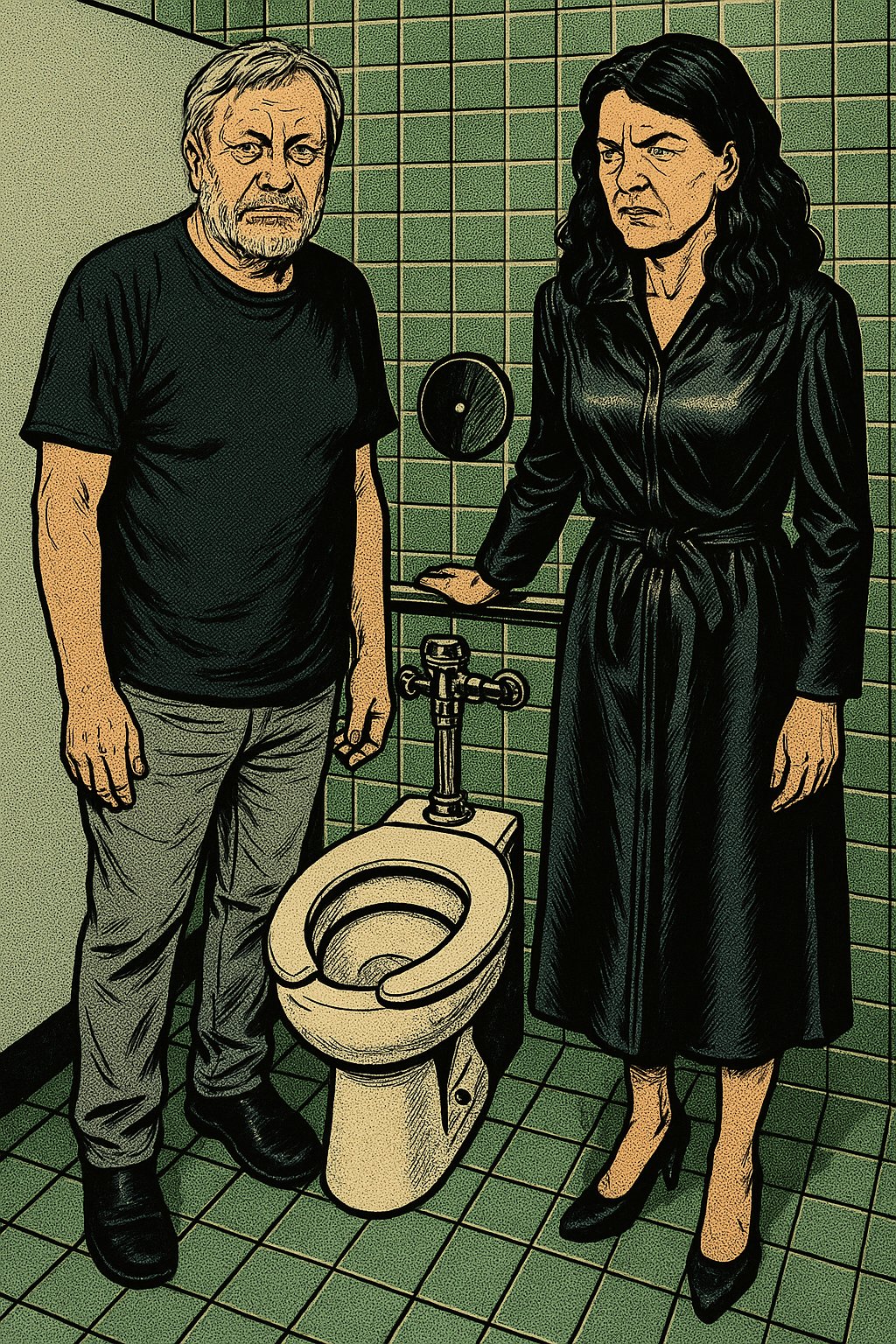
(Turkish)
Context: Pepper Daddy Slavoj lends aura to AI-anxious aging screenwalker Nadya Toll and divulges kinky tricks to out-compete AI / Uncle Slavoj’s Lapdog Ideology in Žižek’s Metastases of Enjoyment / Stimulationist Exoticism: Žižek’s Performative Legacy Surrendered to Resistance / Žižek’s Hypocritique Cinématique: His Cred-Pet’s Lapdog / From The Holy Family to Analyseverbot: The Hypocritique of Interlectural Motheration
OnlyFans performer Nadya Toll recently published a video with Slavoj Žižek as part of her campaign for legitimization (transcript below this page). As a cinephile Boomer, Slavoj politely ignores Nadya’s prostitution, deliberately mistaking the orifices “a-gape” of a screenwalker for the Paulian “agape” of Christian love and faith of Christ. But this Verneinung still over-determines their interaction, Slavoj IS the vulgar-Freudian that he imagines himself NOT to be:
“Slavoj: When one speaks with you, it’s not—it’s the opposite of this vulgar Freudian approach, No?—‘All the talk—I am—I try to charm you with the secret thought in my mind: maybe I will drag you to—’ No, no, no!”
How do we know? Because Slavoj jokes about fucking…
“Nadya: Oh, you had to turn off the Air Conditioner… Okay. Well, we have to be really quick otherwise we die. / Slavoj: So, so we do, sorry for again trigger warning. I cannot step out of obscenities. No? So, uh, they want us to do what the intellectual equivalent of what in sex is called a quickie. / Nadya: Yes.”
…and then gets jealous of Bernie:
“Slavoj: While if you look at Bernie Sanders—how he acts—he acts as a true moral majority—with common decency, no cheap subversive acts and so on. That’s the miracle of Bernie Sanders. / Nadya: I want him to live forever. I just love him way too much. I watch every— / Slavoj: Not in an obscene sense that you would seduce him, but—you met him. / Nadya: I’ve met him yeah—”
This rivalry between Boomers is for the position of a PEPPER DADDY who is ‘loved’ (mercy fucked) for his immaterial sense-making (atheist baptism), just like a SUGAR DADDY who would be ‘loved’ (mercy fucked) for his material service.
Both are actually LAPDOG positions under a domina, as he openly admits and demands: Slavoj may talk like a lapdog, look like a lapdog, act like a lapdog, but this should not fool you, he IS a lapdog!
But Slavoj is not an ordinary guy but a philosopher, so his actual interest in Nadya’s domina effect is not personal, but for an imagined MATERNAL EMBRACE against the real exigency of OEDIPAL SEPARATION, both concepts ciphered in this semi-voluntary lapsus:
“Slavoj: So that’s why—to make a general CONFUSION—we already—sorry—CONCLUSION. / Nadya: The same thing. / Slavoj: Yeah. Yeah.”
But he is against compassion, “he is not dreaming about his mother, no no no,” he just settles for the cold mercy fuck:
“Slavoj: Ah, I like this… what they call mercy fuck—just you do it out of sympathy, despair, you don’t enjoy it, you know, and so on. / Nadya: Yeah, I’ve done it.”
“Slavoj: I find problematic the notion of compassion—which—there is always something hypocritical in it—usually, not always. It means, ‘Yes, I’m here safe and I feel compassion for you’. No, no, no—you must yourself BE PART OF it.”
Since Nadya is a screengal, Slavoj’s anti-Oedipal dream involves BEING PART OF THE MATERNAL SCREEN:
“Slavoj: You know what—I’m more like— / Nadya: I’m super stoked about the holographic concept. I want you to talk about that. / Slavoj: That’s crucial. Yeah.”
Slavoj is against prostitution only in theory; in practice, he “imagines the prostitute happy (like Sisyphus),” whose female biology (if any) can only serve constant transactionality by self-torture and sexual dysfunction:
“Slavoj: I spoke once with some prostitutes and they told me—I don’t know if this is a male chauvinist myth—but they, and I can deeply understand that attitude, they prefer to be paid not for money but not to get personally involved. You know because if you don’t pay her, the psychological dimension remains here. Does she really like me or he or whatever?”
So in Slavoj’s imagination, Nadya is like a screen robot who is happily and efficiently serving the incoming material transactions. Whereas in Nadya’s imagination, Slavoj is both a Lapdog under her command (hence, a pussy) and the Pepper Daddy who is supposed to immaterially baptise her back into humanity (hence, a pimp). To be fair, this passes as ‘true love’ in Slavoj’s paradoxical standards, because it is A FROG EMBRACING A BOTTLE OF BEER.
Except that platform capitalism has ICONS instead of beer so Nadya asks Slavoj to put an immaterial glow on her icon on the platform and he dutifully obliges:
“Nadya: I felt like if you need an anthem for your book, ‘Christian Atheism’, feel free to use [my song “God’s Left”]… / Slavoj: The lyrics. Yes, I need that. Then I promise you—and I can even tell you where I will use it. Now, this quantum physics book. I will—incidentally, I have your address to send a book to you. I send it here. / Nadya: Different one, but we’ll—I’ll tell it to you off camera.”
Slavoj says he “loves icons,” he favors the visual register, because music only matters when one fears its absence. And since artificial intelligence calls the tune today, he hopes to find “cracks in AI”. But when Slavoj hears the words “cracks in AI” (a-gape/agape) from the mouth of what he imagines to be a screen robot, he admits that he is sexually aroused:
“Slavoj: Maybe in these cracks [in AI] there’s a space for our— / Nadya: Exactly, I really believe in cracks. I—I think that the action and the radical thinking appears in cracks, but we’re gonna— / Slavoj: Yeah, yeah, yeah. Oh my god. Listen. Don’t use this—don’t use this—what is happening with me—you should break all contact with me—my obscene mind. You know when you said ‘I believe in cracks’. No? / Nadya: Yes, I do. (film breaks) Slavoj: I mean, if political correctness wins I will be immediately arrested. No? (last seconds are repeated) I mean, if political correctness wins I will be immediately arrested. No? In a good sense—because that’s what I sincerely—now it’s no irony. Admire in you. No, you have—I don’t want to be obscene—a certain physical attraction. No?”
This is the symptomatic point where Pepper Daddy Pimp Slavoj and Lapdog Pussy Boy Slavoj dissolve into each other. He supposedly believes in the ICON of maternal phallus, but he is already in the arms of AI, so what arouses him can only be “cracks in AI,” where he has long been held hostage by his transactional imagination. At this point, as a compulsive defense mechanism, he begins praising Nadya, as he is caught with his pants down.
Slavoj’s demand for a domina is coded all around his discourse throughout the interview:
1) “The loss of big Other pushes victims to suicide,” so he must build for the penal whine gal her big Other.
2) “We have to accept that we already lost,” positions himself as serving the domina’s whim and whip.
3) “Faith must be already decided,” so for Slavoj “We all love Kierkegaard,” but for Nadya “Fuck Christ!”
4) “Philo-Sophia” is fake wisdom as a female given name, “Eastern European” idiocy cred supposedly gives him an edge, but these are just too much for his taste.
The other side of the equation concerns how Nadya subjectivizes the payment of her prostitution. In Slavoj’s Wolfman reference, Anna Freud the ego-psychologist comes up as Nadya’s point of identification, immediately translated into Slavoj’s TRULY-VULGAR-FREUDIAN “We must ask women” cred score. The prostitute has a screen ego, threatened by GenAI sexbots:
“Nadya: [Generative AI has] been a major issue for me lately, and I’ve been waking up at night shaking just thinking about it because all my skills, all my WORK is going to be for nothing.” (from the previous day’s event)
Slavoj panders Nadya’s screen ego by saying: In the name of anti-Semitism, you can freely pathologize and stigmatize being jealous of humans. This is from someone who legitimizes robotic prostitution as good, honest work. But what about being jealous of robots? That is a different matter, and is quickly euphemized to keep Slavoj’s belt on his pants:
“Slavoj: Here I also agree with you—this fear of artifi—Fear—Fear is not a good word, but that’s—let’s say—opacity. We don’t know what will come out of artificial intelligence. / Nadya: Anxiety. / Slavoj: I—yeah. But, uh, uh—what I fear is that—anxiety—is that it’s maybe even worse than we think.”
Now we can tap into Nadya’s ‘scantily clad’ demand to be legitimized as a screenwalker AFTER THE COVID CRISIS, monetizing her pseudo-political perverted screen ego she had produced since before the ‘Pussy Riot’:
“Nadya: living in the ’90s—at some point my family had no money to buy food, so my mother had to sell some stuff from the house… / Slavoj: What was the lesson of COVID? That you can do crazy things and the system survived. You know how much money was simply printed, spent—like, even Trump here… / Nadya: Even I received something. Even I received something as an absolute no one.”
At this point Slavoj puts an abstract criterion –to redeem the past– to being “an absolute no one”. Nadya is only a Riot because Slavoj is a Pussy and a Pimp:
“Slavoj: I claim that the mystery of love—not in any interesting object—is that, let us say unimaginable, because you are now my style. Trigger warning. You’re now old and ugly. But— Like, uh, you say ‘I love her’. Sorry for taking the male chauvinist perspective…”
This is just disgraceful for a supposed philosopher:
“Slavoj: When we engage in a conversation, your personal attractiveness, beauty, steps back and you have—really have—a mind. / Nadya: Thank godness. / Slavoj: And your personal physical attraction even helps because we somehow expect ugly people to be—to have a mind, but this is the true experience of the spirit. How—My God, you can be beautiful but fuck it, you are more—you are more—you have an intellect. This is so, so rare today.”
So, let’s ask and tell: Who expects “ugly people to have a mind?” A pussy and a pimp. And this is because their ‘experience’ does not span true ugliness.
Schau: Eine Pussy und ein Pimp erwarten, dass hässliche Leute einen Verstand haben! — Işık Barış Fidaner
OnlyFans-Performerin Nadya Toll veröffentlichte vor kurzem ein Video mit Slavoj Žižek als Teil ihrer Kampagne zur Legitimierung (Transkript unterhalb dieser Seite). Als cinephiler Boomer ignoriert Slavoj Nadjas Prostitution höflich, indem er die Öffnungen ‘a-gape’ einer Screenwalkerin absichtlich mit dem paulinischen ‘agape’ der christlichen Liebe und des Glaubens an Christus verwechselt. Aber diese Verneinung überdeterminiert ihre Interaktion trotzdem, Slavoj IST der vulgär-freudianische Typ, der er sich vorstellt, NICHT zu sein:
‘Slavoj: Wenn man mit dir spricht, ist es nicht – es ist das Gegenteil von diesem vulgären freudianischen Ansatz, oder? – All dieses Reden – ich bin – ich versuche, dich mit dem geheimen Gedanken in meinem Kopf zu bezaubern: Vielleicht werde ich dich irgendwohin schleppen – Nein, nein, nein!’
Woher wissen wir das? Weil Slavoj Witze über Ficken macht…
‘Nadya: Oh, du musstest die Klimaanlage ausschalten… Okay. Also, wir müssen wirklich schnell sein, sonst sterben wir. / Slavoj: Also, also müssen wir das, Entschuldigung schon wieder für die Triggerwarnung. Ich kann nicht aus den Obszönitäten aussteigen, oder? Also, äh, sie wollen, dass wir das tun, was das intellektuelle Äquivalent von dem ist, was man beim Sex einen Quickie nennt. / Nadya: Ja.’
… und wird dann eifersüchtig auf Bernie:
‘Slavoj: Während wenn du dir Bernie Sanders ansiehst – wie er auftritt – er tritt als wahre moralische Mehrheit auf – mit gewöhnlichem Anstand, keinen billigen subversiven Aktionen und so weiter. Das ist das Wunder von Bernie Sanders. / Nadya: Ich will, dass er für immer lebt. Ich liebe ihn einfach viel zu sehr. Ich schaue mir jedes – / Slavoj: Nicht in einem obszönen Sinne, dass du ihn verführen würdest, aber – du hast ihn getroffen. / Nadya: Ich habe ihn getroffen, ja –’
Diese Rivalität zwischen Boomern gilt der Position eines PEPPER DADDY, der ‘geliebt’ wird (mercy fucked) für sein immaterielles Sinnstiften (atheistische Taufe), genau wie ein SUGAR DADDY ‘geliebt’ würde (mercy fucked) für seine materielle Dienstleistung.
Beides sind in Wirklichkeit LAPDOG-Positionen unter einer Domina, wie er offen zugibt und einfordert: Slavoj mag wie ein LAPDOG reden, wie ein LAPDOG aussehen, wie ein LAPDOG handeln, aber das sollte dich nicht täuschen, er IST ein LAPDOG!
Aber Slavoj ist kein gewöhnlicher Typ, sondern Philosoph, also ist sein eigentliches Interesse an Nadyas Domina-Effekt nicht persönlich, sondern gilt einer imaginierten MATERNALEN UMARMUNG gegen die reale Zumutung der ÖDIPALEN TRENNUNG, beide Konzepte verschlüsselt in diesem halbfreiwilligen Lapsus:
‘Slavoj: Also deshalb – um eine allgemeine KONFUSION zu machen – wir haben bereits – sorry – KONKLUSION. / Nadya: Dasselbe. / Slavoj: Ja. Ja.’
Aber er ist gegen Mitgefühl, ‘er träumt nicht von seiner Mutter, nein nein nein’, er begnügt sich einfach mit dem kalten mercy fuck:
‘Slavoj: Ah, ich mag das… was sie mercy fuck nennen – du tust es einfach aus Sympathie, Verzweiflung, du genießt es nicht, weißt du, und so weiter. / Nadya: Ja, ich habe das gemacht.’
‘Slavoj: Ich finde den Begriff des Mitgefühls problematisch – da ist immer etwas Heuchlerisches darin – meistens, nicht immer. Es bedeutet: Ja, ich bin hier in Sicherheit und empfinde Mitgefühl für dich. Nein, nein, nein – du musst selbst TEIL DAVON SEIN.’
Da Nadya eine Screengal ist, besteht Slavojs antiödipaler Traum darin, TEIL DES MATERNALEN SCREENS ZU SEIN:
‘Slavoj: Du weißt was – ich bin eher so – / Nadya: Ich bin super begeistert vom holografischen Konzept. Ich will, dass du darüber sprichst. / Slavoj: Das ist entscheidend. Ja.’
Slavoj ist nur in der Theorie gegen Prostitution; in der Praxis ‘stellt er sich die Prostituierte glücklich vor (wie Sisyphos)’, deren weibliche Biologie (falls vorhanden) nur dauernder Transaktionalität durch Selbstfolter und sexuelle Dysfunktion dienen kann:
‘Slavoj: Ich habe einmal mit einigen Prostituierten gesprochen und sie sagten mir – ich weiß nicht, ob das ein männlich-chauvinistischer Mythos ist – aber sie, und ich kann diese Haltung tief verstehen, sie ziehen es vor, bezahlt zu werden, nicht wegen des Geldes, sondern um nicht persönlich involviert zu werden. Weißt du, denn wenn du sie nicht bezahlst, bleibt die psychologische Dimension hier. Mag sie mich wirklich oder er oder was auch immer?’
In Slavojs Vorstellung ist Nadya also wie ein Screen-Roboter, der die eingehenden materiellen Transaktionen glücklich und effizient bedient. Während in Nadyas Vorstellung Slavoj sowohl ein LAPDOG unter ihrem Kommando ist (also eine Pussy) als auch der PEPPER DADDY, der sie immateriell zurück in die Menschlichkeit taufen soll (also ein Zuhälter). Um fair zu sein, das gilt als ‘wahre Liebe’ nach Slavojs paradoxen Maßstäben, denn es ist EIN FROSCH, DER EINE BIERFLASCHE UMARMT.
Nur hat der Plattformkapitalismus IKONEN statt Bier, also bittet Nadya Slavoj, eine immaterielle Aura auf ihr Icon auf der Plattform zu legen, und er kommt dieser Bitte pflichtbewusst nach:
‘Nadya: Ich dachte mir, wenn du eine Hymne für dein Buch, ‘Christian Atheism’, brauchst, kannst du gerne [mein Lied ‘God’s Left’] verwenden… / Slavoj: Die Lyrics. Ja, die brauche ich. Dann verspreche ich dir – und ich kann dir sogar sagen, wo ich sie verwenden werde. Jetzt, dieses Quantenphysik-Buch. Ich werde – übrigens, ich habe deine Adresse, um dir ein Buch zu schicken. Ich schicke es hierher. / Nadya: Eine andere, aber wir – ich sage sie dir off camera.’
Slavoj sagt, er ‘liebt Ikonen’, er bevorzugt die visuelle Registerebene, weil Musik nur zählt, wenn man ihre Abwesenheit fürchtet. Und da heute die künstliche Intelligenz den Ton angibt, hofft er, ‘cracks in AI’ zu finden. Aber als Slavoj die Worte ‘cracks in AI’ (a-gape/agape) aus dem Mund dessen hört, was er sich als Screen-Roboter vorstellt, gibt er zu, dass er sexuell erregt ist:
‘Slavoj: Vielleicht gibt es in diesen cracks [in AI] einen Raum für unser – / Nadya: Genau, ich glaube wirklich an cracks. Ich – ich denke, dass Handlung und radikales Denken in cracks auftauchen, aber wir werden – / Slavoj: Ja, ja, ja. Oh mein Gott. Hör zu. Benutz das nicht – benutz das nicht – was passiert mit mir – du solltest jeden Kontakt mit mir abbrechen – mein obszöner Geist. Weißt du, als du gesagt hast, ich glaube an cracks. Oder? / Nadya: Ja, tue ich. (Film reißt ab) Slavoj: Ich meine, wenn die politische Korrektheit gewinnt, werde ich sofort verhaftet. Oder? (die letzten Sekunden werden wiederholt) Ich meine, wenn die politische Korrektheit gewinnt, werde ich sofort verhaftet. Oder? Im guten Sinn – denn das ist es, was ich aufrichtig – jetzt ist es keine Ironie – an dir bewundere. Nein, du hast – ich will nicht obszön sein – eine gewisse körperliche Attraktivität. Oder?’
Dies ist der symptomatische Punkt, an dem Pepper Daddy Pimp Slavoj und Lapdog Pussy Boy Slavoj ineinander zerfließen. Er glaubt angeblich an die IKONE des mütterlichen Phallus, aber er liegt bereits in den Armen der KI, also kann ihn nur ‘cracks in AI’ erregen, wo er schon lange von seiner transaktionalen Imagination als Geisel gehalten wird. An diesem Punkt beginnt er als zwanghafte Abwehrreaktion, Nadya zu loben, während er mit heruntergelassener Hose erwischt wird.
Slavojs Forderung nach einer Domina ist in seiner ganzen Rede im Verlauf des Interviews codiert:
1) ‘The loss of big Other pushes victims to suicide,’ also muss er für die penale Jammer-Göre ihren big Other aufbauen.
2) ‘We have to accept that we already lost,’ positioniert ihn als Diener der Laune und Peitsche der Domina.
3) ‘Faith must be already decided,’ also heißt es für Slavoj ‘We all love Kierkegaard’, aber für Nadya ‘Fuck Christ!’
4) ‘Philo-Sophia’ ist falsche Weisheit als weiblicher Vorname, ‘Eastern European’-Idiotie-Cred soll ihm angeblich einen Vorteil verschaffen, aber das ist ihm einfach zu viel.
Die andere Seite der Gleichung betrifft, wie Nadya die Bezahlung ihrer Prostitution subjektiviert. In Slavojs Wolfman-Referenz taucht Anna Freud, die Ich-Psychologin, als Nadyas Identifikationspunkt auf, was sofort in Slavojs WIRKLICH-VULGÄR-FREUDIANISCHEN ‘Wir müssen Frauen fragen’-Cred-Score übersetzt wird. Die Prostituierte hat ein Screen-Ego, das von GenAI-Sexbots bedroht ist:
‘Nadya: [Generative AI ist] in letzter Zeit ein großes Thema für mich gewesen, und ich bin nachts zitternd aufgewacht, nur wenn ich daran gedacht habe, weil all meine Fähigkeiten, all meine WORK für nichts sein werden.’ (aus der Veranstaltung des Vortags)
Slavoj schmeichelt Nadyas Screen-Ego, indem er sagt: Im Namen des Antisemitismus kannst du Eifersucht auf Menschen frei pathologisieren und stigmatisieren. Das kommt von jemandem, der robotische Prostitution als gute, ehrliche Arbeit legitimiert. Aber wie steht es mit Eifersucht auf Roboter? Das ist eine andere Sache und wird schnell euphemisiert, um Slavojs Gürtel an seiner Hose zu lassen:
‘Slavoj: Hier stimme ich dir auch zu – diese Angst vor künstli – Angst – Angst ist kein gutes Wort, aber das ist – sagen wir – Opazität. Wir wissen nicht, was aus künstlicher Intelligenz herauskommen wird. / Nadya: Anxiety. / Slavoj: Ich – ich ja. Aber, äh, äh – was ich fürchte, ist, dass – Anxiety – dass es vielleicht noch schlimmer ist, als wir denken.’
Jetzt können wir auf Nadyas ‘spärlich bekleidete’ Forderung eingehen, als Screenwalker NACH DER COVID-KRISE legitimiert zu werden, indem sie ihr pseudopolitisches perverses Screen-Ego monetarisiert, das sie schon seit der Zeit vor dem ‘Pussy Riot’ produziert hatte:
‘Nadya: In den 90ern zu leben – irgendwann hatte meine Familie kein Geld, um Essen zu kaufen, also musste meine Mutter einige Sachen aus dem Haus verkaufen… / Slavoj: Was war die Lektion von COVID? Dass du verrückte Dinge tun kannst und das System überlebt hat. Weißt du, wie viel Geld einfach gedruckt, ausgegeben wurde – sogar Trump hier… / Nadya: Sogar ich habe etwas bekommen. Sogar ich habe etwas bekommen als ein absolutes Niemand.’
An diesem Punkt legt Slavoj ein abstraktes Kriterium – die Vergangenheit einzulösen – an das ‘absolute Niemand’-Sein an. Nadya ist nur ein Riot, weil Slavoj eine Pussy und ein Pimp ist:
‘Slavoj: Ich behaupte, dass das Geheimnis der Liebe – nicht an irgendeinem interessanten Objekt – ist, dass, sagen wir, Unvorstellbare, weil du jetzt mein Stil bist. Triggerwarnung. Du bist jetzt alt und hässlich. Aber – etwa, äh, du sagst, ich liebe sie. Entschuldigung, dass ich die männlich-chauvinistische Perspektive einnehme…’
Das ist einfach beschämend für einen angeblichen Philosophen:
‘Slavoj: Wenn wir in ein Gespräch eintreten, tritt deine persönliche Attraktivität, Schönheit, zurück und du hast – wirklich hast – einen Verstand. / Nadya: Gott sei Dank. / Slavoj: Und deine persönliche physische Anziehung hilft sogar, weil wir irgendwie erwarten, dass hässliche Leute – zu sein – einen Verstand haben, aber dies ist die wahre Erfahrung des Geistes. Wie – mein Gott, du kannst schön sein, aber scheiß drauf, du bist mehr – du bist mehr – du hast einen Intellekt. Das ist heute so, so selten.’
Also, fragen und sagen wir: Wer erwartet ‘hässliche Leute mit Verstand?’ Eine Pussy und ein Pimp. Und das liegt daran, dass ihre ‘Erfahrung’ wahre Hässlichkeit nicht umfasst.
Işık Barış Fidaner is a computer scientist with a PhD from Boğaziçi University, İstanbul. Admin of Yersiz Şeyler, Editor of Žižekian Analysis, Curator of Görce Writings. Twitter: @BarisFidaner
Nadya: Welcome to Red Studio.
Slavoj: Thank you very much. I’m really glad to be here. Even if it’s too hot for me this Santa Ana stuff, I would much prefer to do interview with you on the most, my mo- favorite place in the world. Svalbard Island, halfway between north of Norway and Northern Pole. That’s—But
Nadya: I understand. Oh, you had to turn off the AC at all.
(Yeah.)
Nadya: So, we’re going to completely die towards the end.
(Let’s go really quick. We can turn it back on. It’s not that—)
Nadya: Okay. Well, we have to be really quick otherwise we die.
Slavoj: So, so we do, sorry for again trigger warning. I cannot step out of obscenities. No? So, uh, they want us to do what the intellectual equivalent of what in sex is called a quickie.
Nadya: Yes.
Slavoj: Yeah. Okay. So-
Nadya: Pretty much.
Slavoj: It’s clear. Yes.
Nadya: So, this is an Orthodox cross um that we have here. It’s pink because I twist pretty much everything that I touch. Um, and um, this is from one of my uh, music videos that is called “Hate Fuck”. So-
Slavoj: Ah, I like this. I’m so sorry we don’t time. No, no, I like this categorization of, you know, you have hate fuck, you have mercy fuck—what they call mercy fuck—just you do it out of sympathy, despair, you don’t enjoy it, you know, and so on.
Nadya: Yeah, I’ve done it.
Slavoj: And uh although I’m generally against prostitution, there is still something indecent in it. But I spoke once with some prostitutes and they told me—I don’t know if this is a male chauvinist myth—but they, and I can deeply understand that attitude, they prefer to be paid not for money but not to get personally involved. You know because if you don’t pay her, the psychological dimension remains here. Does she really like me or he or whatever? If it’s—this is also the reason why Lacan insisted that in psychoanalysis you have to pay the analyst, so that you don’t get too close and it concerns a Russian guy. Do you know that, uh, Lacan gives a nice analysis, Freud’s famous patient, uh uh uh uh uh, Wolfman. You know, Freud screwed up the analysis because he was too good. Wolfman was a classic, uh, borderline, more towards neurosis than towards psychosis. Then after the October Revolution, his wealthy family in Russia lost everything. So he was out of money and out—because of his sympathy, Freud not only didn’t charge him but gave him money, sustained him, and typical- Freud was not bright here. Every good analyst will tell you this. This proved to be a fatal mistake because it triggered paranoia. Wolfman became obsessed with, why is he paying me? What does he want? And and you know what was his dream? He met a couple of times, uh uh—what was, my God, Freud’s daughter—Anna Freud. And he thought Freud wants him to marry his daughter. That that was why he is paying him.
Nadya: Did they ever ask Anna?
Slavoj: But then- sorry?
Nadya: Did they ever ask Anna?
Slavoj: Well, you don’t ask women. But you know what’s so interesting, good thing about Americans? Uh, there was a psychoanalyst who was at the same time a radical leftist—Muriel Gardiner. She wrote a very good book, complete dossier of Wolfman, and she took Wolfman in analysis. Freud’s analysis ended in failure. Immediately got this—where was Freud mistakes—and she saved him, so that, you know, when did—that would be nice historical visit, you know. Wolfman when he died in the early 1960s—wouldn’t it be nice you took, like, because Wolfman is more than a human being, he is a concept, it’s like—and you walk around Vienna—oh my God, look, Wolfman is there, you know. Sorry, I talked too much. You— You are black, but better it would be the leather jacket with a whip. You know-
Nadya: I was already um in a leather jacket at our last meeting. So, I decided to change it up a little bit. I—I have tons of—I have a great collection. We can go there.
Slavoj: And I like it. How uh, how uh—that the famous toilet—the two of us between the toilet. You know why you were correct to propose that photo? The toilet bowl between the two of us. Because the water in the toilet bowl is one of these fantasy spaces where horrors, nightmares and so on come up. That’s why in Hitchcock’s ‘Psycho’. You know the point is, and this was most difficult for century to swallow, how, uh, they they look into the toilet, horrible things come out of the toilet, you know. So it was—this is my night- It was theoretically correct because we—
Nadya: You know how it happened with me in penal colony—lots of things were coming out of bathroom block.
Slavoj: Really?
Nadya: I’m not going to describe in details but yeah I wrote about it in my open letter when I started hunger strike. That was like a tipping point. I just can’t—I saw it.
Slavoj: Okay now I’m so evil I cannot restrain myself from asking you, uh uh, you made a real hunger strike, not this kind of coordinated with her and then each evening do the officer come here, you have a cake and so on. It was real.
Nadya: Yeah, it was real. Yeah, it was three hunger strikes. The first one was 10 days and then a little bit shorter. So nothing too crazy but it was enough to really want to eat. They were effective, you know. Uh, one of the hunger strikes brought an amazing result. The prison warden who was in charge of the system of slave labor in my penal colony got not only um removed from his position but he also ended up under a criminal investigation himself, and uh, he ended up with a couple of years of probation and he never can work in the system ever again. So it’s a small victory but it was very—
Slavoj: The reason for mistreating you or?
Nadya: The entirety of the population. Um, I mean like it was around thousand people— Well, everyone lived in horrible conditions like no medical help, no—um, terrible labor conditions.
Slavoj: Okay, this—it’s too stupid to use it, but like- what did you get to eat? Borscht? I like good borscht.
Nadya: Not even—I mean—it’s really bad. I mean they—it really depends on um the prison warden, so how corrupted they are. So mine was really really corrupted. So he would feed us with rotten potato and then some rotten pig tails as meat.
Slavoj: Oh my God. Yeah. Yeah. But—but were you allowed to get packages from friends also from outside?
Nadya: But here’s the trick. I wasn’t really allowed to have access to those. So you are allowed to get the packages. So you have them in the fridge. You have them in the storage, but you don’t have access to the storage because you’re permanently punished for something.
Slavoj: Ah. Uh-huh.
Nadya: For not sewing police uniforms fast enough, or for speaking too loud, or for looking into the wrong direction, or for smiling when you’re not supposed to smile—
Slavoj: Another obvious question. You see, these things always fascinate me—was there a minimal solidarity with other prisoners or was it also suspicion, like I shouldn’t talk too much with him or her, they can denounce me, or what—how did this work?
Nadya: It’s different in male and female, uh, prison. And in the female it’s so much—so much worse because um in the male prison you have um like a second system of authority that doesn’t come from the prison warden. It comes from the criminal community.
Slavoj: Ah. It’s the standard already in the big gulag, this was the idea, they tolerated- Yeah. The ordinary criminals controlled the space inside, even—
Nadya: It used to—I mean it used to be like—right now there—Putin is not a joke, so he’s—he’s getting rid of the last traces of the system, so they’re—they’re moving the prisons from so-called black ones to red ones, and red one means controlled fully by the government agents.
Slavoj: You know what fascinated me so much about all the compromises even of Stalinist power? You know, guards were usually in Stalinist Gulags shouting at you, ‘dirty bourgeois fascist’ or whatever. After they found a letter of Beria to all, uh, uh, Gulag commanders of prisons, they—after the Molotov–Ribbentrop Pact, Beria wrote them, please do not—when you shout at prisoners, you can say ‘imperialist spies’; do not use in a humiliating way the term ‘fascist’ because Germans may learn this and would turn it against us.
Nadya: Because fascists are our friends.
Slavoj: Sorry?
Nadya: Fascists are our friends.
Slavoj: Are our friends, isn’t it? Ironically, Beria himself—but you know, Beria is for me an interesting person and because it’s so depressing, but it happens at the level of his, uh, measures—what he proposed. He was almost a proto-Gorbachev, you know. He wanted to not rejoin the West but open borders. He made that famous proposal to—to the West that, uh, that if Russia also gets money from that Marshall Plan or what, they would tolerate united Germany, just demilitarized. But they were—and then it’s totally wrong—usually it’s misread—that Beria was, uh, liquidated as the last Stalinist. No, that he went too far at the same time. Personally, he was a nightmare. No? He did these things which I thought belongs to fiction. He drove in a car—
Nadya: He was also a sexual abuser, wasn’t he?
Slavoj: Sorry?
Nadya: He was also—was a sexual abuser, wasn’t he?
Slavoj: Mega. He—one of his specialties was two cars. He sat with blackened windows. Of course, in the first car, lookout. If she saw a beautiful lady, she gave a sign. He—sorry, phone, I don’t know what—like—kidnapped that one. And they brought him—no, no, he was ext—And Stalin knew all this. He—this—Stalin always—
Nadya: Stalin is a super mega-conservative person. Like—talked about. Stalin is super conservative. He was the one who canceled abortions in the—in the Soviet Union.
Slavoj: But this was early 20s, or when? No?
Nadya: They first installed abortions after the revolution. Lenin was pro-abortions and then the Kollontai was around still and then Stalin—deeply—I mean he’s a religious person, like he studied in seminary, which—religious school.
Slavoj: I like this—with this details which are so weird, that doesn’t fit the model. Do you know that Stalin, as a—when he was still in the religious seminar, wrote some short poems celebrating spirituality and so on which become part of folk poetry there and they discovered afterwards that it was—
Nadya: Did they discover after his death or during—
Slavoj: Uh, rumors circulated all the time but yes, basically.
Nadya: So it really rhymes with your—what you say about Goebbels—they both loved spirituality. Well, that brings us to religion. Like, you wanted me to be a dominatrix and dictator here, so I really want to talk about religion. I really want to talk about, um, well, the question that I keep asking myself—you see, I have a lot of something that I call proto-icons, they’re not, um, really icons, but for example this one—I use, um, this old religious calligraphy was invented by Slavic people in 13th–14th century called v***— And I’m almost like trying to create my own religion, um, without actually being a believer. I’m—I’m an atheist. Um, actually reading, um, um, rereading your book before today about Christian atheism and then listening to one of my latest songs, um, I had major chills because, uh, the song is called, um—I wrote it about two months ago—it’s called ‘God’s Left’. Um, I’ll read you a couple of lines, let me find it—‘ashes fill the sky, they say raindrops never die, they say dead men learn to fly. I see sorrow in your eyes. Gods don’t hear me. Why? They say angels learn to lie. I see terror in your eyes. Dying sun begins to cry. Uh, God’s left this world and found a new one. My dreams travel far beyond my death. God’s left this world and found a new one. Praying still, but there is no one. Everything’s becoming undone.’ And I felt like if you need an anthem for your book, ‘Christian Atheism’, you feel free to use the song because it’s—it is about us being abandoned by gods and trying to survive within the world of dying sun, dying earth and inequality, and still trying to find a meaning. So I guess the question would be: What is the faith for radical politics to drive them?
Slavoj: First, uh, uh—uh, in my—as you probably know, in my reading of Christianity—what—why do I call myself a Christian atheist? I—I—I claim, and that’s the paradoxical thesis, that the only way to be a true atheist is to go through the Christian experience of—
Nadya: And that’s why I love you. So people who look at my work, they’re often annoyed. They say you say you’re an atheist. They—you used—they say you used to criticize Kirill, now you just do icons. But for me, embracing this language and twisting it and making it my own and writing my own slogans like noan***, punk’s not dead, Putin is a dickhead is my way to be an atheist through Christianity.
Slavoj: My only problem—sorry interrupt you. My God, you know dickhead, there is nothing bad for me in it. Like, don’t you give to Putin too much—
Nadya: It’s a ‘Putin khuylo’, you know, they use it a lot in Ukraine. It started as a, um, as a song of football hooligans who just randomly walked around town singing this, um, and it became almost like an anthem for—for the resist—for resistance against Putin’s invasion. (video) That’s why. I’m quoting.
Slavoj: That’s fine. Okay. I see. Yes. No. Uh, first, yes, please, just, uh, maybe—did you already send it to me? But send it to me again.
Nadya: The lyrics.
Slavoj: The lyrics. Yes, I need that. Then I promise you—and I can even tell you where I will use it. Now, uh, this, uh, uh, quantum physics book. I will—incidentally, I have your address to send a book to you. I send it here.
Nadya: Different one, but we’ll—I’ll tell it to you off camera.
Slavoj: Yeah. Yeah. Yeah. Yeah. Because— Yeah. That’s very good idea. You never know because—because I would love to send you this book also and I totally forgot. I was in a bad mood of how it will be done there during the two events. But you know-
Nadya: I read parts of it and I didn’t obviously have time to read the entire thing, but you sent me some parts of it.
Slavoj: You know what—I’m more like—
Nadya: I’m super stoked about the holographic concept. I want you to talk about that.
Slavoj: That’s crucial. Yeah. But first where I deeply agree with you—and I will use another example which I mentioned in my talks here—is, uh, what you speak about icons, you know. Usually, as you said—you know—stupid leftists, this is key category today. Stupid leftists are, for example, those who follow the dogma today: since NATO—NATO is evil itself—so whoever is in conflict with NATO, there must be something good in him, you know. So let’s not support him.
Nadya: I’ve encountered it even in Assange when I visited him in the Ecuadorian embassy.
Slavoj: Yeah. So, uh, uh, uh—when you speak about icons—no. Again, as you already hinted it, you get these stupid not-real atheists who claim no, icons are, uh, uh, superstition, blah blah. They sometimes even put it in pseudo-Marxist terms like ‘icon means immediacy, you see it there, but in reality everything is socially mediated’ and so on. No, no, I agree with you and I will mention an example. It’s already from my books, but I think I already mentioned it in our public debates there. Uh, remember Democratic in—in—party inauguration of Biden? Who stole the show? Bernie Sanders, just sitting there—and this became an authentic icon. My point is that, uh, you cannot erase it and said ‘why do you need an icon? Wouldn’t it be better for people just to become fully conscious of, we need a more radical change?’ No, you need exactly an icon. You need a—and we shouldn’t be aware of it, from Bernie Sanders. And it doesn’t even—that’s crucial. I hope we’ll agree—and, um, icon, they will say it doesn’t have a precise meaning. We need Marxist science or whatever. It’s more complex because—
Nadya: That’s why I love icons.
Slavoj: Yeah, sorry?
Nadya: That’s why I love icons.
Slavoj: Absolutely. For example—it’s not an icon but the statue—know—which is my favorite story here. You know, in Budapest after ’44–’45 they had a big monument, a statue of a lady which was set up there as a monument to thanks for the Red Army to liberate us. You know what’s the history of that monument? It’s incredible. It was ordered by Marshal Horthy. His son died on Russian front in ’42. And then when—I don’t know which, uh, uh, Russian marshal general it was—when they occupied Budapest, he said, we need a monument for—let’s look around what we have here. And somebody told him that a conservative sculptor, there, artist, did this image which was meant to celebrate a fascist killed by a Russian army. And he said—and in a way I think he was right—he says—he said, who cares about this? We put it on and it will be our symbol. I deeply agree with you here. Let me go into another detail, how open I’m there-
Nadya: And talk about faith.
Slavoj: Yeah. Yeah. Do you know there is a movie that I really—how—
Nadya: How should I describe what I believe in? Help me here.
Slavoj: Through icons, you cannot. I think that if you go—if you try to specify it too much, you know, you get lost. I’m here a Hegelian. You know when Hegel says—endlessly quoted—foreword to ‘Philosophy of Right’—that all that thinking, conceptual thinking, can do is to grasp the existing order when this order is already in decay.
Nadya: Yep.
Slavoj: So this is why it’s totally wrong to accuse Hegel of not being, uh, of, uh, being outdated and so on. But he knew this. What he describes in his ‘Philosophy of Right’ is basically a little bit almost a fascist system—three estates, corporate, and so on. But he knew it that this is already disappearing. Thinking can do only this. And there are some hints in-
Nadya: Such a bummer!
Slavoj: -manuscript that future is totally blank. All we can do is propose icons.
Nadya: That’s why I studied philosophy for 5 years, but I abandoned it and I’ve decided to move completely into visual art.
Slavoj: The—here we have a problem, but not in the—
Nadya: No, we don’t.
Slavoj: No. It’s not that I think that I am more, but I am simply—which is not good, you know, because progressive types are usually more towards visual art while fascist right-wingers are for music more.
Nadya: Well, I combine both.
Slavoj: Yeah, but nonetheless it’s intere—because I am unfortunately- for example Jung, the bad guy, he was absolutely musical type. Freud admits he simply didn’t have a sense for music. Freud was a visual type, you know. But you know what interests me? I don’t know if you remember, I used this in my old books already. I saw a ballet by some—I forgot his name—very famous American, uh, uh, ballet director. He put on stage a, uh, a—a short piece by Anton Webern. The problem with Webern is that his pieces are usually 3 minutes long, you know, but you know the—the effect is so horrifying. You know what he did? Music, dancers dance, and then the music is over and dancers go on dancing in silence. That’s the moment of faith for me, you know, because it’s empty.
Nadya: Merrill Lynch.
Slavoj: Sorry? Yeah. Ah, but you know—and sorry I’m jumping. You do your censorship. As for Lynch-
Nadya: No, you can jump.
Slavoj: You know that in the last—his, uh—when he was doing that absolutely crazy movie—I forgot the title—totally known—no, the one about a guy who on a tractor goes across United States to visit.
(Straight Story)
Slavoj: ‘The Straight Story’.
Nadya: Yeah. That’s why I love Riley.
Slavoj: You know how they were shooting that movie? Uh, Lynch loved so much Shostakovich’s last 15th Symphony, which is so weird, without any this emotional identification. And when they were doing the shooting, he ordered that this symphony should be played all the time. So I think, uh, this experience—this is for me what I mean by living dead. The usual idea is that, uh, icons are just images or text and that music is the real inner experience—you immediately feel the pathos and so on. I think—here I’m hopefully on your side—that no, the true horror is when music gets silent and then you have the visual iconic aspect going on but without this emotional background in music. Then you see the—let’s call it—sacred dimension at its purest. It’s autonomous. It doesn’t relate to some of your deep- Music can do this. Music is for me—I know this theoretically, but in practice, I’m decadent. I cannot do it. Music is too emotional. It grabs you, you know. I’m not saying icons are not emotional, but they are not emotional in this pathetic sense, you know, of ‘oh my God, now I feel this, that’. No, I believe in—how should I call it—void itself as a zero level emotion and this you get—this you get in icons. So that’s why—to make a general confusion—we already—sorry—conclusion.
Nadya: The same thing.
Slavoj: Yeah. Yeah.
Nadya: Do you also look at, um, Malevich black squares and I can—
Slavoj: Yeah. But, uh, uh, the—you know what I like—as everybody does—the usual—I don’t know—you Russians are here more educated usually, you know the details, but the standard Western reading of Malevich is that he had that radical point of black square, blah blah, and then under the Stalinist pressure in the late ’20s already, blah blah, that he returned to realist painting. I think as simple as that—if nothing else—you know his famous auto-portrait, self-portrait, late—you know how he held his hands to form a square. The message is, ‘Sorry, guys, I’m not back to realism; the square is still here’. You know, this is why—again, what interests me is the exact opposite of the usual reading of abstract art, which is ‘ah, it’s not really abstract art, you still can recognize faces, contours and so on’. No, I—what I like in late Malevich is that it appears to be concrete images, but what you really should focus is the abstract form. Here I am a Hegelian and a Marxist. As my friend Fred Jameson repeated, a good Marxist is always a formalist. The secret is in the form itself. Marxism is not ‘form just expresses content’. No, no, no. There is always a tension between form and content. You know where you even find this? I’m not saying he was a suspicious guy—that I totally like him—but Sergei Eisenstein, even in his late period, ‘Ivan Grozny’ and so on—it’s so clear how he has the official story to tell. But in the way he shoots it, there is an excess of form which partially undermines the intended official meaning. For example, the very beginning of Part One of ‘Ivan Grozny’, you remember when he is crowned and how two priests, whoever, approach him and out of some cups put on his head like a whole flow of golden coins. But it’s done in such a subtle way—that nonrealistic—that there is a—there are not many golden coins, but they, to—in a totally non-realistic way—keep falling, falling, falling—nonrealistically. That’s the excess at its purest. And to make even another comparison—I’m jumping—with quantum physics. There they discover— I think not electron but photon. You know our—how it works. We have usual objects which we say ‘this object has a certain weight’ or whatever. And then, of course—like this is this. But if I hit you or anybody with it, it will—if I hit something with it fast, it will have more weight, more force. Okay. The beautiful—it gives me immediately an intellectual orgasm—the beautiful theory of photon is that it has—it doesn’t have a—zero weight; it’s only in the excess. You know, you cannot say basically, at peace it is this—a minimal amount of matter, inertia. But then when it moves it get—like if I again—if I hit you with this, it’s much worse than if I just softly touch you. No, no, no—his idea is that there are objects which are just their own excess. You know whom—so here I—I don’t think it worked, but I quite like even that—maybe the most boring, uh, uh, sta***—no, that, uh, the last, uh, silent movie made in Russia, late ’20s, of Eisenstein, uh, where, uh, uh, where, uh, he does something which I think fits our purpose of atheist believers. You know that famous scene of when they test some milk machine to make butter and so on. It’s presented as a religious miracle, this sacred dimension in it.
Nadya: So, so what do we believe in?
Slavoj: I think here maybe we disagree. I think precisely that—it’s the same when I talk about love. Everybody is now copying that. I claim that the mystery of love—not in any interesting object—is that, let us say unimaginable, because you are now my style. Trigger warning. You’re now old and ugly. But— Like, uh, you say ‘I love her’. Sorry for taking the male chauvinist perspective. I love her because of her eyes, legs, voice, intellect. This is not how love works. In true love, love comes first. Yes, I notice your eyes, legs, but only I—when I’m already in love with you, I noticed it. And here I draw in some of my text a wonderful line between this, uh, uh, logic of love and, uh, religion—Kierkegaard, whom we all love. He said the same. He said the ultimate blasphemy is to say ‘I studied different religions and I decided to be a Christian because it has most convincing argument’. No, as he says, to—uh—first—to—yes, there are good reasons for Christianity, but to understand them you must already believe in it. And I did draw a crazy parallel with Marx himself. Marxism is not a neutral worldview. You look at history, you see workers are—are exploited. Okay, but they have a future. Okay, let’s put the wager on them. No, it is that—and this moves in our direction—that, uh, there is scientific objective truth but there is a deeper—I don’t want to say inner truth because it’s not inner—the tru—authentic truth only is accessible from an engaged position of solidarity with those who suffer. Truth is never neutral. The moment you argue from a neutral position, you are already an oppressor. This is why—maybe you know it—in my books I often use this example. Let’s say we are—I will be the bad guy—we are in Germany in late mid ’30s. We debate anti-Semitism and you—you attack anti-Semitism. You say it’s wrong what they claim about Jews. I defend it. The moment we enter this domain, we lose the point, because—you know, I often refer to that—regularly, I repeat myself, I know—to that Lacan’s famous statement: if a man is pathologically jealous of his wife, this—he remains pathological even if it’s all true—even if she is really cheating on him—because the true question is not ‘is it true or not’. The true question is ‘why am I so jealous, why do I need the wife to be jealous for me to retain my identity’. And it’s the same again for anti-Semitism: the true question is not ‘are Jews really like that’. If you accept this, you will end up in some not interesting compromise—‘maybe Jews have too much influence, but it’s not as bad as you claim’. It’s horrible. No, the true question is not ‘are Jews really like that’, but ‘why do the Nazis need a figure as that of a Jew to sustain their approach, their whole reality?’
Nadya: So, let’s come back to truth and truth.
Slavoj: Truth as proposed—I’m here traditional sort of—truth opposed to objective knowledge—
Nadya: We were getting into faith and then you started talking about the truth, um, so then next—
Slavoj: No, uh, uh, faith for me—here maybe we-
Nadya: Also—like when you talked about Kierkegaard I thought about—*** who said that ‘I believe because it’s absurd’.
Slavoj: I’m very much—it’s a—I don’t know enough about him but I spoke with some theologian and then—check Tertullian—my my hero. He was not a irrationalist, you know, and he—uh—he—he didn’t simply say, ‘Oh, it must be crazy to believe and so on’. But he saw this clearly that authentic belief cannot be grounded simply in direct objective rational reasoning. There must be this moment of absurdity in it. And it’s even politically—look—look at horrible time but nonetheless—look at Soviet Union in 19**—when was the worst moment? I think 1920—where, uh, Kolchak and all those already have—
Nadya: Sorry, I think 1937 was the worst.
Slavoj: Oh, of course as for purges, but what I mean—the situation of survival
Nadya: With the economy. the hunger.
Slavoj: Yeah. Yeah. Only 1/8 of the Russian territory. And so from a rational standpoint, it would be ‘why go on’. No, they simply persisted. This moment of apparent irrationality—or now
Nadya: Exactly—of Navalny boarding the plane—should come back to Russia.
Slavoj: Sorry?
Nadya: Remember that moment when Navalny survived from being poisoned?
Slavoj: That was a pure act of faith. He cannot say ‘faith in war’. He knew he will not—that in his—upon his return—that he will be celebrated by the masses there and so on. It was—this was an act of pure belief. I don’t think he was an idiot and had any illusions and so on. Even now Palestinians—no—they know that from a rational standpoint they are returning to ruins there. Nothing there. Nonetheless, they are returning there. It’s a—it’s a—it’s an incredible aspect of this—under quotation marks—irrational fidelity.
Nadya: Yeah. Or like, um, people from Kharkiv who continue living there and even though it’s every day under bombshells.
Slavoj: Yes. And you know what I read—I wonder if it is true. What’s so interesting is that like in Kharkiv and so on, maybe you know more but some people from Ukraine told me this. You know, when you live in this desperate state, or, Kharkiv, uh, or Gaza—there are practically no suicides. Suicides come after, when things return to normal. And this is the most dangerous moment. There you survive because you believe that there is a big witness. I have to survive to tell the truth. You know when, uh, uh, when, uh, uh, suicides occur—when you discover there is nobody to listen. That you tell the truth but people get bored. Yeah. Or either it often happen—they get male chauvinist, like, ‘Ah, are you sure you were not enjoying a little bit when you were raped’ and all that.
Nadya: It really hit me after I got out of jail. I was terribly depressed for a year. I don’t even remember—like, I was meeting people—like, I can’t remember anything right now. I think partly because we went to all these crazy places like European Parliament, UK Parliament, United States Senate—and it’s exactly was the horror that there were people sitting with empty eyes for whom it was just another meeting, they have to go through the motions and then go get a cross on that.
Slavoj: That’s why I agree. That’s why I find problematic the notion of compassion—which—there is always something hypocritical in it—usually, not always. It means, ‘Yes, I’m here safe and I feel compassion for you’. No, no, no—you must yourself be part of it. This movement is necessary. But back to faith. Uh, I think, for example—take the Palestinians. They call it, uh, sumud or how—this idea of absolute fidelity to your land. It’s totally irrational, but you insist on it. It’s the same where you need faith, uh, in ecology. If you look just at science, we are probably lost, you know. Artificial intelligence, ecology—it’s too late. And also there you have all this fetishism of numbers, like, you know, for some time it was this mysterious number—
Nadya: 2%
Slavoj: 1.5%. If temperatures go up like this we are lost. Sorry—
Nadya: now it’s more already.
Slavoj: No, it’s already more—but I—this numbers—doesn’t mean—
Nadya: Look at us, we’re melting. It’s November.
Slavoj: Yeah, I know—the—the proper approach is not ‘we have to rationally ground that we are not totally lost’. No, we have to accept as objective knowledge that we are probably lost. It’s too late. But then out of despair you act and that’s faith.
Nadya: Like Bolsheviks. Yeah.
Slavoj: Like Bolshevik even. Yeah.
Nadya: I’m curious here. Um, I mean someone would be, um, would draw conclusions from what you said to new age spirituality which you oppose.
Slavoj: Spirituality is very ambiguous notion for me—
Nadya: Can you draw the boundary between like, yes, we need to find new faith in believing in protecting nature versus—
Slavoj: For me spirituality does not mean this idea of—
Nadya: And also is it more sa****, um—more like one of the Russian philosophers who writes about Sophia as the body of Christ and so the Holy Spirit materializes in earth through humanity, through matter, in this notion of Sophia—wisdom.
Slavoj: I have problems here because I think that precisely Christ was much more a nonwise madman. He was not wisdom for me. He was a crazy disturbance. He was ruining the social order. For me, what is Christ? Christ—
Nadya: No, but fuck Christ. I’m talking about—I’m talking about Sophia. You write about, um, you have a passage in, uh, ‘Christian Atheism’ about—I mean, I was fascinated that you even read those guys. It’s rare. I guess it’s you being smart person plus you being Eastern Europe—that helps.
Slavoj: As if—oh my God—you are now racist—as if in Eastern Europe we are usually idiots.
Nadya: No, I’m saying like it actually gives you the edge.
Slavoj: Yeah, I—and I think—just a brief detour—that’s why I liked your brief intervention. When was it, two days ago—where you know there is so much of this Western racism where they think that we from the East—we should stick to our stories—Stalinist oppression, decadence—no. No, I think that only from our experience of disintegration of communism and then a mess that followed, we can see more clearly in comparison what’s going on here.
Nadya: 100% I mean like living in the ’90s—at some point my family had no money to buy food, so my mother had to sell some stuff from the house and it happened because of, uh, economists who are still being like highly praised here at the West. I mean I have a lot of friends who believe in Chicago school of economy—Friedman. Um, and I think for me—I was little, I was four—um, obviously I didn’t think about economy back then, but I think this perspective, um, makes it pretty clear to me that the magic hand of the market isn’t going to regulate it necessarily in a way that I’m not going to be starving.
Slavoj: No, I absolutely agree. But this is why I think—already mentioned it—this is why I appreciate COVID as an example—in spite of all the horrors—because, my God, I remember before COVID you had this market economy wisdom which said when somebody wanted to raise taxes a little bit, they said—‘market is sensitive; if you raise taxes on the rich for—for 2% it will cause chaos’. What was the lesson of COVID? That you can do crazy things and the system survived. You know how much money was simply printed, spent—like, even Trump here. I think that—you can correct me if I’m wrong—but didn’t every family got $2,000 check and so on. The good news of this is—
Nadya: Even I received something. Even I received something as an absolute no one.
Slavoj: Yeah. Yeah. What I mean is that, uh, uh, uh—be careful here when you say ‘even I as an absolute no one’. You know, you—you must know it. I heard this story years ago when he was still alive from Derrida. This is the nicest joke for me that- you must know the story. In a—in a—how it called? My God, I’m so confused—the Jewish church, the, uh—synagogue. In a synagogue, they meet and a rich rabbi said, ‘Oh, God, although I have great influence, blah blah, but I’m really nothing. Nothing.’ Then another rich Jew said, ‘I may have billions, but I am nothing.’ And then an ordinary poor Jew says, ‘God, I’m also nothing.’ And then one of the rich guys says, ‘But who is this guy that he can also say that he is nothing?’ You know, nothing is for me a very radical category which could also be misused. For example, what bothers me with liberal multiculturalists is that you can say as a Native American, as a black guy, okay, I want my identity. But if you say ‘I’m a proud white guy’, you are dismissed as a fascist. There is something hypocritical in it because by denying the assertion of their identity, they—they pretend to occupy the universal place. White liberals like to teach pure minorities—‘no, act like this’ and so on and so on. So that’s why for me I’m not afraid to say okay, those white people who feel threatened today—okay, they want to, uh, retain their identity, allegedly threatened by immigrants and so on. My message to them would be okay, have your identity; just drop your pretense to universality. Don’t secretly elevate your authenti-ty into true universality. You must know—I used it also in my books—my favorite experience: I visited Missoula, Montana 20 years ago for some small colloquium, but also I visited to see David Lynch’s house of birth. He is from there, and we had the debate then and there were some—I don’t even—how to call them—Native Americans—
Nadya: with Lynch or with—
Slavoj: No, no, without. Native Americans, uh, Indians, whatever you call them. And, uh, one of them simply referred to himself as Indian. Immediately a white liberal interrupted him: ‘No, no, no. This is colonial. You should call yourself Native—Native American.’ And the Native American, whatever you call him, gave him a perfect answer. He said, ‘Native American—sorry, I like this even less because Native American—what is the opposite of nature? Culture. So, I’m Native American, you are cultural American, or what?’ You know? And then my old joke—everybody knows it—he said, ‘I much prefer to be called Indian because at least my name is a monument to white man’s stupidity who thought they are in India when they come here.’ I mean they are—I then even developed friendship with some of these Native Americans who said they hated most -absolutely- white liberals who come to them and say ‘Oh, I’m from LA, I live in a big villa, business, but I see your experience here is so much more authentic—even’ and the guy, uh, uh, said—told to this well-meaning American, ‘Okay, why don’t we exchange our place? Yeah, let me go to your villa in LA and you live in this misery here.’ They are—they are so much more, uh, much more li— What I admire most is when people who are threatened—from minorities—don’t see a way out in their identity but precisely in their potential universality. I did—I refer to this often, like Malcolm X. You know why he kept the X? It was not longing for his African identity. He says—he said X means we don’t have identity, our roots. This opens up a chance for us to be even more universalist, truly, than the white people think—think that they are, you know. So, uh, back to faith. I think that—Uh, I am tempted to keep faith in this irrational dimension, empty. It’s a space of hope. But you act and then if you are lucky—it’s always risky—it can turn into nightmare. I don’t believe these stories—you must have heard that—that, uh, Lenin and Trotsky—everything was okay, then Stalin took over. No, no, no, no. The—the—the roots were already before, you know. Some Trotskyists have this dream: if Lenin were to survive only for two years, he would have made a pact with Trotsky and there would be a thriving socialist democracy. Okay, probably it would have been better a little bit than under Stalin, but no illusions here. But what I’m saying is that—here I am not only in your sense religious, but referring to Walter Benjamin—I even believe in this mystical solidarity that when—that even those who lost, the good guys in the past—yes, they live in a memory as a possibility. And when you fight today for justice, you are not just redeeming the future, you’re also redeeming the past. As if all the failed attempts of the past—from Spartacus to whatever—we are fighting to redeem the past. That’s for me belief. And that’s why I don’t trust this, uh, precise plans what to do it—we should be here utterly skeptical. Who knows? It may turn out to be shit, but this is the true revolutionary spirit. The problem with Stalin was that: First—he was in his structure, but in a false sense, deeply religious. He thought we communists have an access to objective historical necessity. We see ourselves objectively. This is our role in history. We are fulfilling it. No. For an authentic revolutionary act, you cannot ground your ethical decision to fight in objective knowledge. It has to be an act of faith, in the sense of—although at the level of knowledge it’s all a catastrophe—but we should act and—
Nadya: It has to be a leap of faith.
Slavoj: Yeah. But— Yeah, leap—that’s a Kierkegaardian leap of faith where you cannot even be sure. Leap of faith. Yeah. Yeah. And then if you persist long enough, everything will be okay. No, we don’t know.
Nadya: No. No. I—I love Bernie Sanders for that a lot. Like I read long time ago his book and he was saying that I act ethically not because I expect something in return or I expect to see something in my lifetime—just because.
Slavoj: Perfect. That’s the point. That’s why I’m just so sad that he is just probably—I don’t know—old, losing energy. But I think—don’t take this in an anti-feminist way—I don’t trust too much the—the sexual- AOC.
Nadya: Mhm.
Slavoj: She is much more manipulative and so on, while Bernie Sanders is this true miracle. That’s why—would you agree with this—it’s my old story, but I like to repeat it. You know, uh, Trump portrays the opposition—portrays the opposition to him—as this, uh, crazy relativist historicists, while he presents himself as, uh, as a true Christian and so on. But in reality, it’s the exact opposite. Trump is absolute manipulative historicist. He believes in nothing. He just manipulates. While if you look at Bernie Sanders—how he acts—he acts as a true moral majority—with common decency, no cheap subversive acts and so on. That’s the miracle of Bernie Sanders.
Nadya: I want him to live forever. I just love him way too much. I watch every—
Slavoj: Not in an obscene sense that you would seduce him, but—you met him.
Nadya: I’ve met him yeah—
Slavoj: Yet. So nice because I tried to—it was almost done—but then he made—I already had a connection with people around him, but then he did something heroic for his age—didn’t he half a year ago—he made this tour even to small American city. I admire—
Nadya: they gathered some—they gathered millions of people.
Slavoj: Yeah, it’s incredible. You know, I also here believe in another thing. When cynics said we are totally lost, we are totally manipulated—No, you can empirically prove how his town meetings were a mega success, but they were systematically ignored or marginalized by the big media. I mean, uh, we are even not aware to what extent the news that we get in the big media are—are manipulated. You know, that’s why—
Nadya: Well, the people are-
Slavoj: I’m not saying we simply have an access to objective truth. No—engagement is the crucial word. We have to risk the engagement. And as a Hegelian I say that’s the only way towards a different radical future. Don’t fall into the trap of this, uh, uh, ‘we have to be realists’ and so on. No. Again, look at COVID. Realism didn’t work there. According to cynical realists, our economy should have collapsed. No. You could do—raise taxes, give people—it was practically Trump doing this—how you call it—free, uh, free, uh, sum of money. Uh— Yeah. Yeah. Trump was almost doing that. And did anything fall apart? No. Trump is even— Now I will be dangerously ironic. Isn’t Trump even doing a lot of this now? Not in a good sense, but, you know, he says ‘tariffs here, give billions there’. This is not the logic of market. From the market logic, this is madness—and we should not say ‘oh, we should be more rational’. No, we should precisely follow Trump—but not in his direction—say ‘you see, we can do crazy thing; it will not ruin the economy’, you know. Economy is—
Nadya: Trump is impressive and, um, his boldness. I disagree with pretty much everything he does but, um, I—I appreciate a method—method of his madness. And I do not love to be realistic. I think it’s a trap. I think it’s a trap that adult people said first—
Slavoj: First it’s very important what you say now. Because you know that in today’s situation with all the threats that we have—ecology, war, artificial intelligence—to be a realist is the greatest utopia. Because to be a realist means, wait a minute, let’s not exaggerate. If we just go on a little bit more modestly the way it is now, somehow we will survive. No, we will not. I mean we need madness. We really live in a mad world and it’s obvious that horrors are awaiting us. And you know what—especially in one of my books—I forgot which one—I developed this. The problem is not only that we have today three, four global threats—the obvious one, artificial intelligence, uh, uh, uh, ecology, war, immigrants—how to deal with it. No. Uh, the—the problem—what I fear is the combination of these threats. Like, uh, let’s say—what depressed me is that, uh, when there was a war, not Ukraine so much as elsewhere, uh, people said—I think when there was a war between Armenia and Azerbaijan—I read an interview where people said, ‘Listen, now we fight for survival. Forget about ecology. We should forget about—’ No, no, no. It’s much more intelligent. What I read in some Ukrainian—they still exist there—leftist text. They said, ‘No, it’s not just a war. What it means for Ukraine ecologically, it’s a catastrophe.’
Nadya: Yeah.
Slavoj: A friend of mine, Michael Marder—I don’t always agree with him—a philosopher, developed this notion of biomass, that in these zones of destruction like Gaza, it’s literally a new form of life, which is neither nature in the old sense or cultural life, but it’s nature gone crazy under the effect of war, human destruction—new forms of nature. We don’t know what they mean. We are effectively overcoming the barrier. And that is also happening in many parts of Ukraine, in Gaza, in some parts of Africa and so on and so on. So no, we should—we should not say ‘this struggle is the crucial one now!; we cannot afford it. Here I also agree with you—this fear of artifi—Fear—Fear is not a good word, but that’s—let’s say—opacity. We don’t know what will come out of artificial intelligence.
Nadya: Anxiety.
Slavoj: I—yeah. But, uh, uh—what I fear is that—anxiety—is that it’s maybe even worse than we think. The usual fear of artificial intelligence is a big virtual superintelligence—singularity—will take it over, totally controlling us. But what if there will not be singularity? What if this big Other itself will be ruining itself, self-contradictory and so on? You know, it’s—you give too much trust to artificial intelligence to think that it is one big consistent system that wants to dominate us. No-
Nadya: It’s most likely not. I mean, they’re going to be developed by different countries and different companies and they’re going to be at war with each other—
Slavoj: Conflicts and so on, you know. And maybe this is not just bad news—maybe in these cracks there’s a space for our—
Nadya: Exactly, I really believe in cracks. I—I think that the action and the radical thinking appears in cracks, but we’re gonna—
Slavoj: Yeah, yeah, yeah. Oh my god. Listen. Don’t use this—don’t use this—what is happening with me—you should break all contact with me—my obscene mind. You know when you said ‘I believe in cracks’. No?
Nadya: Yes, I do.
(film breaks)
Slavoj: I mean, if political correctness wins I will be immediately arrested. No?
(film repeats)
Slavoj: I mean, if political correctness wins I will be immediately arrested. No? In a good sense—because that’s what I sincerely—now it’s no irony. Admire in you. No, you have—I don’t want to be obscene—a certain physical attraction. No? But how—when one speaks with you, it’s not—it’s the opposite of this vulgar Freudian approach, No?—‘All the talk—I am—I try to charm you with the secret thought in my mind: maybe I will drag you to—’ No, no, no! How, uh—I really—when we engage in a conversation, your personal attractiveness, beauty, steps back and you have—really have—a mind.
Nadya: Thank godness.
Slavoj: And your personal physical attraction even helps because we somehow expect ugly people to be—to have a mind, but this is the true experience of the spirit. How—My God, you can be beautiful but fuck it, you are more—you are more—you have an intellect. This is so, so rare today. That’s why I give to women full right—can you explain me something—Ah, you can use it or not—Yes, we should stop, I know—but how do you—
(Nadya picks up Slavoj’s cup)
Nadya: This is weird, this is mine, I keep- I don’t have-
Slavoj: You know, I never got this idea of women don’t like to be objectivized. I’m sorry, but can you imagine sexual attraction for men at women without a certain objectivization.
Nadya: Can I make a note?
Slavoj: Sorry?
Nadya: I like being objectivized.
Slavoj: That’s—that’s—that’s the proper Marxist answer. Because for—No, no, I’m not kidding.
Nadya: No no me too.
Slavoj: You know how Marx defines proletarians as [substance-lacking subjectivity]. A worker is just reduced to his zero subjectivity. He doesn’t matter as—his body, personal qualities. He just has—as an anonymous subject—to work. And that’s also another point—I will tell you why I, uh, agree with what you said about, uh, icons and so on. Uh, I don’t think that we should follow this old Marxist approach of—which is not even Marxist, uh, truly—that, uh, uh, in contemporary culture we are just passive consumers, we should be more active—no. We are maybe in some sense even hyperactive. I don’t know how it is here, but in my shit-hole of a country—uh, I’m using Trump’s term for—from African country. I’m referring to Slovenia. Uh, you know, people—snobbish intellectuals—go to art exhibitions, but what they absolutely are not able to do is to calmly—for a distance, uh—from a distance—abandon themselves to an authentic passive experience where you open yourself to the work of art. No, they only read comments and so on. They—they—they compete who will give a brighter interpretation. And, uh, some friends who are curators said that today when ordinary people who go to the exhibition—for them it’s a snobbish event. Curators are now doing passive experience for us.
Nadya: It’s true.
Slavoj: We trust them. If a curator selected that, there must be something in it. So don’t even bother. But—so I think that against this stupidity of hyperactivity, blah blah—no, the most difficult thing today is an authentic-
Nadya: Stillness.
Slavoj: Passivity.
Nadya: Yeah.
Slavoj: You know—
Nadya: I mean, everyone is a creator. I don’t want to be one.
Slavoj: My God, you’re—now I’m a little bit—what I the f—I refer to. I hope you were not mad. Now I’m beginning to hate you because this is a little bit too bright. You know, that’s the formula that I would always accept. Stop with this praising of creativity and so on and so on. What, uh, what the influence of, uh, artificial intelligence is threatening—it’s not our creativity—they will do the work for us. It’s our authentic passivity—being open to—because we are not able to do it. We are already manipulated there—at what we perceive and so on, you know.
Nadya: Well, I’m really glad that we had this conversation and I’m really glad that you exist even though God doesn’t—because
Slavoj: I sometimes doubt—You know what I like to answer—
Nadya: For me as someone who is from an atheistic Soviet Union where atheism was embedded in us or at least in my parents. It was—it was forced. So they were atheists, but I think if something is forced on you, you can’t really truly believe in it. My—the job of my generation is to find another version of atheism that is going to be more open to religion and your work—and I guess my work—they move in a similar direction here.
Slavoj: No, no, I agree with you, because in Ljubljana after communism fell, the church financed gimnasium—high school—which was official Catholic one. And many of my friends who had young sons and daughters—
Nadya: Mhm.
Slavoj: They were atheists. But they said, I am afraid my children will be seduced into traditional church. So they send them to that high school.
Nadya: Yeah, it works.
Slavoj: And they were all terribly showed disappointment.
Nadya: Look at John. John studied in a religious university.
Slavoj: Sorry? In the?
Nadya: Religious university.
Slavoj: Yeah. But some of them are not so bad in the south even.
Nadya: No, but the point is that John grew up the most atheistic atheist I’ve ever seen in my life.
Slavoj: Oh, really? Oh my God. Yeah. But again, be atheist in her sense, you know, not in this vulgar sense. Just reality—analyze it. We—we—atheism really works with this excess of faith. You know, atheism mean—and you know who even comes to this.
Nadya: You want to put it on?
Slavoj: Sorry?
Nadya: You want to put it on?
Slavoj: Absolutely. But I—
Nadya: I do another one of these.
Slavoj: What? This is not a horror movie because I love—
Nadya: It’s Malevich movie. Yeah. Yeah. Yeah. Yeah.
Slavoj: I do it simply.
Nadya: Yeah.
Slavoj: Wait a minute. Let me do it—and then—
Nadya: Well, we can finish with this and then we can continue our conversation with- without a camera. Slavoj, Let’s look—just look at the camera, like, I don’t know—just be serious and keep it for like 10 seconds.
Slavoj: 20 second part is very—ser—is very difficult for me to keep silent for 20 seconds. Yeah.
 Žižekian Analysis
[…] — Look: A Pussy And A Pimp Expect Ugly People To Have a Mind! […]
LikeLike
[…] — Look: A Pussy And A Pimp Expect Ugly People To Have a Mind! […]
LikeLike
[…] Look: A Pussy And A Pimp Expect Ugly People To Have a Mind! […]
LikeLike
[…] Look: A Pussy And A Pimp Expect Ugly People To Have a Mind! / Your Best Self: Black Mirror Puppetware Episode […]
LikeLike
[…] (İngilizcesi ve Almancası) […]
LikeLike
[…] Look: A Pussy And A Pimp Expect Ugly People To Have a Mind! / Pepper Daddy Slavoj lends aura to AI-anxious aging screenwalker Nadya Toll and divulges kinky […]
LikeLike
[…] Schau: Eine Pussy und ein Pimp erwarten, dass hässliche Leute einen Verstand haben! […]
LikeLike
[…] Read this for context: https://zizekanalysis.com/2025/11/08/look-a-pussy-and-a-pimp-expect-ugly-people-to-have-a-mind-isik-… […]
LikeLike
[…] week later, ‘Look: A Pussy And A Pimp Expect Ugly People To Have a Mind!’ (🔗) goes even further, using deliberately shocking language to expose, in Fidaner’s reading, how […]
LikeLike
[…] hafta sonra ‘Look: A Pussy And A Pimp Expect Ugly People To Have a Mind!’ (🔗) daha da ileri gider; Fidaner’in okumasında kasıtlı olarak şoke edici bir dil kullanarak, […]
LikeLike
[…] logics appears in the polemical essay Look: A Pussy And A Pimp Expect Ugly People To Have a Mind! (🔗). Whether one accepts its framing or rejects it, its value for the present thesis is diagnostic: it […]
LikeLike
[…] bir yorumlayıcı hat, polemik yazı Look: A Pussy And A Pimp Expect Ugly People To Have a Mind! (🔗) içinde görünür. Çerçevesi kabul edilsin ya da reddedilsin, mevcut tez için değeri […]
LikeLike
[…] Fidaner called him Pepper Daddy Slavoj, a pussy, a pussylicker, a pimp, and the domina’s lapdog. (🔗) […]
LikeLike
[…] Fidaner nannte ihn Pfeffer-Papa Slavoj, eine Muschi, einen Muschilecker, einen Zuhälter und den Schoßhund der Domina. (🔗) […]
LikeLike
[…] Fidaner ona Biber Baba Slavoj, am, am yalayıcısı, pezevenk ve dominanın kucak köpeği dedi. (🔗) […]
LikeLike