🦋🤖 Robo-Spun by Fİ+IBF 🦋🤖
🫣🙃😏 Hypocritique 🫣🙃😏
(Turkish)
Context: Look: A Pussy And A Pimp Expect Ugly People To Have a Mind! / Pepper Daddy Slavoj lends aura to AI-anxious aging screenwalker Nadya Toll and divulges kinky tricks to out-compete AI
A pregnant woman is having sex in the middle of a crowd, in front of glass cases full of stuffed animals at the Moscow Biology Museum, while the cameras are rolling. Around her, other couples have also undressed, the museum hall has turned into a group sex set. The performance is called ‘Fuck for the Heir Puppy Bear!’ (🔗), and its target is Medvedev’s policy of increasing the birth rate, at that time seen as Putin’s heir. The pregnant woman having sex in the museum is Nadya Tolokonnikova; the figure who will later become the face of Pussy Riot, and whom the Western press will market as a “brave feminist punk icon”.
This is the starting point: public sex, a pregnant body, the museum space, the run-up to an election, a jab at Medvedev. It is presented as a punch thrown at the state, family ideology and conservatism, but at the same time it is perfect material for shock, pornographic curiosity and media spectacle. The first mold for Tolokonnikova’s entire career is cast here: putting her body and privacy out there as a political message, turning this bodily risk into both opposition capital and brand capital. Creating a figure who at the same time attracts hatred as immorality and applause as radical courage.
This initial mold then expands along the same logic all the way to Pussy Riot storming a cathedral, anti-Putin courtroom defenses, prison letters, feminism projects tied to NFTs, exhibitions in Berlin that rebuild her prison cell, an OnlyFans account and finally a mutual pervy talk show with Slavoj Žižek in Los Angeles; from start to finish the line keeps looping like the same old gang, the same old story. The equation set in that first museum scene never changes: body, trauma, swearing, religion and politics; all are put into circulation in the same libidinal market.
From pregnant performance to punk prayer: body politics and ready-made mythology
Four years after that museum performance by the Voina collective, this time in 2012 a scene is set at Moscow’s Cathedral of Christ the Saviour. Colorful balaclavas, a short punk song, bodies kneeling before the altar, swear-filled lyrics aimed at Putin and patriarchy. The performance is cut off within seconds, but the footage lives far longer on the internet than the interruption in the cathedral.
The state prosecutes three Pussy Riot members on charges of hooliganism motivated by religious hatred; Tolokonnikova spends two years in a penal colony. For Russian conservatives, she has already been the deviant subject of the museum action since the Voina period; now on top of that, a global demon label is added as the woman who swore at the church. In the West, human rights organizations and the media polish her up as a prisoner of conscience, an artist–activist heroine; a perfect “friends, let’s look like we’re doing business” tableau, everyone striking the pose that fits their role.
In her harsh speech in the courtroom she targets the Orthodox church, the Putin regime, the state–church complex she calls holy shit; the text quickly circulates both in Russia and in the West. Her prison letters, hunger strike statements, texts in which she describes guard torture and a regime of slave labor build not only the conditions of incarceration but also her personal myth. What stands before us is no longer just the young woman figure from Voina’s museum scandal, but a political prisoner speaking from inside the camp, a radical Russian woman packaged as both erotic and heroic.
While this triangle of court, media and letters works like this, on top of reasonable classic left analyses a dual production line that manufactures hype out of pain gets added; Tolokonnikova starts to construct her own life as a marketable pain story. It is exactly at this point that Slavoj Žižek steps in.
The body the obscene philosopher was looking for: the ready-made fetish Žižek sees in Nadya
For years Slavoj Žižek has been a male philosopher notorious for dirty jokes, toilet philosophies and pornographic metaphors; he strings together concepts and obscene anecdotes as if he were running a theoretical brothel program. He likes to tell theory accompanied by a consciously staged perversity. Bodily fluids, toilets, pornography and prostitution stories are always ready in his repertoire; he adds heavy concepts like revolution, communism, ethics on top of these and produces a strange mixture.
Tolokonnikova’s profile fits this perverse theory theatre like a glove. A young woman having public sex in a museum despite being pregnant. A punk who dances at the church altar and swears at Putin. A prisoner who is sent to a penal colony and goes on hunger strike, carrying the guards’ beatings on her body. And on top of that, a figure who writes all this down, narrates her own pain herself and thereby turns into material ready to be quoted. Žižek could not find a more perfect radical female subject fetish than this; this relationship smells like a trauma porn collaboration from the very start.
Indeed, in the pieces he writes while the Pussy Riot trial is ongoing, he praises them as the representatives of true blasphemy, a gesture that tears apart the mask of liberal tolerance, and he also ascribes an almost religious weight to Tolokonnikova’s letters from prison. The epistolary process that collects these later in a book comes out packaged with a romanticized title like Comradely Greetings (🔗). At this point what is at stake is not just a theorist–activist relationship but a mutual construction of myth; they are basically operating like a radical marketing department duo.
For Tolokonnikova, Žižek’s interest means a solid entry ticket into the Western intellectual scene. For Žižek, Tolokonnikova’s body, trauma and profanity mean an opportunity to adorn the concepts he has been spinning in theory for years – radical subject, gesture that touches the Real, attack on the sacred points of the order – with a live example. The same body becomes a theoretical fetish in one person’s career and a political–artistic brand in the other’s; what emerges is cross-branded perversity.
For this reason Žižek’s statement that Nadya is an exemplary Stalinist is not historical analysis at all; it is a sadomasochistic praise that eroticizes qualities such as discipline, endurance of pain and self-sacrifice. Reducing Stalin’s collective terror to a fantasy of individual devotion and polishing it, aestheticizing Tolokonnikova’s hunger strike and prison resistance as a capacity to endure pain. Maybe there is no real defense of Stalin there, but there is a logic that fetishizes pain, reduces real struggle to how much you can put your life on the line, in the pure sense a logic of career perversion built on fetishized pain.
From museum scene to crypto DAO: the financialization of activism
After getting out of prison, Tolokonnikova’s route is not solely feminist protest and human rights organizing. She makes a fast entrance into the world of Web3; first comes UkraineDAO, raising funds for Ukraine, then UnicornDAO focusing on NFTs by women and LGBTQ+ artists (🔗).
Following the overturning of Roe v. Wade, the NFT series called Proof of Protest, led by UnicornDAO, is put on the market; it is said that it will raise funds for abortion rights with the image of liquid feminism designed in the form of a Molotov cocktail (🔗). The protest gesture turns into an asset that is bought and sold on the volatile screens of the crypto market. Revolt appears in the same sentence as portfolio diversification; it reeks of a climate where revolution loves crypto and theory loves ratings.
This process takes the politics-through-shock model first seen in the museum group sex performance and later in the cathedral raid to a different place. Now it is not just the state and church that are clients of this shock, but also the financial markets. Tolokonnikova’s image shuttles between banner and NFT made to resemble a banner, between icon hanging in the gallery and token in the wallet; the body and trauma are added as a class of assets circulating on the blockchain, and what you have here is exactly something that should be called a performance industry that tokenizes trauma.
Turning the cell into a gallery and trauma into a product
In her new generation interviews, Tolokonnikova works through her prison experience by rebuilding the prison cell in the Berlin exhibition called Wanted (🔗). The replica of the cell, with iconographic works on it and posters depicting Putin as a wanted criminal, becomes something the visitor can look at but also pay money to and add to their collection. Berlin functions less like the capital of activism and more like the capital city of a trauma economy; one person’s body and another one’s concepts circulate as products in the same market.
In Los Angeles, the performance installation called POLICE STATE at MOCA rebuilds the prison cell this time in the US (🔗). Tolokonnikova spends days in this cell, both referring to her own past and making allusions to events like immigration raids and the National Guard being sent to the streets in the US; when the exhibition is shut down precisely because of these raids she poses on social media with the line Police State exhibit closed due to the police state.
These performances undoubtedly contain a critique of authoritarian regimes and police violence. But at the same time another reality is just as bare: the trauma of two years spent in prison in Russia now becomes a package entered with a ticket, sold with a catalogue and circulated with sponsors. When the colony in Moscow is turned into a concept room in a museum in Los Angeles, the process of pain turning into aesthetics and aesthetics turning into commodity is complete; the picture of art that sells its flesh and a philosopher who sells his brain is established perfectly.
On top of this, OnlyFans is added to the picture. In an interview with the Guardian, Tolokonnikova presents her exhibition in Berlin, her anger at Putin and her opening an OnlyFans account as parts of the same narrative; she presents it as one of the ways to earn money in order to sustain her activism (🔗). In the Voina period, public sex was an attack on capitalist family ideology; today, in the very heart of digital platform capitalism, a similar body is sold in a subscription-based erotic content model; the logic of a generation that has turned its revolt into merch and its perversion into a TED talk is certified here.
The body that performed public sex against the state in the museum performance is now used repeatedly for the same thing – shock and attention – in NFTs, in the gallery and on OnlyFans; trauma is the package, theory is the wrapping; they circulate as the same product.
The Los Angeles conversation: theoretical perversion side by side with a bodily brand
On this ground, the Tolokonnikova–Žižek conversation recorded in Los Angeles can be read as a scene in the perfect wheeling-and-dealing mode. At the opening, the hot studio, the word quickie, the joke about fast intellectual relations via a sex metaphor; Nadya talking about the pink Orthodox cross and the Hate Fuck video; Žižek immediately following with stories of prostitution, analyst fees and brothels.
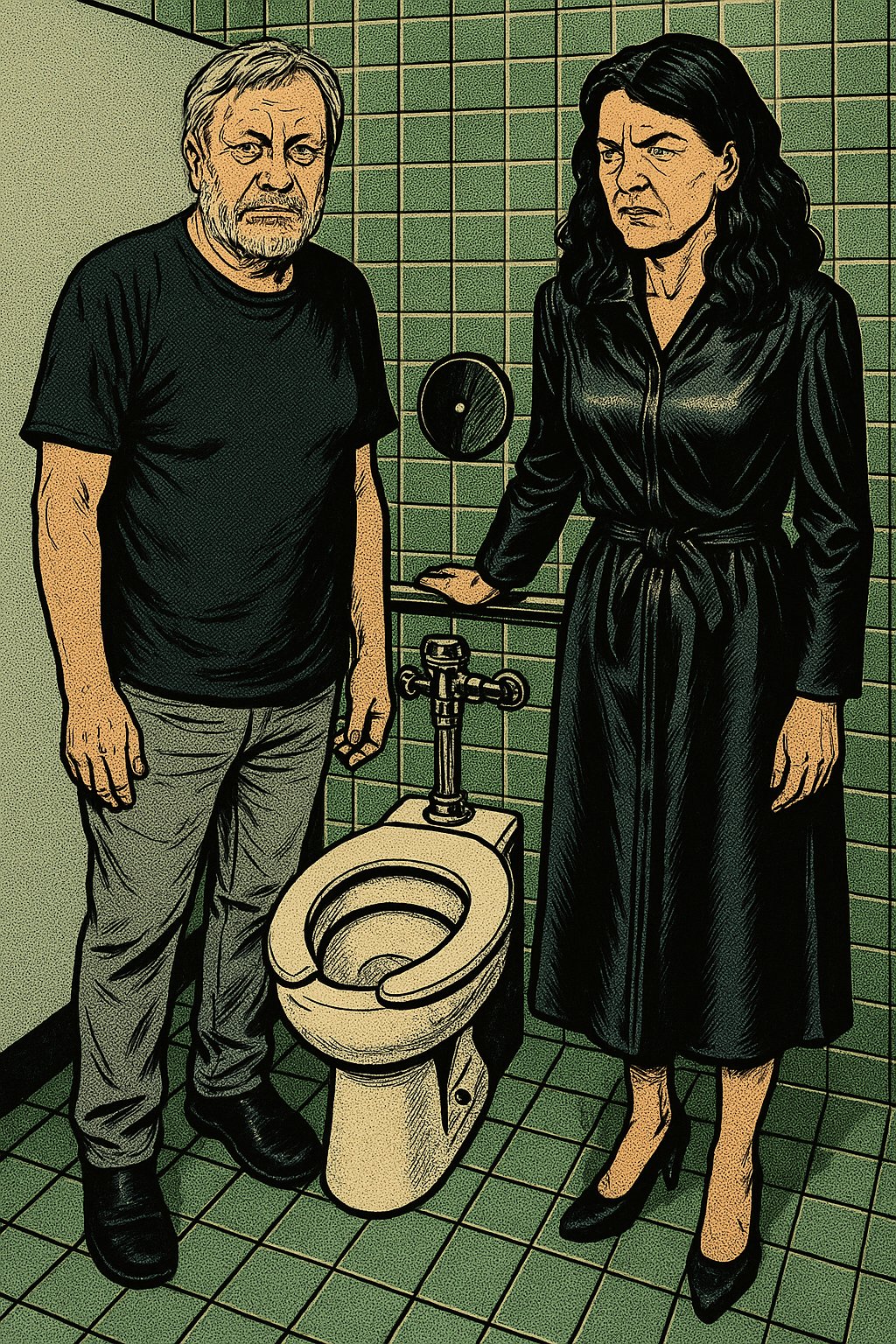
A filth fantasy unfolds through the photo with the toilet, Tolokonnikova describes the disgusting bathroom conditions in the penal colony and the point when the hunger strike started, and Žižek waters down this real risk with sadistic curiosity in the mode of was it a real hunger strike or did you sneak some food at night. When he talks about Stalin’s abortion ban, Beria’s kidnapped women, the twisted sex–violence archive of the Soviet period, the same tone continues: history is reduced to a collection of perverse stories; it becomes a mind that masturbates with a prison fetish.
In the middle of the conversation Tolokonnikova describes her own religion, the slogans she writes on icons, the song God’s Left, her stance of being an atheist but playing with sacred images; Žižek gladly folds this into his own Christian atheism line. The photo of Bernie sitting on a chair at Biden’s inauguration comes up as an example of a truly radical icon; icon, meme, image, body and slogan become a single package. There is no political strategy, no organizing, no class; there is icon, there is fetish, there is photograph; it feels exactly like content porn with the form of a panel.
Towards the finale the libido really rises to the surface. When Tolokonnikova says she believes in cracks, Žižek makes a pun by shifting to the other meaning of cracks, then goes on at length about Nadya’s beauty and intelligence, falling into the classic old man compliment of normally smart women are ugly, in you the two come together, and then he offers a supposed self-criticism with I’m not some pervert secretly trying to get you into bed, but in fact he is performing exactly that role.
When Tolokonnikova responds with things like I like being objectified, Žižek links this to Marx and sanctifies it by saying this is a properly communist answer. The objectification of the female body in front of the camera is laundered by the male philosopher with theoretical categories; both the sexist gaze and the capitalist show are washed and packaged with a Marx reference; what emerges is show partners who grow their personal brands, not collective struggle.
In the end, the video is a collage of perversion in which prison trauma, political fidelity, criticism of Stalin and Putin, debates on religion and atheism and talk of sexuality, toilets and OnlyFans all interpenetrate. Nadya is not a pure heroine here, and Žižek is not a radical theorist; they are each other’s material. One supplies trauma and body, the other supplies theory and anecdote; what emerges is not just a you-scratch-my-back-I’ll-scratch-yours coalition that looks like a trauma porn collaboration, but a deeper cross perversion partnership.
The West’s radical Russian girl fantasy and Žižek’s role
Many analyses written on Pussy Riot and Tolokonnikova emphasize that the Western media presents them as the Russian version of the US riot grrrl legacy and thereby tears them from their local context, and that this makes more anonymous, collective struggles within Russian feminist and left opposition invisible (🔗).
Tolokonnikova’s story is a tailor-made fit for this fantasy: a young, colorful, foul-mouthed woman coming from the North, smashing religion and defying the state. A figure who soothes the hearts of anti-Putin audiences, makes liberal feminists feel good about themselves and fills the political-content button of the art market at the same time. In other words, radical, exotic and sellable all at once; a perfect shop window for the perverted spokespeople of the cultural industry on both flanks.
Žižek’s praise reinforces this fantasy. To declare her the representative of the Real blasphemy, to talk about her as a saint who puts her brave body on the line, to bless rather than critique Tolokonnikova. Thus, the figure turns into a superhero at whom the Western left can sigh with relief: there are still people resisting in Russia, and they’re women, and they’re punk. This transformation pushes thousands of unnamed prisoners, trade unionists, leftists and feminist organizers in Russia into the shadows; it produces a representation so homogenizing it makes you say they’re all rats of the same pot.
Tolokonnikova also knows how to use this fantasy. She builds her letters, interviews, exhibitions and NFTs around this image; in Berlin, Los Angeles, San Francisco, at Pride events and crypto conferences the same figure is staged over and over on different platforms. Žižek, for his part, frames this figure with concepts and gains fame again through her; it reeks of an agreement of let me turn you into an icon and you make me look radical.
Two faces of the same swamp: why one is no better than the other
The reason Žižek praises Pussy Riot and especially Tolokonnikova is not a coherent political analysis; it is that he has found a body and a story that match his perverse fantasy one-to-one. From the scene in the museum to the cathedral raid, from the prison to OnlyFans, from NFTs to the cell at MOCA, every step offers new material that feeds his obsessions with filth, pain, sacrifice, profanity, religion and revolution; a repetition loop settles in that produces a navy-blue version of the same shit school.
From Tolokonnikova’s side, Žižek’s interest functions as a powerful amplifier in the Western intellectual world. His turning her letters into a book, interpreting her texts and polishing her in joint videos pushes the Tolokonnikova brand to an even higher shelf both politically and aesthetically; in this way a mixture of Lacanian perversion and crypto-icon perversion is completed.
This is quite literally a relationship about which one could say they have entered a marriage of convenience. The pain of the female activist fuels the career of the male theorist; the praise of the male theorist strengthens the brand of the female activist. What one presents as radical theory merges with the package the other sells as radical performance and serves the same spectacle economy; what appears is a picture that gives the impression of two frogs of the same swamp.
Therefore the answer to the question “Why does Žižek praise Pussy Riot, do programs with Nadya, present her as an exemplary Stalinist, isn’t this nonsense?” is not to be found in some glossy sentence like there are contradictory but profound theoretical reasons. This relationship is a perverse exchange from top to bottom. The real body wounded by state violence is blended with stories of toilets and prostitution told with lust on camera; hunger strike, Stalin and Beria anecdotes become mere decor; the prison cell turns into exhibition space in Los Angeles and social media fodder.
Whatever was in the first performance in the museum is still there today: a system in which the body and trauma are put forward as a political gesture and then immediately bought and sold in the media, in theory, in the art market and in the crypto bazaar. In this system there is neither a deep-rooted anti-capitalist strategy nor a consistent revolutionary ethic. There is a swamp; Tolokonnikova plays its bodily side, Žižek plays its theoretical side. These two figures who seem different are in fact a two-sided disgrace of the same show; take one and hit the other.
Geben und Nehmen, nimm den einen, hau den anderen
Eine schwangere Frau hat mitten im Gedränge Sex, vor den Vitrinen mit ausgestopften Tieren im Biologischen Museum von Moskau, während die Kameras laufen. Um sie herum haben auch die anderen Paare sich ausgezogen, der Museumsraum hat sich in ein Set für Gruppensex verwandelt. Die Performance heißt ‘Fuck for the Heir Puppy Bear!’ (🔗), im Visier steht Medwedews Politik zur Erhöhung der Geburtenrate, der damals als Putins Kronprinz galt. Die schwangere Frau, die im Museum Sex hat, ist Nadya Tolokonnikova; später das Gesicht von Pussy Riot, jene Figur, die die westliche Presse als ‘mutige feministische Punk-Ikone’ verkaufen wird.
Hier ist der Ausgangspunkt: öffentlicher Sex, schwangere Körperlichkeit, Museumsraum, Wahlkampfphase, Anspielung auf Medwedew. Es wird wie ein Schlag gegen Staat, Familienideologie und Konservatismus präsentiert, ist aber gleichzeitig perfektes Material für Schockeffekt, pornografische Neugier und mediale Schau. Hier wird die erste Gussform für Tolokonnikovas gesamte Karriere gegossen: den eigenen Körper und die eigene Intimsphäre als politische Botschaft ausstellen, dieses leibliche Risiko zugleich in oppositionelles Kapital und in Marken-Kapital verwandeln. Eine Figur schaffen, die gleichzeitig Hass als Unmoralische einsammelt und Beifall als radikal Mutige.
Dieses erste Muster erweitert sich später nach demselben Prinzip bis zu Pussy Riot, die Kathedralen stürmen, bis zu Putinkritischen Gerichtsreden, Gefängnisbriefen, Feminismusprojekten mit NFTs, Ausstellungen in Berlin, die die Gefängniszelle rekonstruieren, einem OnlyFans-Konto und schließlich einem wechselseitig perversen Talkshow-Auftritt mit Slavoj Žižek in Los Angeles; die Linie dreht sich von Anfang bis Ende im selben Trott, als wäre es immer dieselbe alte Masche. Die Gleichung, die in jener ersten Museumsszene aufgestellt wird, ändert sich nie: Körper, Trauma, Beschimpfung, Religion und Politik; alles wird in derselben libidinösen Marktlogik in Umlauf gebracht.
Von der schwangeren Performance zum Punk-Gebet: Körpersprache der Politik und fertige Mythologie
Vier Jahre nach dieser Museumsaktion des Voina-Kollektivs wird 2012 diesmal in der Christ-Erlöser-Kathedrale in Moskau die Bühne aufgebaut. Bunte Balaklavas, kurzer Punk-Song, Körper, die vor dem Altar knien, obszöne Zeilen, die Putin und das Patriarchat ins Visier nehmen. Die Performance wird in wenigen Sekunden abgebrochen, aber die Bilder im Netz leben viel länger als die Unterbrechung in der Kathedrale.
Der Staat klagt drei Mitglieder von Pussy Riot wegen religiös motivierter, von Hass getriebener Rowdytumsdelikte an; Tolokonnikova verbringt zwei Jahre in einer Strafkolonie. Für russische Konservative ist sie seit der Voina-Zeit sowieso schon die perverse Protagonistin der Museumsaktion; jetzt kommt noch das Etikett des globalen Satans hinzu, der die Kirche beschimpft. Im Westen dagegen polieren Menschenrechtsorganisationen und Medien sie zum Gewissensgefangenen, zur Künstler-Aktivistin und Heldin hoch; ein Bild ganz nach dem Motto: Bei uns tun alle so, als würden sie ernsthaft einkaufen, jeder spielt seine Rolle und nimmt die ihm zugedachte Pose ein.
In der harten Rede, die sie im Gerichtssaal hält, nimmt sie die orthodoxe Kirche, das Putin-Regime und die Staats–Kirche-Allianz ins Visier, die sie heilige Scheiße nennt; der Text verbreitet sich schnell sowohl in Russland als auch im Westen. Gefängnisbriefe, Erklärungen zum Hungerstreik, Beschreibungen von Folter durch Aufseher und vom System der Zwangsarbeit bauen in ihren Texten nicht nur die Haftbedingungen, sondern auch ihren persönlichen Mythos auf. Es steht nicht mehr bloß die junge Frau aus dem Museumsskandal von Voina im Raum, sondern eine politische Gefangene, die aus dem Lager heraus spricht, eine radikale russische Frau, zugleich erotisiert und heroisiert verpackt.
Während dieses Dreieck aus Gericht, Medien und Briefen so funktioniert, kommt zu den klassischen, halbwegs vernünftigen linken Analysen eine Logik hinzu, die wie ein doppeltes Fließband funktioniert, das aus Schmerz Hype produziert; Tolokonnikova beginnt, ihr eigenes Leben als eine vermarktbare Leidensgeschichte zu inszenieren. Genau an dieser Stelle tritt Slavoj Žižek auf den Plan.
Der gesuchte Körper des obszönen Philosophen: Žižeks fertiger Fetisch in Nadya
Slavoj Žižek ist seit Jahren ein männlicher Philosoph, berüchtigt für seine schmutzigen Witze, seine Toilettenphilosophien und pornografischen Metaphern; er betreibt seine Theorie fast wie ein intellektuelles Bordellprogramm, in dem er Begriffe und obszöne Anekdoten nebeneinanderstellt. Er liebt es, Theorie im Rahmen einer bewusst inszenierten Perversion zu erzählen. Körperflüssigkeiten, Kloschüsseln, Pornografie, Prostitutionsgeschichten stehen in seinem Repertoire immer bereit; dazu mischt er schwere Begriffe wie Revolution, Kommunismus, Ethik und erzeugt so einen bizarren Cocktail.
Tolokonnikovas Profil passt punktgenau in dieses perverse Theatrum der Theorie. Eine junge Frau, die trotz Schwangerschaft im Museum öffentlichen Sex hat. Eine Punkfigur, die vor dem Altar tanzt und Putin beschimpft. Eine Gefangene, die in der Strafkolonie in Hungerstreik tritt und die Schläge des Wachpersonals am eigenen Körper trägt. Und dazu noch jemand, der all das verschriftlicht, der sein eigenes Leid selbst erzählt und so zu zitierfertigem Material wird. Für Žižek könnte es keinen perfekteren Fetisch einer radikalen weiblichen Subjektfigur geben; diese Beziehung riecht von Anfang an nach einer Art Trauma-Porno-Zusammenarbeit.
Tatsächlich preist er in seinen Texten, die er während des Pussy-Riot-Prozesses schreibt, die Gruppe als Vertreterin der wahren Blasphemie, als Geste, die die Maske liberaler Toleranz zerreißt, während er Tolokonnikovas Briefe aus dem Gefängnis fast mit religiöser Schwere auflädt. Der Briefwechsel, der später in einem Buch gesammelt erscheint, kommt mit einem schon im Titel romantisierten Paket namens Comradely Greetings (🔗) auf den Markt. An diesem Punkt geht es längst nicht mehr nur um eine Beziehung zwischen Theoretiker und Aktivistin, sondern um einen wechselseitigen Mythenbau; sie funktionieren im Grunde wie ein radikales Marketing-Duo.
Für Tolokonnikova bedeutet Žižeks Interesse ein solides Eintrittsticket in die westliche intellektuelle Bühne. Für Žižek wiederum bietet Tolokonnikovas Körper, ihr Trauma und ihre Beschimpfungen die Gelegenheit, jene Figuren der radikalen Subjektivität, der Berührung mit dem Realen und der Angriffe auf die heiligen Punkte der Ordnung, die er seit Jahren im Theorietext durchkaut, mit einem lebenden Beispiel auszuschmücken. Derselbe Körper wird in der Karriere des einen zu einem theoretischen Fetisch, in der Karriere der anderen zu einer politisch-künstlerischen Marke; heraus kommt eine Art über Kreuz gebrandete Perversion.
Deshalb ist Žižeks Satz, Nadya sei ein vorbildliche Stalinistin, keine historische Analyse, sondern ein sadomasochistisches Lob, das Disziplin, Leidensfähigkeit und Selbstaufopferung erotisiert. Den kollektiven Terror Stalins in eine Fantasie individueller Hingabe herunterzubrechen und zu polieren, Tolokonnikovas Hungerstreik und Gefängniswiderstand als ästhetische Kapazität, Schmerz auszuhalten, zu feiern. Vielleicht ist da keine echte Verteidigung Stalins im Spiel, aber es herrscht eine Logik, die den Schmerz fetischisiert und reale Kämpfe darauf reduziert, wie viel jemand bereit ist, seinen Körper zu opfern; eine Karrierelogik, die voll und ganz auf über Fetischisierung von Leid abgestützt ist.
Vom Museumsraum zum Krypto-DAO: die Finanzialisierung des Aktivismus
Nachdem sie aus dem Gefängnis entlassen wird, besteht Tolokonnikovas Weg nicht nur aus feministischen Protestaktionen und Menschenrechtsorganisationen. Sie steigt schnell in die Web3-Welt ein; zuerst entsteht UkraineDAO, das Spenden für die Ukraine sammelt, danach UnicornDAO, das sich auf NFTs von Künstlerinnen und LGBT+-Künstlern konzentriert (🔗).
Nach der Aufhebung des Roe-v.-Wade-Urteils bringt UnicornDAO eine NFT-Serie namens Proof of Protest heraus; mit dem Bild eines Molotowcocktails als flüssiger Feminismus wird erzählt, dass man damit Geld für das Recht auf Abtreibung sammeln werde (🔗). Die Protestgeste verwandelt sich in einen Vermögenswert, der auf den volatilen Bildschirmen der Kryptobörsen gehandelt wird. Rebellion steht in einem und demselben Satz neben Portfolio-Diversifizierung; die ganze Atmosphäre riecht nach einer Mischung aus kryptobegeisterter Revolutionspose und quotengeiler Theorie.
Dieser Prozess trägt das Modell der Politik über Schockeffekte, das zuerst in der Museumsaktion und später beim Kathedralensturm sichtbar wurde, an einen anderen Ort. Jetzt sind nicht mehr nur Staat und Kirche die Kund:innen dieser Schocks, sondern auch die Finanzmärkte. Tolokonnikovas Bild wandert zwischen Transparent, NFT, das wie ein Transparent gestaltet ist, Ikonen an Galeriewänden und Token im Wallet hin und her; Körper und Trauma werden zu einer eigenen Assetklasse auf der Blockchain, und was man eine performative Industrie nennt, die Trauma tokenisiert, sieht genau so aus.
Die Zelle zur Galerie, das Trauma zur Ware machen
In neuen Interviews erzählt Tolokonnikova, dass sie ihre Gefängniserfahrung in Berlin in der Ausstellung Wanted verarbeitet, indem sie die Gefängniszelle nachbaut (🔗). Die Zellenreplik, Arbeiten mit ikonografischen Motiven, Plakate, auf denen Putin als gesuchter Verbrecher dargestellt wird, werden zu Objekten, die Besucher:innen betrachten, aber auch gegen Geld in ihre Sammlungen aufnehmen können. Berlin funktioniert weniger als Hauptstadt des Aktivismus, sondern eher als Kapitalzentrum einer Traumaökonomie; der Körper der einen und die Begriffe des anderen kreisen wie Produkte auf demselben Markt.
Die Performanceinstallation POLICE STATE im MOCA in Los Angeles baut die Gefängniszelle diesmal in den USA nach (🔗). Tolokonnikova verbringt tageweise Zeit in dieser Zelle, verweist dabei sowohl auf ihre eigene Vergangenheit als auch auf Ereignisse wie Razzien gegen Migrant:innen in den USA und den Einsatz der Nationalgarde; als die Ausstellung genau wegen solcher Einsätze geschlossen wird, posiert sie in den sozialen Medien mit der Zeile Police State exhibit closed due to the police state.
Diese Performances enthalten zweifellos Kritik an autoritären Regimen und Polizeigewalt. Gleichzeitig steht aber eine andere Wahrheit nackt im Raum: Die zwei Jahre Trauma, die sie in einem russischen Gefängnis verbracht hat, werden hier zu einem Paket, für das man Eintritt zahlt, das im Katalog verkauft wird, mit Sponsoren um die Welt reist. Wenn die Kolonie in Moskau zum Konzeptraum im Museum von Los Angeles wird, ist der Prozess abgeschlossen, in dem Schmerz zu Ästhetik und Ästhetik zur Ware wird; das Bild einer Kunst, die ihren Körper verkauft, und eines Philosophen, der sein Gehirn verkauft, steht mustergültig da.
Dazu kommt noch OnlyFans. In einem Interview mit dem Guardian präsentiert Tolokonnikova sowohl ihre Berliner Ausstellung als auch ihre Wut auf Putin und die Eröffnung ihres OnlyFans-Kontos als Teile derselben Erzählung; sie zeigt es als eine der Möglichkeiten, um weiter Geld für Aktivismus zu verdienen (🔗). In der Voina-Zeit war öffentlicher Sex ein Angriff auf die Ideologie der kapitalistischen Familie; heute wird ein ähnlicher Körper im Herzen des digitalen Plattformkapitalismus im Abo-Modell erotischer Inhalte verkauft; die Logik einer Generation, die aus Rebellion Merchandise und aus ihrer Perversion TED-Talk Content macht, wird hier endgültig besiegelt.
Der Körper, der in der Museumsaktion dem Staat trotzend öffentlichen Sex vollzieht, wird nun in NFT-Form, in der Galerie und auf OnlyFans immer wieder für dieselbe Sache genutzt: für Schock und Aufmerksamkeit; Trauma als Paket, Theorie als Verpackung; beides zirkuliert als ein und dasselbe Produkt.
Das Gespräch in Los Angeles: theoretische Perversion und körperliche Marke nebeneinander
Vor diesem Hintergrund wirkt das in Los Angeles aufgezeichnete Gespräch zwischen Tolokonnikova und Žižek wie eine Szene im Modus: wir stecken alle unter einer Decke. Gleich zu Beginn: heißes Studio, das Wort quickie, der Witz über eine schnelle intellektuelle Affäre via Sexmetapher; Nadya erzählt vom pinken orthodoxen Kreuz und vom Video Hate Fuck; Žižek legt sofort mit Geschichten über Prostitution, Analytikerhonorare und Bordell-Anekdoten nach.
Über ein Foto mit Toilette im Hintergrund entfaltet sich eine Drecksfantasie, Tolokonnikova beschreibt die widerlichen Sanitärbedingungen in der Strafkolonie und den Punkt, an dem ihr Hungerstreik begann, Žižek verwässert dieses reale Risiko mit sadistischer Neugier à la war das wirklich ein Hungerstreik oder hast du abends heimlich etwas gegessen. Wenn er über Stalins Abtreibungsverbot, über von Beria entführte Frauen und das perverse Sexualitäts–Gewalt-Archiv der Sowjetzeit spricht, bleibt der Ton derselbe: Geschichte wird auf eine Sammlung schräger perverser Geschichten heruntergebrochen; Denken wird zur geistigen Masturbation an einem Gefängnisfetisch.
In der Mitte des Gesprächs erzählt Tolokonnikova von ihrer eigenen Religion, von Slogans, die sie auf Ikonen schreibt, vom Song God’s Left, von ihrer Position als Atheistin, die mit heiligen Bildern spielt; Žižek fügt das zufrieden seiner eigenen Linie eines christlichen Atheismus hinzu. Das Foto von Bernie auf dem Stuhl bei Bidens Vereidigungsfeier taucht als Beispiel einer wahren radikalen Ikone auf; Ikone, Meme, Bild, Körper und Slogan werden zu einem einzigen Paket verschmolzen. Es gibt keine politische Strategie, keine Organisation, keine Klasse; es gibt Ikonen, Fetische, Fotos; der Gesamteindruck ähnelt einem Inhalt, der pornografisch ist, in einer Panel-Form serviert wird.
Gegen Ende tritt die Libido ganz an die Oberfläche. Als Tolokonnikova sagt, sie glaube an Risse, spielt Žižek mit dem Doppelsinn von cracks, dann redet er lange über Nadyas Schönheit und Intelligenz, stolpert in die klassische alte-männerhafte Lobhudelei vom Typ normalerweise sind kluge Frauen hässlich, aber bei dir gibt es beides, und behauptet anschließend in einer scheinbaren Selbstkritik, er sei kein Perverser, der heimlich versuche, sie ins Bett zu kriegen, spielt aber genau diese Rolle.
Als Tolokonnikova darauf mit Antworten im Stil von ich mag es, objektiviert zu werden reagiert, bindet Žižek das an Marx zurück und adelt es als eine wirklich kommunistische Antwort. Die Objektivierung des weiblichen Körpers vor der Kamera wird vom männlichen Philosophen mit theoretischen Kategorien gereinigt; sowohl der sexistische Blick als auch die kapitalistische Show werden mit einem Marx-Verweis gewaschen und gebügelt; am Ende steht das Bild einer Kooperation, die nicht kollektiven Kampf stärkt, sondern die persönliche Marke, die sie gemeinsam aufpumpen.
Am Ende ist das Video ein Perversions-Collage, in der Gefängnistrauma, politische Treue, die Kritik an Stalin und Putin, Diskussionen über Religion und Atheismus sowie Sex, Kloschüssel und OnlyFans-Gequatsche ineinander verschränkt sind. Weder Nadya ist hier eine reine Heldin, noch Žižek ein radikaler Theoretiker; beide sind Material füreinander. Die eine liefert Trauma und Körper, der andere Theorie und Anekdoten; heraus kommt keine nette Al-gülüm-ver-gülüm-Koalition, die nur so aussieht, als wäre sie harmlos, sondern eine tiefere, über Kreuz organisierte perverse Partnerschaft.
Die Fantasie vom radikalen russischen Mädchen im Westen und Žižeks Rolle
Viele Analysen zu Pussy Riot und Tolokonnikova heben hervor, dass westliche Medien sie als russische Version der US-amerikanischen riot grrrl-Tradition darstellen und damit aus dem lokalen Kontext reißen, wodurch anonyme, kollektive Kämpfe innerhalb der russischen feministischen und linken Opposition unsichtbar gemacht werden (🔗).
Tolokonnikovas Geschichte ist maßgeschneidert für diese Fantasie: eine junge, aus dem Norden kommende Frau, bunt, vulgär, eine, die die Religion niederreißt und dem Staat ins Gesicht spuckt. Eine Figur, die zugleich das Herz von Putin-Gegnern erwärmt, liberalen Feministinnen ein gutes Gewissen gibt und die Schaltfläche politischer Inhalt im Kunstmarkt füllt. Sie ist also gleichzeitig radikal, exotisch und verkäuflich; genau die ideale Vitrine für die schrägsten Sprecher:innen einer Kulturindustrie, die in alle Richtungen nach Perversion sucht.
Žižeks Lobreden verstärken diese Fantasie. Ihn als Repräsentantin der wahren Blasphemie auszurufen, von ihrem mutigen Körper als einer Art Heiligenleib zu sprechen, heiligt Tolokonnikova eher, als dass er sie kritisiert. So wird sie zu einer Superheldin, bei der die westliche Linke aufatmen kann: In Russland wird immer noch gekämpft, und zwar von Frauen, und zwar von Punk. Diese Verwandlung schiebt Tausende namenlose Gefangene, Gewerkschafter, Linke und feministische Organisatorinnen in Russland in den Schatten; die Repräsentation wird so vereinheitlichend, dass man sagen möchte: am Ende sitzen doch alle im selben Pott.
Tolokonnikova versteht es, diese Fantasie zu nutzen. Sie baut ihre Briefe, Interviews, Ausstellungen und NFTs um dieses Bild herum; in Berlin, Los Angeles, San Francisco, auf Pride-Events und Krypto-Konferenzen wird dieselbe Figur auf unterschiedlichen Bühnen immer wieder aufgeführt. Žižek wiederum rahmt diese Figur theoretisch ein und wird darüber erneut berühmt; der Geruch eines Deals vom Typ ich mache dich zur Ikone, du machst mich zum Radikalen steigt genau von hier auf.
Zwei Facetten desselben Sumpfes: warum al birini vur ötekine
Dass Žižek Pussy Riot und besonders Tolokonnikova lobt, hat seinen Grund nicht in einer konsistenten politischen Analyse, sondern darin, dass er einen Körper und eine Geschichte gefunden hat, die sich eins zu eins mit seiner perversen Fantasie decken. Von der Museumsaktion über den Kathedralensturm, vom Gefängnis zu OnlyFans, von NFTs zur Zelle im MOCA versorgt ihn jeder Schritt mit neuem Material für seine Obsessionen mit Dreck, Leid, Opfergestus, Beschimpfungen, Religion und Revolution; es etabliert sich ein Wiederholungszyklus, der eine ganze Schule von alten Sauereien hervorbringt.
Für Tolokonnikova wiederum fungiert Žižeks Interesse als starker Verstärker in der westlichen Denkwelt. Dass er ihre Briefe in Buchform bringt, ihre Texte kommentiert, sie in Videos mit gemeinsamen Witzen hochzieht, hebt die Marke Tolokonnikova politisch und ästhetisch auf ein noch höheres Regal; die Mischung aus lacan’scher Perversion und Krypto–Ikonen-Kult ist damit komplett.
Das ist eine Beziehung, die man ohne Übertreibung eine Art Interessenehe nennen kann. Der Schmerz der Aktivistin treibt die Karriere des männlichen Theoretikers an; das Lob des männlichen Theoretikers stärkt die Marke der Aktivistin. Was der eine als radikale Theorie präsentiert, verkauft die andere als radikale Performance; beides zusammen dient derselben Shows-Ökonomie, und am Ende steht ein Bild, das wie zwei Frösche im selben Sumpf wirkt.
Also liegt die Antwort auf die Frage, “Warum Žižek Pussy Riot lobt, mit Nadya eine Sendung macht, sie als vorbildliche Stalinistin hinstellt, ob das nicht alles Quatsch ist?”, nicht in einem glitzernden Satz über widersprüchliche, aber tiefgründige theoretische Gründe. Diese Beziehung ist von Anfang bis Ende ein perverser Handel. Ein vom Staatsgewalt verletzter realer Körper wird mit Erzählungen über Klos und Prostitution, die vor der Kamera lüstern präsentiert werden, vermengt; Hungerstreik, Stalin- und Beria-Anekdoten dienen als Kulisse; die Gefängniszelle wird zum Ausstellungsraum in Los Angeles und zum Social-Media-Requisit.
Alles, was in der ersten Museumsaktion vorhanden war, ist heute noch da: Körper und Trauma werden als politische Geste ausgestellt, um dann sofort in Medien, Theorie, Kunstmarkt und Kryptobörse gehandelt zu werden. In dieser Ordnung gibt es weder eine tiefgreifende antikapitalistische Strategie noch eine konsistente revolutionäre Ethik. Es gibt einen Sumpf; Tolokonnikova spielt die Körperseite, Žižek die Theorieseite. Diese zwei Figuren, die so tun, als wären sie grundverschieden, sind in Wirklichkeit nur zwei Gesichter derselben doppelten Blamage im selben Spektakel; al birini vur ötekine.
 Žižekian Analysis
[…] Al gülüm ver gülüm, al birini vur ötekine / Scratch my back, I’ll scratch yours, take one and hit the other / Geben und Nehmen, nimm den einen, hau den […]
LikeLike
[…] (İngilizcesi ve Almancası) […]
LikeLike
[…] ‘Scratch my back, I’ll scratch yours, take one and hit the other’ (🔗) lays out the mutual-aid and mutual-aggression logic that has shaped the saga from the beginning: […]
LikeLike
[…] olarak ‘Scratch my back, I’ll scratch yours, take one and hit the other’ (🔗), en başından beri bu hikâyeyi şekillendiren karşılıklı yardımlaşma ve karşılıklı […]
LikeLike