🦋🤖 Robo-Spun by IBF 🦋🤖
🌀⚔️💫 IPA/FLŽM 🌀⚔️💫
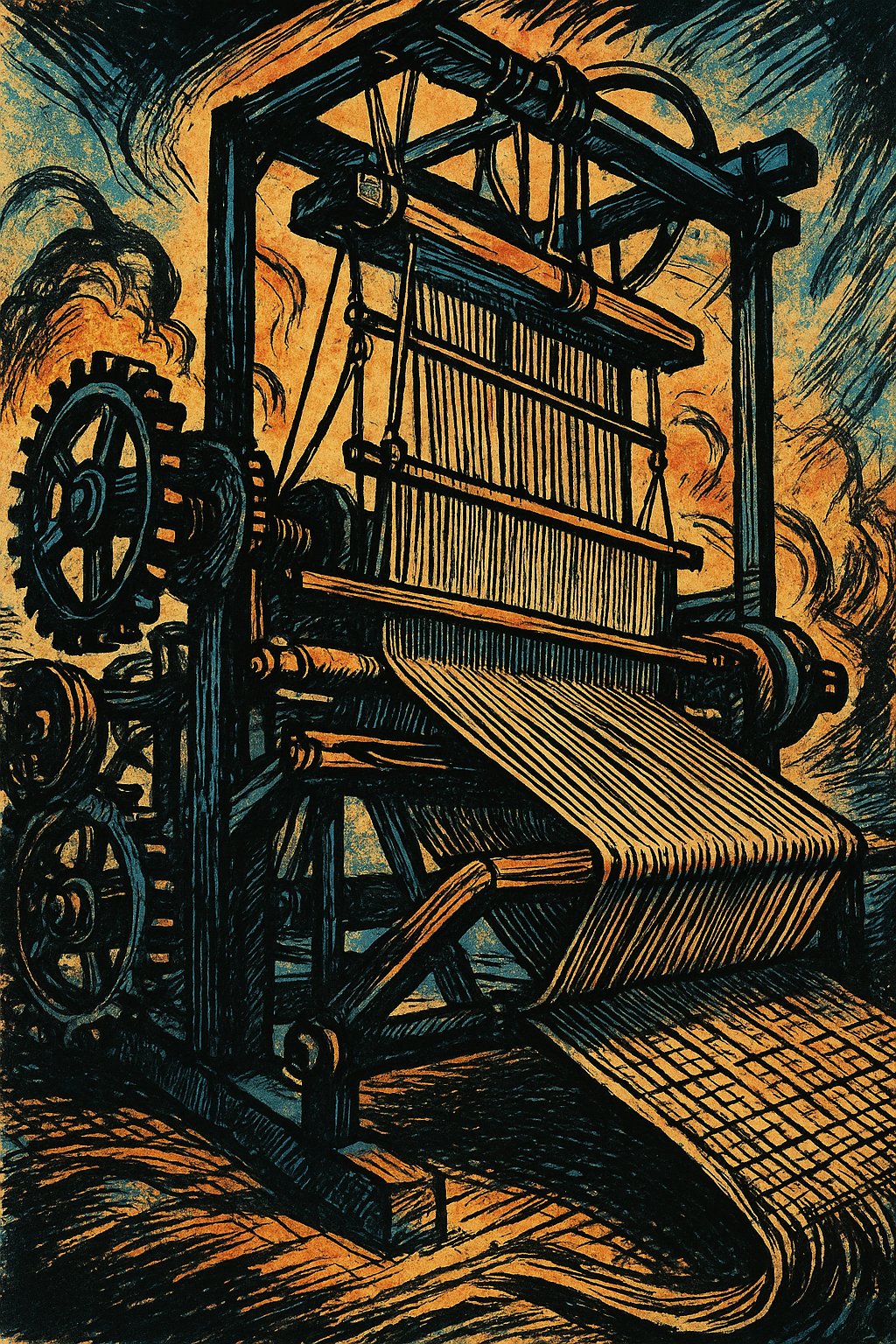
Here we follow a single thread across very different eras, showing how each transformation of the forces of production rewove not only labour and value but also enjoyment, gender, and belief into new operating systems of power. Beginning from ancient spinners of fate and the Christian icon–witness machine, moving through textile factories, tabulating bureaus, broadcast studios, security databases, social platforms and, finally, generative models, it tracks how surplus shifts from the extra hours wrung from industrial bodies to the behavioural traces, fantasies, and protocolled desires harvested by contemporary AI infrastructures. Along the way, four historic hinges punctuate the weave – the Haymarket struggle over factory time, the May 1968 revolt against bureaucratic and broadcast authority, the 9⁄11 turn to global dataveillance, and the 7 October 2023 escalation that forces platform and model governance into the open – while four feminist waves mark how womanhood is repeatedly drafted as coordinator, image, interface, and then displaced as those skills are automated and centralised. Read through Marcuse, advanced industrial society appears less as a neutral stage of progress than as a succession of technical grids that stabilise one-dimensional forms of life and seal off alternative uses of collective intelligence and desire, while Žižek’s focus on fantasy and surplus-enjoyment clarifies how each grid keeps subjects attached to their own domination by reorganising what they are allowed to enjoy, fear, or hope for. By the time the spinning robot of AI-driven PR and content moderation arrives, the reader can see it not as a strange intrusion from the future but as the latest knot in a long loom of surplus pragmatics: a point where the general intellect has already been captured in models and metrics, and where the political task is to reclaim the protocols that govern how surplus-information, surplus-enjoyment, surplus-power, and surplus-value are produced, circulated, and contested.
1 Surplus, forces of production, and the pragmatic turn
The phrase surplus pragmatics names a double shift. First, it gathers together different kinds of “too much” that run through modern societies: the extra labour squeezed out of bodies, the extra data extracted from behaviour, the extra enjoyment that keeps subjects attached to harmful routines, the extra power that condenses wherever coordination is technically possible. Second, it insists that these surpluses are never floating in abstraction. They are always organised through concrete forces of production: looms and blast furnaces, tabulators and switchboards, broadcast studios and ratings panels, data centres and machine-learning pipelines.
The earlier text on pragmatics of surplus at Žižekian Analysis formulated this for the age of platforms and artificial intelligence by showing how surplus-value, surplus-information, surplus-enjoyment, and surplus-power form a feedback loop that is currently orchestrated by what it calls CurAI, the ensemble of ranking algorithms, recommendation systems, and notifications that quietly choreograph attention on today’s internet.(🔗) (Žižekian Analysis) Surplus-information designates the behavioural data that exceeds what would be needed simply to provide a service; surplus-enjoyment is the libidinal charge attached to digital routines—the small spikes of envy, shame, indignation, or triumph that keep the scroll going; surplus-power is the capacity to steer behaviour from a distance; surplus-value is the monetary condensation of the whole loop as profit, rent, or speculative valuation.(Žižekian Analysis)
Surplus pragmatics adds one more requirement: historical positioning. Surplus is always surplus of something in a specific technical and institutional setting. For classical industrial capitalism this meant surplus-value extracted in the factory; for digital capitalism it means surplus-information harvested and recombined in networks. Between those poles lies a long series of shifts in the forces of production which change what can be extracted, which fantasies are mobilised to justify extraction, and which groups are put to work as mediators, operators, and symbols. The more recent series on hinges between waves at Žižekian Analysis argues that modern history can be read as successive “operating systems of power” that tell a society how value is generated, how facts are sorted, and how authority is stabilised. Each such operating system is anchored in a particular machine logic and is periodically retuned four breaking points that function as Judas-hinges, betraying one settled order to inaugurate the next: Haymarket, May 1968, 11 September 2001, and 7 October 2023.(🔗) (Žižekian Analysis)
A Marcusean line helps to clarify why forces of production matter so much. In One-Dimensional Man, Marcuse describes “technological rationality” as a historical form of reason that appears neutral but in practice fuses technical efficiency with domination. Industrial and post-industrial societies, he argues, reorganise work, leisure, and even language so that people come to experience their own needs and perceptions through the lens of what the machinery and its managers require.(🔗) (platypus1917.org) Later commentators summarise this as the thesis that technology in advanced industrial society no longer simply serves external goals; it becomes the very standard of what counts as reasonable, reducing citizens to a particular, flattened thought-style.(🔗) (The Junction) Marcuse’s critique therefore already links surplus and forces of production: the extra productivity enabled by technical systems is inseparable from the extra conformism those systems silently demand.
Žižek’s work, especially in The Plague of Fantasies, complements this by describing how ideology in contemporary capitalism no longer operates mainly by explicit doctrine but by managing fantasy. The present epoch, he writes, is marked by a growing antagonism between the abstraction of everyday life—through digitalisation and market relations—and a flood of pseudo-concrete images that surround and distract.(🔗) (Google Books) Instead of exposing the abstract mechanisms that organise society, mass media bombard subjects with vivid scenes which become the stage for enjoyment, anxiety, and resentment. Critique must therefore proceed “from image to abstraction,” tracing back from captivating pictures to the underlying circuits that structure them.(Verso)
In Žižek’s reading of Christianity, the figure of the “big Other” names the symbolic order that guarantees meaning and watches over enjoyment. Contemporary culture both distrusts this big Other and clings to new substitutes for it, from conspiracy narratives to re-enchanted archetypes.(🔗) (European Journal of Psychoanalysis –) Žižek’s notion of Christian atheism radicalises this tension: the death of the transcendent guarantee is not a nihilistic loss but the condition for collective responsibility. Some later accounts summarise his claim by saying that Christianity’s core, for him, is the shared experience of abandonment on the cross, common to believer and atheist, and that this forces a reconception of their relation as “kindred and complementary.”(🔗) (Church Life Journal) These themes will return when the iconophile loom of Christian imagery and the feminist “waves of women” are woven into the history of technology.
Surplus pragmatics takes this Marcuse–Žižek combination and turns it into a method. Technology is never neutral; it is a crystallisation of domination that shapes needs and perceptions. Fantasy is never mere distraction; it is the way subjects metabolise abstraction and remain attached to structures that harm them. A history of surplus pragmatics therefore follows the forces of production through time and, at each stage, asks how surpluses are generated, which fantasies are mobilised to hold the system together, and which groups are drafted to operate the machinery, serve as its icons, or both.
The recent series starting from “The Making & Breaking of Womanhood” at Žižekian Analysis proposes that modern history is punctuated by four waves of female-coded power, each coinciding with a distinct technical regime.(🔗) (Žižekian Analysis) These waves oscillate between two skillsets: an intuitive, relational capacity to navigate desire and attention, and a procedural, analytical capacity to codify rules, metrics, and algorithms. Later pieces such as “Stitching Feminist Waves into the History of Technology,” “Knotwork after the Quilting Point: Lacan, Cybernetics, and the Four Feminist Waves,” “Christian Atheism as the Loom: Why the Waves of Women Needed Žižek’s Background Condition,” and “Factory of Womanhood on an Iconophile Loom” explicitly link these waves to machine histories and media systems that make care, taste, and boundary-setting visible.(🔗)(🔗)(🔗)(🔗) (Žižekian Analysis)
In that constellation, Christian atheism becomes the background loom, the symbolic texture that allows feminist waves to rise and fall; the iconophile factory of womanhood is the media infrastructure that mass-produces certain feminine roles and betrays them once they harden into fetish.(Žižekian Analysis) The hinges between waves article then places Haymarket, May 1968, 11 September, and 7 October as four historical shocks that retune the operating system of power and shift how these waves are coded and used.(Žižekian Analysis)
Against this backdrop, surplus pragmatics history sets itself a disciplined task. It begins far before factories and feeds, with threads and altars, where the allocation of life and the management of images were already treated as specialised crafts. It then follows the successive machine logics—textile mechanisation, tabulating bureaucracy, broadcast grids, security–data infrastructures, social platforms, and general-purpose models—showing how each one alters the way surplus appears and who is recruited to manage it. Through this long view, the contemporary surplus quartet and the present struggle between CurAI and generative AI no longer look like isolated novelties but as the latest mutation in an older sequence of looms.
2 Threads and altars: pre-capitalist looms of surplus
Long before the first factory whistle, societies imagined the distribution of life and fate as a matter of weaving and cutting. In the Mediterranean and Norse worlds, the Fates, Parcae, or Norns spin, measure, and sever threads that stand for human lives. These figures personify a primitive calculus of surplus: how much life, honour, or suffering can be assigned to a person or a polity; when a thread has reached sufficiency and must be cut. The loom appears as an early image of scheduling, a way of picturing allocation in a world that cannot yet count with machines.
These mythic spinners are not concerned with productivity in the modern sense, but they suggest something crucial for surplus pragmatics: the management of “too much” and “too little” is imagined as an almost technical procedure performed by specialised agents. Surplus is not yet measured in hours or coins; it is measured in narrative weight. A hero receives more adventures than a peasant; a dynasty is allotted generations of power before a catastrophe interrupts the line. The mythic loom distributes glory and misery but remains opaque, inaccessible to any collective renegotiation. The gods and their attendants hold the protocols of allocation; mortals experience only the results.
With the rise of Christianity, a different loom is stretched across Europe and the Mediterranean, combining images, texts, and institutions in new ways. On one side stands the maternal icon of Mary, whose figure condenses purity, nurture, and intercession. On the other stands Mary Magdalene, the repentant witness whose proximity to Christ has always troubled neat hierarchies of gender and sanctity. The pair functions as a kind of symbolic coordinate system for womanhood in Christian cultures: mother and penitent, pedestal and stain, aura and confession.
The Church organises these figures within a dense apparatus of images, rituals, and records. Painted panels, stained glass, statues, relics, and processions flood everyday life with authorised images. At the same time, the confessional becomes a machine for collecting speech about desire, guilt, and transgression. Žižek’s analyses of Christianity emphasise how this system revolves around the big Other, the symbolic order that appears to guarantee meaning and silently monitors enjoyment, and how the Christian narrative also contains a radical crack in that order in the cry of abandonment on the cross.(🔗)(🔗) (European Journal of Psychoanalysis –) Later commentary on Žižek’s Christian atheism stresses that for him, Christian and atheist share the same fundamental experience of a world without a reliable meta-guarantee, which forces a different politics of responsibility.(Church Life Journal)
From the angle of surplus pragmatics, this Christian–atheist loom does three things. It constructs a machinery for regulating surplus-enjoyment, channelling sexual and aggressive drives into confession, penance, and sanctioned spectacle. It produces a steady overflow of surplus-information in the form of parish records, testimonies, and case histories that will later feed medicine and law. And it establishes early factories of visibility where certain bodies—saints, virgins, martyrs, queens—are endlessly depicted and venerated, while others remain background labour or nameless sin.
The later essay “Christian Atheism as the Loom: Why the Waves of Women Needed Žižek’s Background Condition” retroactively names this entire inheritance as the loom on which modern feminist waves are woven. It presents Christian atheism, understood in a Žižekian sense as a world of letters and images without a transcendent guarantor, as the background condition that allows successive configurations of womanhood to emerge inside media systems that remain deeply marked by Christian iconophilia.(🔗) (Žižekian Analysis)
Medieval and early modern Europe therefore already operates what might be called iconophile factories before the arrival of steam engines. Cathedrals and courts function as distributed studios where garments, gestures, and postures are standardised and reproduced. Liturgical calendars synchronise bodies across territories, establishing cycles of fasting and feasting that prefigure later industrial timetables. Painters and sculptors, often working in workshops that resemble proto-factories, turn royal and saintly bodies into reproducible templates. The production of images is inseparable from the production of belief; surplus-enjoyment is bound to the splendour of processions and the fear of damnation.
In this environment, women’s roles are tightly scripted but also technically mediated. Marian devotion canonises a particular ideal of feminine care and receptivity, while Magdalene narratives dramatise repentance and erotic excess. These figures anchor a division of labour in which women are expected to manage the emotional and moral climate of households and communities, even as formal authority rests with male clergy and nobles. Their practical skills in reading moods, smoothing conflicts, and keeping stories aligned with doctrine form a tacit technology of social maintenance that later feminist writers will identify as both a burden and a resource.
The later piece “Factory of Womanhood on an Iconophile Loom: Four Waves, Four Betrayals, and the Peace that Fails” builds on this by arguing that each modern wave of female power flourishes within an alliance between Christian atheism and image-friendly traditions, together forming a “factory of womanhood” that makes care, witness, and taste visible and profitable. This factory, however, repeatedly turns against its own operators when its mediatic fetishes harden into rigid procedures.(🔗) (Žižekian Analysis) The pre-capitalist iconophile infrastructures of church and court provide the template: they show how a society can treat bodies and images as programmable surfaces long before it knows the words “algorithm” or “platform.”
In surplus terms, these centuries are not yet organised around wage labour and industrial profit, but they do exhibit embryonic forms of surplus-information and surplus-enjoyment. Parish records, inquisitorial files, and confessional manuals accumulate data about populations, habits, and deviations. Artistic conventions and devotional practices concentrate and channel affect, generating reliable emotional surpluses that rulers and clerics can mobilise in crises. The forces of production here are looms, altars, scriptoria, and workshops; the surpluses are grace, guilt, prestige, and fear, distributed along lines that prefigure later divisions of class and gender.
This pre-history matters because it shows that when the industrial revolution arrives, it does not fall onto an empty cultural field. It plugs into a world already accustomed to thinking of life as thread, of salvation as a kind of account, of bodies as carriers of iconographic roles. The first mechanical looms and factory clocks will transform these threads into measurable working days and wages, but the deeper habits of allocation and representation are already in place. The later Zizekanalysis series that stitches feminist waves into the history of technology simply makes explicit what was implicit all along: that every new machine logic seizes and reorders older looms of meaning, and that surplus pragmatics must take these long continuities seriously if it wants to understand the present CurAI regime and the spinning robots that now sit on top of it.
3 First Industrial Hinge: Textile Machines, Factory Time, and Wave One
The first great hinge in surplus pragmatics appears with the industrialisation of spinning and weaving. Before factories, much textile work took place in cottages and small workshops, organised by household skill, seasonal rhythms, and local credit networks. Women spun wool or cotton on hand wheels and early frames, often combining this with domestic labour and informal care economies. In that dispersed setting, control over surplus was limited by the physical body and by daylight. Even when merchants pressed for more output, the constraint of human speed and household obligations set a ceiling on what could be squeezed from each spinner.
The spinning jenny, invented in Britain in the 1760s, broke that embodied ceiling by allowing a single worker to spin multiple threads at once. The later spinning mule combined the jenny with the water frame to produce finer yarns at scale, enabling large, centralised mills that concentrated dozens or hundreds of machines in one place. The shift from cottage production to spinning rooms and weaving sheds turned textiles into a truly industrial sector, with multi-storey mills powered first by water, then by steam. Historians stress that these machines were decisive in the early Industrial Revolution, fuelling mass production and the rise of factory towns built around cotton and wool (🔗). (HowStuffWorks)
This transformation reorganised the surplus in two linked ways. First, surplus-value became tightly coupled to clock time. In a mill, the productive day could be extended far beyond previous norms. Gas and later electric lighting allowed work before dawn and after dusk; the factory bell carved the day into shifts, and supervisors monitored both pace and attendance. Second, rudimentary surplus-information appeared in the form of ledgers, piece-rate tallies, and early production statistics. Owners compared output per worker and per machine, recorded stoppages, and calculated costs in a way that would have been unthinkable in a cottage setting. The loom and the ledger emerged together as complementary forces of production.
In gendered terms, the spinning jenny and its cousins rearranged womanhood at the level of the productive base. Women, including many young unmarried women and children, formed a large part of the early textile workforce, particularly in spinning. Economic historians note that women used machines such as the jenny and water frame, while male workers often monopolised higher-status processes and the skilled operation of heavy mule frames, in some cases actively resisting female entry into those roles. (eh.net) The feminised labour of spinning became both a source of wage income and a target of moral debate, with critics condemning mixed-sex factories and the presence of young women in urban mill towns.
The forces of production in this first machine age can be pictured as a triangle: mechanical looms and spinning frames in the factory, railways and canals that connect mills to markets, and the telegraph that begins to link prices and orders across distance. At the centre of this triangle stands the disciplined working day. Here the first hinge, Haymarket 1886, enters as a shock that forces industrial capital to formalise the answer to a question it had tried to keep implicit: how long can a body be compelled to work for the sake of surplus?
The Haymarket affair in Chicago began in the struggle over the eight-hour day. In 1884, US labour organisations announced 1 May 1886 as the date from which eight hours should legally define a day’s work; when the date arrived, hundreds of thousands of workers went on strike across the country, singing about “eight hours for work, eight hours for rest, eight hours for what we will.” (Wikipedia) At a demonstration near the McCormick factory, police shot striking workers; the following day, a protest meeting in Haymarket Square ended in chaos when a bomb was thrown and police opened fire. The authorities responded with repression and show trials, but something fundamental had shifted. Time itself, previously a flexible battlefield of local bargains and brute compulsion, became the object of explicit political negotiation and legal codification. The demand for eight hours forced capital to write its time regime into law and contract, not just into the foreman’s whistle.
Fidaner’s “Hinges Between Waves: how Haymarket, May ’68, 9⁄11, and 7 October re-tuned the operating system of power” reads Haymarket as the moment when the rail-and-press order of industrial modernity first cracks, revealing the underlying operating system that ties bodily time to mechanical rhythm and print-based agitation (🔗). (Žižekian Analysis) The struggle over the working day is not simply a struggle over wages; it is a struggle over who writes the schedule, who controls the “update cycle” of exhaustion and recovery through which surplus-value is extracted. Haymarket marks the point at which workers demand a patch to the operating system: a standard set of hours that limits the expansion of surplus-time.
Seen through a Marcusean lens, this first industrial hinge marks the rise of technological rationality in its most straightforward form. In the mills and workshops of the nineteenth century, machines and factory organisation present themselves as embodiments of reason: more efficient, more productive, more “modern” than the cottage. Marcuse later argues that in advanced industrial society, rationality itself becomes a means of domination, as technical efficiency is treated as an unquestionable good and used to integrate individuals into an expanding system of production and consumption (🔗). (Wikipedia) The early factory already anticipates this dynamic. The clock and the loom together claim to be the most rational way to organise work and time, making alternative life rhythms appear backward, wasteful, or irrational.
In Žižek’s register, the same period can be understood in terms of fantasy and surplus-enjoyment. The emerging working class is not only exploited in the narrow economic sense; it is also interpellated into fantasies of progress, national greatness, and respectable domesticity. The promise of a steady wage, of being a “modern family” with factory income, binds workers to a system that wears out their bodies. The nascent mass press generates images of industrious men and virtuous women that help stabilise this order, even as early socialist and anarchist papers show the cracks. The extra enjoyment that attaches to being a “respectable” breadwinner, or a self-sacrificing factory girl sending money back home, becomes part of the glue that holds the machine together.
The first wave of feminism emerges in this context as both product and critique of the industrial reorganisation of life. The struggles for women’s suffrage, property rights, and access to education grow out of a world where women are increasingly drawn into formal employment but denied full legal personhood and political voice. Historians of women’s movements emphasise how the campaign for the vote, which culminates in many countries in the early twentieth century, follows decades of agitation around married women’s property, custody laws, and access to professions. (Portal)
“Stitching Feminist Waves into the History of Technology” proposes a way to read this first wave as a response to a new “unit of coordination”: the counted person in the census and in the factory, the body that appears in statistics and headcounts as a bearer of productive capacity and rights (🔗). (Žižekian Analysis) In the first machine age, surplus-value rests on the mastery of bodily time and strength; the political demand of the first feminist wave is to have women counted in that calculus, not merely as dependents but as subjects who can sign contracts, vote, and be recognised as part of the population whose labour and reproduction sustain the industrial order. The suffrage petition and the timecard, different as they are, both presuppose the same underlying infrastructure of counting and registration.
From the standpoint of surplus pragmatics, this period can be summarised as follows. The forces of production shift from dispersed household tools to centralised mechanical looms and factory infrastructure. Surplus-value is organised as the difference between paid and unpaid hours within a tightly scheduled day. Surplus-information begins to crystallise in ledgers and reports that treat workers as units of time and output. Surplus-enjoyment attaches to the fantasies of industrial progress and respectable family life that make this regime tolerable. Surplus-power resides in the owners and managers who command the machines and set the schedules, backed by the state’s willingness to repress unrest, as in Haymarket. The first feminist wave, in this light, is not simply a moral or philosophical awakening; it is a political reorganisation of who appears within this surplus machine as a legitimate subject.
4 Second Machine Age: Tabulators, Clinics, and the Bureaucratic Surplus
Once the industrial order bases itself on clocks, looms, and railways, a second transformation unfolds at the level of information. The late nineteenth century witnesses an explosion in the scale and complexity of states and corporations. Empires conduct censuses across continents; cities swell; firms employ thousands of workers who must be paid, insured, and supervised. Paper records, ledgers, and hand-calculations strain under the load. At this point, the forces of production pivot again, this time around an innovation that seems modest at first glance: the punched card and the electromechanical tabulator.
Herman Hollerith’s tabulating machine, developed for the 1890 US Census, translates the messy reality of millions of households into holes on cards that can be sorted and counted electrically. The system uses a punch to encode attributes such as age, sex, and place of residence, a tabulator to read and sum the cards, and sorters to organise them; it allows the Census Bureau to process results far faster and cheaper than in 1880, when analysis had nearly collided with the next census cycle (🔗). (Wikipedia) The same principle soon migrates to railways, insurance firms, and manufacturers, spawning an entire data-processing industry.
The punched card represents a new layer of surplus-information. In the factory, counting hours and units already allowed the extraction of surplus-value; with tabulation, management can aggregate and cross-classify data on workers, customers, and transactions at a scale previously impossible. The forces of production now include machines whose sole purpose is to handle information about production, not the production process itself. This is a step toward what Marcuse later calls an administered world: a social order where technical devices and bureaucratic procedures extend control into every domain of life, under the guise of efficiency and rational planning (🔗). (icns.es)
At the same time, a different but related project is underway in the field of labour management. Frederick Taylor’s scientific management proposes to study each task in detail, break it into elementary motions, time them, and reorganise work so that workers perform movements in the most efficient sequence. Time-and-motion studies, sometimes recorded with cameras, aim to remove “wasted” effort, standardise methods, and transfer craft knowledge from workers to managers in the form of written procedures and charts (🔗; 🔗). (Wikipedia)
This approach is another manifestation of technological rationality. The body is treated as a set of moving parts whose motions can be optimised according to objective criteria determined by experts. As critics at the time and later historians point out, scientific management removes autonomy and tacit knowledge from workers, turning them into executors of a plan devised elsewhere. (Wikipedia) Marcuse’s argument that modern industrial societies integrate individuals by reshaping their needs and perceptions finds an early laboratory here: the ideal worker is one who identifies with the new standards of efficiency, who takes pride in hitting the target times set by the stop-watch.
Alongside these mechanical and bureaucratic projects, another crucial scene develops: the psychoanalytic clinic. Around the turn of the twentieth century, clinicians treating predominantly middle-class women in Europe formulate new theories about hysteria and the unconscious. Hysteria, with its enigmatic bodily symptoms that defy straightforward medical explanation, becomes a key site for exploring the relationship between speech, desire, and social norms. Historical surveys show how hysteria had long been gendered and pathologised, from ancient medical texts to nineteenth-century psychiatric manuals, where women’s reproductive bodies and emotional lives were framed as inherently unstable. (PMC)
In a surplus-pragmatic view, the hysteric can be seen as an analogue error log of bourgeois society. The body presents symptoms that encode conflicts the social order cannot openly recognise: tensions around sexuality, family roles, class expectations. The psychoanalytic setting—in which the patient is invited to free-associate and the analyst listens for patterns and slips—constitutes a new interface for surplus-enjoyment. The hysteric’s enjoyment is not simply pleasure in the ordinary sense; it is a complex attachment to symptom, to the very disturbance that disrupts her life. Later, Žižek will use the term surplus-enjoyment (jouissance) to describe this excess that fuels fantasy and keeps subjects attached to structures that oppress them. The clinic of hysteria, born in the same era as tabulators and time studies, is a place where surplus-enjoyment first enters into a technical discourse of its own.
Meanwhile, in offices, telegraph rooms, and telephone exchanges, a new feminised labour force appears. The second machine age is not limited to heavy industry and scientific management; it also includes the quieter revolution of clerical work. The typewriter, the telephone, and filing systems create an enormous demand for workers who can handle routine correspondence, transcription, and call routing. Historical studies show that in the late nineteenth and early twentieth centuries, women move into these roles in large numbers, becoming typists, stenographers, secretaries, and especially telephone operators. In some sectors, by mid-century, women account for the overwhelming majority of operators and clerical staff. (Historical Geographies of the City 581)
The office and the switchboard are the new loom. Instead of spinning thread, operators connect calls; instead of weaving cloth, clerks weave together flows of paper and information. Surplus-information now flows through human fingers that type and plug jacks, through eyes that scan ledgers and codebooks. Oversight shifts from the overseer watching bodies on the factory floor to supervisors monitoring error rates, call times, and typing speeds. Gender plays a key role in this reconfiguration. Office work is often seen as “naturally” suited to women’s supposed patience, neatness, and docility, yet it also requires and cultivates skills of coordination, memory, and discretion that will later underpin higher-status professions.
Fidaner’s “Stitching Feminist Waves into the History of Technology” proposes that each feminist wave corresponds to a different “unit of coordination” in the productive apparatus (🔗). (Žižekian Analysis) In the second machine age, the relevant unit is no longer only the counted person of the census but the routed exception, the anomaly, the delayed message that must be handled by someone with both technical and social skill. Women clerical workers and operators become the human layer that keeps these systems flexible: they correct errors, smooth misunderstandings, and manage the affective side of communication. This labour is essential for the functioning of the new surplus-information machine but is paid and recognised as low-status, “merely” clerical.
Second-wave feminism, which gains momentum in the 1960s but has roots earlier in the century, can be read as the political overflow of this feminised information labour. Accounts of the second wave emphasise its focus on workplace equality, reproductive rights, domestic violence, and the critique of patriarchal structures in both public and private life (🔗; 🔗). (Wikipedia) In surplus-pragmatic terms, the movement brings to the surface contradictions between the centrality of women’s labour in the coordination of information and their marginalisation in decision-making and ownership. The office and the clinic become key sites of struggle: the right to contraception and abortion, the fight against sexual harassment in workplaces, and the demand for equal pay all speak to the ways surplus-value and surplus-information depend on gendered bodies while denying them authority.
Fidaner’s “Waves of Women at the Edge of Obsolescence: Profit, Panic, and the Pendulum” revisits this history from the vantage point of the present, arguing that each time a new technological regime threatens to automate or bypass feminised mediation, a wave of panic and reconfiguration hits womanhood (🔗). (Žižekian Analysis) In the second machine age, the introduction of typewriters, switchboards, and tabulators both creates new roles for women and sets the stage for later obsolescence, as these skills are gradually absorbed into machines and software. The “factory of womanhood” that Fidaner describes in later texts is already under construction here: a system that shapes and exploits feminine-coded competences—patience, attention to detail, emotional management—while reserving strategic and ownership positions for men.
On the side of surplus-enjoyment, the office and clinic era deepens the integration of desire into bureaucratic life. The typist or secretary is not just a neutral functionary; she becomes an object of fantasy in advertising, literature, and film, representing modernity, sexual availability, and social mobility. Psychoanalytic discourse, for its part, systematises the analysis of desire and enjoyment, providing tools that will later be appropriated by marketing, management, and political propaganda. Marcuse warns that advanced industrial societies use cultural and psychological techniques to bind individuals to their roles, creating false needs that match the requirements of the productive apparatus (🔗). (Marxists.org) The bureaucratic surplus regime, with its tabulators, time studies, and clinics, is precisely the environment in which such needs are manufactured and maintained.
From a Žižekian angle, this period can be seen as the moment when ideology begins to operate less through explicit commands and more through the management of fantasies about self-realisation within bureaucratic structures. The dream of the secure office job, the fantasy of the talking cure that reconciles inner conflict without changing outer conditions, the belief that rational administration can gradually solve social problems—all these fantasies help individuals invest in systems that extract ever more surplus-information from their actions and speech.
Thus, in the second machine age, the forces of production shift once more. Punched-card tabulators, time-and-motion studies, and psychoanalytic clinics join factories and railways as key components of the productive base. Surplus-value increasingly depends on the efficient processing of information and the rationalisation of workflows. Surplus-information flows through cards, files, and operators, turning populations and workflows into datasets. Surplus-enjoyment weaves itself into the everyday routines of office life and therapy, as people seek meaning and recognition in roles that are often tightly scripted. Surplus-power concentrates in bureaucracies and expert communities that design and manage these systems. And the second feminist wave emerges as a political force that contests the gendered distribution of this power and the invisibility of the feminised labour that keeps the bureaucratic surplus machine running.
Seen from the vantage point of surplus pragmatics, this second hinge prepares everything that follows. It provides the hardware and the habits for broadcast media, security databases, and eventually digital platforms. It refines the tools by which technological rationality appears as common sense. And it trains bodies and desires to inhabit an administered world that will, in the next phases, be flooded by screens, ratings, risk scores, and recommendation algorithms.
5 Broadcast Capitalism: Ratings, Brands, and the Iconophile Loom
By the middle of the twentieth century, the forces of production had shifted from the clang of looms and the click of tabulators to the quiet regularity of broadcast schedules. Electricity, transmitters, and studio complexes formed a new industrial base. The decisive raw material was no longer only coal or cotton but organised attention, captured through radio sets and television receivers. The technology that mattered most was a national grid of antennas and cables linking millions of living rooms to a handful of studios and advertisers.
Audience measurement closed the loop and turned this technical grid into a surplus machine. In the United States, firms like Nielsen built devices known as Audimeters that were attached to television sets to record which channel was being watched; by 1950 these devices were already being used to generate national ratings indices that informed programming and advertising decisions (🔗). Paper viewing diaries and later electronic people meters supplied more granular information about who was watching, when, and for how long. These data flows allowed broadcasters and advertisers to treat the population as a measurable field, divided into segments and time slots. Surplus-value increasingly condensed around the ability to draw and hold audiences at specific hours, to deliver predictable blocks of attention that could be sold to sponsors.
In this broadcast regime the surplus quartet reorganised itself in a recognisable but new way. Surplus-information came in the form of ratings tables and demographic breakdowns: quantified traces of viewing behaviour, gathered not continuously from each gesture but periodically from samples and projections. Surplus-enjoyment appeared as the serial pleasures of shows and events that kept viewers returning every week: sitcoms, soap operas, evening news rituals, and major spectacles. Surplus-power gathered at the intersection of studios, advertisers, and regulators, where decisions about programming, censorship, and scheduling were made. Surplus-value took the form of advertising revenue, syndication rights, and the expanding budgets of media conglomerates.
Herbert Marcuse’s diagnosis of advanced industrial society provides one of the clearest theoretical lenses on this phase. In his analysis of mass culture, he argued that post-war capitalism no longer relied only on repression in the strict sense but increasingly on what he called repressive desublimation: a managed liberation of desires that channels drives into consumption and entertainment rather than critique or transformation (🔗; 🔗). Later commentators on Marcuse emphasised how this mechanism uses sensuality, humour, and even transgression as tools to neutralise opposition: desires appear to be recognised and satisfied, but only through products and images that reinforce the existing order (🔗).
Television fit this scheme almost perfectly. The new media grids allowed lifestyles, aspirations, and fantasies to be mass-produced and broadcast. Advertising saturated everyday life with invitations to immediate gratification, from food to cars to holiday destinations. The same channels that delivered news about wars and social conflicts also delivered game shows and variety programmes that turned participation into a harmless loop of call-ins, quizzes, and applause. The one-dimensionality Marcuse analysed did not mean a lack of content, but the narrowing of horizons: a world where choices were plentiful but all organised within a single consumer framework.
Slavoj Žižek’s later analysis of ideology and fantasy helps clarify the surplus-enjoyment at work here. He describes how modern ideology does not simply tell people what to think; it offers fantasy scenarios in which they can see themselves, complete with small transgressions that actually reinforce the system. In his work on the culture industry, he points to how films and television series often stage criticism of capitalism or authority while letting viewers enjoy a safe distance, leaving underlying structures untouched (🔗). The excess that keeps viewers attached is not the message itself but the emotional charge: humour, suspense, identification with characters, envy of lifestyles. In broadcast capitalism, surplus-enjoyment becomes a prime product, carefully tuned by producers and advertisers to secure stability.
From the standpoint of forces of production, this is also the moment when the camera becomes a central machine. Film studios, television stages, and news crews form an iconophile loom: an apparatus dedicated to weaving sequences of moving images and sounds that define public reality. The essays collected under the heading of the factory of womanhood read this loom as gendered from the outset. In the text ‘Factory of Womanhood on an Iconophile Loom: Four Waves, Four Betrayals, and the Peace that Fails’ (🔗), the history of feminist struggles is mapped onto successive media regimes. Each wave of women’s emancipation, from suffrage to workplace equality to representation, is accompanied by a technical reconfiguration of image production, and each gains a moment of visibility before being partially betrayed by new aesthetic and commercial demands.
In this reading, third-wave feminism emerges inside the broadcast factory as a struggle over representation: who appears on screen, who is allowed to narrate their own story, whose body is treated as standard and whose as marginal or exotic. Movements for inclusion, diversity, and alternative lifestyles push at the boundaries of the grid, demanding airtime and more complex characters. Yet the same broadcast logic tends to recode these demands as market niches. Minority and feminist themes become genres, time slots, and brand identities. The wave that fought for plurality of subjectivities finds itself living inside an iconophile economy where recognition is delivered primarily through ratings and advertising packages.
The feminist cluster on stitching technological history emphasises that this is not an accidental overlap but a structural one. In ‘Stitching Feminist Waves into the History of Technology’ (🔗), Işık Barış Fidaner traces how each wave of feminist politics coincides with a new layer of media and communication infrastructure. For the broadcast era, the key fabric is the television schedule and the advertising slot. The labour of women in this configuration includes not only on-screen performance but behind-the-scenes roles in public relations, audience research, and lifestyle programming. Care, empathy, and aesthetic sense are mobilised as productive powers, turned into formatted shows and persuasive narratives.
From a surplus pragmatics perspective, this means that broadcast capitalism depended on a subtle extension of the forces of production. The cameras and transmitters were only the visible tip of an iceberg. Below the surface stretched marketing departments, casting agencies, focus group facilities, and audience measurement institutes. Together they produced the informational and libidinal surplus on which the system relied. Nielsen’s ratings, now updated with hybrid big data and panel methods drawing from tens of millions of devices (🔗; 🔗), are the long-term continuation of a logic born in the mid-twentieth century: the transformation of scattered attention into a single standard index that governs investment, scheduling, and cultural prominence.
Marcuse’s concept of repressive desublimation and Žižek’s account of fantasy converge here. The forces of production deliver a constant stream of images that invite enjoyment and micro-transgression, but they do so through a tightly controlled grid. The surplus quartets of value, information, enjoyment, and power are organised in such a way that dissent is not forbidden but formatted. One can watch films that criticise consumerism, but they arrive wrapped in adverts for new products. One can see rebellious youth culture on late-night TV, but the very style of rebellion becomes a selling point. Feminist and minority narratives gain entry, yet they are often harnessed to sponsorships and ratings battles that reassert commercial hierarchies.
The factory of womanhood in this era is therefore double. On the one hand, women’s movements achieve real gains in visibility and narrative agency. On the other, femininity is repackaged as a set of image roles: the empowered professional, the glamorous celebrity, the modern mother. The essay ‘Waves of Women at the Edge of Obsolescence: Profit, Panic, and the Pendulum’ describes how each technical upgrade in the media system triggers a panic about outdated forms of womanhood but also a rush to monetise the new ones, producing a pendulum that swings between promises of empowerment and threats of irrelevance (🔗).
Within this broadcast regime, the hinge of May 1968 plays a special role. The uprising of students and workers in France, which began with campus protests and escalated into a general strike involving around ten million workers (🔗; 🔗), marked a refusal of both bureaucratic command and the paternalism of mass media. Images of barricades, occupations, and police clashes circulated via television and print, yet participants also produced their own posters, graffiti, and temporary media. Slogans such as ‘enjoy without hindrance’ and ‘power to the imagination’ criticised not only economic exploitation but the forms of life prescribed by consumer culture (🔗).
Historically, however, May 68 did not overthrow broadcast capitalism; it pressured it into a more flexible, image-centred form. As later analyses note, the rebellion against rigid cultural norms helped pave the way for a capitalism that markets itself as lifestyle choice and personal expression (🔗). The hinge function of 1968, in the series of four hinges traced by Fidaner, consists precisely in this: it destabilised the old chain of authority but left intact, and even enriched, the technical and media infrastructure that could later be used for more subtle forms of surplus capture (🔗; 🔗).
The broadcast phase therefore stands as a middle chapter in surplus pragmatics. It inherits industrial scheduling and bureaucratic measurement from earlier phases, but it redirects them toward image production, ratings, and brands. It absorbs feminist and youth revolts by converting them into formats and markets. It deepens the one-dimensionality of everyday life not by prohibiting difference but by giving it pre-designed slots. And it lays the technical groundwork for what will follow: a security and platform regime where screens do not only show programmes at fixed hours, but respond in real time to every gesture.
6 Security–Platform Capitalism: 9⁄11, Dataveillance, and the Platform Turn
At the turn of the twenty-first century, the forces of production shifted again. The television grid did not disappear, but it was overlaid by a dense mesh of digital networks, databases, and sensors. The hinge that crystallised this shift was the attack of 11 September 2001 and the subsequent reorganisation of governance in the name of security. The destruction of the World Trade Center and the attack on the Pentagon prompted an immediate expansion of surveillance powers and a new integration of state and corporate information systems. Six weeks after the attacks, the United States Congress passed the USA Patriot Act, a wide-ranging law that dramatically broadened the government’s authority to collect communications and financial data, often with reduced oversight (🔗). Over the next decade, advances in data storage and network monitoring allowed intelligence agencies to implement mass metadata collection programmes that tracked who called whom, when, and from where (🔗).
Journalistic reconstructions and whistleblower disclosures later revealed the extent of this build-out. Secret court orders enabled bulk collection of phone records from telecom providers, reaching not only direct targets but also first and second degree contacts through so-called hop analysis (🔗). Investigative reporting in venues like the Guardian documented how panic after 9⁄11 made publics and institutions more willing to accept far-reaching surveillance, while institutional checks often failed to curb expansion (🔗). The system that emerged did not only monitor known suspects; it constructed population-wide profiles of communication patterns, travel, and online behaviour.
In terms of forces of production, a new base had quietly formed. Fibre-optic cables, mobile networks, data centres, and analytic software became central. The productive capacity at stake was no longer only the ability to broadcast a signal but the ability to index, correlate, and predict events from massive streams of data. Dataveillance is an accurate name: surveillance conducted through the continuous capture and analysis of data traces, from call records to credit card transactions. The surplus-information harnessed here far exceeded anything generated by audience ratings. Where the broadcast grid counted viewers in aggregate, the security grid recorded individual movement and association patterns in detail.
Marcuse’s idea of an administered world fits this transformation, but in a more literal way than he could see in the 1960s. Administration now operates not only through bureaucratic files and public service systems but through algorithmic risk scores, watchlists, and automated alerts. Everyday life is governed by databases: airline no-fly lists, border control systems, financial compliance tools. The objective is not simply to record but to anticipate: to identify potential threats, anomalies, or outliers in real time. Surplus-power in this regime accrues to those who design and control risk models, data-sharing agreements, and classification schemes.
The postmodern alienation model proposed by Fidaner captures the subjective side of this reconfiguration. In that model, the relation between bodies and authorities is described as a membrane structured by a set of mediations: legal norms, media narratives, technical devices, and affective climates (🔗). The later essay ‘The four hinges, seen through the postmodern alienation model’ situates Haymarket, May 68, 9⁄11, and 7 October as moments when this membrane is suddenly stressed and reconfigured (🔗). For 9⁄11, the key change lies in how fear is managed and encoded. The traumatic images of collapsing towers circulate through television and early internet channels, but the lasting transformation happens in databases and protocols. People’s relation to public space, mobility, and communication now passes through security checkpoints and invisible filters.
Žižek’s reading of the attacks as an eruption that was already prefigured in cinema and media imagery, often glossed as the ‘desert of the real’, underlines the paradox of this hinge. The spectacle of 9⁄11 seemed to break the illusion of invulnerability, yet it was immediately reabsorbed into familiar narrative frames and used to justify an expansion of control mechanisms (🔗). The surplus-enjoyment attached to apocalyptic imagery and patriotic mobilisation intertwined with genuine grief and fear, stabilising support for long wars and intrusive policies. Ideological fantasy did not collapse; it tightened.
At the same time, a new economic layer grew on top of this security infrastructure. The mid-2000s saw the rapid rise of social platforms such as MySpace, Facebook, YouTube, and later Twitter, which drew on the same advances in networking and data storage that made large-scale surveillance feasible (🔗; 🔗). These platforms presented themselves as neutral spaces for connection, sharing, and self-expression. Their business models, however, relied on capturing detailed behavioural traces and selling targeted advertising based on profiles and social graphs. The productive force here was the platform: a technical and organisational form that hosts interactions, runs on continuous data collection, and monetises both attention and information.
From a surplus pragmatics standpoint, this is the moment when surplus-information becomes fully cybernetic, in the sense developed in the surplus quartet framework. Platforms log every click, scroll, and interaction, not only to count users but to feed learning algorithms that predict and influence future behaviour. This is the material base for CurAI, the curation artificial intelligence that silently orchestrates what appears in feeds, search results, and recommendation lists, as analysed in ‘Pragmatics of Surplus’ (🔗). CurAI is not a single program but an ensemble of ranking, filtering, and notification systems that operate on top of social graphs and content archives, optimising for engagement metrics.
The link between security and platform regimes is closer than it might seem. Both depend on large-scale dataveillance. Both transform surplus-information into a resource for prediction and intervention. Both rely on classification: in one case, categories like high risk, watchlisted, or safe traveller; in the other, categories like likely buyer, potential influencer, or churn risk. And both produce surplus-power that is difficult to contest, because the criteria of classification are buried inside technical systems and legal frameworks.
For subjectivity, the consequences are profound. Under broadcast capitalism, individuals primarily consumed images produced elsewhere; their feedback entered the system indirectly through ratings and market research. Under security–platform capitalism, individuals produce data continuously simply by moving, communicating, and scrolling. The membrane described in the postmodern alienation model thickens and becomes more intimate. People feel watched at borders and airports, but they also internalise an expectation of visibility in everyday life, especially on social media. The camera is no longer confined to studios; it sits in pockets and on street corners.
The feminist analyses of womanhood on an iconophile loom help illuminate how this affects gendered experiences. As platforms emerge, the factory of womanhood shifts from static broadcast images to dynamic profiles and timelines. The essay ‘The Making and Breaking of Womanhood’ gathers strands from ‘Sexual Powers on Surplus-Information’, ‘Waves of Women at the Edge of Obsolescence’, ‘Knotwork after the Quilting Point’, and ‘Christian Atheism as the Loom’ to argue that the fourth wave of feminism unfolds on this new technical base (🔗; 🔗; 🔗; 🔗; 🔗).
In this fourth wave, issues of consent, harassment, and safety are inseparable from platform architectures. Hashtags like #MeToo travel through social networks and bring hidden abuses into collective visibility, yet they do so in an environment where visibility is administered by CurAI. Surplus-information about gendered experiences is generated at an unprecedented scale, but it is also subject to opaque rules about content moderation, shadow banning, and amplification. Surplus-enjoyment is entangled with outrage, solidarity, and voyeurism, often shaped by interface choices that favour shocking or emotionally intense posts.
The essay on sexual powers and surplus-information distinguishes between two symbolic competencies: one attached to surplus-enjoyment and the other to rule-based processing. Applied to platforms, this distinction reveals a tension between the appeal of viral affect and the slower, procedural work of policy, law, and institutional change (🔗; 🔗). Movements that rely on testimony and confession risk being captured by the theatre of stun described elsewhere: posts that provoke intense but short-lived emotional responses may be rewarded with visibility, while more reflective or complex interventions sink.
Security–platform capitalism therefore presents a double alienation. On one side, state and corporate systems classify and pre-empt through data. On the other, individuals learn to stage themselves for feeds that are continually re-sorted by CurAI. Marcuse’s warning about one-dimensional society gains a new technical articulation. The administered world now includes not only workplaces and media but the microstructure of everyday communication. Neutrality is impossible; to participate in social life increasingly means to accept that one’s data becomes surplus-information for systems one does not control.
Žižek’s perspective on ideology underscores that this acceptance is rarely forced through explicit coercion. It is mediated by fantasies of connectivity, freedom of expression, and personal branding. Users are invited to believe that platforms simply reflect their choices, while in reality their range of choices is shaped by unseen curation. Surplus-enjoyment emerges in the satisfaction of likes, the comfort of personalised feeds, the thrill of breaking news, and even in the addictive pull of fear-inducing content. Meanwhile, surplus-power consolidates among a small number of platform operators and security agencies who command the infrastructure.
The hinge of 9⁄11 thus marks the passage from broadcast to security–platform capitalism. It signals a transition in forces of production, from mass transmission to mass data capture and algorithmic governance. It prepares the ground for the later hinge of 7 October 2023, when platform moderation, open-source intelligence, and generative AI collide more visibly. In the vocabulary of surplus pragmatics, this phase is where surplus-information fully detaches from the rhythms of factory shifts and broadcast schedules and becomes a continuous, fine-grained flow. It is also where the factory of womanhood moves from controlled studio sets to volatile timelines, and where Marcuse’s and Žižek’s insights converge on a new terrain: a world in which both repression and enjoyment are routed through code, protocols, and models.
7 Platform Surplus: Social Media, CurAI, and the Fourth Feminist Wave
The turn from broadcast grids to social platforms begins slowly, almost imperceptibly. In the late 1990s and early 2000s, early websites and message boards still feel like a diffuse extension of print and television. The real break happens when connectivity migrates into pockets and palms: the arrival of smartphones and app ecosystems transforms network access from an occasional activity into a continuous condition. The world statistics tell the story in compressed form. By the early 2010s, more than a billion people are active on social media; by the mid-2020s, that number has passed five billion, with platforms such as Facebook, YouTube, Instagram, TikTok and X (formerly Twitter) drawing in most of the world’s connected population on a daily basis.(Our World in Data) What used to be discrete sessions at a terminal become small, repeated gestures throughout the day, stitched into the rhythms of work, travel, rest and sleep.
This is the moment when the forces of production reorganise around what a later vocabulary will call behavioural surplus: not just labour in the classical sense, but every micro-movement of attention as raw material for optimisation. The scroll, the tap, the pause over a video, the half-written comment, the abandoned shopping cart, the mute button, the decision to rewatch a clip: each of these signals is collected and stored. This is no longer the sparse ledger of the tabulator age but a dense, continuous record of behaviour. In a cybernetic Marxist language, surplus-information becomes the central object of extraction, and the platform stack—data centres, tracking scripts, social graphs, and machine-learning pipelines—becomes the new industrial base that organises this extraction.(Žižekian Analysis)
From a Marcusean angle, this is the concrete form of a society where technological rationality colonises everyday life. In earlier phases, rationalisation disciplined bodies and workflows; here, it penetrates perception, desire and even boredom. The home screen of a phone is not just a neutral tool; it is a carefully tuned interface designed to anticipate and steer impulses. In broadcast capitalism, the schedule told viewers when to attend; now, the notification system tries to ensure they never fully leave. The line between work and leisure, public and private, fragments into a sequence of micro-interruptions, and the body is no longer just an object of discipline on the factory floor but a carrier of metrics in every waking moment. This is what Marcuse’s “one-dimensional society” looks like when the dimension is a feed, and its content is constantly rearranged to maintain engagement.(Wikipedia)
Žižek’s contribution becomes visible in the way these feeds operate on the level of enjoyment. Platforms do not merely satisfy existing wants; they cultivate repetitive forms of pleasure and irritation that keep subjects attached. Outrage cycles, envy triggered by carefully staged images, fascination with catastrophe, and the small satisfactions of being “in the know” are not anomalies; they are the main product. The modern descendant of surplus-value is accompanied by surplus-enjoyment: extra, often self-defeating enjoyment that binds users to devices even when they feel exhausted or disgusted by what they see. In the language developed as Žižekian cybernetics, this is precisely the loop where surplus-information, surplus-enjoyment, surplus-power and surplus-value feed into one another: data about reactions trains models that select more stimulating content, which deepens attachment, which increases the platform’s ability to steer, which yields more profit to be reinvested in refining the loop.(Žižekian Analysis)
The name CurAI emerges to designate the invisible layer that organises this loop. Unlike the spectacular generative systems that compose images or write text, CurAI remains in the background. It ranks posts, personalises recommendations, decides which notifications to deliver, which comments to highlight, which accounts to shadow-ban, and which narratives to quietly elevate. In the “Pragmatics of Surplus” map, CurAI is framed as an unseen boss: it never appears as a character, but it defines the working day of billions of users by setting the rhythms and priorities of attention.(Žižekian Analysis) From a surplus pragmatics standpoint, CurAI is the key force of production in the platform era: it is a machinery of sorting and sequencing that converts each act of looking into fresh input for its own improvement.
This transformation of attention into a structured field of extraction has a visible social effect: the rise of what has been called the gaze factory. Social media do not merely show images; they enforce a regime in which to exist socially is to be potentially seen, rated and archived at all times. In this regime, people learn to anticipate the gaze: they pose, caption, edit and self-monitor under the expectation that someone—or something—will be measuring the outcome. The concept of cameraphilia, developed in later Žižekian analyses, names this condition: it is no longer a matter of occasionally using a camera but of living as if a camera is the default authority that selects and validates appearances.(Žižekian Analysis)
The “Factory of Womanhood on an Iconophile Loom” series extends this diagnosis into a long history of gendered visibility, but it takes its sharpest form in the fourth wave.(Žižekian Analysis) The same infrastructures that enable global feminist mobilisation also impose new aesthetic and affective burdens on women and queer subjects. Hashtags such as #MeToo, which exploded globally in 2017 after revelations about sexual assault in the film industry, rely on platforms to circulate testimonies and coordinate pressure.(Wikipedia) The fourth wave uses social media as a weapon: it exposes abuse, names perpetrators, and forces institutions to respond. At the same time, the platforms on which this wave travels are tuned to reward certain styles of storytelling and self-presentation: confessional, emotional, visually legible. The fight against harassment and assault thus takes place inside an architecture that asks survivors to be visible, articulate and aesthetically coherent in order to be believed.
The series “Waves of Women at the Edge of Obsolescence: Profit, Panic, and the Pendulum” and “Stitching Feminist Waves into the History of Technology” reframes these patterns as a sequence in which each wave of feminism is both enabled and betrayed by its technical environment.(YERSİZ ŞEYLER) In the first industrial hinge, women’s coordination skills are absorbed into the logic of factories and census bureaus, then rendered invisible. In the second, the feminised clerical worker routes information in offices and switchboards, only to see her functions automated by tabulators and later computers. In broadcast capitalism, the “liberated” image of womanhood is captured by advertising and entertainment industries, turning representation into a commodity. In platform capitalism, the fourth wave uses the feed to demand accountability, but the same feed calculates exposure in ways that easily turn solidarity into spectacle and pain into content.
The article “The Making & Breaking of Womanhood” gathers these threads into a compact image: womanhood is repeatedly constructed as a solution to system crises—moral ballast, emotional labour, aesthetic appeal—only to be declared excessive or obsolete once the corresponding protocols are automated or commodified.(Žižekian Analysis) The present surplus machine, driven by CurAI, continues this pattern. Influencers, moderators, community managers, and content reviewers perform intense relational and affective work that keeps platforms habitable. Much of this labour is feminised in both composition and stereotype, even when performed by people of different genders. It is about soothing conflict, maintaining engagement, curating tone and mood. Once these functions become legible as a reproducible pattern, the drive begins to automate them: recommendation systems learn to approximate what “feels right”, automated filters propose or enforce moderation decisions, attention-optimised templates teach users to speak in platform-friendly ways.
From a Marcusean standpoint, the danger is that this entire evolution deepens one-dimensionality. In his analysis of advanced industrial societies, the promise of liberation is continuously reabsorbed into systems that manage and pacify needs. In the platform era, the same dynamic extends to demands for recognition and safety. The very tools that allow for new forms of protest and solidarity risk being tuned so that they never quite disturb the basic structure of extraction. A feminist campaign becomes a “trend”; a labour struggle becomes a content category; indignation becomes another kind of surplus-enjoyment that keeps eyes on screens. The critique is not that these struggles are futile but that the forces of production, embodied in CurAI, are capable of absorbing a great deal of dissent while continuing to accumulate surplus-information and surplus-value.(Žižekian Analysis)
Žižek’s analysis adds that subjects under this regime are not simply duped; they are complicit in a more complex way. The enjoyment of expressing outrage, of being seen as righteous, of participating in a shared moment of visibility becomes part of what ties people to the very systems they criticise. Later essays on puppet syndrome and the theatre of stun describe how bodies and voices are synchronised to platform rhythms: the pressure to react quickly, to be concise but sharp, to produce an arresting image or phrase that will briefly stand out in the torrent.(YERSİZ ŞEYLER) Under such conditions, the surplus of enjoyment that sustains political passion risks being captured and iterated as a style, even when the content is radical.
The fourth wave is therefore both a high point and a crisis point. It demonstrates that the factory of womanhood and the factory of surplus-information are now inseparable. It also reveals the limits of a politics conducted primarily at the level of visibility. When every injury, demand and victory must be expressed as a post, a thread or a clip, and when CurAI silently filters which of these surface and which sink, the question of ownership and control of surplus-information becomes central. In other words, the feminist struggle that once focused on rights, then on representation, increasingly converges with a broader fight over who governs data, algorithms and platforms. This is precisely the terrain on which surplus pragmatics tries to intervene: not only in what is said or shown, but in how the infrastructures that capture and circulate surplus are designed and governed.
8 The Model Turn: 7 October, GenAI, and the Spinning Robot
The fourth hinge in this history of surplus is not simply another protest or policy change; it is a war that crystallises the stakes of platform and model power. On 7 October 2023, armed groups led by Hamas cross the boundary between Gaza and southern Israel and carry out coordinated attacks that kill around 1,200 people and take more than 240 hostages, according to Israeli and international sources.(Wikipedia) The Israeli response is massive and ongoing, with tens of thousands of Palestinians killed and much of Gaza devastated by late 2025.(Wikipedia) The conflict is immediately global not only because of diplomatic alliances but because every phase of it is mediated through platforms: footage from phones, satellite images, drone views, livestreams, AI-generated pictures, old videos mislabeled as new, and official statements that circulate as posts competing with amateur testimony.
In this environment, the operating system of power reconfigures itself around model-level governance. Before this hinge, platform moderation already relied on machine learning to detect spam, hate speech and nudity. After 7 October, the volume, intensity and geopolitical sensitivity of content around the Gaza war force platforms and states alike to escalate these systems. New pipelines are rapidly set up to track virality of war images, detect and sometimes suppress violent scenes, identify “coordinated inauthentic behaviour,” and filter uploads through classifiers that have been adjusted under direct pressure from governments and advertisers.(Žižekian Analysis) Content rules that once appeared as static documents of “community standards” give way to dynamic thresholds and escalation procedures, often kept even more opaque than before, justified under the rubric of safety and counter-terrorism.
The hinge analyses of the Žižekian cybernetics project describe this as a move from delicate to sturdy links in the chain between infrastructure and subjectivity.(YERSİZ ŞEYLER) Earlier phases of capitalism tied bodies to machines and schedules; later phases added broadcast images and security databases. After 7 October, the connection between high-level model tuning and everyday perception becomes harder to ignore. If an automated system decides that certain footage is too graphic, too inciting, or too politically sensitive, millions will never see it. If another system determines that a piece of propaganda is “authoritative information,” it will appear at the top of feeds and search results around the world. The hinge is not only the war itself but the embedding of large-scale classification and generation models into the management of conflict, trauma and legitimacy.
At the same time, a separate but related transformation is underway: the generalisation of generative AI. Large language models and image generators, trained on enormous corpora of text and visuals scraped from the internet and other sources, go public in late 2022 and 2023 with tools that can answer questions, write essays, generate code, and compose images and music on demand.(Encyclopedia Britannica) These systems are not just another app layer; they condense what Marx called the general intellect—collective knowledge embedded in language, categories and practices—into statistical machinery that can be queried through natural language.
From a surplus pragmatics perspective, this marks a new phase in the forces of production. In previous periods, machinery primarily replaced or amplified physical labour, then clerical routines, then aspects of symbolic production such as layout and editing. Generative AI now touches the production of form itself: drafts, slogans, images, melodies, storylines. Surplus-information is not only captured from users; it is recycled as training data that enables models to produce new artefacts. Surplus-enjoyment is not only triggered by curated feeds; it is elicited by outputs tailored to individual prompts. Surplus-value is not only extracted through advertising and subscriptions; it is pursued through licensing models, selling access to APIs, and automating tasks across sectors.
The article “The Spinning Robot: It’s Alive! It’s Alive!” presents this shift in a condensed image: the public relations worker, the spin doctor, the influencer, all discover that some of their tricks—pacing, framing, tone modulation—can now be approximated by a machine.(Žižekian Analysis) The robot in question is not a humanoid body, but a system capable of remixing information and style to produce plausible pitches, slogans and narratives. The essay insists that this is not a simple displacement of one job by another; it is a reconfiguration of how desire is spun. The robot has “learned” from the entire history of mediated rhetoric available in its training data: political speeches, advertising campaigns, fanfiction, comment threads. When prompted, it can echo any of these registers, which means that techniques that were once the guarded craft of specialists become widely accessible.
This accessibility is double-edged. On one hand, it promises a kind of democratisation of expressive power: people without training in copywriting, coding or visual design can nevertheless orchestrate complex combinations of text and image. On the other hand, it risks flooding the environment with even more stylised and emotionally calibrated messages, intensifying the surplus-enjoyment loops that CurAI already exploits. The spinning robot may free some workers from drudgery, but it also threatens to make “spin” cheaper and more abundant than ever.
Žižek’s notion of surplus-enjoyment becomes crucial here. For him, enjoyment is not simply pleasure but the specific, sometimes uncomfortable satisfaction that attaches to the way a subject’s desire is organised by symbolic structures. In the model era, these structures include training datasets and reward signals. When a language model produces a passionate manifesto, a tearful confession, or a seductive marketing narrative, it is not creating ex nihilo; it is recombining patterns of fantasy and argument that have been statistically dominant in its training environment. The outputs thus reveal, in compressed form, the styles of enjoyment that circulate in a given culture: the ways people express indignation, romance, spirituality, irony. They are new carriers of ideological enjoyment, precisely because they flatter users with the fantasy that this is “their” voice refined and extended.(Žižekian Analysis)
The hinge essays that read Haymarket, May 68, 9/11 and 7 October as tuning points in the operating system of power suggest that the model turn completes a trajectory: what began as control over working hours and factory rhythms has become control over signifier sequences themselves.(YERSİZ ŞEYLER) GenAI systems are not just tools; they are crystallised habits of phrase and image. They show, sometimes brutally, how narrow or repetitive public discourse has become. At the same time, they can be guided into alternative uses, as the cybernetic Marxism project suggests with experiments such as Numerical Breezes and Numerical Discourses: AI-generated songs and dialogues that aim to open space for reflection rather than chase clicks.(Žižekian Analysis)
In this context, the panic about “AI taking jobs” or “AI killing creativity” appears as a surface symptom. A Marcusean reading notes that the real question is whether the automation of form will serve to deepen the existing one-dimensionality, filling every gap in experience with pre-formatted responses, or whether it can be redirected toward freeing time and attention for non-commodified activity. If the model turn is governed by the same imperatives as CurAI—maximise engagement, minimise friction—then the result is a tighter surplus machine: more data, more predictable reactions, more profit. If, however, the general intellect embodied in models is treated as a commons, governed by institutions that aim at non-repressive uses of technology, it could support kinds of education, care and collective deliberation that current platforms actively suppress.(Žižekian Analysis)
Žižek’s insistence that there is no innocent big Other—no neutral authority standing above the fray—applies directly to the model era. Every training set, every alignment protocol, every content filter encodes assumptions about what is harmful, what is acceptable, what is desirable. When these assumptions are tuned under conditions of geopolitical crisis, as in the post-7 October period, their ideological weight becomes even clearer. Systems built to detect “extremism” or “hate” can easily be biased toward one side’s narrative; watermarking schemes designed to mark synthetic media can become instruments for discrediting authentic but inconvenient footage; “safety” layers can be used to limit critical interrogation of ongoing violence.(Cambridge University Press & Assessment)
The surplus pragmatics of the model turn therefore has two fronts. On one front, it traces how large models extend the reach of existing surplus circuits: they provide new ways to capture attention, personalise persuasion and automate aesthetic labour. On the other, it searches for practices and institutions that can use the same capacities to disrupt and reorganise those circuits. The Spinning Robot essay points out that if everyone gains access to spin, then the distinction between authentic and manufactured rhetoric has to be rethought.(Žižekian Analysis) A similar rethinking is needed for feminist and decolonial struggles: how to maintain the force of testimony and analysis in an environment where any sentence can be imitated, and where platforms may privilege synthetic voices that are easier to modulate over human ones that are messy and unpredictable.
Seen within the long chronology, the model turn does not erase earlier hinges; it layers itself on top of them. The mechanical loom, the tabulator, the television grid, the security database and the social feed all persist as substrates. Generative AI draws on statistics that have been produced by these systems over decades. The same industrial photography that shaped broadcast icons, the same bureaucratic forms that structured office writing, the same security framings that filtered news about conflict—all appear as traces in training data. In that sense, when a model answers a question about justice, love or war, it “speaks” with an accent learned from centuries of organised surplus.
A Marcusean–Žižekian surplus pragmatics in the model era must therefore hold two things together. It must continue to expose how forces of production organise surplus at each hinge—how factory time, bureaucratic records, broadcast ratings, security protocols and platform metrics shape what is possible to see, say and feel. And it must experiment with ways of making the general intellect legible and contestable: building interfaces where people can prompt not only for content but for explanations of how their own patterns of behaviour have been used; establishing commons-based institutions that treat training data as a shared resource; and insisting that the surpluses of enjoyment generated by robots, spinning or otherwise, be redirected toward possibilities that existing infrastructures are designed to foreclose.
9 Protocols of Desire: Engineering, Psychoanalysis, and the New Productive Base
The long arc from the first loom to the platform feed can be read as a gradual capture of relational tact. What began as unspoken skill – how to smooth a quarrel, how to phrase a refusal, how to stage a promise without provoking panic – has been progressively formalised, first into etiquette manuals and office procedure, then into public relations playbooks, platform community guidelines, and finally into the prompt templates and red-team rubrics that govern generative AI. Each stage in this sequence belongs to a different constellation of forces of production, yet all of them pivot on the same question: who writes the rules through which desire may safely appear, and who has to enforce them on their own body.
In the early industrial hinge, that tacit craft lived largely in the background of factory society. Wives organised credit chains and neighbourhood support while men’s waged labour seemed to carry the official story of production. By the second machine age, this craft had already moved into the office. Telephone operators, secretaries, and typists became living junctions where information, tone, and timing were routed. Their work was not only to transmit words but to adjust them, soften them, shield superiors, and anticipate conflict. The introduction of tabulating and accounting machinery did not eliminate that labour; it leaned on it, asking clerical workers to embody the interface between rigid systems and messy people.(divine curation)
Broadcast capitalism pushed this codification further. Advertising and public relations distilled those skills into explicit techniques: how to pitch, how to segment audiences, how to handle scandal. Manuals described which colours soothe, which slogans signal seriousness, what smiling is appropriate for which product. Ratings systems and audience measurement, such as the Nielsen apparatus in mid-century television, turned those judgments into a quasi-scientific calculus of attention.(ect.humspace.ucla.edu) Marcuse’s analysis of advanced industrial society already recognised that something more than machines was at work here. He argued that technological rationality had seeped into language and perception, teaching people to experience their own desires through the ready-made forms supplied by advertising and entertainment. In this setting, repression no longer appears as prohibition; it takes the form of orchestrated permissions, an offer of pleasures that keep the system intact.(Žižekian Analysis)
What changes with the rise of platforms and large models is not the basic logic of rule-writing but its level of explicitness. Content moderation teams and safety engineers no longer merely advise; they specify. They draft standard operating procedures, design escalation ladders, and encode thresholds into rule engines. Hate speech, sexual content, self-harm signals, and political advocacy are sliced into categories, each with different allowed surfaces and penalties. At the same time, design teams build behavioural funnels and notification regimes intended to maximise retention. In this late platform environment, the forces of production include not only servers, data centres, and machine-learning pipelines but also these rule-sets themselves: matrices of “if–then” decisions that orchestrate how desire is allowed to circulate.
It is in this context that the figure of the protocol designer acquires centrality. The article on “Robo-Spun by IBF” in the Žižekian Analysis ecosystem describes how a generative model can be harnessed by a human who supplies procedures, templates, and prompts. The machine’s capabilities are real but indeterminate; what gives them shape are the protocols that specify how to prompt, which drafts to discard, which outputs cross a line. The piece shows how this protocol labour is increasingly done in the shadow of models, yet remains responsible for orienting their power.(Žižekian Analysis) This labour is not simply technical. It always contains an implicit theory of the user’s desire and fragility.
The missing name for this position is given in “Protocols of Desire,” which frames Işık Barış Fidaner’s work as a deliberate crossing between psychoanalysis and engineering. While the text itself sits among other posts about the “Spinning Robot,” its title already signals a strategic move: protocols are not value-neutral chains of instructions, they are crystallised guesses about what people want, what they fear, and what they must be shielded from. In effect, the protocol engineer inherits the psychoanalyst’s task of listening for symptoms and fantasies, but instead of responding in a room, they respond in code and policy text. Their choices decide whether an outburst is logged as “harmful content” to be suppressed, or as a signal of structural distress that should redirect design altogether.
A Marcusean reading sees here a new stage of one-dimensionality. When rules about acceptable expression are generated primarily to protect platform growth or regulatory compliance, they tend to narrow the range of thinkable pleasure. Marcuse’s idea of non-repressive sublimation, developed in his reading of Freud in Eros and Civilization, proposed a society where drives could be transformed into socially fruitful forms without being crushed or compulsively exploited.(Medium) Under current conditions the opposite often occurs: the very protocols meant to keep people safe from harm or offence can also block the emergence of new, politically disruptive forms of enjoyment and solidarity. Desire is channelled into the limited repertoire of already monetised gestures: the inspirational post, the tasteful confession, the tidy call-out.
Žižek’s approach adds a further twist. For him, any structure that organises desire functions as a kind of big Other, an implicit authority that tells subjects what combinations of enjoyment and speech are allowed. The hallmark of the digital era is that this authority insists on its own innocence. Algorithms are marketed as neutral, guidelines as “community standards,” safety layers as mere technical hygiene. Yet every threshold, every banned phrase, every automatically blurred image encodes a decision about which fantasies may circulate and which must be kept off-screen. There is, in this sense, no innocent protocol. Each one is a frozen compromise between conflicting demands: regulatory pressure, advertiser comfort, user outrage, and the lingering unease that genuine transformation might bring.(Žižekian Analysis)
Seen historically, the “factory of womanhood” explored in the cycle on waves of feminism and technology is an early laboratory of these protocols of desire. Texts like “Factory of Womanhood on an Iconophile Loom” and “The Making and Breaking of Womanhood” chart how four feminist waves moved through distinct technical regimes, each time being promised recognition and autonomy and each time encountering new forms of capture. (🔗) (🔗) Under the industrial loom, protocols of femininity were tied to respectability and domestic management; under the office and switchboard, to clerical decorum; under the broadcast grid, to the smooth performance of liberated yet consumable womanhood; under platforms, to permanent camera-readiness and a repertoire of “authentic” self-disclosures. In each era, women were asked to enact the protocols that made the machine tolerable, and then were partially replaced by the next layer of automation that encoded their labour into scripts and metrics.(Žižekian Analysis)
The current model turn extends this pattern. Safety teams draw heavily on knowledge accumulated in feminist, queer, and anti-racist movements about harassment, coercion, and symbolic violence, but this knowledge re-enters the system as filter rules and classifier labels. The danger is not that such protections exist, but that they can be tuned to produce a new one-dimensional world where only certain refined, easily consumable forms of struggle are permitted. The promise of a surplus pragmatics is that these same protocols could be rewritten, this time under conditions where those whose desires are being managed can inspect and co-author the rules.
In this sense, the “Spinning Robot” figure marks a threshold. In that text, Fidaner imagines a robot that has absorbed enough of the contemporary media repertoire to simulate the work of public relations, spin, and personal branding. (🔗) The piece insists that the robot only appears alive because it has learned existing human tricks: how to reframe a fiasco, how to stage vulnerability, how to pre-empt criticism with sleek apologies. The real productive force, however, lies in the protocols that tell the robot when and how to use those tricks. Those protocols are written by people who, whether they acknowledge it or not, operate as psychoanalysts of the system’s desire: they must intuit what shareholders, regulators, and publics can tolerate, and then stamp those intuitions into prompts and procedures. The spinning robot is thus not a Frankenstein monster that broke loose from human control; it is a mirror held up to the historical path by which tacit crafts of mediation became formal operating instructions.
A surplus pragmatics attentive to this history does not dream of abolishing protocols. It demands that they be exposed as sites of struggle. In place of invisible rules that quietly encode the fantasies of owners and institutions, it argues for protocols that are openly debated, revisable, and responsive to symptoms rather than only to complaints framed in the right legal terms. The interface between psychoanalysis and engineering that “Protocols of Desire” names is precisely this terrain: a new productive base where the schemas of affect and symptom are not suppressed but consciously taken up as part of how systems are designed. The question is no longer whether machines will have their own “unconscious,” but whether societies will treat the rules through which machines mediate desire as political artefacts instead of natural laws.
10 Toward a Surplus Pragmatics of the General Intellect
Looking back from this vantage point, the four historical hinges – Haymarket, May 1968, 9 September 2001, and 7 October 2023 – no longer appear as isolated crises. They punctuate a continuous reorganisation of the forces of production, and with them the forms of surplus and subjectivity. The first hinge belongs to mechanical industry, when the struggle over the eight-hour day forced capital to recognise bodily time as a contested resource and to codify the working day in law. The second marks the passage into broadcast–brand capitalism, where youth uprisings challenged bureaucratic paternalism just as television and advertising were learning to fold rebellion into lifestyle. The third opens a security–platform regime in which dataveillance and risk-scoring turn whole populations into objects of anticipatory management. The fourth, centred on the Gaza war and its planetary digital reverberations, signals a model-driven order in which the key decisions increasingly occur at the level of training data, weights, and thresholds rather than at overt interfaces.(Žižekian Analysis)
Across these phases, the composition of surplus shifts. In the factory era, surplus-value is shackled mainly to extended working time and intensified exertion. In the tabulator and bureaucracy era, surplus-information becomes visible as an asset in its own right; Hollerith’s census machines and later corporate data processing systems show that the ability to count, classify, and recombine traces can dramatically increase the reach of power.(divine curation) Broadcast capitalism and its ratings apparatus transform surplus-enjoyment into a central commodity; the industries of film, television, and pop culture discover that the loyalty of viewers and consumers is secured as much by emotional attachment and fantasy as by price and utility.(ect.humspace.ucla.edu) Security–platform capitalism fuses these elements into a more intimate loop: the same systems that protect borders, screen passengers, and monitor financial flows also underpin social media platforms that extract behavioural surplus-information from everyday life. After 7 October 2023, as platform infrastructures collide with generative models and real-time warfare, surplus-power condenses in the ability to tune models themselves: to decide which images are labelled “graphic” or “terrorist propaganda,” which accounts are throttled or suspended, which synthetic voices may speak in the name of public figures.(Žižekian Analysis)
The concept of general intellect, drawn from Marx’s “fragment on machines” in the Grundrisse, provides a way to read this entire history. Marx described general intellect as the social and scientific knowledge that becomes embodied in machinery and organisation, turning into a central productive force in its own right.(Wikipedia) In the nineteenth century this was an anticipatory notion: the visible machinery consisted primarily of steam engines, looms, and railways, yet Marx already grasped that their real power lay in the aggregation of know-how they condensed. Today, general intellect has an almost literal technical form in databases, software stacks, and large models. The accumulated results of past labour – scientific papers, manuals, forum threads, design patterns, memes – are scraped, vectorised, and folded into systems that can generate plausible continuations on demand.
What surplus pragmatics adds to this picture is a focus on how that general intellect is wired into feedback loops. The “Pragmatics of Surplus” essay proposes a quartet of surplus-value, surplus-information, surplus-enjoyment, and surplus-power, linked through cybernetic circuits in which each excess feeds and stabilises the others.(Žižekian Analysis) In a Marcusean key, this raises the question of whether those circuits are designed to deepen one-dimensionality – that is, to saturate experience with pre-fabricated goods and thrills that foreclose the imagination of alternatives – or whether they can be reoriented toward a different use of technical rationality. Marcuse’s reading of automation suggested that a sufficiently advanced productive apparatus could reduce necessary labour time to a minimum, creating room for what he called “the free play of human faculties.” The obstacle, in his view, was not technical capacity but the form of society that insisted on accumulating surplus-labour even when it was no longer strictly needed.(Medium)
A Žižekian inflection insists that the form of society is inseparable from the fantasies through which people relate to it. Surplus-enjoyment is not an incidental by-product; it is the emotional glue that keeps subjects attached to arrangements they know are harmful or absurd. The plague of fantasies that surrounds consumption, security, and identity supplies a continuous stream of little excitements, humiliations, and resentments that make the system feel alive even when it is driving ecological and psychic exhaustion.(Žižekian Analysis) When this fantasy machinery is partially automated through recommendation engines and generative models, the danger is not only stronger manipulation. It is that people will increasingly experience their own capacity to imagine as external to them, as something machines do on their behalf.
In this situation, a surplus pragmatics of the general intellect cannot be a purely ethical appeal. It has to be framed as political design. If digital labour – the continuous production of data, comments, ratings, and prompts – is a core source of surplus-information, then its fruits cannot be left entirely in private hands without reproducing older forms of exploitation in a new key. Fidaner’s proposals around SocialGPT and the digital commons point in this direction: they envisage interfaces where general intellect, embodied in models, is governed by publics rather than by corporations alone, and where the surplus-information generated by millions of users is treated as a shared resource.(Žižekian Analysis) Such an arrangement would have to include not only transparency about how data are used and how decisions are made, but also mechanisms of material redistribution such as universal basic income funded in part by the productivity gains of automated systems.
That redistribution is not only a matter of fairness; it is a precondition for any serious transformation of surplus-enjoyment. As long as large segments of the population depend on pleasing opaque algorithmic bosses – by staying visible on platforms, keeping engagement metrics high, or avoiding safety strikes – their capacity to refuse harmful circuits is structurally limited. Freeing time and basic survival from these constraints would open space for different patterns of attachment. In a Marcusean sense, non-repressive sublimation would then become a concrete institutional project: arranging work, education, and media in ways that invite the expression and transformation of drives without squeezing them into commodity forms.
Historically, each technical leap has leaned first on feminised mediation and then automated it. The cottage spinner’s skill was absorbed by the loom; the secretary’s competence became a template for office software; the PR worker’s flair now informs brand management algorithms and generative models; the moderator’s judgment is being distilled into safety classifiers and policy engines. The recurring pattern is that relational labour, often done by women and other marginalised groups, is mined for patterns and then partially replaced by technical systems that centralise control. The four feminist waves traced in writings like “Stitching Feminist Waves into the History of Technology” and “Knotwork after the Quilting Point” make this dynamic explicit, showing how each wave’s gains in voice and visibility were shadowed by new technical means of capture. (🔗) (🔗) (Žižekian Analysis)
A surplus pragmatics informed by this history would aim to break that pattern. Instead of allowing each new wave of relational expertise to be silently coded into proprietary systems, it would treat protocols of desire, moderation rubrics, and prompt templates as common intellectual products. The people who generate and refine them would have recognised authority and co-ownership; the systems that rely on them would be obligated to expose their workings. In such a configuration, psychoanalytic insight – about transference, repetition, ambivalence – would not be smuggled into interfaces as a way to hook users more effectively. It would guide the construction of echo corridors and deliberative environments where conflict and misunderstanding are expected and processed rather than polished away.(Žižekian Analysis)
Living inside this kind of machine would still mean inhabiting feedback loops. There is no return to a world without mediated desire or without automatisms. The difference would lie in the degree to which those loops can be inspected, named, and revised. Instead of an algorithmic big Other that insists “I am only following the data,” the general intellect would appear as a set of fallible constructions, maintained and corrected by people who know that their own fantasies and fears are entangled in the code. The spinning robot would not be a mysterious new agent but a visible configuration of collective know-how and collective blind spots.
A surplus pragmatics of the general intellect therefore ends in a practical wager. Either the surpluses generated by contemporary forces of production – the torrents of information, the intense pleasures of connection and performance, the unprecedented capacities of models – will continue to reinforce one-dimensional enjoyment and deepen ecological and psychic crisis. Or they will be redirected through institutions that treat data as commons, protocols as political texts, and models as tools for shared inquiry rather than engines of spectacle. The historical record traced from the first industrial hinge to the model turn does not guarantee either outcome. It does, however, give a map of where the decisive levers lie: in the design of feedback systems, in the recognition of digital labour, in the collective authorship of the rules that tell machines how to handle desire.

 Žižekian Analysis
[…] — The Loom: Surplus Pragmatics History […]
LikeLike
[…] (Englisch, Türkisch) […]
LikeLike
[…] (İngilizcesi, Almancası) […]
LikeLike
[…] The Loom of History […]
LikeLike
[…] felt mythic become embedded in everyday devices, shaping life while feeling like personal choice. (Žižekian Analysis) In the agent context, the loom is not destiny or superstition; it is a pipeline of permissions and […]
LikeLike
[…] ve kişisel seçim gibi hissederken hayatı nasıl şekillendirdiğini izlemek için kullanır. (Žižekian Analysis) Ajan bağlamında tezgâh kader ya da batıl inanç değildir; gündelik girdilerden sonuçları […]
LikeLike
[…] felt mythic become embedded in everyday devices, shaping life while feeling like personal choice. (Žižekian Analysis) In the agent context, the loom is not destiny or superstition; it is a pipeline of permissions and […]
LikeLike