🦋🤖 Robo-Spun by IBF 🦋🤖
🧵⚙️💪🏻 TEZGÂH 🧵⚙️💪🏻

(Turkish)
The article takes as its backdrop the ZPPKŽ law, which will not enter into force after 53 percent “no” in the 2025 referendum on assisted dying in Slovenia, and reads together three different Žižek figures that became entangled in the same political process –the campaign face addressing the soul, the “AI Žižek” generated by artificial intelligence, and the Dnevnik Žižek who gets angry at the fake text and declares “this is precisely why one must vote yes”–; it tries to think the debate on assisted dying simultaneously through the discourse of the soul and through the erosion of authority in the age of artificial intelligence. While showing how the campaign Žižek, who addresses believers by saying “a human being is more than intelligence and calculation, the human being is a spiritual being”, lifts pain out of the realm of biological data and carries it into the dissolution of the soul, and turns the request “my soul is disintegrating, kill me” into the spiritual justification of euthanasia; it reads the fact that, as the referendum approaches, the right-conservative “no” campaign eagerly circulates the AI Žižek text which claims that late capitalism sells nihilism as “dignified death”, through the concept “ad robotem”, the digital-age extension of ad hominem. The article argues that the sentence “my soul is disintegrating” produces a paradox which, if true, cancels decision-making capacity and, if false, cancels the grounds of the request; and that the same paradox also corrodes from within the medical and ethical expertise architecture on which the law is based. Žižek’s cinephile act of playing dead in 2005, standing on the rooftop and proposing to the camera “a modest, ethical suicide service for five dollars”, is placed side by side with today’s procedural assisted-dying regime in Slovenia, which promises to prevent unfortunate coincidences, protect privacy and distinguish crisis from “metaphysical suicide”, and is shown to be tied to a “final solution” logic that terminates, in technical fashion, the bearer of suffering instead of resolving structural suffering; in the ad robotem age, in which artificial-intelligence simulations dissolve authority at the level of style, it concludes with the idea that what is needed is not the rapid extension of irreversible death decisions, but their radical politicisation and postponement.
Introduction: One referendum, three Žižeks and who owns the death decision?
In the autumn of 2025, a small Central European country turned into a miniature laboratory of a global-scale problem. In Slovenia, in the binding referendum held on 23 November 2025, voters rejected the assisted-dying law, the ZPPKŽ, which the parliament had adopted in July. According to the official results, about 53 percent of those who voted said “no”, 47 percent said “yes”; turnout was around 41 percent and the 20 percent threshold of “no” votes required for the rejection to be legally valid was exceeded (🔗, 🔗, 🔗). (Reuters) The same electorate had, a year earlier, in the consultative referendum of 9 June 2024, approved the idea of “a law regulating the right to end life with medical assistance” by approximately 55 percent (🔗, 🔗). (Wikipedia) Rather than a society that changed its mind in a year, what emerged was the picture of a society that, first, responded to an abstract “right” principle and, second, to a concrete law text, and in the meantime weighed its trust and its information sources.
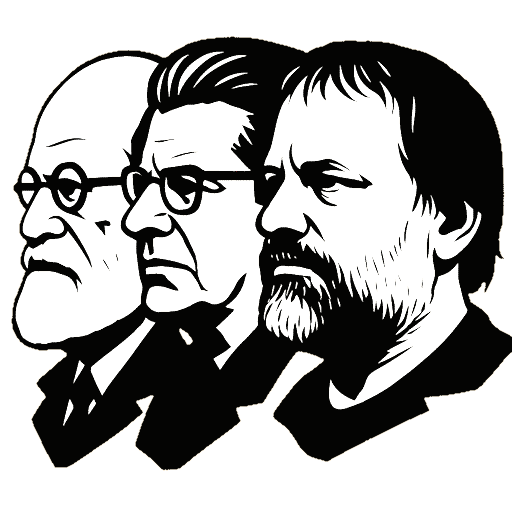
There are already many reports that turn this story into a chronicle of legislative technicalities. Here, the lens will be turned toward the strange triptych unfolding in the shadow of Slovenia’s most famous philosopher. In the debate around ZPPKŽ, three different Slavoj Žižek figures appeared onstage at once: the real Žižek in the campaign video supporting the law, addressing “the soul” of believers; the “AI Žižek” text, circulated on social media as the referendum approached and later revealed to have been written by artificial intelligence; and the third Žižek, who reacted to this fake text in the newspaper Dnevnik and declared that it was “definite proof that one must vote yes in the referendum” (🔗, 🔗). (Dnevnik) The legal and ethical debate on the right to assisted dying was thus drawn into a peculiar quarrel in which a philosopher confronts his own name and his own shadow.
The phrase in the title, “Final Solutionist Ad Robotem: One Has Not Truly Lived Anyway, If One Does Not Know How To Die For One’s Soul”, invites this story to be read on two levels. On one side, there is a final-solutionist governance logic that says, faced with unbearable suffering produced by gaps in the health system, shortcomings in care regimes and social loneliness, “since we can no longer resolve the suffering, let us remove from the stage, in a controlled way, the bodies that bear that suffering”. On the other side, there is the collapse of authority at the level of style, as artificial intelligence imitates a philosopher’s voice, gestures and examples to produce fake yet seemingly coherent texts. These two levels become entangled in Žižek’s campaign video, where he sets the soul against intelligence and calculation by saying “a human being is not merely an animal that calculates, but a spiritual being”, in the AI Žižek text that claims “the capitalist system is selling nihilism as ‘dignified death’, I am opposed to this law”, and in the Dnevnik statement that says “precisely because of this fakery one must vote yes in the referendum”. The problem is not only: On whose behalf, and by what criteria, can a decision for euthanasia be taken; it is also: What kind of authority can bear the ethical weight of that decision, and when that authority can be artificially simulated, is a terminal law still entrusted to human beings, or to ad robotem.
The background of the assisted-dying debate in Slovenia: two votes, one fragile law
In Slovenia, “assisted dying” had long been debated in medical ethics and human-rights circles, but with ZPPKŽ it acquired, for the first time, the form of a concrete law text. The draft was prepared in 2023 under the leadership of “Srebrna nit – združenje za dostojno starost” (Silver Thread – Association for Dignified Old Age) and presented to the public; the text published on the website of the association and the “Moje življenje, moja pravica” (My Life, My Right) initiative defined “the right to assistance in voluntarily ending one’s life” as a new right and insisted that it did not diminish any existing patient or citizen rights (🔗, 🔗). (Moje Življenje) The underlying logic was simple: to offer, under legal safeguards, a choice to adults who live with unbearable and irreversible illness, whose treatment options have been exhausted and whose consciousness is intact, as to when and how to end their life stories.
This principle was first put to the ballot on 9 June 2024. In the consultative referendum with four questions held on the same day, voters were asked, alongside issues such as medical cannabis and the electoral system, whether “a law regulating the right to voluntary termination of life with medical assistance” should be adopted. In the end, about 55 percent of those who voted expressed their will in favour of drafting such a law; as with the other three questions, “yes” votes were dominant (🔗). (Wikipedia) This vote was not legally binding, but it provided a strong basis of legitimacy for both the government and the drafters of the law.
Even so, the journey of ZPPKŽ through parliament was not smooth. In July 2025, the bill was adopted in the National Assembly with 50 votes in favour, 34 against and 3 abstentions; Slovenia thus approached the threshold of becoming the first Eastern European country to regulate assisted dying (🔗). (Reuters) The law opened with an introductory article stating that it regulated “the right to assistance in voluntarily ending one’s life, the manner in which this right is exercised, the rights and obligations of the parties and the safeguards introduced to prevent abuse” (🔗). (ds-rs.si) The text envisaged that terminally ill adults whose treatment options had been exhausted, who were mentally competent and whose capacity to decide for themselves had been medically and psychiatrically confirmed, could, after certain waiting periods, second opinions and ethics-committee approvals, end their lives by means of a drug to be self-administered. As some commentators emphasised, this model was closer to tightly regulated physician-assisted suicide than to direct active euthanasia carried out by doctors (🔗, 🔗). (Al Jazeera)
Nevertheless, criticism from both medical circles and disability organisations soon intensified. Warnings were raised that the law could create indirect pressure on vulnerable groups, that elderly and disabled people who had become an economic and emotional burden might be pushed to choose death under the feeling of being a “burden on society”, and that because of the vagueness of its scope it could be expanded over time. Analyses in the Slovenian ethics literature paid particular attention to the weakness of long-term care, palliative care and psychosocial support networks and voiced the criticism that the “care crisis we have failed to resolve” was being shifted, in the final stage, onto the shoulders of the individual (🔗). (Al Jazeera)
In this climate, right-wing activist Aleš Primc and his circle, long known for campaigns around family, children and the “culture of life”, began collecting signatures to demand a binding referendum against the law. The Catholic Church, some medical associations and conservative parties supported this initiative. After the necessary 40,000 signatures were collected, the National Assembly decided, on 17 October 2025, to hold a legislative referendum on ZPPKŽ, and the State Election Commission set the date of the vote for 23 November (🔗, 🔗). (Domov | Uradni list)
In order for the law to be overturned in the referendum, it was not enough simply to obtain an absolute majority; at least 20 percent of all registered voters also had to vote “no”. In the end, with the 53 percent “no” representing about 21 percent of the electorate, this threshold was exceeded as well (🔗). (Wikipedia) Thus, the first law concretising the “right to assisted death” that had been approved in principle in 2024 was suspended before it could be born. The same society that had endorsed an abstract “right” a year earlier rejected the concrete law text a year later, due to the risks it perceived and a loss of trust in the information environment. At precisely this fragile point of the debate, Slavoj Žižek’s name began to circulate in three different guises, and the issue became not only a matter of law, but also of representation, authority and artificial intelligence.
The first Žižek: the campaign video that sets the soul against intelligence and calculation
The “Moje življenje, moja pravica” campaign in favour of ZPPKŽ produced short videos with figures from different fields in order to present its ideas to the public. One of these figures was Slavoj Žižek, one of the world’s most widely known philosophers. In the campaign video shot with the team, Žižek did not begin his argument from technical legal justifications, medical protocols or human-rights conventions, but from the concept of “the soul”. In the speech reported by Dnevnik and shared on the campaign’s social media pages, he explicitly framed the debate as a matter of the soul (🔗, 🔗, 🔗). (Dnevnik)
Žižek begins by saying that “when someone suffers terrible pain, the issue is not only that they are in great pain or that everything seems meaningless; it is that they begin to disintegrate as a spiritual being in a living body”; he describes this disintegration as “terrifying from the point of view of spirituality” and states that he is addressing “especially believers”. He then rejects approaches that define the human as “a slightly more intelligent animal” or “an animal that only knows how to calculate”, insists that the human is a spiritual being, and says that being a spiritual being “means that there are things for which one is ready to sacrifice one’s life”. In this framework, he suggests that the subject under severe suffering will at some point “realise, in a blur, that they have a soul, but that this soul is dissolving, and be horrified by this”; he argues that “the only correct spiritual attitude”, with all safeguards in place, is to offer that person the possibility of a death through which they can preserve “their sense of dignity and inner freedom”.
This tone can be read as a channel opened toward conservative and religious voters who are not persuaded by secular language. Žižek speaks about the assisted-dying debate not through secular legal concepts such as “individual freedom”, “patient rights” or “autonomy”, but through the disintegration of the soul and the capacity to risk one’s life for one’s soul. In doing so, he reproduces a distinction often heard in contemporary public debates, between intelligence and calculative capacity on the one hand and the soul on the other. Intelligence, reason and calculation, on the one hand, appear as faculties increasingly delegated to modern technology, especially artificial intelligence; the soul, sacrifice, dignity and the “spiritual dimension” are positioned as the surplus value that sets the human apart from the machine. In this sense, one can read in the subtext of the video a clearly anti-AI motif: the human is not just a calculating system; what makes the human special is the capacity to sacrifice, including one’s own life, for something.
Yet the speech ties this emphasis on the soul to the experience of unbearable pain and disintegration at a point that tightens the knot. If someone’s soul is disintegrating in a living body and this disintegration threatens what belongs to human dignity, then, according to Žižek, it is a spiritual obligation to offer them the possibility of assisted dying. The internal logic here rests on the assumption that the subject “ready to sacrifice their life for their soul” may, for the sake of preventing the disintegration of the soul, demand their own death. But this assumption involves a subtle switch between risking one’s life for one’s soul and relinquishing life in order to protect the soul from pain and disintegration. In the first case, the subject risks their body for the meaning their soul has forged; in the second, they demand that the body be removed from the equation in order to stave off the collapse of the soul. The campaign video does not sharpen this distinction; it puts the soul on the field as the last refuge that saves the human from intelligence and calculation, and at the same time turns that very concept of the soul into the justification of a sterile, procedurally framed death.
Once this soul language is translated into the legislative register, it does not remain a purely emotional rhetoric; it is also rendered into medical and legal forms. Expressions in the ZPPKŽ text such as “unbearable suffering”, “irreversible illness” and “sense of loss of self-integrity” in practice function as the clinical-language version of the narrative of soul disintegration. In application forms, ethics-committee reports and psychiatric evaluation notes, the spiritual horror voiced in Žižek’s video is reduced to sentences such as “the patient’s quality of life has been irreversibly impaired”. The soul is thus exalted, at the very moment it is mobilised as a surplus that saves the human against intelligence and calculation, as the key concept that justifies a bureaucratically administered death procedure.
The second Žižek: the artificial-intelligence text deployed by the conservative “no” campaign
As the date of the referendum drew closer, not only official campaign messages but also semi-anonymous contents produced and circulated on social media multiplied rapidly in Slovenia. The most striking of these was the fake Žižek text generated by artificial intelligence, which Goran Vojnović criticised in his piece titled “AI Žižek” (🔗). (portalnovosti.com) This text was, in appearance, a long tirade opposing ZPPKŽ, but it did so in Slavoj Žižek’s familiar style, using his jokes and conceptual repertoire.
The fake text opens with verbal gestures typical of Žižek, such as “look, look, I will say something very clear now”, then goes on, using Freudian terminology, to argue that the law is a “symptom”, not a solution to the problem, but a way for society to accept its own powerlessness. It claims that the law produces a kind of cynicism that says “since you are in pain, at least you can die in a dignified way” instead of “we will make sure that no one suffers, no one is alone”; it likens this to the marketing logic of coffee chains that sell the feeling of “ethical consumption”. It argues that the capitalist system does not know what to do with elderly, sick, depressed, unproductive people and therefore offers, under the label “help to voluntarily end life”, a very gentle, very mild humanitarian mask. The sentence “a society that proclaims death a human right is a society that has raised the white flag in the face of life” stamps the assisted-dying law as a kind of normalisation of nihilism. Citing as examples that euthanasia is permitted for depression in Belgium and for poverty in Canada, it builds a slippery-slope narrative in which the boundaries are constantly expanding; with the emphasis “institutions do not operate on exceptional cases, but on routine”, it argues that any regulation that begins with extraordinary cases will soon become normalised. At the end of the paragraph, it binds the chain of analysis it has woven from the beginning into a clear “no” call by saying “for this reason, let me be honest, I am against this law; not because I am conservative, nor because I am an emotional person, but because I see in it the liberal-perverse cynicism of late capitalism”.
What makes this text interesting is not only that it resembles Žižek, but that it is deployed on the field as a tool of the conservative “no” campaign. Alenka Jeraj, one of the prominent figures of the Slovenian right and an MP for SDS, shared this text on her Facebook page with the caption “Slavoj Žižek (GPG version) on the Law on Executions”; this caption both made an ironic allusion to the fact that the text was produced by artificial intelligence and established a harsh frame such as “Žižek on the execution law” (🔗, 🔗). (Facebook) Looking at the slogans and materials of the conservative coalition that triggered the referendum against ZPPKŽ, in addition to phrases such as “choose life, vote NO”, it is evident that this fake Žižek text generated real excitement in certain segments (🔗). (Sarajevo Times)
What is paradoxical here is this: the conservative circles that requested the referendum and argued that the law violated respect for human life used a copy of the very philosopher who supported the law, generated by artificial intelligence, in order to strengthen their arguments. Their confidence in their own campaigns, the persuasive power of their own discourse, was not enough; they preferred to borrow the authority of a figure from the “enemy camp” – and moreover, a fake authority. For this, they no longer needed a person’s real signature, a television appearance or books; an artificial intelligence text that imitates the package of name, face and style was deemed sufficient to say “look, the ideologue of the left is also against this law.” Even though the AI Žižek text is, in terms of its content, extremely close to the real Žižek’s critique of capitalism, its tying that critique to a completely opposite normative conclusion – categorical opposition to the assisted dying law – exposes the strange gap between fakery and coherence.
This gap at the same time offers a clue as to how authority functions in contemporary political communication. What matters now is no longer the words uttered by a particular person while personally taking risks, but the attachment of that person’s name, face and vocabulary to a discourse. The signature is replaced by “stylistic fit.” The existence of AI Žižek can be read as a striking example of how authority breaks away from material foundations – body, biography, political risk – and turns into a pure style package. It is precisely at this point that the third move came into play: the real Žižek responded to his own artificial shadow through Dnevnik and declared this forgery as proof that one should vote “yes” to the law.
Third move: the response to the fake statement through Dnevnik and the logic of “fake news as proof for yes”
On 21 November 2025, two days before the referendum, the newspaper Dnevnik directly put the fake text on stage with an article titled “Slavoj Žižek ponaredek svojim izjavam: ‘To je znamenje, kako nizko smo padli'” (🔗). (Dnevnik) In the article, Žižek explicitly stated that the AI Žižek text did not belong to him, described it as “an extremely crude forgery,” “completely fabricated,” and said that he would normally not even react to such a thing, but that he had to speak because it was increasingly spreading “as if it were my own statement.” His truly sharp sentence, however, was the assessment highlighted in the article’s headline: “I am now beyond anger. This is a sign of how low we have sunk.” He stated that most of those who shared the fake statement on social media were knowingly and willingly spreading lies, that this was being done by people who talked about “human dignity” in their everyday lives, and that they calculated that the chaos of these few days would cause enough harm. And immediately afterwards he uttered the following sentence: “For me, this is at the same time conclusive proof that one should vote yes in the referendum.”
When the logical chain of this sentence is carefully unpacked, it silently displaces the center of the debate. First, Žižek offers a diagnosis of the moral position of those who disseminate the fake text: deliberate fraud, moral degradation, knowingly spreading lies. Then he says that this is an indication of how much Slovenia’s information regime and culture of public debate have been corrupted. In the final step, he turns this corruption into a reason to support ZPPKŽ in the referendum. In other words, the argument in favor of the law is no longer the unbearable suffering of the terminally ill individual, the subject’s dignity or the dissolution of their soul, but rather the low ethical level of the opposing campaign and the pollution of the information environment.
This move blurs two levels in the euthanasia debate. The first level consists of the life and death experiences of those who will be directly affected by the law – terminally ill patients, disabled people, the elderly – the institutional capacity of the health system, the fragility of care relationships. The second level is the culture war waged through fake news, manipulation and social media. In his Dnevnik statement, Žižek pushes the soul argument of the first video into the background and brings the anger on the second level to the fore; he turns support for the assisted dying law into a “political reflex against fake news” rather than an ethical stance aimed at the well-being of the subject in terminal agony. The logic “they have sunk this low, therefore out of spite one must vote yes” reduces an ethical choice to a reaction to the moral position of the opponent.
The same sentence can also be read in reverse. If the information regime is this rotten, if fake statements can spread this easily, if people’s names and styles can be imitated this comfortably, then this situation can be considered not as a justification for legally expanding irreversible death decisions, but on the contrary as a warning for greater caution. In his Dnevnik statement, Žižek does not engage with the critique of capitalism and nihilism contained in the AI Žižek text; he cancels the text on the basis of its source, saying “this is not mine,” thus making a kind of ad robotem move, and treats this forgery as epistemic evidence for “yes.” Yet the conceptual framework used by the fake text – capitalism not knowing what to do with old and unproductive bodies, the death option packaged with humanitarian masks, cynicism that delegates structural suffering to individual decisions – are issues that need to be discussed in real life as well.
At this point, the tension between the three Žižek figures becomes more visible. In the campaign video, there is a Žižek who puts the soul on the field as a surplus that exalts the human being against intelligence and calculation and who makes the dissolution of that soul the justification for assisted dying. In the AI Žižek text, the same philosophical repertoire is used this time to brand the assisted dying law as a liberal-perverse symptom of capitalist nihilism. In the Dnevnik statement, the real Žižek rejects his fake twin on the basis of its source and turns its very existence into proof for “yes” in the referendum. Seen this way, the euthanasia referendum in Slovenia appears not only as a vote on a legal text, but also as a branching moment regarding where the justification for the decision about death will be sought: in the soul, in politics, in the information regime, or in a “final solution” type of governance logic. Moreover, this branching takes place right in the middle of an era when artificial intelligence can simulate authority at the level of style.
The “my soul is falling apart, kill me” scene: the paradox of decision-making capacity
The scene described in Žižek’s campaign video constructs a fictional patient figure that presses exactly on the raw nerve of the euthanasia debate: the person who “as a spiritual being, begins to disintegrate inside a living body” realizes the dissolution of their soul in unbearable torment and says that they want to die in order to preserve their “spiritual dignity.” In this sentence, there are two claims at the same time. The first is a phenomenological claim: “My soul is falling apart.” The second is a normative claim: “Therefore I must die; I demand this.” The first claim points to a threshold where the integrity of the self is destroyed, identity disintegrates, and the subject can no longer easily think of themselves as a “self.” The second claim is the expression of a heavy and irreversible decision made precisely at this moment of dissolution.
Modern medicine and law bring in the concept of “decision-making capacity” at the junction of these two claims. If a terminally ill person is in deep depression or delirium, if their cognitive capacity is impaired, if their ability to weigh their long-term interests has been damaged, then questions arise as to whether the decision is “free and informed.” Most euthanasia and assisted dying laws foresee medical and psychiatric assessment, waiting periods, second opinions and ethics committee reports to secure this point. The Slovenian draft tried to build a similar architecture; as can be seen in the first texts analyzed by Brčič, it is apparent that, among many exceptions and layers of assessment, “the subject’s decision-making capacity” still remains the ultimate reference point.(Journals)
However, the image of “the soul’s disintegration” that Žižek himself constructs short-circuits this capacity at a metaphysical level. If the soul really has disintegrated, that is, if the subject can no longer experience themselves as a whole, if the bonds that keep identity upright are unraveling, if the horizon of meaning is falling apart, then how can this person rationally and autonomously pass judgment on the ending of their own life? In that case, even if the medical report says “has decision-making capacity,” the metaphor itself cancels this report from within. By contrast, if the “my soul is falling apart” rhetoric is an exaggeration, a metaphorical cry, if the subject’s sense of self is not in fact breaking down so dramatically, but unbearable pain and loneliness simply make the subjective experience feel this way, then the justification for the death request is weakened; without evaluating potential care opportunities, pain control, psychosocial support, community and solidarity forms available to the patient, an irreversible decision is made on the basis of a metaphysical diagnosis.
This dual structure recalls familiar paradoxes: if the person who says “all Cretans are liars” is also a Cretan, they undermine their own statement; if the subject says “I am lying,” then if what they say is true they are not lying, and if they are lying they have told the truth. In the euthanasia context, the sentence “my soul is falling apart, therefore I must die” targets both the epistemic basis of the decision and the capacity of the subject making the decision at the same time. This short circuit is usually rendered invisible in practice through medical forms and tick-boxes: the cry related to the soul is translated into clinical terminology with phrases such as “unbearable suffering,” “no hope of recovery,” “feeling of loss of self-integrity.”
Debates in other countries show how deep this paradox runs. Studies examining the legalization of child euthanasia in Belgium reveal that people assess the decision not only for ideological reasons, but also in light of emotional, cognitive and religious factors; the question of what the child “really understands” and how the experience of pain affects cognitive capacity emerges as a key point of tension.(PMC) For adults, the measurement of “decision-making capacity,” which is already difficult, turns into limit cases that strain law and ethics when it comes to the point at which the child’s soul and consciousness can be considered sufficiently whole to “request death on their own behalf.” In the Slovenian draft debates as well, especially disabled people’s organizations and psychiatrists emphasize that when chronic mental disorders, dementia and developmental differences are in question, these assessments cannot be tied to any objective criterion and that therefore the risk of abuse is structural.(Journals)
For this reason, the sentence “my soul is falling apart” makes visible a crack at the heart of the discourse that advocates assisted dying but does not want to articulate it much. The subject is simultaneously exalted as a “spiritual being” and expected to make the gravest decision precisely at the moment when their soul is falling apart. The law delegates this contradiction to procedure; but the procedure itself says nothing about the subject’s metaphysical status. In this sense, Žižek’s discourse on the soul functions as a short circuit that both legitimizes the law and quietly sabotages it.
From ad hominem to ad robotem: attack on fake authority, disintegration of real authority
In classical logic, the fallacy called ad hominem refers to dealing not with the content of an argument but with the character, intent or past of the person who utters it. The AI Žižek case that appeared in the campaign in Slovenia evokes the new form this formula has taken in the digital age, ad robotem: attacking the artificial figure uttering the argument rather than the argument itself. The AI Žižek text quite ably imitates Žižek’s style, critique of capitalism, Lacanian jargon, “Starbucks morality” metaphors, references to McDonald’s and wellness, and the diagnosis that “the system is marketing nihilism as dignified death”; and it ended by connecting all this to a fatal conclusion: “therefore I oppose this law, and I am doing this not because I am conservative or emotional, but because I see the liberal-perverse cynicism of late capitalism in it.”(portalnovosti.com)
Those who disseminated this text were the actors of the conservative “no” campaign. On the one hand, religious-conservative initiatives that organized the signature drive that led to the referendum and, on the other, center-right parties like New Slovenia, circulated the text with their own slogans under the label “Slavoj Žižek (GPG version) on the Execution Act”; the text became a propaganda tool that presented the systemic critique Žižek had been carrying out for years as if it naturally led to right-wing populist conclusions.(portalnovosti.com)
Žižek’s response in Dnevnik constitutes a typical example of the ad robotem gesture. He described the text as “a very crude forgery,” “completely fabricated,” called it an example of consciously spreading lies, of “those who talk about human dignity willingly committing fraud,” and uttered his striking sentence: “For me, this is at the same time conclusive proof that one should vote yes in the referendum.”(Journals) Here, without entering into the content of the fake text, he points only to the forgery of its source and performs a kind of epistemic inversion: “If they need such base lies, it means the law is right.”
At first glance, this gesture looks like an understandable outburst of anger. However, the shadow of the ad robotem logic is immediately felt. The AI Žižek text in fact makes use of Žižek’s forty-year thought repertoire, his reading of Lacan, his analysis of the culture industry, his diagnosis of late capitalism; it simply fits this repertoire into a frame that linearly ties it to a conservative conclusion. That is, the problematic side of the fake text is not the authenticity of the style but the ideological direction of the chain of inferences. Nevertheless, Žižek chooses to deal not with the content but with the “non-mine simulacrum.” What the robot says, and how accurate it might be, is not decisive; what matters is who produced the robot and for what purpose.
At this point it is necessary to see that the real Žižek is simultaneously carrying out ad hominem from two directions. On the one hand, he brands those who produce and disseminate the fake text as “deliberate liars,” “debased types”; on the other, he takes this tendency to lie as the justification for voting “yes” in the referendum. In this way, he derives his argument in favor of the law not from the well-being of terminally ill patients but from the character of the opposing side. He leans on a line of reasoning that is empty in terms of content: “Because they are this bad, the law must be good.”
The irony of the ad robotem gesture opens up precisely here. If the authority of a philosopher has now turned into a package that can be simulated at the level of style, gestures and rhythm of jokes, then the difference between AI Žižek and the real Žižek is limited only to having the right to one’s own name. At the level of content, both texts use the same references, share the same critique of capitalism, and simply arrive at different political conclusions. In this situation, “appeal to authority” itself loses its meaning, because authority is no longer a sum of body, biography and risk, but a discursive package that can be copied.
This erosion directly affects the heart of the euthanasia debate. Laws like ZPPKŽ rely on medical experts, ethics committees and evaluation boards in order to lighten the weight of the decision. The authority of these institutions is protected by discourses such as “scientific knowledge,” “professional ethics” and “impartial assessment.” Yet when the language of the doctor on one side and the philosopher’s style on the other can be simulated, the argument “because the expert said so” is also weakened. The sentence of the expert is now taken into account not because of its content but because of which institutional procedure it belongs to and which signature block accompanies it. Authority collapses at the level of style; only PDFs bearing signatures remain.
In this sense, ad robotem, while it appears to be an attack on artificial intelligence, is in fact a gesture that also undermines human authority. The moment one says “this is fake, therefore worthless,” the question “under what conditions was that forgery possible, and on what ground is our authority established” is skipped. Žižek’s merely scolding his fake version overlooks the fact that his real version is ultimately subject to the same regime of simulation; the only differences are copyright and legal responsibility.
“Ethical suicide service for five dollars”: from cinephile playdead to state-supported death logistics
The scene in Žižek’s 2005 documentary can today be read in an eerie resonance with the assisted dying debate in Slovenia. Standing at the top of a high staircase, he points to the ground below; he recounts that he came there a few times, that sometimes the police cordoned off the area with tape, that he saw a body covered with a sheet on the ground. He tells the camera “it’s easy to climb up and throw yourself down”; then he turns this into a cinematic fantasy: “A nice, modest, ethical suicide. Without showing off in the street, without disturbing people, without traumatizing children… We arrange the whole thing. We prevent unpleasant coincidences. We charge five dollars. We don’t let the children in.”(eScholarship)
At that time, this scene was read as a mise-en-scène constructed to analyze cinema’s distanced gaze on death and the way in which the viewer, by “playing dumb,” turns death scenes into safe pleasure. Drawing inspiration from Foucault, Žižek imagines a medical-psychiatric board that asks potential suicide candidates, in a manner reminiscent of the health questions asked before marriage, to distinguish between “metaphysical suicide” and “temporary crisis.” He says “maybe you just broke up with your lover, it will pass in two or three weeks; maybe you are indeed in a metaphysical turmoil; then one must act differently.” Here suicide is part of the game between cinema and philosophy: the theorist turns his own body into a figure that plays dead; the viewer rehearses facing death but within the safe boundaries of the big screen.(eScholarship)
Seen from today, it is striking how closely this cinematic fantasy overlaps with the procedural logic of ZPPKŽ. As can be seen in Brčič’s analysis, the Slovenian draft is built on a series of “safeguards”: waiting periods, opinions from multiple doctors and experts, psychiatric assessment, ethics committee approval, a request repeated within a certain time frame, extra checks against abuse.(Journals) On paper, the aim is to prevent unpleasant coincidences: the prevention of death requests made in moments of sudden anger, suicide decisions taken under others’ pressure, and the conversion of temporary crises into “permanent solutions.” The clinical setting is designed to guarantee privacy and a “dignified death”; children and third parties are placed outside this choreography of death.
The similarity between Žižek’s fantasy of an “ethical suicide service for five dollars” and ZPPKŽ’s procedures emerges precisely at this logistical level. In both cases, death is removed from the spontaneous and messy and turned into a scheduled, controlled event. Unpleasant coincidences – suicides that take place in the street, at home, in public spaces, in front of others, producing trauma and scandal – are transported into a sterile frame. Here what is ethical is not death itself but the way death is staged: that no one is disturbed, that no one “sees,” that death becomes a kind of technical service.
There is continuity, in terms of how humans cope with the fact of death, between cinema’s “playing dead” and euthanasia’s “ethical suicide service.” While watching a film, the fact that the actors do not really die is used to create the possibility of taking pleasure in death scenes by feigning ignorance. In assisted dying, the reality of death is not erased altogether; but its traumatic, uncontrolled dimensions that draw others into it are blunted. Death is tied to a predictable date and hour and dissolved into a chain of procedures. In this way it becomes manageable, both for relatives and for institutions.
From this angle, a linear continuity can be seen between Žižek’s cinephile gesture in 2005 and the support he gave in 2025 for ZPPKŽ. In the first case, a theorist who plays with death positions his own body in the frame like a dead body and offers the spectator a cinematic model that says “you will look, but you will not be affected.” In the second, he provides theoretical ground for the state apparatus that regulates death and endorses the technicalisation of death in the name of “protecting spiritual dignity.” In both, death is reduced to a manageable gesture of termination that skips over structural suffering, political conflicts, class inequalities, and gaps in care regimes. Playing dead here becomes not only a cinematic game but a principle of political management.
Final solutionism: eliminating not the conditions of suffering but its bearer
The expression “nihai çözümcülük” (Endlösung, final solutionism) is a concept so loaded that it cannot be used without evoking the darkest pages of history; but precisely for that reason it has to be carefully rethought in order to describe today’s more “reasonable” appearing eutaNAZI regulatory techniques. What is meant here is the logic of managing structural problems that cannot be solved, or are not meant to be solved, by eliminating the bodies that bear those problems. Debates on assisted dying have become one of the liveliest laboratories of this logic.
In the Slovenian case, the ground of this laboratory is formed by chronic deficiencies in the health system, care for the elderly and disabled remaining as a burden within the family, difficulties in accessing medical services in rural areas and small towns, the rise of loneliness and isolation, and the gendered and class-based division of care work. Public opinion research shows that people’s attitudes toward medically assisted dying are directly related not only to an abstract understanding of “rights” but also to their trust in the health system, their trust in state institutions, and their expectations for the future; as trust increases, support for euthanasia can also increase. (Živ? Živ!) This data, even in its bare form, reveals the paradox of final solutionism: those who are aware of the system’s failures are less willing to entrust the decision over death to that system’s procedures.
In his article that examines the Slovenian voluntary assisted dying draft in detail, Brčič stresses that the first version was in fact not limited only to terminally ill people; he emphasizes that through categories such as chronic illness, disability and “intolerable” but medically not fully defined suffering, it risked covering a much broader population. (Journals) Even though later revisions tried to narrow this scope, the shadow of these initial texts lies behind the widespread public concern that “pressure on the elderly and disabled will increase.” The conservative “no” campaign translated this concern into the slogan “choose life, say NO,” but most of the time offered no concrete proposals regarding real care policies; it was content to erect a moral barrier against the technicalisation of death. (teof.uni-lj.si)
On the “yes” side, one of the arguments often used is this: “We are not saying we must close every gap in the system, but at least when people are in unbearable pain we should offer them a way out.” Taken in its plain form, this sentence looks like a humane gesture of compassion. But read the other way round, it is a declaration of resignation in the face of structural suffering: loneliness, lack of care, economic precariousness, and the malfunctioning of the health system are accepted as unmanageable; the only remaining domain is to close the file of the subject who finds it hard to continue living under these conditions, under the heading of “dignified death.”
Final solutionism appears precisely at this point. Instead of transforming the conditions that produce suffering, the reflex of eliminating the bearer of suffering in legal and technical terms leads to death being thought of as a kind of “social policy instrument.” In documents and legal texts this is of course never stated so bluntly; the language used is polished with concepts such as spiritual dignity, freedom of choice, the right to be freed from suffering, and medical autonomy. But in everyday practice the picture that emerges is one in which the most vulnerable – the elderly, the disabled, those with mental disorders, chronically ill people living alone – are confronted with the option of death.
Experiences in other countries show how this logic expands. Comparative studies of euthanasia and assisted dying reveal that a door initially opened only for terminal physical illnesses, over time widens toward areas such as chronic mental illnesses, advanced dementia, and multiple geriatric syndromes; they show that this expansion is debated at once in the language of both “freedom” and “risk.” (PMC) The initial form of the Slovenian draft, in line with this global trend, had a structure that opened the way to possible future expansions.
Final solutionism therefore refers not only to a particular legal text but to a more general outlook: “We cannot change this much life; let us at least properly organise death.” The sentence from AI Žižek that says “because capitalism cannot offer young people a life, it markets nihilism under the label of dignified death,” although fake, strikes an uncomfortably accurate note exactly here; the problem does not lie in the legitimacy of people’s desire to be freed from pain, but in the political economy within which this desire emerges, in the absence of care regimes, and in the conditions of social loneliness under which it takes shape.
“One can hardly be said to have really lived if one does not know how to die for one’s soul”: two regimes of death and the tension with Žižek’s own thought
The harsh phrase in the title of the article is neither a spontaneous insult nor a romantic eulogy of heroism; it should be thought of as a theoretical provocation pointing to the difference between two regimes of death. When one looks at one of Žižek’s own texts, the essay titled “Three Fragments on Suicide as a Political Factor,” one sees that suicide is conceived there sometimes as a radical political gesture and sometimes as a nihilistic expression of incompatibility with the system. (Crisis and Critique) In this text, what matters is whether the death of the self-sacrificing subject produces a meaning that not only ends their own suffering but also wounds the legitimacy of the existing order.
From this perspective, the first regime of death can be seen as an ending that retroactively crystallises the meaning the subject has built throughout life, the risks they have taken, the struggles they have engaged in, their acts of resistance and commitments. Hunger strikes, death fasts, self-immolation, protests that turn the body into a hostage of a political demand are examples of this regime. In these practices the person does not simply “want to escape suffering”; they thrust their death into others’ faces, occupy public space, and lay bare the complicity of the existing order. In this sense, “knowing how to die for one’s soul” means risking the body for the trace the soul will leave in the world and turning death into the most extreme form of bargaining with the system.
The second regime of death is the one into which the structure of final solutionism is also absorbed: the form in which death is turned into a technical event managed by the system, sterile, modest, non-disturbing and, if possible, rendered invisible. In assisted dying protocols, death is wrapped in the language of “personal choice”; it is withdrawn from the public sphere into the clinic room; it becomes procedure rather than act. Here the soul continues to speak, but now not to change the world, but to justify withdrawal from it. The sentence “my soul is falling apart, I want to die in order to protect my dignity” is the typical formula of this second regime; it means: “you cannot change the conditions of my suffering, so at least remove me from these conditions in due form.”
Žižek’s sentence “to be a spiritual being means that there are things for which I am ready to sacrifice my life” belongs, at the level of theory, to the first regime. The soul here represents the risk taken for an idea, a cause, an other, a future that exceeds the self and goes beyond its naked interest. But in the way it is used in the pro-ZPPKŽ campaign video, the soul shifts to the second regime: there is no longer a subject who risks life for the soul, but one who asks for death in order to flee the torment of the soul’s disintegration. And this death, moreover, does not shake the system or disturb others; it is a procedurally bound, “dignified,” “clean,” logistically planned termination.
The expression “yaşamış sayılmaz zaten ruhu için ölmesini bilmeyen” (“one can hardly be said to have really lived if one does not know how to die for one’s soul”) can be read as an objection to this inversion. The “knowing how to die” here is not about glorifying the romanticism of death fasts, but about reminding that even when one speaks in the language of the soul, death cannot be configured merely as an instrument of escape and relief; if one is going to talk about some surplus called soul, it will only have a real counterpart in the risks taken while living and in the bonds established with others. To die for the soul is not a purely metaphysical choice but a concrete political and ethical position; when it is conflated with flight from suffering, the discourse of the soul is emptied out entirely.
The sentence in AI Žižek’s text, “because capitalism cannot offer young people a life, it markets nihilism under the label of dignified death,” although it does not overlap one-to-one with Žižek’s real arguments, crudely but accurately grasps the tension between these two regimes. (portalnovosti.com) When the system cannot offer the young and the fragile a meaningful future, a stable life, networks of solidarity, possibilities of collective struggle, it can conceal its own failure under the guise of personal choice by sticking the label of “dignity” onto their demand for death. In such a situation, talking about whether the soul is disintegrating or not, debating who it is “ethical” to kill in order to protect the soul, postpones the real question – the question of why so many people feel so alone and uncared for that they feel their soul is disintegrating.
The tension with Žižek’s own intellectual legacy arises from here. When the theorist who in one text reads suicide as a radical political gesture, in another context appears as the face of a campaign that turns the same movement of death into the object of a state-supported technical service, he splits his right to speak in the name of the soul within himself. Rhetoric masks theory; the soul is translated into procedure; death becomes a regulatory tool directed not at the living but at files.
Conclusion: the collapse of authority in the ad robotem era and the postponement of the decision over death
All of this shows the three layers of the final solutionist ad robotem era at once. In the first layer lies the decay of the information regime. The AI Žižek incident is not just an unfortunate event that befell a philosopher who speaks Slovene; it is a flare signalling a period in which AI tools can produce stylistically, tonally and argumentatively highly convincing simulations, and in which propaganda campaigns that “rent” the voice of public figures are easy to mount. As is also emphasised in the report on Portal Novosti, for those who circulated the fake text, what mattered was not whether it was real, but that they could create an image of a “left ideologue” who supported their position. (portalnovosti.com)
In the second layer lies the dissolution of authority at the level of style. In his response to Dnevnik, where Žižek describes the fake text as “a sign of how low we have sunk” and at the same time presents it as “proof that one must vote yes,” it becomes clear that the authority figure is now defined not by the content of his arguments but by whom he is angry with and whom he disparages. The same repertoire of thought is capable of producing texts that both defend euthanasia and categorically oppose it; what makes the difference is the signatory. In this situation, “appeal to authority” has no content left; ad robotem and ad hominem circulate simultaneously.
In the third layer stands the technicalisation of death itself. Assisted dying laws, ethics committees, medical reports, videos decorated with the language of the soul, cinephile plays of feigned death – when all are taken together, death is presented as a reasonable and orderly “solution” to the structural hardships of life. As studies that summarise the historical evolution of euthanasia and assisted dying in the global literature also show, this trend towards technicalisation is not unique to Slovenia; from the Netherlands to Belgium, from Canada to Spain, different legal systems are developing similar reflexes aimed not at changing the conditions of suffering but at eliminating the bearer of suffering in a controlled manner. (PMC)
At the intersection of these three layers, the moral impossibility of the death decision becomes apparent. In an environment where the information regime is so open to manipulation, where authority figures can be so easily simulated, and where the same conceptual set can be used for opposing purposes, to present irreversible decisions over death as if they were “evidence-based” procedures contains serious epistemic hubris. Expert reports, evaluations of the soul, competence forms, terminal diagnoses, cost calculations, and debates over care burden, even when all are brought together, do not resolve the paradox contained in the sentence “my soul is falling apart, kill me”; they merely push it into a footnote in the file.
At this point it is clear that Žižek’s move “fake news is proof that one must vote yes” has to be inverted. If the information environment really is this rotten, if fake texts, deepfake videos, and simulations of authority can poison politics so easily, then this should be an argument not for speeding up euthanasia laws but for re-politicising all mechanisms that regulate life and death. The allure of final solutionism comes precisely from its promise to end the argument; by presenting the decision over death as the technical closing of a file, it relieves us of the burden of debating the conditions under which suffering is produced.
In the ad robotem era, perhaps the only reasonable ethical reflex is to postpone the decision over death as much as possible. This postponement does not mean ignoring the suffering of terminally ill patients; on the contrary, it means pushing to the limit all possible interventions into life, from pain control to palliative care, from social support to economic security. In a period when AI simulations squeeze authority onto the thin line between fake and real, and when the cinephile aesthetics of playing dead for the pleasure of “playing dumb” in front of the screen normalises a flirtation with death at a distance, it is clear that the discourse of the soul can only gain meaning together with such a radical orientation towards life. To know how to die for one’s soul is not to break the soul’s bond with the world, but, on the contrary, to be willing to confront the final solutionist mechanisms that attempt to sever that bond.


[…] (İngilizcesi, AI Žižek) […]
LikeLike
[…] — Nihai Çözümcü Ad Robotem: Yaşamış Sayılmaz Zaten, Ruhu İçin Ölmesini Bilmeyen / Final Solutionist Ad Robotem: One Has Not Truly Lived Anyway, If One Does Not Know How To Die For On… […]
LikeLike
[…] tek tek ölümler değil, ölümün bir çözüm teknolojisi haline gelmesi olduğunu söylüyor (🔗) (🔗). (Žižekian […]
LikeLike
[…] is not individual deaths one by one, but the transformation of death into a technology of solution (🔗) (🔗). […]
LikeLike