
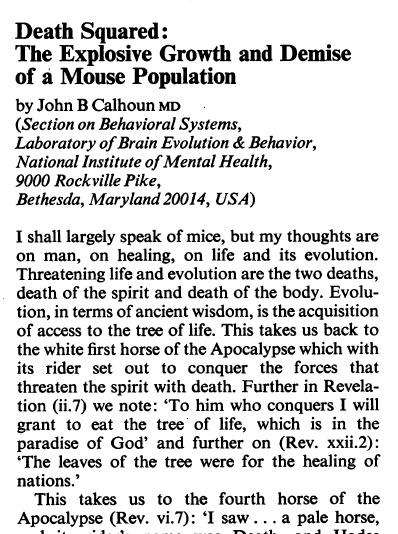
John B. Calhoun was an ethologist who experimented with rodent societies. His prominent work tells what happened in the great mouse colony that he called Universe 25 [1]. Given how his paper compares mice to men and quotes Bible verses, Calhoun seems to have been playing God in orchestrating these rodent colonies.
Here’s a summary of the result of the Universe 25 experiment: When (1) the young mice were unable to leave the territory and (2) there were no external causes that would kill the old mice, eventually (1) the society ran out of available positions (not spatial but combinatorial positions [2]), (2) the young mice became unable to socialize, (3) this situation caused great conflicts and a lot of mouse fights; and finally the society collapsed entirely, resulting in a final generation of (1) non-reproducing females and (2) asocial males that Calhoun called the “beautiful ones” all of which were both incapable of and had given up on the survival of their species.
What caused the collapse of this mouse society was clearly a generalized crisis of authorization (Calhoun calls this “behavioral sink”) [3]. Unable to replace the older generation or go someplace else, the young mice were defeated in their murine Oedipal drama (if such a notion is allowed) and they were forced to withdraw from the mouse society. The final male generation of “beautiful ones” were “largely confined to eating, drinking, sleeping and grooming, none of which carried any social implications”. These final members gave up on getting social authorization and limited themselves to a murine “care of the self” that only concerned their own bodies.
A mouse can obtain a minimal form of social authorization when other mice recognize it as an individual (mainly through “movements and body posture” according to Calhoun). Of course, the mouse individual cannot get recognized as a father or an author by neighbors, as would be in a human society. But it can still get recognized (1) as being in charge of a territory, or (2) as being someone who gets beaten by the others, etc.
These mice cannot write letters and conceive ideas like we humans do, but they can mate and “conceive” baby mice, in other words, litter. This recalls the Lacanian/Joycean wordplay letter/litter: The human way of symbolization is to address the human history by writing letters. The murine way of symbolization is to address the murine history by making baby mice, by “writing” litters.
If we can attribute these mice a limited form of will that may ground their minimal form of authorization, we can say that the murine Oedipal crisis of authorization (behavioral sink) resulted in a general loss of the murine will to propagate their species. Even when members of the final generation were carried to another environment with convenient conditions, they had absolutely no interest in mating or socializing.
In a way, these “beautiful ones” no longer had anything to “say”. They stopped “writing” litters/letters addressed to the murine history. Perhaps they themselves were the final litter/letter of Universe 25, as they managed to make it into Calhoun’s famous paper.
(Turkish)
Işık Barış Fidaner is a computer scientist with a PhD from Boğaziçi University, İstanbul. Admin of Yersiz Şeyler, Editor of Žižekian Analysis, Curator of Görce Writings. Twitter: @BarisFidaner
Notes:
[1] Calhoun, John B. (1973). “Death Squared: The Explosive Growth and Demise of a Mouse Population”. Proc. R. Soc. Med. 66 (1 Pt 2): 80–88.
[2] See “Spatial and Combinatorial”
[3] See “‘Crisis of Masculinity’ is a Manifestation of the General Crisis of Authorization”, “Rodents and the entanglement of authorization and embodiment”
 Žižekian Analysis
[…] — Calhoun and the Murine Oedipal Crisis of Authorization […]
LikeLike
[…] — Calhoun and the Murine Oedipal Crisis of Authorization […]
LikeLike
[…] of Masculinity’ is a Manifestation of the General Crisis of Authorization”, “Calhoun and the Murine Oedipal Crisis of Authorization”, “The Crisis of Authorization in Dark”, “Life, Philosophy, […]
LikeLike
[…] (İngilizcesi) […]
LikeLike
[…] Fidaner, I. B. (2021). Calhoun and the Murine Oedipal Crisis of Authorization. Žižekian Analysis. Erişim tarihi: 9 Ekim 2021. https://zizekanalysis.wordpress.com/2021/10/09/calhoun-and-the-murine-oedipal-crisis-of-authorizatio… […]
LikeLike
[…] 2) Calhoun and the Murine Oedipal Crisis of Authorization […]
LikeLike
[…] See “Calhoun and the Murine Oedipal Crisis of Authorization” […]
LikeLike
[…] Fidaner, I. B. (2021, Ekim 9). Calhoun and the Murine Oedipal Crisis of Authorization. Žižekian Analysis. https://zizekanalysis.wordpress.com/2021/10/09/calhoun-and-the-murine-oedipal-crisis-of-authorizatio… […]
LikeLike