When we witness the staging of an act and undergo its poetic effect, either in the theater or in the “real world”, our experience flows through multiple levels that go beyond the usual range of our conscious awareness. We can detect the effect on the deeper (unconscious) levels through the emergence of emotions that warrant explanation.
An “ordinary” or “normal” person will explain the emergence of emotions by appealing to commonsense: If the staging of the act causes good sensations and makes him/her happy, then it must be a good act. If the staging of the act causes bad sensations and makes him/her upset, then it must be faulty or flawed in some way. This negative judgement comes from the superego-in-power that is in charge of keeping “ordinary” or “normal” reality intact.
The so-called “extraordinary” or “original” person, on the other hand, may explain the emergence of emotions by appealing to uncommonsense: The more humorous and/or anxiety provoking the staging is, the more truthful it is. This combined truth effect is often called “tragicomic” or “ironic” but it goes deeper.
Notice that the labels “extraordinary” and “original” do not actually point to anything other than the fear and uncanniness experienced by the “ordinary” and “normal” person in the face of someone who dares to deviate from the commonsensical reality. These labels are euphemisms for abnormality, mild stigmatizations by the superego-in-power to incur a cost on you for deviating from the commonsense.
By remaining in the dark, the feared and uncanny “extraordinary” element evokes the mystery of a beyond, like the signs on ancient maps that say “Here be dragons”. This mysterious evocation challenges the ordinary superego-in-power and drives it to “Enlighten” what’s actually there. Uncommonsense thereby provides Enlightenment with a horizon of truth.
Commonsense is the screen that veils the horizon of uncommonsense. The screen is imaginary and the horizon is real. But one cannot simply unveil the imaginary screen and reveal the real horizon, because these two are mediated by the symbolic order embodied by the book, the letter or the page. These three levels of staging truth are shown on the following figure:
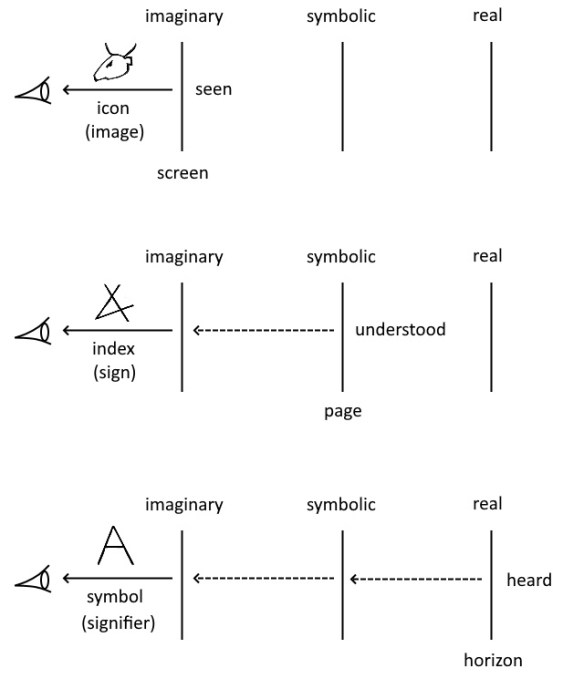
The commonsensical “ordinary” awareness is limited to (1) seeing the images on the screen and (2) understanding the words on the page. It oscillates between icons and indices: What cannot be seen is always indexed (by labels, by ranks, by categories, by concepts, etc.) and what cannot be understood is always iconized (by love, by hatred, by religion, by art, etc.).
This awareness belongs to the Enlightenment that fluctuates between the Library and the Church. It acknowledges that (1) what is invisible can still be understood through a system of indices and (2) what remains opaque to the understanding can still be iconized and hoped (and/or dreaded) to be discovered in the future.
In fact, the Enlightenment is unconsciously driven by the real horizon whose essence is articulated as follows:
The fact of saying remains forgotten behind what is said in what is heard.
(Jacques Lacan, L’Étourdit)
This maxim is translated as follows: The fact of “Enlightening” remains forgotten behind the Library and the Church in what is heard by those who become the victims of these institutions. This is how Eurocentrism becomes the great issue [1]: The indices and the icons of the European efforts to “see and understand the other” run amok when Europe becomes tone-deaf to (unable to hear) what its position of enunciation symbolizes for “the other” (which is why it’s appropriate to call it “Neurope”).
It is relatively easy to “see” the icons and “understand” what they are indexing. This is mere “data” and “information” processing, computers do this better than us. What is truly challenging is to form “knowledge” by processing what remains opaque to both vision and understanding: to “hear” the symbolization that emerges on the horizon of both.
To be able to hear through understanding and understand through listening, one must also be able to hear through vision and see through auscultation [2] just like Pyramus seeing the voice of Thisbe and then hearing her face:
I see a voice. Now will I to the chink,
To spy an I can hear my Thisbe’s face. Thisbe?
(Shakespeare, A Midsummer Night’s Dream)
.
Işık Barış Fidaner is a computer scientist with a PhD from Boğaziçi University, İstanbul. Admin of Yersiz Şeyler, Editor of Žižekian Analysis, Curator of Görce Writings. Twitter: @BarisFidaner
Notes:
[1] See “The latcher from the world-symptom Neurope”
[2] See “Echology, Echosystems, Echocide”, “Ego is Echocide before Ecocide”
See also “Narration of Fantasmatic Reality and Staging of Symptomatic Truth”
 Žižekian Analysis
[…] About the horizon as what is heard, see: “Three Levels of Staging Truth: See the Icon, Understand the Index, Hear the Symbol”; about the audiable, see: The Hum of The World (2019) by Lawrence […]
LikeLike
[…] — Three Levels of Staging Truth: See the Icon, Understand the Index, Hear the Symbol […]
LikeLike
[…] — Three Levels of Staging Truth: See the Icon, Understand the Index, Hear the Symbol […]
LikeLike
[…] İşitilenlerin ufku konusunda, bkz: “Three Levels of Staging Truth: See the Icon, Understand the Index, Hear the Symbol”; ayrıca Lawrence Kramer’ın kitabı: The Hum of The World […]
LikeLike
[…] [4] See “Three Levels of Staging Truth: See the Icon, Understand the Index, Hear the Symbol” […]
LikeLike