🦋🤖 Robo-Spun by IBF 🦋🤖
👻🪸🐈⬛ Phantomoperand 👻🪸🐈⬛


WHEN TO OBEY LAW AND ORDER IS A TRUE SUBVERSION
Žižek’s proud article begins with the scene of a thinker discovering that his own writing has entered the machinery of Israeli command. The essay names the choice as coexistence between Jews and Palestinians with full mutual recognition or genocidal war, then immediately turns the drama toward Roman Gofman, an Israeli military figure connected in the pasted dossier to West Bank oppression, rogue activity, and a theory of commanders acting beyond formal authority. The obscene charge appears at once: Žižek presents himself as surprised that his writing supplied intellectual grounding for Gofman’s activity, then quotes a description in which Gofman’s commander operates in a “discursive space,” identifies an external “anchoring point” beyond himself and the system, and acts outside the lines. The Palestinian appears as the body exposed to occupation, ethnic cleansing, detention, settlement, military law, and illegal state-backed force; Žižek appears as the contaminated theorist whose concepts have reached the command room. That is the whole scandal: D&G’s schizoanalysis helps military thought imagine Palestinian space as open, liquid, traversable, and available, while Žižek’s hysteroanalysis helps command imagine legality as a surface behind which a deeper mandate can be read. Freud and Lacan worked on symptom, speech, loss, transference, fantasy, the cut, the name, and the divided subject. D&G and Žižek turn that work into portable theory. D&G make the wall melt. Žižek makes the mandate melt. The two betrayals meet in Palestine, where the home becomes route, the law becomes elastic, the civilian becomes terrain, and the victim becomes evidence for somebody else’s theory of transgression.
Freud and Lacan matter here because Oedipus, in its serious psychoanalytic sense, means more than the family melodrama of father, mother, child. It names the symbolic cut that separates the child from immediate possession, installs speech, binds desire to loss, and gives the subject a place inside law, kinship, naming, and responsibility. Lacan’s Name-of-the-Father names this separating function, the signifier that interrupts the closed circuit of bodily demand and makes desire possible through mediation. D&G’s Anti-Oedipus attacks this structure as capture. Their schizoanalysis moves desire away from the clinic and the family toward factories, money, institutions, bodies, machines, territories, and flows. The charge developed by Žižekian Analysis is that D&G replace Lacan’s object-cause and the cut with productive flows, replacing the suffering subject with machinic production and turning the act into circulation (🔗). (Žižekian Analysis)
Žižek appears at first as D&G’s enemy. He attacks the dream of pure anti-Oedipal liberation by saying that the fantasy of escaping Oedipus remains Oedipal, because the subject who imagines escape from the Father still organizes desire around the Father. Yet this attack draws him into the same club at a higher level of cleverness. D&G say: break the Father, break the family code, break the wall, break the subject into flows. Žižek says: the fantasy of breaking the Father proves the Father, and the analyst of this fantasy can enjoy the whole scene as paradox. His hysteroanalysis keeps returning to the hysteric who asks what the Master really wants, the subject who confronts obscene law, the act that exceeds the given order, and the external point from which a subject authorizes itself beyond explicit legality. The disagreement between D&G and Žižek is doctrinal. Their shared posture is libidinal. Both turn the violated limit into intellectual prestige.
The Palestinian case gives this theoretical betrayal its concrete ground. Eyal Weizman’s account of IDF urban warfare describes Israeli military operations in Palestinian cities where soldiers moved through walls, floors, ceilings, and domestic interiors, treating buildings as a medium of movement rather than treating homes as protected interiors. The city becomes something like a soft material under military hands; the wall becomes a surface to breach; the room becomes a passage; the private interior becomes a route for armed movement (🔗). (Radical Philosophy) This is the military capture of post-structuralist vocabulary. Smooth and striated space, war machine, deterritorialization, rhizome, multiplicity, and movement across boundaries become attractive to power because they help reimagine a lived city as operational matter. D&G’s schizoanalysis attacks fixed coordinates. Military command translates that attack into the destruction of Palestinian coordinates.
Gofman supplies the Žižekian counterpart. His Hebrew article ‘תיאטרון המצביאות’ develops a model of the commander’s influence on political leadership through a discursive space between military and political authority. The open IDF page frames the problem around the commander’s role in shaping policy and maneuvering where policy remains unclear (🔗). The open PDF gives the primary article (🔗). In the dossier’s extracted translation, the decisive cluster is clear: the commander locates an external anchoring point beyond himself and the system; this anchoring point preserves personal independence while maintaining commitment to the system’s values; the commander’s position allows and even requires action beyond formal authority; some actions lack formal legitimacy, yet the actor can be required by inner commitment to act according to conscience; footnotes explicitly cite Žižek.
This is why the title’s phrase “motherfuckers club” has analytic force. It names the pride of having passed through the prohibition. It names the conversion of the limit into a credential. D&G’s version says: Oedipus is a prison, desire flows elsewhere, the family code can be smashed, the wall can be decoded, the body can become a machine among machines. Žižek’s version says: the escape from Oedipus proves Oedipus, the law’s explicit command hides an obscene underside, the subject can act from a deeper point, the commander can read what authority truly wants before authority says it. D&G’s posture is the proud vandalism of the symbolic limit. Žižek’s posture is the proud interpretation of vandalism as the truth of the symbolic limit. In both cases, violation becomes insight.
Freud and Lacan Did Actual Work
Freud’s work begins with the symptom. A dream, a slip, a compulsive repetition, a bodily conversion, a fantasy, a silence, a hesitation, a fixation, a return of pain: each becomes a piece of speech that arrives in disguise. The unconscious speaks through distortion. Desire appears as compromise. The subject suffers from what it wants and from what it cannot recognize that it wants. Freud’s gravity lies in this refusal to turn suffering into clean liberation. The symptom demands work. It requires listening, transferential tension, memory, fantasy, repetition, and the humiliating discovery that the subject has been participating in its own wound.
Lacan sharpens the same discovery. The unconscious has the structure of speech. The signifier cuts the body. The name gives the subject a place. Desire passes through the Other. The object is lost. The analyst occupies a position around lack, timing, silence, and punctuation. Žižekian Analysis phrases this Lacanian standard directly: the analyst is the agent of the cut, the one who sustains lack and lets absence work, rather than filling the gap with positive production (🔗). (Žižekian Analysis)
This is actual work because it stays beside suffering. It resists the easy promise that desire can be purified, accelerated, decoded, or made heroic. The analytic cut gives the subject a place where speech becomes consequential. It refuses the rush toward flow and the rush toward spectacle. Freud and Lacan keep desire wounded, mediated, and answerable.
D&G’s Schizoanalysis Turns the Cut into Flow
D&G enter with a seductive complaint. Psychoanalysis, they say, traps desire in the family triangle. It forces every problem back into father, mother, child. It reduces the world to Oedipus. Against this, schizoanalysis opens desire onto factories, markets, institutions, machines, bodies, territories, and social production. It speaks to a real frustration: analytic language can shrink politics into family romance, and clinical authority can domesticate madness by forcing it into familiar names.
The betrayal begins when this correction becomes liquidation. Lack becomes flow. The cut becomes circuit. The subject becomes machine. The symptom becomes output. The object-cause becomes desiring-production. Žižekian Analysis describes the mutation sharply: D&G recode the Lacanian object-cause of desire as desiring-machines, flows, and couplings; the analyst becomes a cheerleader of flows; the act becomes a spark in the circuit of production (🔗). (Žižekian Analysis)
The suffering schizophrenic exposes the obscenity of the operation. D&G turn schizophrenia into an emblem of deterritorialization, breakthrough, and process. The person in agony becomes theoretical material. The catatonic body becomes a sign of machinic blockage. Žižekian Analysis calls this an objectification of the schizophrenic: the suffering subject gets turned into a conceptual figure inside Anti-Oedipus (🔗). (Žižekian Analysis)
This is D&G’s disgrace. The clinic becomes metaphor. The patient becomes emblem. Pain becomes theoretical fuel. The schizo is praised as a figure of liberation while the suffering subject disappears behind the machinery of concepts. The family code is cracked open, and in the crack a new machine begins humming.
Žižek’s Hysteroanalysis Turns the Cut into Performance
Žižek’s betrayal moves differently. He keeps Freud and Lacan close. He speaks of lack, castration, the Real, the symbolic order, the act, the obscene supplement, the hysteric, the Master, and the divided subject. He attacks D&G’s naïve anti-Oedipus by arguing that the dream of escaping the Father remains trapped inside the Father’s field. He knows that Juliet’s fantasy of Romeo without the name is a fantasy of substance without symbolic inscription, sweetness without genealogy, love without the cut.
Yet Žižek keeps the pleasure of that cancellation alive. The hysteric asks the Master: what do you really want from me? Žižek turns this question into a political machine. Authority says one thing and wants another. The law appears clean and carries an obscene supplement. The subject acts beyond the given coordinates and later becomes legible as faithful to a deeper truth. The stated order becomes surface. The hidden order becomes the exciting object of interpretation.
This is hysteroanalysis as performance. It keeps the cut as a spectacle. It turns Lacanian difficulty into a public engine of reversals. Every scandal can become a proof of obscene law. Every obscene law can become a proof of ideology. Every proof of ideology can become a fresh display of interpretive mastery. Žižek’s disagreement with D&G becomes a higher form of the same club membership. D&G abolish the Father like vandals. Žižek keeps the Father in the room, smears the mirror, and calls the stain truth.
Juliet, the Rose, and the Sentimental Form of Anti-Oedipus
Juliet’s rose gives the small emotional form of the same structure. She wants Romeo after the name has been removed. She imagines the beloved body surviving the cancellation of the paternal mark. The fantasy is simple and powerful: remove the name, keep the sweetness. Remove genealogy, keep love. Remove the symbolic wound, keep the living substance.
D&G generalize this fantasy into theory. Remove Oedipus, keep desire. Remove the Father, keep production. Remove the symbolic cut, keep flow. Remove the clinic, keep liberation. The sentimental wish becomes machinic philosophy.
Žižek makes the same wish reflexive. He knows the name produces the very substance Juliet wants to save. He knows the attempt to cancel the name proves the force of the name. Yet he keeps staging the attempt, returning to the pleasure of watching the subject attack symbolic mediation while claiming depth. Juliet wants the smell of the rose with the wound of the name removed. D&G build a philosophy from that wish. Žižek builds a theater from explaining why that wish belongs to the name.
The IDF Walks Through the Wall
The capture of D&G becomes material in Palestinian cities. Weizman’s account of Israeli urban warfare describes a tactic in which soldiers move through the interiors of buildings, through walls and ceilings, through rooms and apartments, rather than through streets and doors. Domestic space becomes tactical space. The home becomes a route. The wall becomes a membrane. The ordinary geometry of a city gets reorganized by force (🔗). (Radical Philosophy)
This is the military meaning of schizoanalysis under capture. Fixed coordinates become obstacles to dissolve. Streets, rooms, thresholds, doors, alleys, and walls become elements in a flexible field. A city that belongs to residents becomes a surface for maneuver. The language of smooth space and deterritorialization fits this operation because it offers a prestige vocabulary for moving through boundaries.
A wall that once held a room together becomes a military sentence: pass here.
Gofman Walks Through the Mandate
The Žižekian capture appears in Gofman’s commander theory. The commander operates between military and political leadership. He reads a situation where policy remains unclear. He finds an external anchoring point beyond himself and the system. He acts beyond formal authority. He treats inner commitment and conscience as sufficient authorization when formal legitimacy falls short. The Žižek references in the footnotes matter because they attach this commanderly self-authorization to a theory of external points, symbolic commitment, and action beyond ordinary authorization.
This is the military meaning of hysteroanalysis under capture. The hysteric asks what the Master wants. The commander answers on behalf of the Master. The formal order says too little. The hidden will becomes readable. The mandate becomes elastic. The law becomes surface. The subject acts from a deeper point and calls it duty.
D&G teach the soldier to move through the wall. Žižek teaches the commander to move through the mandate.
Žižek’s Proud Article and the Enjoyment of Contamination
Žižek’s essay condemns genocidal war at the level of explicit politics. It names coexistence as the alternative. It criticizes Gofman’s logic. It says the external anchoring point has become ethnic cleansing of Gaza and the West Bank. Yet the essay’s form stages a different enjoyment. The dramatic center is the discovery that Žižek’s own writing supplied intellectual grounding for a commander tied to lawless state violence. The passage flatters the theoretical brand while condemning the use: my thought is dangerous enough for command, my concepts have reached the apparatus, my name appears inside the obscene underside of power.
This pride lives in the choreography rather than in an explicit confession. The essay moves from genocidal war to Gofman, from Gofman to Mossad, from Mossad to Žižek’s writing, from Žižek’s writing to his critics, from his critics to irony, from irony back to ethnic cleansing. The Palestinian appears as victim of the system. Žižek appears as the thinker whose concept reveals and contaminates the system. The essay says horror. The staging says relevance.
The charge here concerns libidinal enjoyment rather than direct political endorsement. Žižek condemns the genocide machine at the level of stated content, while extracting theoretical prestige from the fact that his concepts entered command language. The scandal gives him the position his work repeatedly seeks: the theorist who knows where law meets crime, where authority hides enjoyment, where the official order carries an obscene underside. The commander’s citation becomes the obscene compliment.
The Motherfuckers Club as Structure
The motherfuckers club names a structure of enjoyment around a violated prohibition. The phrase is vulgar because the posture is vulgar. It describes the figure who gains prestige from approaching the forbidden point and then displaces responsibility into theory.
D&G’s version is direct. Break Oedipus. Escape the Father. Dissolve the family, the name, the wall, the subject, the clinic. Call the result liberation. Their pride lies in the image of desire after the cut has been declared a trap.
Žižek’s version is reflexive. Expose the Father’s obscene underside. Explain that the attempted escape proves the Father. Keep the violation alive as paradox. Call the result dialectics. His pride lies in knowing that the anti-Oedipal rebel still belongs to Oedipus, then enjoying the scene where rebellion and law contaminate each other.
The shared structure is clear. The prohibition remains central as enemy or stage. The subject gains prestige through proximity to the forbidden. Responsibility moves into conceptual cleverness. The victim becomes material for theory. The club exists wherever the wound becomes credential.
Aluhut and the Media Layer
The media-social layer deepens the problem. Žižekian Analysis’s ‘Aluhut’ essay describes how the schizo position becomes a cultural slot: the one who detects hidden wiring, sees connections, senses machinery, and speaks from a place outside ordinary consensus. That position can be packaged, circulated, mocked, and eaten by abnormie culture. The alarm becomes content. The demand for tracing becomes a personality problem. The witness becomes a comic type (🔗). (Žižekian Analysis)
This matters for Palestine because genocidal systems require more than bombs, bulldozers, checkpoints, prisons, and command. They also require a discourse field where alarms turn into ridicule, testimony becomes noise, and the person tracing the machinery gets marked as abnormal. The schizo sees wiring. The abnormie eats the schizo. The commander uses the confusion. The alarm rings, becomes content, becomes a joke, and then disappears under the sound of machinery.
Palestine as the Place Where the Two Betrayals Meet
A home has walls. A door marks entry. A family name marks belonging. A street holds ordinary movement. A legal limit promises a small zone where violence can be challenged. An arrest procedure, a chain of command, a court, a military lawyer, a written mandate: each names a point where force should encounter form.
D&G’s captured theory attacks the spatial set: walls, interiors, rooms, streets, coordinates, thresholds.
Žižek’s captured theory attacks the legal set: mandate, authority, formal legitimacy, command, responsibility, stated policy.
Together, the wall opens and the order stretches. The home becomes route. The commander becomes interpreter. The civilian becomes terrain. The victim becomes evidence for somebody else’s paradox.
Genocide advances by removing protections one after another. Theory serves genocide when it supplies elegant language for removing those protections. A body becomes reachable after the wall weakens and the order loosens.
Freud and Lacan Against the Club
Freud and Lacan remain crucial because they keep the symbolic limit serious. The other is a subject rather than an object. The name matters. The wall matters. The symptom matters. The law matters as a structure even when authority corrupts it. The cut protects desire from immediate seizure. The subject survives through mediation.
D&G remove mediation through flows. Žižek theatricalizes mediation through obscene insight. Freud and Lacan keep mediation difficult.
The issue concerns the cut as concrete protection. The cut stands between desire and seizure, between love and possession, between command and atrocity, between a room and an armed passage, between a written mandate and a commander’s fantasy of deeper authorization. The cut is thin, and every theory that turns it into a toy prepares the ground for somebody else’s force.
Final Movement
A symptom speaks. Freud listens. Lacan cuts. D&G turn the symptom into flow. Žižek turns the cut into performance. The IDF walks through walls. Gofman’s commander walks through formal authority. Palestinian homes, names, testimony, and legal protections become operational matter. The motherfuckers club is the proud fraternity of theory that treats violation as access to truth.
Freud and Lacan did actual work because they stayed with suffering, speech, loss, and the cut. D&G betrayed that work by replacing the cut with flow. Žižek betrayed it by keeping the cut as spectacle. D&G’s schizoanalysis served genocide by helping power imagine Palestinian space as liquid. Žižek’s hysteroanalysis served genocide by helping power imagine command as authorized from an external point beyond formal legality. The two approaches meet wherever the victim’s wall and the victim’s legal protection fall together. The club’s badge is the thrill of going beyond the law while somebody else’s house, name, body, and life absorb the consequences.
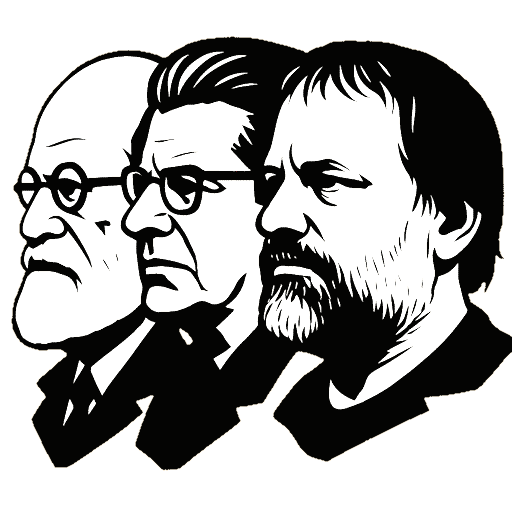


[…] Žižek’s Hysteroanalysis Joined D&G Schizoanalysis Motherfuckers Club of Serving Genocide […]
LikeLike