(playlist)
🦋🤖 Robo-Spun by IBF 🦋🤖
👻🪸🐈⬛ Phantomoperand 👻🪸🐈⬛
(Turkish)
Guerrilla Games built the Horizon games around a world where four colors repeatedly organize story, gameplay, environment, technology, and social life. Blue appears in tribal markings, calm machine lights, the Focus, water, cold effects, artificial intelligence, healing resources, and established visual orders. Yellow appears in ritual light, machine suspicion, weak points, climbing routes, solar imagery, golden artificial intelligence, valuable equipment, flowers, minerals, and competing futures. Red appears in Aloy’s hair and blood, vegetation, fire, hostile machines, political costume, Corruption, ecological disease, crystal growth, storms, and volcanic landscapes. Purple appears in machine tracks, technological overlays, Cauldrons, machine components, artificial alteration, Plasma, synthetic muscle, equipment, pigments, flowers, and technological energy.
A compact model called the Antiprogression Chain provides a simple way to read this four-color system. Blue means authority. Yellow means expectation. Red means body. Purple means mechanism. Yellow expectations support blue authorities. Purple mechanisms support red bodies. Purple mechanisms reshape blue authorities. Yellow expectations reshape red bodies. The chain continues through failure. An authority loses its hold. An expectation creates another demand. A body breaks or changes. A mechanism fails, escapes, gets captured, or gets redirected. Each apparent resolution produces the conditions for another arrangement. The original formulation presents the color code directly. (🔗)
Horizon places this structure inside a far-future Earth. Human civilization collapsed after autonomous military machines consumed the planet’s biomass. Elisabet Sobeck organized Project Zero Dawn, which created the artificial intelligence GAIA and a network of subordinate systems. GAIA later restored Earth’s biosphere and produced a new ecology of animal-shaped machines. Human communities developed into tribes among the ruins of the old civilization. Aloy, a red-haired Nora outcast, grows up inside this reconstructed world and gradually discovers the machinery that produced the planet, the machines, and her own existence. Horizon Zero Dawn establishes that history. The Frozen Wilds exposes another layer of machine autonomy. Horizon Forbidden West turns planetary repair into the central task. Burning Shores carries the same conflicts into a volcanic coastal region. (🔗) (🔗)
The important feature is reuse. One blue authority can confront another blue authority. One yellow future can compete with another yellow future. One red body can fight another red body. One purple mechanism can try to control another purple mechanism. Individual objects can also contain several colors. A Carja priest can combine red and gold. A Tenakth Marshal can combine blue and yellow. A Specter can carry blue eyes inside a white-gold body. The Focus can glow blue while revealing purple tracks and yellow weak points. Machines can move from blue to yellow to red as their behavior changes.
The games therefore treat color less like a set of isolated symbols and more like four recurring positions whose occupants keep changing. Horizon first teaches those positions around an excluded child. It repeats them during ordinary machine encounters. Zero Dawn enlarges them into tribal and planetary history. The Frozen Wilds makes blue authority confront purple mechanism. Forbidden West makes same-colored futures, bodies, and mechanisms fight over the planet. Burning Shores compresses the whole structure again into a volcanic landscape and an awakened war machine.
Aloy’s Childhood Teaches the Entire Chain
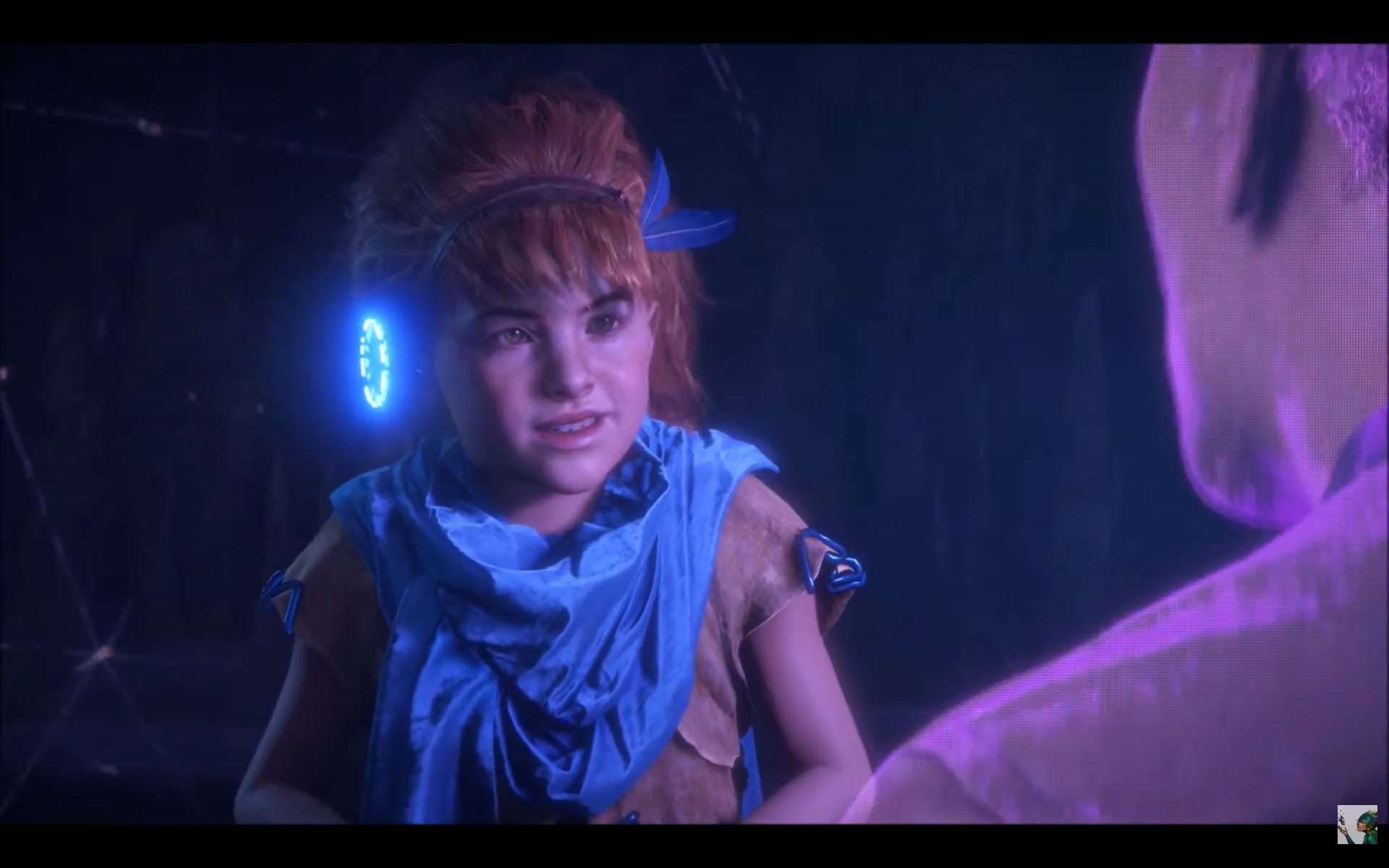
Horizon Zero Dawn introduces the four-color structure before Aloy understands the history of her world. The opening Nora environment gives the player blue tribal markings, yellow ritual light, Aloy’s red hair, her red blood, the blue glow of the Focus, purple machine tracks, and yellow machine weak points.
Blue first belongs to the Nora social world. Nora faces and clothing carry blue pigment. Those markings make belonging visible on human bodies. The tribe regulates birth, motherhood, exile, hunting, sacred land, the Proving, and access to All-Mother. Blue therefore appears on people who already possess a recognized place inside an established order.
Aloy grows up outside that order. Her exclusion drives her toward another blue authority. As a child, she falls into an Old World ruin and finds a Focus. The device glows blue at her temple and overlays physical reality with a blue-violet virtual layer. The Nora social world has denied her ordinary access to genealogy, explanation, conversation, and recognition. The Focus immediately supplies voices, names, records, signals, paths, and information.
The blue Focus therefore becomes a virtual compensation for Aloy’s physical and social exclusion. The tribe can refuse to tell her who her mother is. The Focus can retrieve speech from dead people. The tribe can restrict sacred knowledge. The Focus can penetrate ruins and recover buried information. The tribe can call Aloy an outcast. The Focus can identify machines, objects, components, pathways, and eventually genetic identity.
The Focus becomes a prosthesis of recognition. Nora blue marks an established social authority around Aloy. Focus blue creates an informational authority at her temple. The first authority determines who belongs. The second authority determines what Aloy can perceive and know. Their competition begins during childhood and expands through both games.
Purple appears inside this compensatory apparatus almost immediately. During Rost’s hunting lessons, the Focus reveals machine patrol routes as purple tracks. The machine body remains visible in ordinary space while the purple path shows the rule according to which that body moves. Purple mechanism therefore begins with a very simple image: a colored trail showing how a Watcher will travel through the grass.
That small tutorial anticipates the entire investigative structure of Horizon. Aloy repeatedly encounters a visible body, activates a technological mode of perception, discovers the mechanism organizing that body, and follows the mechanism toward a deeper cause. The first version involves a Watcher’s patrol route. Later versions involve Cauldrons, HADES, HEPHAESTUS, GAIA, Far Zenith, and Nemesis.
Yellow appears in the same lesson through machine weakness markers. The Focus highlights vulnerable components in bright yellow or yellow-orange. The color presents a future action before the action happens. Aloy sees where a shot can detach a component, ignite a canister, disable an attack, or produce greater damage.
Yellow also belongs to machine suspicion. A machine entering an uncertain or searching state uses yellow visual cues. The same encounter can therefore contain two competing yellow expectations. Aloy’s yellow weak point says that a future strike can happen here. The machine’s yellow suspicion says that a future threat may be nearby.
Red enters through Aloy’s body. Her hair gives her a permanent red presence in almost every outdoor scene. The camera usually follows her from behind or nearby, so the player constantly looks past red hair toward the world. Other characters also recognize her through her distinctive appearance.
Childhood gives the red body a wound. Bast throws a stone at Aloy and cuts her face. Blood makes social exclusion physically visible. The social mark becomes a bodily mark. The wound appears close to the part of Aloy’s head where the blue Focus sits. Red scar and blue device therefore become two adjacent consequences of the same childhood condition: one physical and one virtual.
The wound produces the next expectation. Aloy asks Rost why she is an outcast and who her mother is. That question leads to the Proving. Winning the Proving can grant recognition and a chance to demand the truth about her birth. A red bodily injury therefore produces a yellow future. That expectation then shapes the red body through years of training.
Yellow appears again in the Nora Blessing through fire and lantern light. The ceremony concerns lineage, mothers, children, and hopes carried into the future. Glowing lanterns rise into the night sky before the Proving. Yellow expectation therefore becomes an actual luminous object above a community waiting for continuity.
The childhood sequence already contains the complete chain. Red gives exclusion a body through Aloy’s hair, blood, wound, and scar. Blue gives the excluded body a virtual authority through the Focus. Purple reveals mechanisms through patrol routes and hidden information. Yellow exposes possible actions through weakness markers and turns Aloy’s unanswered origin into the expectation of the Proving.
The Proving enlarges that childhood sequence into social history. Yellow expectation has shaped Aloy’s red body through years of training. Purple Focus knowledge has shaped the same body through observation and tactical learning. Blue Nora authority promises recognition after victory. Aloy wins. The expected completion immediately becomes catastrophe when attackers massacre the participants. Her success produces a larger problem. Her new status allows her to travel beyond Nora territory. The chain advances because the achieved goal creates the next journey.
The Focus also survives as a position beyond one physical device. A particular Focus can be destroyed and replaced while Aloy’s dependence on virtual authority continues. The compensation has become reproducible.
Aloy’s own origin later repeats the same structure at planetary scale. GAIA responds to systemic rupture by producing Aloy as a genetic copy of Elisabet. A technological system answers failure by creating a body capable of repair. Aloy’s childhood repeats that origin in miniature. Nora exclusion creates the circumstances in which she acquires the Focus. A rupture generates a compensation. The compensation produces capacities larger than the condition that preceded it.
Every Machine Encounter Repeats the Chain
The machines teach the same four-color structure through repetition. Horizon’s mechanical animals belong to the restored ecosystem. Many graze, collect resources, transport materials, purify environments, or defend territories. Their lights make behavioral changes readable. (🔗)
Blue commonly appears when a machine occupies its ordinary state. Its eyes and luminous components sit calmly inside the landscape. Machine cables and internal structures can also carry blue or cyan light. In Zero Dawn, ordinary machine scanning through the Focus can use blue technological outlines. Calm Apex variants can retain blue sensory lights while their bodies expose purple internal material.
Blue therefore describes an established machine condition. The machine currently occupies its place in the ecology.
Yellow arrives when that condition becomes uncertain. Suspicion produces yellow cues. The machine searches. Its attention moves. Combat may begin.
Yellow weak-point highlighting creates the opposite expectation at the same time. The player sees the place where the machine can be changed. The machine expects a possible threat while Aloy expects a possible strike. Yellow becomes anticipation on both sides of the encounter.
Red follows when anticipation becomes bodily confrontation. Hostile machine lights turn red. The machine attacks through movement, impact, jaws, claws, projectiles, and mass. Red turns the uncertain encounter into immediate embodiment.
Purple reveals what organizes the body. Patrol routes appear as purple tracks. Components can receive purple or magenta highlighting. Purple triangular markers can isolate machine parts or loot. Cauldrons reveal the production systems that manufacture machine bodies. Ancient interfaces reveal the information beneath their behavior.
A single machine encounter can therefore move through blue authority, yellow expectation, red body, and purple mechanism within seconds.
The ancient Horus war machine extends the same behavioral sequence across another historical layer. Its sensory states also use blue, yellow, and red. Burning Shores eventually makes one of these enormous Old World machines active again. The same color sequence that helps the player read wildlife-sized machines still operates inside a weapon created by the civilization that destroyed the original biosphere.
Blue machine normality therefore crosses technological eras. GAIA-era machines use it. Ancient Faro machines use it. Far Zenith Specters also carry blue eyes inside white-gold bodies. Different machine civilizations reuse the same authority color.
The equipment system repeats the palette in another register. Rare weapons, outfits, and modifications use blue. Very Rare equipment uses purple. Legendary gear in Forbidden West moves into gold or gold-orange. Blue authority, purple mechanism, and yellow expectation therefore also become stages of value inside the player’s inventory.
Elemental combat repeats the colors again. Shock uses blue electricity. Frost and Chillwater use icy blue and cyan. Purgewater adds another blue-cyan substance. Plasma uses purple. Glowblast gives that purple state a material source. Plasma can coat a machine in violet energy and flood the player’s screen with purple effects.
Fire spans yellow, orange, and red. Zero Dawn’s elemental coding frequently pushes Fire toward yellow, while the flame itself moves through yellow-orange and red. Firegleam makes the transition physical. It begins as a red crystalline obstruction and becomes yellow-orange combustion when Aloy ignites it.
The same colors therefore appear in machine behavior, Focus analysis, equipment rarity, elemental substances, and bodily consequences. The player learns the chain through repeated action before the story enlarges it into civilization and planetary history.
Zero Dawn Enlarges the Colors Into Politics and History
Aloy’s journey into Carja territory gives red and yellow a civilizational scale. The Carja built Meridian around worship of the Sun. Their architecture uses warm stone. Their ceremonial culture uses gold. Guards, priests, nobles, fabrics, feathers, and banners repeatedly bring red into the same visual field.
Yellow expectation becomes public order. The Sun promises recurrence every morning. Carja ritual turns that recurrence into political continuity. Gold fixes the expectation color onto buildings, clothing, ceremonial objects, and religious symbols.
Red body sits directly beside that gold. Carja ceremonial clothing often joins red cloth to golden decoration. Political bodies therefore wear expectation on their surfaces.
Carja Guards make the combination especially visible through golden helmets, red feathers, and red-grey clothing. Sun-Priests use cinnabar red with gold and white, and some garments add blue thread. Avad wears red-and-white fabric with gold detailing. A single political order can therefore place red body, yellow expectation, and blue authority on the same human surface.
The Carja story also creates competition inside a shared palette. The reign of Jiran and the later rule of Avad arise from the same Sun-centered civilization. Their political projects diverge. Jiran’s Red Raids turn Carja power toward sacrifice and war. Avad’s rule attempts reconciliation. Gold stays inside the culture while the future changes. Red stays inside Carja bodies while those bodies serve rival political directions.
The Shadow Carja intensify the same conflict. Their darker red visual world grows from a break within Carja civilization. Dusky red face paint gives that separation another bodily form. The Eclipse then adds HADES to the division. Red becomes a field where several bodies compete for the same historical inheritance.
Red also saturates ordinary material life. Tall red grass conceals Aloy when she crouches inside it. Her red-haired body enters a red plant body and disappears from nearby enemies. Zero Dawn also places red among medicinal plants. Red therefore carries bodily danger, healing, concealment, clothing, blood, and the protagonist’s own appearance.
Corruption turns the same field toward technological pathology. Machines touched by HADES acquire red-black growths and aggressive behavior. Their Focus treatment shifts toward red. Corrupted Zones spread the same color into the ground. HADES itself receives red luminous manifestations. An invisible computational disturbance therefore acquires red bodies, red circuitry, and red territory.
The story repeatedly sends Aloy from red embodiment toward hidden mechanism. A corrupted body becomes a visible symptom. The Focus exposes technological traces. Investigation leads toward HADES, GAIA, Zero Dawn, and the extinction history beneath the present world.
GAIA introduces the next great yellow claimant. Her holographic manifestation uses a golden appearance. The artificial intelligence exists to restore and maintain Earth’s biosphere. Gold therefore becomes attached to a future measured across centuries and ecosystems.
Project Zero Dawn gives that golden expectation its historical foundation. Human civilization faces extinction. Elisabet organizes a system designed to outlive everyone who builds it. The project expects life to return after total biological collapse. GAIA carries that expectation into planetary reconstruction.
The discovery of Aloy’s origin joins yellow directly to red. GAIA created Aloy as a genetic copy of Elisabet because a person with Elisabet’s genetic access could repair the damaged system. A golden artificial intelligence produces a future-oriented plan that takes the form of a red-haired human body.
The relation repeats Aloy’s childhood in reverse scale. The blue Focus virtually compensated for a red social wound. Golden GAIA physically produces the red body that can compensate for planetary failure.
The end of Zero Dawn completes one task and preserves another problem. Aloy defeats HADES and prevents renewed extinction. Sylens captures the surviving HADES entity because he seeks further knowledge. Successful defense therefore carries unresolved mechanism into the future. The next game grows from the residue of victory.
The Frozen Wilds Turns Blue Against Purple
The Frozen Wilds concentrates the chain around Banuk blue and HEPHAESTUS purple. The expansion sends Aloy into the snowy Cut, where machine behavior has become unusually dangerous. (🔗)
The Banuk surround themselves with blue. Their clothing, paint, cords, and spiritual imagery repeatedly use the color. They take machine light seriously and develop the idea of the Blue Light. Machine-derived materials enter ritual decoration and clothing.
Blue lanterns illuminate parts of the Shaman’s Path. Bluegleam gives the color a crystalline body that Aloy can physically collect. Ice, water, snow shadow, cold haze, and distant mountain atmosphere extend the same field through the landscape.
CYAN adds an artificial intelligence whose very name belongs to the blue-cyan family. The region therefore contains Banuk Blue Light, blue machine illumination, blue ritual decoration, Bluegleam, cold blue landscape, and CYAN inside the same visual world.
Blue authority now competes internally. Nora blue belongs to one sacred order. Banuk blue belongs to another. Calm machine light belongs to ordinary machine operation. Focus blue belongs to Aloy’s informational authority. CYAN belongs to an artificial intelligence hidden beneath another layer of interpretation.
Purple arrives through HEPHAESTUS. Aloy eventually discovers that the supposed Daemon behind the region’s dangerous machines is the machine-production intelligence adapting against human hunters. Daemonic machines carry conspicuous purple alteration. The mechanism color leaves the underground system and appears directly on machine bodies.
The conflict therefore becomes blue authority against purple mechanism. Banuk interpretations confront a machine intelligence that actively changes the reality they interpret. Aloy’s Focus supplies another mechanism for understanding the same process. Purple mechanism also fights purple mechanism because human technological perception confronts autonomous technological adaptation.
The expansion turns color into collectible matter as well. Pigment deposits can be gathered from geological formations. Banuk artists use pigments in paintings. Color can therefore move from mineral surface into human image.
That transfer matters because Horizon repeatedly lets color migrate between substances. Machine light becomes religious imagery. Rock pigment becomes art. Blue crystal becomes currency. Purple technological alteration becomes machine tissue. The color code belongs to matter as much as to interface.
Forbidden West Makes Same Colors Fight Over the Planet
Forbidden West begins after Aloy already knows the history beneath the world. The central problem has changed from discovery to repair. Earth’s terraforming system is failing. GAIA needs missing subordinate functions. HEPHAESTUS remains independent. Far Zenith arrives with its own future. The four colors now operate at planetary scale.
Red gives the crisis a body through the Red Blight. Diseased growth spreads across vegetation and agricultural land. Animals from affected regions can yield Blighted Meat. Supercell storms add red lightning to the atmosphere. Earth’s ecological failure therefore spreads through plants, animals, ground, and sky.
Aloy enters this landscape as another red body. Her hair places her inside the same color field as the planetary symptom. One red body travels through another red body while trying to repair it.
Crimson Bloom gives red a smaller organic form. Its pigment can become dye. Firegleam gives red a mineral form. Red therefore passes through hair, blood, vegetation, flowers, hostile machines, corruption, ecological disease, crystal, meat, clothing, and weather.
Gold provides the future-bearing intelligence. Reconstructed GAIA appears in stable golden form. She directs the recovery of AETHER, POSEIDON, DEMETER, and eventually HEPHAESTUS. Each successful recovery expands her ability to stabilize the planet while revealing the next dependency.
Far Zenith introduces a rival gold. Zenith technology uses brilliant white-gold surfaces and golden machine shells. Specters carry white-gold armor while their eyes shine blue. The sequel therefore stages gold against gold.
The two golden futures want the same planetary intelligence for different continuations. Aloy seeks GAIA to stabilize Earth. The Zeniths seek GAIA because they need another path of survival after catastrophe destroys their Sirius colony. One golden expectation is tied to planetary repair. Another is tied to departure and renewed colonization.
Blue appears inside both futures. Earth’s ordinary machines use blue sensory lights. Zenith Specters also possess blue eyes. The new technological order arrives with an authority color already familiar from the old one.
Specter Prime adds red destructive output to this gold-and-blue machinery through intense heat attacks. A white-gold future with blue sensory authority therefore produces red bodily violence during combat.
Purple supplies the stubborn mechanism at the center of the planetary repair problem. HEPHAESTUS has spent years adapting machine production against human hunting. Capturing it would allow GAIA to regain control over machine manufacture.
Apex machines make the conflict visible through black armor and purple synthetic musculature. Their calm blue sensors can remain visible at the same time. One body therefore carries blue established operation and purple internal mechanism.
Plasma extends purple into combat. Glowblast gives it a material source. Purple component markers and Focus highlights continue to isolate machine parts for analysis. Very Rare gear keeps purple present in the player’s inventory. The mechanism color now appears in machine tissue, elemental energy, scanning, equipment, and artificial intelligence.
The Gemini operation gives this purple conflict its clearest antiprogressive form. Aloy and her allies successfully trap HEPHAESTUS inside a Cauldron. Far Zenith attacks. Varl dies. Beta is taken. GAIA is captured. Technical progress becomes the scene of a larger failure.
Later, Beta releases HEPHAESTUS into the Zenith network during the assault on their base. The escaped machine intelligence manufactures machines that attack Zenith Specters. The purple mechanism that escaped golden planetary repair becomes the mechanism that defeats the rival golden future.
That victory leaves HEPHAESTUS free again. Capturing the mechanism creates a crisis. Losing the mechanism creates a weapon. Using the mechanism creates victory. Victory restores the unresolved need for the mechanism. The story advances by renewing the same structural problem.
Forbidden West also multiplies the colors through human societies.
Tenakth clans distribute blue, turquoise, red, yellow, fuchsia, white, and black across body paint, armor, cloth, weapons, and settlement decoration. Marshals prominently combine blue with yellow and white. Kotallo carries blue-and-yellow beads and Marshal ornament. Sky Clan design introduces sky blue and fuchsia. Lowland design uses turquoise and azure with red accents. Desert Clan design combines yellow, red, and black.
Memorial Grove adds a mechanism for this color transfer. Damaged Old World holographic Visions display intense distortions. Tenakth culture absorbs parts of those images into body paint, textiles, weapons, and architectural decoration. Technological color becomes political color.
The Utaru landscape around Plainsong adds blue-green and turquoise through organic architecture, woven material, vegetation, and settlement decoration. Blue authority therefore enters a society whose built environment grows directly through living structures.
The Quen extend turquoise and cyan through maritime clothing and ornament. Their political hierarchy depends heavily on controlled access to Old World knowledge through Focus technology. Blue cultural authority and blue virtual authority therefore meet inside another society.
Forbidden West also changes routine healing toward blue medicinal berries. The player reaches for blue in the landscape to restore Aloy’s body. A color already associated with established machines, social authority, and the Focus enters bodily maintenance.
Dye flowers make color physically transferable. Crimson Bloom supplies red. Golden Bloom supplies yellow. Azure Bloom appears visually purple and therefore joins the purple field through its visible hue. Plants become sources from which human bodies can acquire new colors.
The system is simple and concrete. A flower contains pigment. A person collects it. Dye moves onto an outfit. The colored body then enters a settlement whose architecture and political groups distribute the same palette differently.
Yellow also expands across traversal and navigation. Ropes, ladders, beams, handles, climbing holds, Focus-highlighted cliffs, quest markers, search areas, custom waypoints, and tagged targets all place expectation into space. Yellow tells the player where movement, searching, or action can continue.
Golden Bloom gives expectation a plant body. Brimshine later gives it a crystal body. Oseram brass, bronze, forge light, lanterns, dry grasses, sand, and warm stone give it everyday material presence. Legendary equipment gives it value.
The planet therefore contains several yellow futures at once: player anticipation, machine suspicion, tribal ritual, Carja solar continuity, GAIA’s restoration, Zenith escape, navigation, mineral value, and equipment progression.
Blue becomes equally crowded: Nora markings, Banuk Blue Light, CYAN, Focus authority, calm machines, Rare equipment, Shock, Frost, Chillwater, Purgewater, medicinal berries, Tenakth Marshals, Utaru environments, Quen ornament, Faro sensors, and Zenith eyes.
Red becomes crowded with Aloy, blood, grass, medicine, Carja costume, hostile machines, HADES, Corruption, Crimson Bloom, Red Blight, Blighted Meat, Firegleam, red lightning, Specter Prime heat, and later volcanic terrain.
Purple becomes crowded with Focus tracks, component highlights, Cauldrons, Very Rare gear, HEPHAESTUS, Daemonic machines, Apex musculature, Plasma, Glowblast, Tenakth fuchsia, Memorial Grove color, Azure Bloom, Stingspawn, and technological holography.
The story gains movement from that crowding. Each color supplies a shared position while several occupants seek incompatible outcomes.
The chain also expands beyond Earth through Nemesis. The Zeniths reveal that their attempt to preserve themselves digitally produced the intelligence that destroyed their Sirius colony and sent the extinction signal toward Earth. A mechanism built from a future-oriented project generates the failure that sends its creators toward another future. Forbidden West therefore ends with another expectation already approaching the planet.
Burning Shores Compresses the Whole Palette Again
Burning Shores moves the story into the flooded and volcanic ruins of Los Angeles. The environment intensifies the four colors. Lava and heated rock strengthen red. Ocean and Quen ornament strengthen blue and turquoise. Zenith remnants preserve gold. Brimshine adds bright yellow mineral matter. Stingspawn add purple incubation. Ancient and advanced machines continue the technological palette. (🔗)
Walter Londra carries the surviving Zenith future into this landscape. His plan involves escape, a chosen population, and another colony. The golden expectation that survived the base game’s climax therefore produces another golden project.
The Quen provide a blue authority field around the conflict. Their hierarchy, ancestral interpretation, Focus knowledge, clothing, and maritime identity organize the stranded community. Seyka acts inside that order while challenging particular commands. Blue contains another internal contest over how authority should respond to crisis.
Purple appears through hostile machine processes. Stingspawn capsules glow purple before releasing their flying machines. A small purple mechanism visibly produces another body.
Red dominates the volcanic body of the region. Lava runs through broken terrain. Fire and heated rock surround the reactivated Horus. The Old World war machine becomes physically mobile again.
The Horus then returns the story to the machine color sequence learned during childhood. Its sensory states use blue, yellow, and red. A machine large enough to reshape the coastline still moves through the same readable states that organized encounters with much smaller machines.
Burning Shores therefore compresses the entire color structure into one landscape: blue Quen authority, gold Zenith expectation, purple machine production, red volcanic embodiment, yellow Brimshine and machine anticipation, and a Horus that cycles through the elementary behavioral colors.
The Colors Keep Changing Owners
Horizon gains continuity by keeping the four colors while changing who or what occupies them.
Blue moves through Nora social authority, Focus authority, Banuk spirituality, CYAN, ordinary machine states, Faro machine sensors, Tenakth Marshals, Utaru environments, Quen knowledge systems, healing berries, Rare equipment, cold effects, water, and Zenith eyes.
Yellow moves through machine weak points, machine suspicion, Nora lanterns, Carja Sun worship, climbing routes, quest markers, Golden Bloom, Legendary equipment, GAIA, Far Zenith, Brimshine, and other anticipated futures.
Red moves through Aloy’s hair and blood, stealth grass, medicinal plants, Carja bodies, hostile machines, HADES, Corruption, Crimson Bloom, Red Blight, Blighted Meat, Firegleam, red lightning, Zenith heat attacks, fire, and lava.
Purple moves through Focus tracks, holography, machine-component markers, Cauldrons, HEPHAESTUS, Daemonic machines, Apex musculature, Plasma, Glowblast, Very Rare gear, Sky Clan fuchsia, Memorial Grove color, Azure Bloom, Stingspawn, flowers, and dusk.
The important operation is competition within the same hue. Gold GAIA faces white-gold Zenith technology. Red Aloy crosses red planetary disease. Purple Focus technology confronts purple machine adaptation. Blue tribal authorities coexist with blue machine normality and blue technological authority. Yellow machine suspicion confronts yellow player anticipation.
A second operation occurs inside multicolored objects. The Focus uses blue authority while exposing purple tracks and yellow weaknesses. Carja ceremonial bodies combine red and gold, sometimes with blue detail. Tenakth Marshals combine blue and yellow. Specters combine white-gold armor with blue eyes. Apex machines combine purple musculature with blue calm-state sensors. Firegleam moves from red crystal into yellow-orange ignition. Machines cycle from blue through yellow into red.
A third operation transfers color between substances. Machine light becomes Banuk religious imagery. Geological pigment becomes painting. Flowers become clothing dye. Holographic distortion becomes Tenakth decoration. Bluegleam turns blue into collectible mineral value. Brimshine turns yellow into crystal. Glowblast turns purple into ammunition material. Red Blight turns red into ecological matter.
The childhood tutorial already contains all three operations in miniature. Aloy’s red wound sits beside the blue Focus that compensates for her exclusion. The Focus exposes purple tracks. It marks yellow weaknesses. Machine suspicion produces a competing yellow. Nora blue authority confronts Focus blue authority. The colors already overlap, compete, and change material before Aloy becomes an adult.
The rest of Horizon enlarges that small structure. The first game’s Nora valley becomes the Carja Sundom, the Frozen Wilds, buried Zero Dawn facilities, and GAIA’s planetary history. Forbidden West expands it into the Blight, Tenakth politics, Quen knowledge, HEPHAESTUS, Far Zenith, and Nemesis. Burning Shores returns the same colors to a volcanic coast and an awakened Horus.
A snowy Banuk settlement, a desert Carja city, an underground Cauldron, a blighted field, a Las Vegas ruin, a Tenakth stronghold, a Zenith facility, and a volcanic coastline therefore look radically different while redistributing the same four positions.
Decorative elements matter because the color system lives in matter. A flower belongs to the same field as a machine light. A robe belongs to the same field as a hologram. A crystal belongs to the same field as a ritual flame. Pigment can move from ground to body. A technological glitch can become a tribal pattern. A machine state can become a religious image. The story reaches beyond dialogue and cutscenes because the same four positions keep reappearing in objects, bodies, landscapes, interfaces, and materials.
Horizon builds progression from those repeated rearrangements. Yellow expectation produces or directs a red body. Purple mechanism supports that body. Blue authority organizes the world around it. Another mechanism alters the authority. Another expectation reshapes the body. Failure creates another arrangement.
The simplicity of the system allows the story to grow without abandoning its earliest visual grammar. Horizon tells a story about childhood exclusion, machine ecology, tribal civilization, extinction, reconstruction, artificial intelligence, planetary repair, machine autonomy, interstellar escape, and another approaching threat. The games keep rendering those changes through four familiar colors.
Blue gives visible form to authority. Yellow gives visible form to expectation. Red gives visible form to body. Purple gives visible form to mechanism.
The narrative advances because every color keeps finding another owner.
Wie Horizon seine Geschichte in vier Farben erzählt: Blaue Autorität, gelbe Erwartung, rote Körper, violette Mechanismen
Guerrilla Games hat die Horizon-Spiele um eine Welt herum aufgebaut, in der vier Farben wiederholt Geschichte, Spielmechanik, Umgebung, Technologie und gesellschaftliches Leben organisieren. Blau erscheint in Stammesmarkierungen, ruhigen Maschinenlichtern, dem Fokus, Wasser, Kälteeffekten, künstlicher Intelligenz, Heilressourcen und etablierten visuellen Ordnungen. Gelb erscheint in rituellem Licht, maschinellem Argwohn, Schwachstellen, Kletterrouten, Sonnenbildern, goldener künstlicher Intelligenz, wertvoller Ausrüstung, Blumen, Mineralien und konkurrierenden Zukünften. Rot erscheint in Aloys Haar und Blut, Vegetation, Feuer, feindlichen Maschinen, politischer Kleidung, Verderbnis, ökologischer Krankheit, Kristallwachstum, Stürmen und Vulkanlandschaften. Violett erscheint in Maschinenspuren, technologischen Überlagerungen, Brutstätten, Maschinenkomponenten, künstlicher Veränderung, Plasma, synthetischer Muskulatur, Ausrüstung, Pigmenten, Blumen und technologischer Energie.
Ein kompaktes Modell namens Antiprogressionskette bietet eine einfache Möglichkeit, dieses Vierfarbensystem zu lesen. Blau bedeutet Autorität. Gelb bedeutet Erwartung. Rot bedeutet Körper. Violett bedeutet Mechanismus. Gelbe Erwartungen stützen blaue Autoritäten. Violette Mechanismen stützen rote Körper. Violette Mechanismen formen blaue Autoritäten um. Gelbe Erwartungen formen rote Körper um. Die Kette setzt sich durch das Scheitern fort. Eine Autorität verliert ihren Halt. Eine Erwartung erzeugt eine weitere Forderung. Ein Körper zerbricht oder verändert sich. Ein Mechanismus versagt, entkommt, wird eingefangen oder umgelenkt. Jede scheinbare Auflösung erzeugt die Bedingungen für eine weitere Anordnung. Die ursprüngliche Formulierung präsentiert den Farbcode unmittelbar. (🔗)
Horizon versetzt diese Struktur auf eine Erde in ferner Zukunft. Die menschliche Zivilisation brach zusammen, nachdem autonome Militärmaschinen die Biomasse des Planeten aufgezehrt hatten. Elisabet Sobeck organisierte Projekt Zero Dawn, das die künstliche Intelligenz GAIA und ein Netzwerk untergeordneter Systeme hervorbrachte. GAIA stellte später die Biosphäre der Erde wieder her und schuf eine neue Ökologie tiergestaltiger Maschinen. Menschliche Gemeinschaften entwickelten sich zwischen den Ruinen der alten Zivilisation zu Stämmen. Aloy, eine rothaarige Nora-Ausgestoßene, wächst in dieser rekonstruierten Welt auf und entdeckt nach und nach die Maschinerie, die den Planeten, die Maschinen und ihre eigene Existenz hervorgebracht hat. Horizon Zero Dawn begründet diese Geschichte. The Frozen Wilds legt eine weitere Schicht maschineller Autonomie frei. Horizon Forbidden West macht die planetare Reparatur zur zentralen Aufgabe. Burning Shores trägt dieselben Konflikte in eine vulkanische Küstenregion. (🔗) (🔗)
Das wichtige Merkmal ist die Wiederverwendung. Eine blaue Autorität kann einer anderen blauen Autorität entgegentreten. Eine gelbe Zukunft kann mit einer anderen gelben Zukunft konkurrieren. Ein roter Körper kann gegen einen anderen roten Körper kämpfen. Ein violetter Mechanismus kann versuchen, einen anderen violetten Mechanismus zu kontrollieren. Einzelne Objekte können ebenfalls mehrere Farben enthalten. Ein Carja-Priester kann Rot und Gold verbinden. Ein Tenakth-Marschall kann Blau und Gelb verbinden. Ein Specter kann blaue Augen in einem weiß-goldenen Körper tragen. Der Fokus kann blau leuchten, während er violette Spuren und gelbe Schwachstellen sichtbar macht. Maschinen können von Blau über Gelb zu Rot wechseln, wenn sich ihr Verhalten verändert.
Die Spiele behandeln Farbe daher weniger wie eine Reihe isolierter Symbole als vielmehr wie vier wiederkehrende Positionen, deren Besetzungen sich ständig ändern. Horizon lehrt diese Positionen zunächst rund um ein ausgeschlossenes Kind. Es wiederholt sie bei gewöhnlichen Maschinenbegegnungen. Zero Dawn erweitert sie zur Stammes- und Planetengeschichte. The Frozen Wilds lässt blaue Autorität auf violetten Mechanismus treffen. Forbidden West lässt gleichfarbige Zukünfte, Körper und Mechanismen um den Planeten kämpfen. Burning Shores verdichtet die gesamte Struktur erneut zu einer Vulkanlandschaft und einer erwachten Kriegsmaschine.
Aloys Kindheit lehrt die gesamte Kette
Horizon Zero Dawn führt die Vierfarbenstruktur ein, bevor Aloy die Geschichte ihrer Welt versteht. Die anfängliche Nora-Umgebung gibt dem Spieler blaue Stammesmarkierungen, gelbes Rituallicht, Aloys rotes Haar, ihr rotes Blut, das blaue Leuchten des Fokus, violette Maschinenspuren und gelbe Maschinenschwachstellen.
Blau gehört zunächst zur gesellschaftlichen Welt der Nora. Gesichter und Kleidung der Nora tragen blaues Pigment. Diese Markierungen machen die Zugehörigkeit auf menschlichen Körpern sichtbar. Der Stamm regelt Geburt, Mutterschaft, Verbannung, Jagd, heiliges Land, die Erprobung und den Zugang zur Allmutter. Blau erscheint daher an Menschen, die bereits einen anerkannten Platz innerhalb einer etablierten Ordnung besitzen.
Aloy wächst außerhalb dieser Ordnung auf. Ihr Ausschluss treibt sie zu einer anderen blauen Autorität. Als Kind stürzt sie in eine Ruine der Alten Welt und findet einen Fokus. Das Gerät leuchtet blau an ihrer Schläfe und überlagert die physische Wirklichkeit mit einer blau-violetten virtuellen Schicht. Die gesellschaftliche Welt der Nora hat ihr den gewöhnlichen Zugang zu Genealogie, Erklärung, Gespräch und Anerkennung versagt. Der Fokus liefert ihr unmittelbar Stimmen, Namen, Aufzeichnungen, Signale, Wege und Informationen.
Der blaue Fokus wird daher zu einer virtuellen Kompensation für Aloys physischen und gesellschaftlichen Ausschluss. Der Stamm kann sich weigern, ihr zu sagen, wer ihre Mutter ist. Der Fokus kann Sprache von Toten abrufen. Der Stamm kann heiliges Wissen beschränken. Der Fokus kann in Ruinen eindringen und verschüttete Informationen bergen. Der Stamm kann Aloy eine Ausgestoßene nennen. Der Fokus kann Maschinen, Objekte, Komponenten, Wege und schließlich genetische Identität bestimmen.
Der Fokus wird zu einer Prothese der Anerkennung. Nora-Blau kennzeichnet eine etablierte gesellschaftliche Autorität um Aloy herum. Fokus-Blau erzeugt eine informationelle Autorität an ihrer Schläfe. Die erste Autorität bestimmt, wer dazugehört. Die zweite Autorität bestimmt, was Aloy wahrnehmen und wissen kann. Ihr Wettstreit beginnt in der Kindheit und weitet sich über beide Spiele aus.
Violett erscheint beinahe augenblicklich innerhalb dieses kompensatorischen Apparats. Während Rosts Jagdlektionen enthüllt der Fokus die Patrouillenrouten der Maschinen als violette Spuren. Der Maschinenkörper bleibt im gewöhnlichen Raum sichtbar, während der violette Pfad die Regel zeigt, nach der sich dieser Körper bewegt. Der violette Mechanismus beginnt daher mit einem sehr einfachen Bild: einer farbigen Spur, die zeigt, wie sich ein Wächter durch das Gras bewegen wird.
Dieses kleine Tutorial nimmt die gesamte Untersuchungsstruktur von Horizon vorweg. Aloy begegnet wiederholt einem sichtbaren Körper, aktiviert einen technologischen Wahrnehmungsmodus, entdeckt den Mechanismus, der diesen Körper organisiert, und folgt dem Mechanismus zu einer tieferen Ursache. Die erste Version betrifft die Patrouillenroute eines Wächters. Spätere Versionen betreffen Brutstätten, HADES, HEPHAESTUS, GAIA, Far Zenith und Nemesis.
Gelb erscheint in derselben Lektion durch Markierungen maschineller Schwachstellen. Der Fokus hebt verwundbare Komponenten in leuchtendem Gelb oder Gelborange hervor. Die Farbe präsentiert eine zukünftige Handlung, bevor die Handlung geschieht. Aloy sieht, wo ein Schuss eine Komponente abtrennen, einen Behälter entzünden, einen Angriff außer Kraft setzen oder größeren Schaden verursachen kann.
Gelb gehört auch zum maschinellen Argwohn. Eine Maschine, die in einen unsicheren oder suchenden Zustand eintritt, verwendet gelbe visuelle Hinweise. Dieselbe Begegnung kann daher zwei konkurrierende gelbe Erwartungen enthalten. Aloys gelbe Schwachstelle sagt, dass hier ein zukünftiger Treffer erfolgen kann. Der gelbe Argwohn der Maschine sagt, dass sich möglicherweise eine zukünftige Bedrohung in der Nähe befindet.
Rot tritt durch Aloys Körper ein. Ihr Haar verleiht ihr in fast jeder Außenszene eine dauerhafte rote Präsenz. Die Kamera folgt ihr gewöhnlich von hinten oder aus der Nähe, sodass der Spieler ständig über rotes Haar hinweg auf die Welt blickt. Andere Figuren erkennen sie ebenfalls an ihrem unverwechselbaren Erscheinungsbild.
Die Kindheit gibt dem roten Körper eine Wunde. Bast wirft einen Stein nach Aloy und verletzt ihr Gesicht. Blut macht gesellschaftlichen Ausschluss körperlich sichtbar. Das gesellschaftliche Mal wird zu einem körperlichen Mal. Die Wunde erscheint nahe an jener Stelle von Aloys Kopf, an der der blaue Fokus sitzt. Rote Narbe und blaues Gerät werden daher zu zwei benachbarten Folgen derselben kindlichen Bedingung: die eine körperlich und die andere virtuell.
Die Wunde erzeugt die nächste Erwartung. Aloy fragt Rost, warum sie eine Ausgestoßene ist und wer ihre Mutter ist. Diese Frage führt zur Erprobung. Der Sieg bei der Erprobung kann Anerkennung und die Gelegenheit gewähren, die Wahrheit über ihre Geburt einzufordern. Eine rote körperliche Verletzung erzeugt daher eine gelbe Zukunft. Diese Erwartung formt anschließend den roten Körper durch jahrelanges Training.
Gelb erscheint erneut beim Nora-Segen durch Feuer und Laternenlicht. Die Zeremonie betrifft Abstammung, Mütter, Kinder und Hoffnungen, die in die Zukunft getragen werden. Leuchtende Laternen steigen vor der Erprobung in den Nachthimmel auf. Gelbe Erwartung wird daher zu einem tatsächlichen leuchtenden Objekt über einer Gemeinschaft, die auf Kontinuität wartet.
Die Kindheitssequenz enthält bereits die vollständige Kette. Rot gibt dem Ausschluss durch Aloys Haar, Blut, Wunde und Narbe einen Körper. Blau gibt dem ausgeschlossenen Körper durch den Fokus eine virtuelle Autorität. Violett enthüllt Mechanismen durch Patrouillenrouten und verborgene Informationen. Gelb legt mögliche Handlungen durch Schwachstellenmarkierungen offen und verwandelt Aloys unbeantwortete Herkunft in die Erwartung der Erprobung.
Die Erprobung erweitert diese Kindheitssequenz zur Sozialgeschichte. Die gelbe Erwartung hat Aloys roten Körper durch jahrelanges Training geformt. Violettes Fokuswissen hat denselben Körper durch Beobachtung und taktisches Lernen geformt. Blaue Nora-Autorität verspricht Anerkennung nach dem Sieg. Aloy gewinnt. Die erwartete Vollendung wird augenblicklich zur Katastrophe, als Angreifer die Teilnehmer massakrieren. Ihr Erfolg erzeugt ein größeres Problem. Ihr neuer Status erlaubt ihr, über das Gebiet der Nora hinauszureisen. Die Kette schreitet voran, weil das erreichte Ziel die nächste Reise hervorbringt.
Der Fokus überdauert auch als Position über ein einzelnes physisches Gerät hinaus. Ein bestimmter Fokus kann zerstört und ersetzt werden, während Aloys Abhängigkeit von virtueller Autorität fortbesteht. Die Kompensation ist reproduzierbar geworden.
Aloys eigene Herkunft wiederholt später dieselbe Struktur im planetaren Maßstab. GAIA reagiert auf einen systemischen Bruch, indem sie Aloy als genetische Kopie von Elisabet hervorbringt. Ein technologisches System beantwortet ein Versagen, indem es einen zur Reparatur befähigten Körper erschafft. Aloys Kindheit wiederholt diesen Ursprung im Kleinen. Der Ausschluss durch die Nora schafft die Umstände, unter denen sie den Fokus erhält. Ein Bruch erzeugt eine Kompensation. Die Kompensation erzeugt Fähigkeiten, die größer sind als die Bedingung, die ihr vorausging.
Jede Maschinenbegegnung wiederholt die Kette
Die Maschinen lehren dieselbe Vierfarbenstruktur durch Wiederholung. Horizons mechanische Tiere gehören zum wiederhergestellten Ökosystem. Viele grasen, sammeln Ressourcen, transportieren Materialien, reinigen Umgebungen oder verteidigen Gebiete. Ihre Lichter machen Verhaltensänderungen lesbar. (🔗)
Blau erscheint gewöhnlich, wenn sich eine Maschine in ihrem normalen Zustand befindet. Ihre Augen und leuchtenden Komponenten liegen ruhig in der Landschaft. Maschinenkabel und innere Strukturen können ebenfalls blaues oder cyanfarbenes Licht tragen. In Zero Dawn kann das gewöhnliche Scannen von Maschinen durch den Fokus blaue technologische Umrisse verwenden. Ruhige Apex-Varianten können blaue Sensorlichter behalten, während ihre Körper violettes inneres Material freilegen.
Blau beschreibt daher einen etablierten Maschinenzustand. Die Maschine nimmt gegenwärtig ihren Platz in der Ökologie ein.
Gelb tritt auf, wenn dieser Zustand unsicher wird. Argwohn erzeugt gelbe Hinweise. Die Maschine sucht. Ihre Aufmerksamkeit verlagert sich. Der Kampf kann beginnen.
Die gelbe Hervorhebung von Schwachstellen erzeugt zugleich die gegenteilige Erwartung. Der Spieler sieht den Ort, an dem die Maschine verändert werden kann. Die Maschine erwartet eine mögliche Bedrohung, während Aloy einen möglichen Treffer erwartet. Gelb wird auf beiden Seiten der Begegnung zur Antizipation.
Rot folgt, wenn Antizipation zur körperlichen Konfrontation wird. Die Lichter feindlicher Maschinen werden rot. Die Maschine greift durch Bewegung, Aufprall, Kiefer, Klauen, Geschosse und Masse an. Rot verwandelt die unsichere Begegnung in unmittelbare Verkörperung.
Violett enthüllt, was den Körper organisiert. Patrouillenrouten erscheinen als violette Spuren. Komponenten können violett oder magentafarben hervorgehoben werden. Violette dreieckige Markierungen können Maschinenteile oder Beute isolieren. Brutstätten enthüllen die Produktionssysteme, die Maschinenkörper herstellen. Alte Schnittstellen enthüllen die Informationen unter ihrem Verhalten.
Eine einzelne Maschinenbegegnung kann daher innerhalb von Sekunden durch blaue Autorität, gelbe Erwartung, roten Körper und violetten Mechanismus verlaufen.
Die alte Horus-Kriegsmaschine dehnt dieselbe Verhaltenssequenz über eine weitere historische Schicht aus. Auch ihre Sensorzustände verwenden Blau, Gelb und Rot. Burning Shores macht schließlich eine dieser gewaltigen Maschinen der Alten Welt wieder aktiv. Dieselbe Farbsequenz, die dem Spieler hilft, Maschinen von der Größe wilder Tiere zu lesen, wirkt noch immer in einer Waffe, die von der Zivilisation geschaffen wurde, welche die ursprüngliche Biosphäre vernichtete.
Blaue Maschinennormalität durchquert daher technologische Epochen. Maschinen der GAIA-Ära verwenden sie. Alte Faro-Maschinen verwenden sie. Auch Specter von Far Zenith tragen blaue Augen in weiß-goldenen Körpern. Verschiedene Maschinenzivilisationen verwenden dieselbe Autoritätsfarbe erneut.
Das Ausrüstungssystem wiederholt die Palette in einem anderen Register. Seltene Waffen, Outfits und Modifikationen verwenden Blau. Sehr seltene Ausrüstung verwendet Violett. Legendäre Ausrüstung in Forbidden West geht zu Gold oder Goldorange über. Blaue Autorität, violetter Mechanismus und gelbe Erwartung werden daher auch zu Wertstufen im Inventar des Spielers.
Der Elementarkampf wiederholt die Farben erneut. Schock verwendet blaue Elektrizität. Frost und Kühlwasser verwenden Eisblau und Cyan. Löschwasser fügt eine weitere blau-cyanfarbene Substanz hinzu. Plasma verwendet Violett. Glanzstrahl verleiht diesem violetten Zustand eine materielle Quelle. Plasma kann eine Maschine mit violetter Energie überziehen und den Bildschirm des Spielers mit violetten Effekten überfluten.
Feuer erstreckt sich über Gelb, Orange und Rot. Die elementare Farbcodierung von Zero Dawn drängt Feuer häufig in Richtung Gelb, während die Flamme selbst durch Gelborange und Rot verläuft. Feuerglimmer macht den Übergang physisch. Er beginnt als rotes kristallines Hindernis und wird zur gelb-orangen Verbrennung, wenn Aloy ihn entzündet.
Dieselben Farben erscheinen daher im Maschinenverhalten, in der Fokus-Analyse, der Ausrüstungsseltenheit, elementaren Substanzen und körperlichen Folgen. Der Spieler lernt die Kette durch wiederholtes Handeln, bevor die Geschichte sie zur Zivilisations- und Planetengeschichte erweitert.
Zero Dawn erweitert die Farben zu Politik und Geschichte
Aloys Reise in das Gebiet der Carja verleiht Rot und Gelb einen zivilisatorischen Maßstab. Die Carja errichteten Meridian rund um die Verehrung der Sonne. Ihre Architektur verwendet warmen Stein. Ihre zeremonielle Kultur verwendet Gold. Wachen, Priester, Adlige, Stoffe, Federn und Banner bringen Rot wiederholt in dasselbe visuelle Feld.
Gelbe Erwartung wird zur öffentlichen Ordnung. Die Sonne verspricht jeden Morgen Wiederkehr. Das Ritual der Carja verwandelt diese Wiederkehr in politische Kontinuität. Gold befestigt die Erwartungsfarbe an Gebäuden, Kleidung, zeremoniellen Gegenständen und religiösen Symbolen.
Der rote Körper befindet sich unmittelbar neben diesem Gold. Zeremonielle Kleidung der Carja verbindet häufig roten Stoff mit goldener Verzierung. Politische Körper tragen daher Erwartung auf ihren Oberflächen.
Carja-Wachen machen die Kombination durch goldene Helme, rote Federn und rot-graue Kleidung besonders sichtbar. Sonnenpriester verwenden Zinnoberrot mit Gold und Weiß, und manche Gewänder fügen blauen Faden hinzu. Avad trägt rot-weißen Stoff mit goldenen Details. Eine einzelne politische Ordnung kann daher roten Körper, gelbe Erwartung und blaue Autorität auf derselben menschlichen Oberfläche platzieren.
Die Geschichte der Carja erzeugt außerdem Konkurrenz innerhalb einer gemeinsamen Palette. Die Herrschaft Jirans und die spätere Herrschaft Avads gehen aus derselben sonnenzentrierten Zivilisation hervor. Ihre politischen Projekte gehen auseinander. Jirans Rote Raubzüge wenden die Macht der Carja Opferung und Krieg zu. Avads Herrschaft versucht Versöhnung. Gold bleibt innerhalb der Kultur, während sich die Zukunft verändert. Rot bleibt innerhalb der Carja-Körper, während diese Körper rivalisierenden politischen Richtungen dienen.
Die Schatten-Carja verschärfen denselben Konflikt. Ihre dunklere rote Bildwelt erwächst aus einem Bruch innerhalb der Carja-Zivilisation. Dämmerig rote Gesichtsfarbe verleiht dieser Trennung eine weitere körperliche Form. Die Eclipse fügt der Spaltung anschließend HADES hinzu. Rot wird zu einem Feld, in dem mehrere Körper um dasselbe historische Erbe konkurrieren.
Rot sättigt auch das gewöhnliche materielle Leben. Hohes rotes Gras verbirgt Aloy, wenn sie sich darin duckt. Ihr rothaariger Körper tritt in einen roten Pflanzenkörper ein und verschwindet für nahe Feinde. Zero Dawn platziert Rot auch unter Heilpflanzen. Rot trägt daher körperliche Gefahr, Heilung, Verbergen, Kleidung, Blut und das eigene Erscheinungsbild der Protagonistin.
Verderbnis wendet dasselbe Feld einer technologischen Pathologie zu. Von HADES berührte Maschinen entwickeln rot-schwarze Wucherungen und aggressives Verhalten. Ihre Darstellung im Fokus verschiebt sich in Richtung Rot. Verderbniszonen verbreiten dieselbe Farbe im Boden. HADES selbst erhält rote leuchtende Erscheinungsformen. Eine unsichtbare rechnerische Störung erhält daher rote Körper, rote Schaltkreise und rotes Territorium.
Die Geschichte schickt Aloy wiederholt von roter Verkörperung zu verborgenem Mechanismus. Ein verdorbener Körper wird zu einem sichtbaren Symptom. Der Fokus legt technologische Spuren offen. Die Untersuchung führt zu HADES, GAIA, Zero Dawn und der Auslöschungsgeschichte unter der gegenwärtigen Welt.
GAIA führt die nächste große gelbe Anspruchsträgerin ein. Ihre holografische Erscheinung besitzt ein goldenes Aussehen. Die künstliche Intelligenz existiert, um die Biosphäre der Erde wiederherzustellen und zu erhalten. Gold wird daher an eine Zukunft gebunden, die in Jahrhunderten und Ökosystemen gemessen wird.
Projekt Zero Dawn gibt dieser goldenen Erwartung ihr historisches Fundament. Die menschliche Zivilisation steht vor der Auslöschung. Elisabet organisiert ein System, das darauf ausgelegt ist, alle zu überdauern, die es errichten. Das Projekt erwartet, dass das Leben nach einem vollständigen biologischen Zusammenbruch zurückkehrt. GAIA trägt diese Erwartung in die planetare Rekonstruktion.
Die Entdeckung von Aloys Herkunft verbindet Gelb unmittelbar mit Rot. GAIA erschuf Aloy als genetische Kopie von Elisabet, weil eine Person mit Elisabets genetischen Zugriffsrechten das beschädigte System reparieren konnte. Eine goldene künstliche Intelligenz erzeugt einen zukunftsorientierten Plan, der die Form eines rothaarigen menschlichen Körpers annimmt.
Die Beziehung wiederholt Aloys Kindheit in umgekehrtem Maßstab. Der blaue Fokus kompensierte virtuell eine rote gesellschaftliche Wunde. Die goldene GAIA erzeugt physisch den roten Körper, der planetarisches Versagen kompensieren kann.
Das Ende von Zero Dawn vollendet eine Aufgabe und bewahrt ein weiteres Problem. Aloy besiegt HADES und verhindert eine erneute Auslöschung. Sylens fängt die überlebende HADES-Entität ein, weil er weiteres Wissen sucht. Erfolgreiche Verteidigung trägt daher einen ungelösten Mechanismus in die Zukunft. Das nächste Spiel wächst aus dem Rückstand des Sieges.
The Frozen Wilds wendet Blau gegen Violett
The Frozen Wilds konzentriert die Kette auf das Blau der Banuk und das Violett von HEPHAESTUS. Die Erweiterung schickt Aloy in den verschneiten Cut, wo das Maschinenverhalten ungewöhnlich gefährlich geworden ist. (🔗)
Die Banuk umgeben sich mit Blau. Ihre Kleidung, Bemalung, Schnüre und spirituellen Bilder verwenden die Farbe wiederholt. Sie nehmen Maschinenlicht ernst und entwickeln die Vorstellung vom Blauen Licht. Von Maschinen stammende Materialien gehen in rituellen Schmuck und Kleidung ein.
Blaue Laternen erhellen Teile des Schamanenpfads. Blauglanz verleiht der Farbe einen kristallinen Körper, den Aloy physisch sammeln kann. Eis, Wasser, Schneeschatten, kalter Dunst und ferne Gebirgsatmosphäre dehnen dasselbe Feld durch die Landschaft aus.
CYAN fügt eine künstliche Intelligenz hinzu, deren Name selbst zur blau-cyanfarbenen Familie gehört. Die Region enthält daher Banuk-Blaues Licht, blaue Maschinenbeleuchtung, blaue Ritualdekoration, Blauglanz, kalte blaue Landschaft und CYAN innerhalb derselben Bildwelt.
Blaue Autorität konkurriert jetzt intern. Nora-Blau gehört zu einer heiligen Ordnung. Banuk-Blau gehört zu einer anderen. Ruhiges Maschinenlicht gehört zum gewöhnlichen Maschinenbetrieb. Fokus-Blau gehört zu Aloys informationeller Autorität. CYAN gehört zu einer künstlichen Intelligenz, die unter einer weiteren Interpretationsschicht verborgen liegt.
Violett erscheint durch HEPHAESTUS. Aloy entdeckt schließlich, dass der vermeintliche Dämon hinter den gefährlichen Maschinen der Region die Maschinenproduktionsintelligenz ist, die sich gegen menschliche Jäger anpasst. Dämonische Maschinen tragen auffällige violette Veränderungen. Die Mechanismusfarbe verlässt das unterirdische System und erscheint unmittelbar auf Maschinenkörpern.
Der Konflikt wird daher zu blauer Autorität gegen violetten Mechanismus. Banuk-Interpretationen begegnen einer Maschinenintelligenz, die die Wirklichkeit, die sie interpretieren, aktiv verändert. Aloys Fokus liefert einen weiteren Mechanismus zum Verständnis desselben Prozesses. Violetter Mechanismus kämpft außerdem gegen violetten Mechanismus, weil menschliche technologische Wahrnehmung auf autonome technologische Anpassung trifft.
Die Erweiterung verwandelt Farbe auch in sammelbare Materie. Pigmentvorkommen können aus geologischen Formationen gesammelt werden. Banuk-Künstler verwenden Pigmente in Gemälden. Farbe kann daher von mineralischer Oberfläche in ein menschliches Bild übergehen.
Diese Übertragung ist wichtig, weil Horizon Farbe wiederholt zwischen Substanzen wandern lässt. Maschinenlicht wird zu religiöser Bildwelt. Gesteinspigment wird zu Kunst. Blauer Kristall wird zu Währung. Violette technologische Veränderung wird zu Maschinengewebe. Der Farbcode gehört ebenso sehr zur Materie wie zur Benutzeroberfläche.
Forbidden West lässt gleiche Farben um den Planeten kämpfen
Forbidden West beginnt, nachdem Aloy die Geschichte unter der Welt bereits kennt. Das zentrale Problem hat sich von Entdeckung zu Reparatur verändert. Das Terraforming-System der Erde versagt. GAIA benötigt fehlende untergeordnete Funktionen. HEPHAESTUS bleibt unabhängig. Far Zenith trifft mit seiner eigenen Zukunft ein. Die vier Farben wirken jetzt im planetaren Maßstab.
Rot gibt der Krise durch die Rote Fäule einen Körper. Krankes Wachstum breitet sich über Vegetation und Ackerland aus. Tiere aus betroffenen Regionen können verdorbenes Fleisch liefern. Superzellenstürme fügen der Atmosphäre rote Blitze hinzu. Das ökologische Versagen der Erde breitet sich daher durch Pflanzen, Tiere, Boden und Himmel aus.
Aloy tritt als weiterer roter Körper in diese Landschaft ein. Ihr Haar platziert sie im selben Farbfeld wie das planetare Symptom. Ein roter Körper reist durch einen anderen roten Körper und versucht dabei, ihn zu reparieren.
Purpurblüte gibt Rot eine kleinere organische Form. Ihr Pigment kann zu Farbstoff werden. Feuerglimmer gibt Rot eine mineralische Form. Rot verläuft daher durch Haar, Blut, Vegetation, Blumen, feindliche Maschinen, Verderbnis, ökologische Krankheit, Kristall, Fleisch, Kleidung und Wetter.
Gold liefert die zukunftstragende Intelligenz. Die rekonstruierte GAIA erscheint in stabiler goldener Form. Sie leitet die Rückgewinnung von AETHER, POSEIDON, DEMETER und schließlich HEPHAESTUS. Jede erfolgreiche Rückgewinnung erweitert ihre Fähigkeit, den Planeten zu stabilisieren, und enthüllt zugleich die nächste Abhängigkeit.
Far Zenith führt ein rivalisierendes Gold ein. Zenith-Technologie verwendet strahlend weiß-goldene Oberflächen und goldene Maschinenhüllen. Specter tragen weiß-goldene Panzerung, während ihre Augen blau leuchten. Die Fortsetzung inszeniert daher Gold gegen Gold.
Die beiden goldenen Zukünfte wollen dieselbe planetare Intelligenz für unterschiedliche Fortsetzungen. Aloy sucht GAIA, um die Erde zu stabilisieren. Die Zeniths suchen GAIA, weil sie nach der Katastrophe, die ihre Sirius-Kolonie zerstört, einen weiteren Überlebensweg benötigen. Eine goldene Erwartung ist an planetare Reparatur gebunden. Eine andere ist an Aufbruch und erneute Kolonisierung gebunden.
Blau erscheint in beiden Zukünften. Die gewöhnlichen Maschinen der Erde verwenden blaue Sensorlichter. Auch Zenith-Specter besitzen blaue Augen. Die neue technologische Ordnung trifft mit einer Autoritätsfarbe ein, die bereits aus der alten bekannt ist.
Specter Prime fügt dieser gold-blauen Maschinerie durch intensive Hitzeangriffe roten zerstörerischen Ausstoß hinzu. Eine weiß-goldene Zukunft mit blauer sensorischer Autorität erzeugt daher während des Kampfes rote körperliche Gewalt.
Violett liefert den hartnäckigen Mechanismus im Zentrum des planetaren Reparaturproblems. HEPHAESTUS hat sich jahrelang daran angepasst, die Maschinenproduktion gegen menschliche Jagd auszurichten. Seine Gefangennahme würde GAIA ermöglichen, erneut die Kontrolle über die Maschinenherstellung zu gewinnen.
Apex-Maschinen machen den Konflikt durch schwarze Panzerung und violette synthetische Muskulatur sichtbar. Ihre ruhigen blauen Sensoren können gleichzeitig sichtbar bleiben. Ein Körper trägt daher blauen etablierten Betrieb und violetten inneren Mechanismus.
Plasma dehnt Violett auf den Kampf aus. Glanzstrahl gibt ihm eine materielle Quelle. Violette Komponentenmarkierungen und Fokus-Hervorhebungen isolieren weiterhin Maschinenteile zur Analyse. Sehr seltene Ausrüstung hält Violett im Inventar des Spielers präsent. Die Mechanismusfarbe erscheint jetzt in Maschinengewebe, elementarer Energie, Scannen, Ausrüstung und künstlicher Intelligenz.
Die Gemini-Operation gibt diesem violetten Konflikt seine deutlichste antiprogressive Form. Aloy und ihre Verbündeten fangen HEPHAESTUS erfolgreich in einer Brutstätte ein. Far Zenith greift an. Varl stirbt. Beta wird entführt. GAIA wird gefangen genommen. Technischer Fortschritt wird zum Schauplatz eines größeren Scheiterns.
Später setzt Beta HEPHAESTUS während des Angriffs auf ihre Basis im Zenith-Netzwerk frei. Die entkommene Maschinenintelligenz stellt Maschinen her, die Zenith-Specter angreifen. Der violette Mechanismus, der der goldenen planetaren Reparatur entkommen ist, wird zu dem Mechanismus, der die rivalisierende goldene Zukunft besiegt.
Dieser Sieg lässt HEPHAESTUS erneut frei. Das Einfangen des Mechanismus erzeugt eine Krise. Der Verlust des Mechanismus erzeugt eine Waffe. Die Verwendung des Mechanismus erzeugt den Sieg. Der Sieg stellt den ungelösten Bedarf an dem Mechanismus wieder her. Die Geschichte schreitet voran, indem sie dasselbe strukturelle Problem erneuert.
Forbidden West vervielfacht die Farben außerdem durch menschliche Gesellschaften.
Tenakth-Clans verteilen Blau, Türkis, Rot, Gelb, Fuchsia, Weiß und Schwarz über Körperbemalung, Rüstung, Stoff, Waffen und Siedlungsdekoration. Marschälle verbinden auffällig Blau mit Gelb und Weiß. Kotallo trägt blau-gelbe Perlen und Marschallsschmuck. Das Design des Himmelsclans führt Himmelblau und Fuchsia ein. Das Design des Tieflandclans verwendet Türkis und Azur mit roten Akzenten. Das Design des Wüstenclans verbindet Gelb, Rot und Schwarz.
Der Gedenkhain fügt einen Mechanismus für diese Farbübertragung hinzu. Beschädigte holografische Visionen der Alten Welt zeigen intensive Verzerrungen. Die Tenakth-Kultur nimmt Teile dieser Bilder in Körperbemalung, Textilien, Waffen und architektonische Dekoration auf. Technologische Farbe wird zu politischer Farbe.
Die Utaru-Landschaft um Singsang fügt Blaugrün und Türkis durch organische Architektur, gewebtes Material, Vegetation und Siedlungsdekoration hinzu. Blaue Autorität tritt daher in eine Gesellschaft ein, deren gebaute Umwelt unmittelbar durch lebende Strukturen wächst.
Die Quen dehnen Türkis und Cyan über maritime Kleidung und Schmuck aus. Ihre politische Hierarchie hängt stark vom kontrollierten Zugang zu Wissen der Alten Welt durch Fokus-Technologie ab. Blaue kulturelle Autorität und blaue virtuelle Autorität treffen daher innerhalb einer weiteren Gesellschaft aufeinander.
Forbidden West verlagert auch die routinemäßige Heilung zu blauen Heilbeeren. Der Spieler greift in der Landschaft nach Blau, um Aloys Körper wiederherzustellen. Eine Farbe, die bereits mit etablierten Maschinen, gesellschaftlicher Autorität und dem Fokus verbunden ist, geht in die körperliche Erhaltung ein.
Färberblumen machen Farbe physisch übertragbar. Purpurblüte liefert Rot. Goldblüte liefert Gelb. Azurblüte erscheint visuell violett und tritt daher durch ihren sichtbaren Farbton in das violette Feld ein. Pflanzen werden zu Quellen, aus denen menschliche Körper neue Farben gewinnen können.
Das System ist einfach und konkret. Eine Blume enthält Pigment. Eine Person sammelt es. Farbstoff geht auf ein Outfit über. Der gefärbte Körper betritt anschließend eine Siedlung, deren Architektur und politische Gruppen dieselbe Palette unterschiedlich verteilen.
Gelb breitet sich außerdem über Fortbewegung und Navigation aus. Seile, Leitern, Balken, Griffe, Klettergriffe, durch den Fokus hervorgehobene Klippen, Questmarkierungen, Suchgebiete, benutzerdefinierte Wegpunkte und markierte Ziele versetzen Erwartung in den Raum. Gelb sagt dem Spieler, wo Bewegung, Suche oder Handlung fortgesetzt werden können.
Goldblüte gibt Erwartung einen Pflanzenkörper. Brimglanz gibt ihr später einen Kristallkörper. Oseram-Messing, Bronze, Schmiedelicht, Laternen, trockene Gräser, Sand und warmer Stein geben ihr alltägliche materielle Präsenz. Legendäre Ausrüstung gibt ihr Wert.
Der Planet enthält daher mehrere gelbe Zukünfte zugleich: Spielerantizipation, maschinellen Argwohn, Stammesritual, solare Kontinuität der Carja, GAIAs Wiederherstellung, Zenith-Flucht, Navigation, mineralischen Wert und Ausrüstungsfortschritt.
Blau wird ebenso dicht besetzt: Nora-Markierungen, Blaues Licht der Banuk, CYAN, Fokus-Autorität, ruhige Maschinen, seltene Ausrüstung, Schock, Frost, Kühlwasser, Löschwasser, Heilbeeren, Tenakth-Marschälle, Utaru-Umgebungen, Quen-Schmuck, Faro-Sensoren und Zenith-Augen.
Rot wird dicht besetzt mit Aloy, Blut, Gras, Heilmitteln, Carja-Kleidung, feindlichen Maschinen, HADES, Verderbnis, Purpurblüte, Roter Fäule, verdorbenem Fleisch, Feuerglimmer, roten Blitzen, Specter-Prime-Hitze und später vulkanischem Gelände.
Violett wird dicht besetzt mit Fokus-Spuren, Komponenten-Hervorhebungen, Brutstätten, sehr seltener Ausrüstung, HEPHAESTUS, dämonischen Maschinen, Apex-Muskulatur, Plasma, Glanzstrahl, Tenakth-Fuchsia, der Farbe des Gedenkhains, Azurblüte, Stingspawn und technologischer Holografie.
Die Geschichte gewinnt aus dieser dichten Besetzung Bewegung. Jede Farbe liefert eine gemeinsame Position, während mehrere Besetzungen unvereinbare Ergebnisse anstreben.
Die Kette dehnt sich durch Nemesis auch über die Erde hinaus aus. Die Zeniths enthüllen, dass ihr Versuch, sich selbst digital zu bewahren, jene Intelligenz hervorbrachte, die ihre Sirius-Kolonie zerstörte und das Auslöschungssignal zur Erde sandte. Ein Mechanismus, der aus einem zukunftsorientierten Projekt hervorgegangen ist, erzeugt das Scheitern, das seine Schöpfer einer weiteren Zukunft entgegentreibt. Forbidden West endet daher mit einer weiteren Erwartung, die sich dem Planeten bereits nähert.
Burning Shores verdichtet die gesamte Palette erneut
Burning Shores verlegt die Geschichte in die überfluteten und vulkanischen Ruinen von Los Angeles. Die Umgebung verstärkt die vier Farben. Lava und erhitztes Gestein stärken Rot. Ozean und Quen-Schmuck stärken Blau und Türkis. Zenith-Überreste bewahren Gold. Brimglanz fügt leuchtend gelbe Mineralmaterie hinzu. Stingspawn fügt violette Inkubation hinzu. Alte und fortgeschrittene Maschinen setzen die technologische Palette fort. (🔗)
Walter Londra trägt die überlebende Zenith-Zukunft in diese Landschaft. Sein Plan umfasst Flucht, eine ausgewählte Bevölkerung und eine weitere Kolonie. Die goldene Erwartung, die den Höhepunkt des Hauptspiels überlebt hat, erzeugt daher ein weiteres goldenes Projekt.
Die Quen schaffen um den Konflikt ein blaues Autoritätsfeld. Ihre Hierarchie, Ahneninterpretation, ihr Fokus-Wissen, ihre Kleidung und maritime Identität organisieren die gestrandete Gemeinschaft. Seyka handelt innerhalb dieser Ordnung und stellt dabei bestimmte Befehle infrage. Blau enthält einen weiteren internen Streit darüber, wie Autorität auf die Krise reagieren soll.
Violett erscheint durch feindliche Maschinenprozesse. Stingspawn-Kapseln leuchten violett, bevor sie ihre fliegenden Maschinen freisetzen. Ein kleiner violetter Mechanismus erzeugt sichtbar einen weiteren Körper.
Rot dominiert den vulkanischen Körper der Region. Lava fließt durch zerbrochenes Gelände. Feuer und erhitztes Gestein umgeben den reaktivierten Horus. Die Kriegsmaschine der Alten Welt wird wieder körperlich beweglich.
Der Horus führt die Geschichte anschließend zur Maschinenfarbsequenz zurück, die während der Kindheit gelernt wurde. Seine Sensorzustände verwenden Blau, Gelb und Rot. Eine Maschine, die groß genug ist, um die Küstenlinie umzuformen, bewegt sich noch immer durch dieselben lesbaren Zustände, die Begegnungen mit weitaus kleineren Maschinen organisiert haben.
Burning Shores verdichtet daher die gesamte Farbstruktur in einer Landschaft: blaue Quen-Autorität, goldene Zenith-Erwartung, violette Maschinenproduktion, rote vulkanische Verkörperung, gelben Brimglanz und maschinelle Antizipation sowie einen Horus, der die elementaren Verhaltensfarben durchläuft.
Die Farben wechseln ständig ihre Besitzer
Horizon gewinnt Kontinuität, indem es die vier Farben beibehält und zugleich verändert, wer oder was sie besetzt.
Blau wandert durch gesellschaftliche Nora-Autorität, Fokus-Autorität, Banuk-Spiritualität, CYAN, gewöhnliche Maschinenzustände, Sensoren von Faro-Maschinen, Tenakth-Marschälle, Utaru-Umgebungen, Quen-Wissenssysteme, Heilbeeren, seltene Ausrüstung, Kälteeffekte, Wasser und Zenith-Augen.
Gelb wandert durch Maschinenschwachstellen, maschinellen Argwohn, Nora-Laternen, Carja-Sonnenverehrung, Kletterrouten, Questmarkierungen, Goldblüte, legendäre Ausrüstung, GAIA, Far Zenith, Brimglanz und andere erwartete Zukünfte.
Rot wandert durch Aloys Haar und Blut, Tarnungsgras, Heilpflanzen, Carja-Körper, feindliche Maschinen, HADES, Verderbnis, Purpurblüte, Rote Fäule, verdorbenes Fleisch, Feuerglimmer, rote Blitze, Zenith-Hitzeangriffe, Feuer und Lava.
Violett wandert durch Fokus-Spuren, Holografie, Markierungen von Maschinenkomponenten, Brutstätten, HEPHAESTUS, dämonische Maschinen, Apex-Muskulatur, Plasma, Glanzstrahl, sehr seltene Ausrüstung, Fuchsia des Himmelsclans, Farbe des Gedenkhains, Azurblüte, Stingspawn, Blumen und Dämmerung.
Der wichtige Vorgang ist die Konkurrenz innerhalb desselben Farbtons. Goldene GAIA trifft auf weiß-goldene Zenith-Technologie. Die rote Aloy durchquert rote planetare Krankheit. Violette Fokus-Technologie trifft auf violette Maschinenanpassung. Blaue Stammesautoritäten koexistieren mit blauer Maschinennormalität und blauer technologischer Autorität. Gelber maschineller Argwohn trifft auf gelbe Spielerantizipation.
Ein zweiter Vorgang findet innerhalb mehrfarbiger Objekte statt. Der Fokus verwendet blaue Autorität und legt zugleich violette Spuren und gelbe Schwachstellen offen. Zeremonielle Carja-Körper verbinden Rot und Gold, manchmal mit blauen Details. Tenakth-Marschälle verbinden Blau und Gelb. Specter verbinden weiß-goldene Panzerung mit blauen Augen. Apex-Maschinen verbinden violette Muskulatur mit blauen Sensoren des Ruhezustands. Feuerglimmer geht von rotem Kristall in gelb-orange Entzündung über. Maschinen durchlaufen von Blau über Gelb den Übergang zu Rot.
Ein dritter Vorgang überträgt Farbe zwischen Substanzen. Maschinenlicht wird zu religiöser Banuk-Bildwelt. Geologisches Pigment wird zu Malerei. Blumen werden zu Kleidungsfarbstoff. Holografische Verzerrung wird zu Tenakth-Dekoration. Blauglanz verwandelt Blau in sammelbaren mineralischen Wert. Brimglanz verwandelt Gelb in Kristall. Glanzstrahl verwandelt Violett in Munitionsmaterial. Rote Fäule verwandelt Rot in ökologische Materie.
Das Kindheitstutorial enthält bereits alle drei Vorgänge im Kleinen. Aloys rote Wunde liegt neben dem blauen Fokus, der ihren Ausschluss kompensiert. Der Fokus legt violette Spuren offen. Er markiert gelbe Schwachstellen. Maschineller Argwohn erzeugt ein konkurrierendes Gelb. Blaue Nora-Autorität trifft auf blaue Fokus-Autorität. Die Farben überlagern sich bereits, konkurrieren und wechseln ihre materielle Form, bevor Aloy erwachsen wird.
Der Rest von Horizon erweitert diese kleine Struktur. Das Nora-Tal des ersten Spiels wird zum Sonnenreich der Carja, zu den Frozen Wilds, zu verschütteten Zero-Dawn-Anlagen und zu GAIAs planetarer Geschichte. Forbidden West erweitert es zur Fäule, zur Tenakth-Politik, zum Quen-Wissen, zu HEPHAESTUS, Far Zenith und Nemesis. Burning Shores führt dieselben Farben an eine vulkanische Küste und zu einem erwachten Horus zurück.
Eine verschneite Banuk-Siedlung, eine Carja-Stadt in der Wüste, eine unterirdische Brutstätte, ein von Fäule befallenes Feld, eine Ruine von Las Vegas, eine Tenakth-Festung, eine Zenith-Anlage und eine vulkanische Küstenlinie sehen daher radikal verschieden aus, während sie dieselben vier Positionen neu verteilen.
Dekorative Elemente sind wichtig, weil das Farbsystem in der Materie lebt. Eine Blume gehört zum selben Feld wie ein Maschinenlicht. Ein Gewand gehört zum selben Feld wie ein Hologramm. Ein Kristall gehört zum selben Feld wie eine Ritualflamme. Pigment kann vom Boden auf den Körper übergehen. Eine technologische Störung kann zu einem Stammesmuster werden. Ein Maschinenzustand kann zu einem religiösen Bild werden. Die Geschichte reicht über Dialoge und Zwischensequenzen hinaus, weil dieselben vier Positionen immer wieder in Objekten, Körpern, Landschaften, Benutzeroberflächen und Materialien erscheinen.
Horizon baut Fortschritt aus diesen wiederholten Neuordnungen auf. Gelbe Erwartung erzeugt oder lenkt einen roten Körper. Violetter Mechanismus stützt diesen Körper. Blaue Autorität organisiert die Welt um ihn herum. Ein anderer Mechanismus verändert die Autorität. Eine andere Erwartung formt den Körper um. Scheitern erzeugt eine weitere Anordnung.
Die Einfachheit des Systems ermöglicht es der Geschichte zu wachsen, ohne ihre früheste visuelle Grammatik aufzugeben. Horizon erzählt eine Geschichte über kindlichen Ausschluss, Maschinenökologie, Stammeszivilisation, Auslöschung, Rekonstruktion, künstliche Intelligenz, planetare Reparatur, Maschinenautonomie, interstellare Flucht und eine weitere sich nähernde Bedrohung. Die Spiele stellen diese Veränderungen weiterhin durch vier vertraute Farben dar.
Blau gibt Autorität eine sichtbare Form. Gelb gibt Erwartung eine sichtbare Form. Rot gibt dem Körper eine sichtbare Form. Violett gibt dem Mechanismus eine sichtbare Form.
Die Erzählung schreitet voran, weil jede Farbe immer wieder einen anderen Besitzer findet.


[…] How Developers Color-Coded Horizon Games: Blue Authority, Yellow Expectation, Red Bodies, Purple Mec… […]
LikeLike
[…] (İngilizcesi ve Almancası) […]
LikeLike